

At a one-pip allowance, the price-confirmed model has +8.92R among 61 resolved trades, while the baseline has −7.49R among 179 resolved trades. These are partial sums: one confirmed entry has missing minute data; the baseline also has one ambiguous minute. This fixed USD/JPY H1 experiment reports all entries, every evaluation month and the unresolved cases instead of assigning them invented exits.
1. Define the AC sequence before judging the price
The Accelerator Oscillator (AC) is AO minus its own five-bar simple average. AO is SMA5 of median price minus SMA34 of median price; median price is (High+Low)/2. We use full observed windows and exact arithmetic. AO first becomes available after 34 observed hours, AC after 38, and the first color comparison after 39. Earlier partial hours and gaps remain visible in the history counters.
A green AC bar means its value rose from the previous value; a red bar means it fell. A green bar can still be below zero, and a red bar can remain above it. Our frozen convention treats equal values as flat and an exact zero as neutral. Both break the same-color, same-side run. This is an explicit research convention, not a claim about every terminal’s color buffers.
The test translates the two-bar/three-bar color idea into exact events: two green bars above zero or two red bars below zero; three green bars below zero or three red bars above zero. All bars in a qualifying run must have the same color and remain strictly on the same side of zero. The event occurs only at the exact second or third bar. A longer run does not repeat it, and crossing zero alone is not an entry.
2. Reserve one first event and compare a closing-price filter
Count the run continuously through recorded history; do not restart it at midnight or when the signal window opens. On each UTC date, reserve the earliest observed event of either direction among H1 candles ending from 07:00 through 17:00 inclusive. Select it before checking data, stop distance or price confirmation. A rejected first event consumes the date in both models. Gaps may hide an event, so “first” always means first observed.
A two-bar sequence of one color requires three complete adjacent H1 bars; a three-bar sequence requires four. These include the predecessor used to establish the first color. The immediate next minute must exist. Enter at that minute’s Open, with an initial stop distance of 5–50 pips inclusive. For USD/JPY, one pip is 0.01 JPY per USD. These bounds and the time window were fixed before replay; alternatives were not ranked.
The baseline takes every eligible first event. The confirmed model keeps the same long only when the completed signal Close is strictly above the previous H1 High, or the same short only when Close is strictly below the previous H1 Low. Equality rejects. An intrabar touch, the signal High/Low, or a later breakout does not satisfy this close-based test. Both models use the same immediate reference entry; there is no waiting order.
| Rule | Fixed definition |
|---|---|
| Long sequence | 2 green above zero / 3 green below zero; exact same-side run completion |
| Short sequence | 2 red below zero / 3 red above zero; exact same-side run completion |
| Price confirmation | Long: Close>previous High; short: Close<previous Low; equality rejects |
| Supporting hours | 2 same-color AC bars: 3 complete adjacent H1 bars; 3 AC bars: 4 |
| Entry and pip | Immediate next M1 Open; USD/JPY pip=0.01 |
| Stop and R | Signal Low−1 pip / High+1 pip; 5≤R≤50 pips |
| Target and deadline | 2R; maximum four clock hours |
| Date and cost rules | One first event; no replacement; 0/1/2-pip allowance, primary 1 pip |
3. Keep the entry, stop, target and deadline identical
For a long, put the initial stop one pip below the signal Low; for a short, one pip above the signal High. R is the positive entry-to-stop distance. The target is 2R and the maximum holding period is four clock hours. If neither level resolves the path, exit at the exact deadline minute Close. The latest deadline is 21:00 UTC. There is no trailing, resizing or overnight extension.
A recorded minute Open at or beyond the stop exits at that adverse Open. At or beyond the target it exits at the target, without a favorable gap bonus. Otherwise check that minute’s High/Low. Touching both levels with unknown order leaves the outcome ambiguous; a required missing minute makes it unknown. Level checks precede the deadline Close. Later records cannot repair an earlier missing minute.
4. Read the resolved sums together with the missing outcomes
Across 335 evaluation dates, 586 observed events produce 239 first daily candidates; 96 dates have none. Common checks reject 58 candidates: 57 have a stop distance outside the fixed bounds, two have incomplete supporting hours, and one belongs to both groups. The baseline enters 181 trades. Price confirmation rejects 119 eligible entries and retains 62.
At the main one-pip allowance, the 179 resolved baseline trades sum to −7.49R and −182 pips; the 61 resolved confirmed trades sum to +8.92R and +169 pips. Their cumulative-R drawdowns are 30.34R and 6.36R, and their net-R profit factors are 0.932 and 1.298. Each statistic describes the resolved subset, with unresolved trades excluded. These drawdowns are not account percentages.
The baseline entry on 2024-10-03 has a minute that touches both stop and target without a known order; price confirmation rejects that candidate. The short on 2024-12-02 is retained by both models, but the minute ending at 10:58 UTC is missing before a reference exit is known. We keep that entire trade unresolved, even though later quotes exist. Because this missing path remains, neither model has a complete all-entry profit total.
For the confirmed resolved subset, zero allowance gives +13.31R and +230 pips; two pips give +4.53R and +108 pips. The baseline resolved subset gives +8.33R but −3 pips at zero allowance: R weights each trade by its own initial stop distance, while raw pips do not. The sign can differ. A positive subset in this single retrospective test establishes neither a full-period profit nor a reliable live return.
Statistics below use resolved trades only. The baseline has one ambiguous and one missing path; the confirmed model has one missing path. Neither all-entry total is complete.
| Model | Allowance · pip | Resolved / entered | Positive / zero / negative | Positive outcomes · % | Net total · R | Net total · pips | Maximum drawdown · R | Profit factor · R |
|---|---|---|---|---|---|---|---|---|
| Without price confirmation | 0 | 179 / 181 | 71 / 2 / 106 | 39.66 | 8.33 | -3.00 | 24.34 | 1.08 |
| Without price confirmation | 1 | 179 / 181 | 70 / 1 / 108 | 39.11 | -7.49 | -182.00 | 30.34 | 0.93 |
| Without price confirmation | 2 | 179 / 181 | 69 / 1 / 109 | 38.55 | -23.31 | -361.00 | 36.51 | 0.81 |
| With price confirmation | 0 | 61 / 62 | 29 / 1 / 31 | 47.54 | 13.31 | 230.00 | 6.00 | 1.48 |
| With price confirmation | 1 | 61 / 62 | 29 / 0 / 32 | 47.54 | 8.92 | 169.00 | 6.36 | 1.30 |
| With price confirmation | 2 | 61 / 62 | 29 / 0 / 32 | 47.54 | 4.53 | 108.00 | 6.81 | 1.14 |
Every evaluation month · 1-pip allowance
| Month · UTC | Model | Resolved / entered | Net total · R | Maximum drawdown · R |
|---|---|---|---|---|
| 2024-02 | Without price confirmation | 14 / 14 | -1.07 | 4.30 |
| 2024-02 | With price confirmation | 4 / 4 | -2.42 | 2.42 |
| 2024-03 | Without price confirmation | 13 / 13 | -7.58 | 8.32 |
| 2024-03 | With price confirmation | 4 / 4 | -3.60 | 3.60 |
| 2024-04 | Without price confirmation | 10 / 10 | 2.59 | 3.37 |
| 2024-04 | With price confirmation | 3 / 3 | 1.10 | 1.20 |
| 2024-05 | Without price confirmation | 17 / 17 | 9.85 | 1.41 |
| 2024-05 | With price confirmation | 11 / 11 | 3.73 | 1.91 |
| 2024-06 | Without price confirmation | 14 / 14 | 9.51 | 3.35 |
| 2024-06 | With price confirmation | 5 / 5 | 1.64 | 2.24 |
| 2024-07 | Without price confirmation | 19 / 19 | 2.24 | 4.58 |
| 2024-07 | With price confirmation | 6 / 6 | 3.20 | 1.17 |
| 2024-08 | Without price confirmation | 17 / 17 | -3.99 | 8.38 |
| 2024-08 | With price confirmation | 4 / 4 | -1.73 | 2.06 |
| 2024-09 | Without price confirmation | 17 / 17 | -0.54 | 5.65 |
| 2024-09 | With price confirmation | 7 / 7 | 3.27 | 1.03 |
| 2024-10 | Without price confirmation | 22 / 23 | -8.90 | 13.42 |
| 2024-10 | With price confirmation | 10 / 10 | -3.14 | 6.36 |
| 2024-11 | Without price confirmation | 18 / 18 | -10.68 | 10.79 |
| 2024-11 | With price confirmation | 4 / 4 | 1.51 | 1.11 |
| 2024-12 | Without price confirmation | 18 / 19 | 1.08 | 8.59 |
| 2024-12 | With price confirmation | 3 / 4 | 5.36 | 0.00 |
Entries with unresolved minute paths
| Candidate | Confirmation status | Unresolved path |
|---|---|---|
| 2024-10-03L13 | Reject | 2024-10-03: one minute touches both levels; order unknown. Baseline only. |
| 2024-12-02S07 | Pass | 2024-12-02: the minute ending at 10:58 UTC is missing. Both models retain the entry; neither receives an invented exit. |
5. Inspect three examples selected by chronology
The figures show the first resolved baseline entry, the first different resolved confirmed entry, and the first different resolved baseline entry rejected by confirmation. Selection uses chronology and filter status, never profit. The first baseline loses; the first confirmed example also loses after costs; the rejected example reaches its target in the baseline. A filter can reject a winner. Later candles illustrate the historical path and were unavailable at signal time.
E: reference entry; X: exit minute; S: stop; T: target. UTC; JPY per USD. X identifies a minute interval, not a known tick fill.
First baseline trade · price confirmation rejects
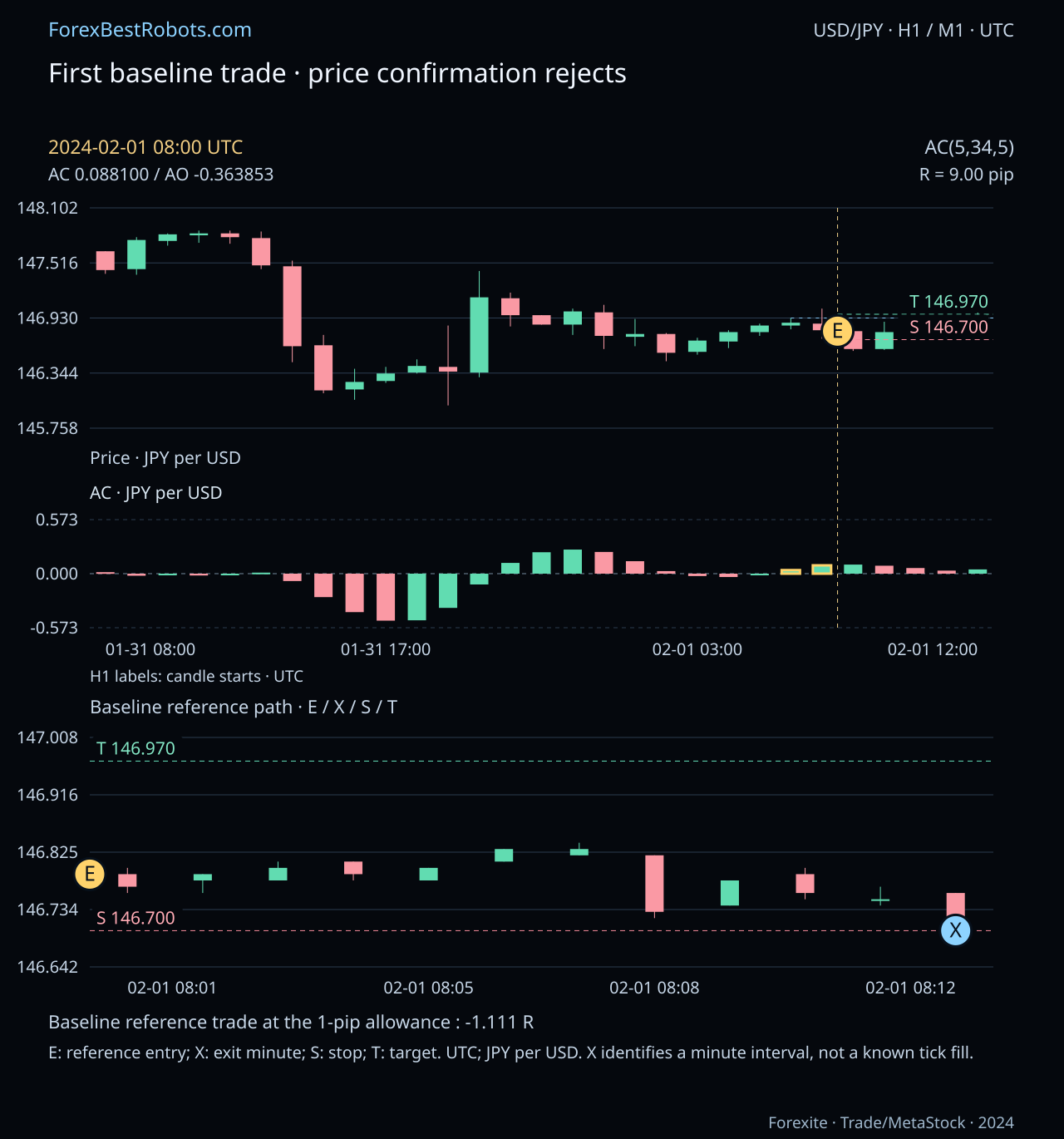
Signal end · UTC: 2024-02-01 08:00; Direction: Long; Previous AC · JPY per USD: 0.037541; Current AC · JPY per USD: 0.088100; Initial stop distance · pip: 9.00; Baseline reference trade at the 1-pip allowance: -1.111 R; Closing-price confirmation: Reject
First different trade with price confirmation
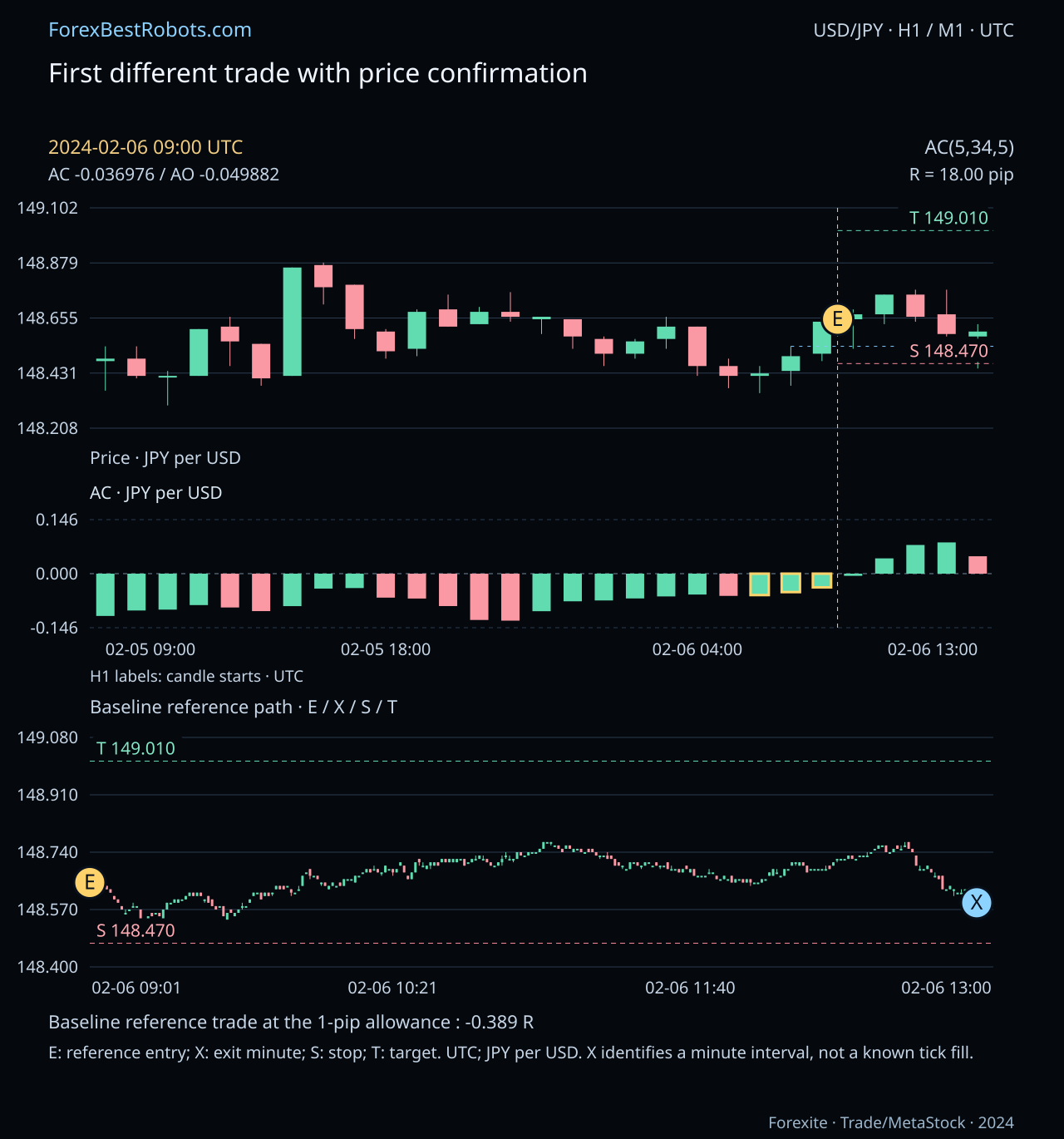
Signal end · UTC: 2024-02-06 09:00; Direction: Long; Previous AC · JPY per USD: -0.049765; Current AC · JPY per USD: -0.036976; Initial stop distance · pip: 18.00; Baseline reference trade at the 1-pip allowance: -0.389 R; Closing-price confirmation: Pass
First different rejection · baseline target reached
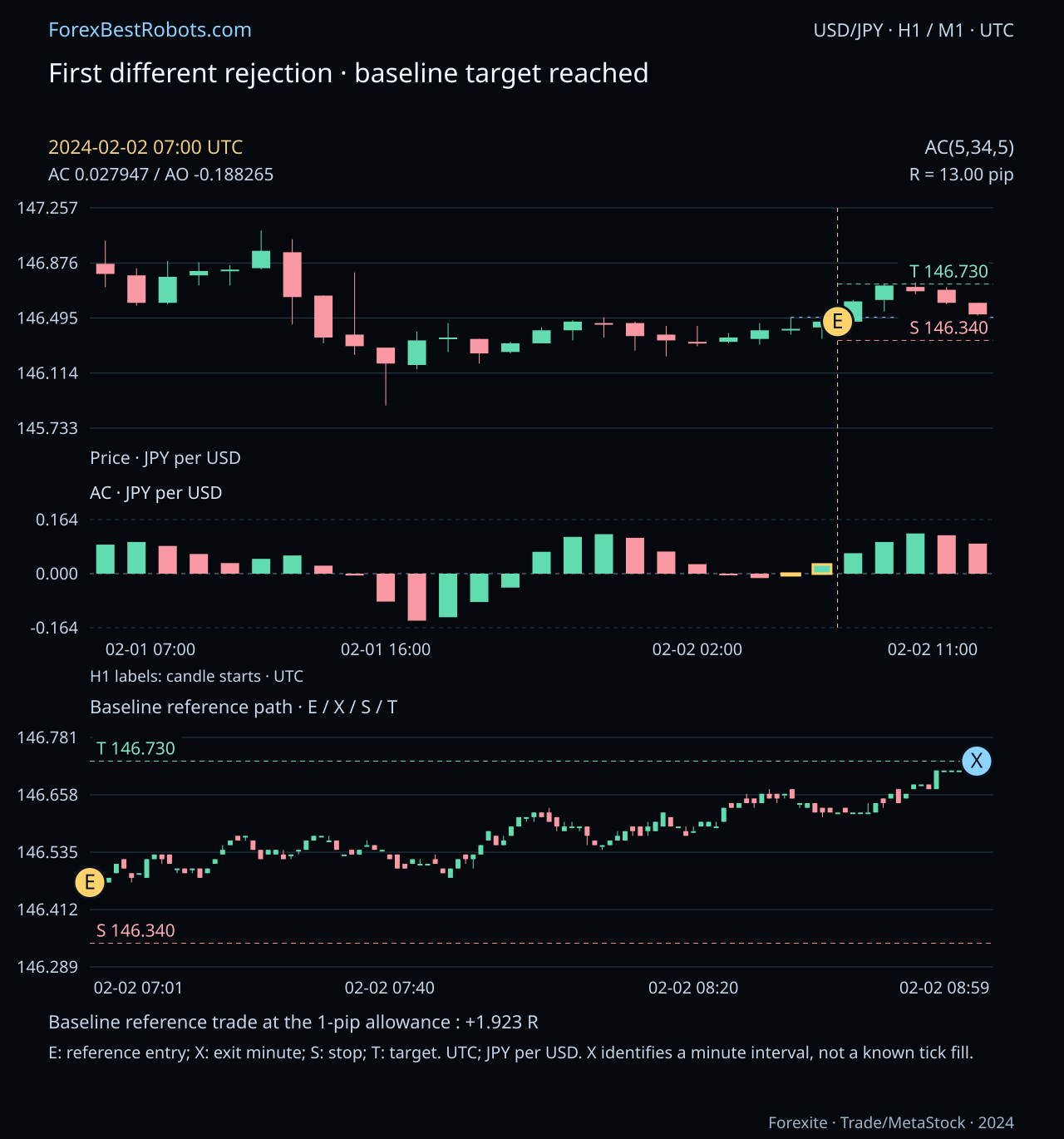
Signal end · UTC: 2024-02-02 07:00; Direction: Long; Previous AC · JPY per USD: 0.000171; Current AC · JPY per USD: 0.027947; Initial stop distance · pip: 13.00; Baseline reference trade at the 1-pip allowance: 1.923 R; Closing-price confirmation: Reject
6. Inspect every candidate, including unresolved paths
Choose a first daily candidate or step through the list. The allowance selector changes that candidate’s baseline reference result; the separate price-confirmed status says whether the other model accepts it. A rejected candidate receives no confirmed-model profit. For an ambiguous or missing path, net result and exit price remain unavailable. The unresolved-minute field identifies the ambiguous interval or first missing interval. H1 labels mark candle starts; the selected signal time is the preceding candle end.
Loading historical candidates…
- Direction
- —
- Previous AC · JPY per USD
- —
- Current AC · JPY per USD
- —
- AO / SMA5(AO) · JPY per USD
- —
- AC color / side / run length
- —
- Signal Close / previous High or Low · JPY per USD
- —
- Closing-price confirmation
- —
- Baseline model
- —
- Price-confirmed model
- —
- Reference entry · JPY per USD
- —
- S · stop
- —
- T · target
- —
- Initial stop distance · pip
- —
- Common data and risk checks
- —
- Supporting complete hours required
- —
- Last 41 AC-history bars · gaps / partial hours
- —
- Baseline outcome status
- —
- Reference exit reason
- —
- Reference exit price · JPY per USD
- —
- Reference exit minute · UTC
- —
- Ambiguous or first missing minute interval · UTC
- —
- Baseline gross result · R
- —
- Baseline result after allowance · R
- —
7. Separate a frozen study from verified live execution
AC has a finite 38-observed-bar calculation window. The history counter covers the last 41 recorded bars, enough for three colored bars and their preceding AC value; it counts gaps between those bars and partial hours within them. The common entry checks cover only the three or four supporting hours, not every older indicator-input hour. Older partial hours or gaps inside the 41-bar history can therefore influence an eligible candidate. No synthetic candles fill them.
The 0/1/2-pip scenarios subtract a fixed combined round-trip spread, commission and slippage allowance after the quote-based reference exit. They do not shift stop/target hit tests and do not reconstruct historical Bid/Ask execution. No financing model is included. R means initial price-distance risk, not a percentage of account equity; variable stops also make R and raw-pip sums different weightings.
The 366 original 2024 archives were already available from earlier work. January USD/JPY had been viewed for a guide and supplies indicator history. The complete AC sequence, confirmation and execution protocol was fixed and durably saved before this February–December USD/JPY replay. There was no outcome-based retuning. The study is retrospective, with no prospective live or native-terminal verification and no untouched external holdout.
Frequently asked questions
Why do some sequences need two AC bars and others three?
This test uses two green AC bars strictly above zero or two red bars strictly below zero; it requires three green bars below zero or three red bars above zero. All bars must have the same color and remain strictly on the same side of zero throughout the run. Only its first completion is an event. These are the frozen mechanical definitions, not a guarantee of profitability.
Can AC be green below zero, and does a zero crossing trigger a trade?
Yes. Color compares the current AC with its previous value, while the sign compares it with zero. A zero crossing alone does not trigger this model. An exact zero is neutral; equal consecutive values are flat. Each breaks the qualifying same-side run.
Does touching the previous High or Low satisfy price confirmation?
No. The completed signal Close must be strictly above the previous H1 High for a long or strictly below the previous H1 Low for a short. Equality and an intrabar touch both fail. The model does not wait for a later break or replace a rejected first candidate.
Does the +8.92R confirmed result establish a profitable full test?
No. At one pip it is the sum of 61 resolved trades out of 62 confirmed entries. The remaining entry has missing minute data, so the complete all-entry result is unknown. The baseline also has a separate ambiguous outcome. Neither a subset sum nor this retrospective single-pair experiment proves live profitability.
Why does rejecting the first event still consume the date?
The frozen experiment compares the same first observed daily event before data, risk and confirmation checks. Searching for a later accepted event would create another strategy. Rejection therefore consumes the date in both models.
Will MT4 reproduce these entries and exits exactly?
That has not been verified. Full-window initialization, flat and zero handling, observed-history gaps, the assumed minute-end labels and quote-based execution are explicit research choices. Broker history, spread, execution and terminal color behavior can differ. Demo or forward validation is a separate step.
Data, frozen protocol and reproducible checks
The test reuses Forexite’s 366 original daily Trade/MetaStock ZIPs for 2024. The 375,702 USD/JPY minute records rebuild 6,265 H1 bars: 6,178 complete, 87 partial and 52 gaps between recorded hours. Fixed GMT+1 labels are shifted back one hour to UTC. Treating labels as minute ends and H1 intervals as (start,end] are explicit reconstruction assumptions. Evaluation is 2024-02-01 through 2024-12-31; January supplies history.
Downloads preserve the original ZIPs and hashes, frozen protocol, all 335 calendar dates, cost scenarios and both calculation paths. A separate raw parser and hourly reducer, exact fractional averages, expanded AC convolution, backward run scan and normalized minute replay cross-check the outputs. Both implementations and the translations were written by the same assistant; no independent-human, native-speaker or native-terminal certification is claimed.