

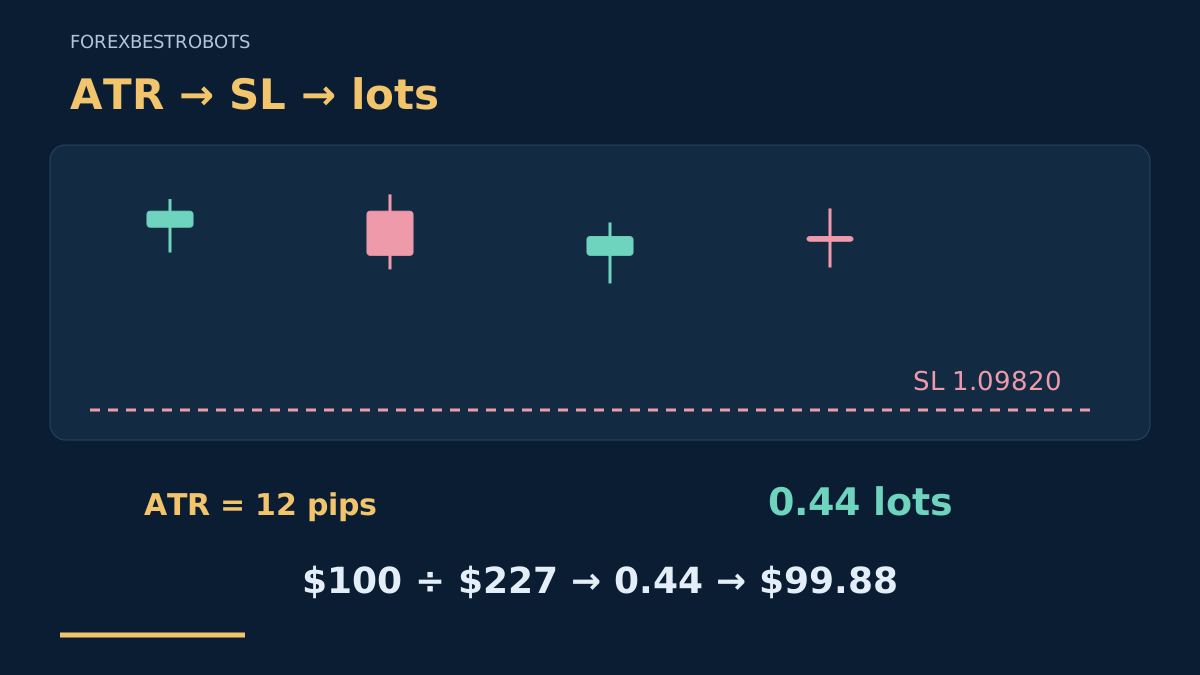
Imagine two trades with the same lot size. One has a nearby stop; the other needs twice as much room. The second can lose more money even though the platform shows the same volume. Position sizing connects the distance to the stop with an amount the account can accommodate.
This final guide in the Volatility and ATR cluster follows one invented example from a completed ATR reading to a planned lot size. Read the simple explanations first; an expandable technical section lets you check the units. The example is a sizing exercise, not an entry signal or a recommendation to use its settings.
1. Give the distance and the money separate jobs
Think of the stop as the room allowed for a trade idea, and the lot size as how much money each pip represents. ATR can help describe recent movement. It cannot decide where the idea is invalid or how much your account should lose.
Use a consistent sequence: define the trade and its exit rule, specify the stop price, estimate the loss for one lot including costs, then fit the volume to a chosen money budget. If a suitable stop needs more room, reduce the position or skip the trade.
Moving a stop closer just to fit a preferred lot size changes the trading rule. A multiplier such as 1.5 × ATR has no universal advantage; its usefulness needs separate testing. The ATR construction guide explains the measurement, and the volatility comparison guide explains how other indicators differ.
2. Freeze a completed reading before calculating
For this exercise, assume a ready, completed EURUSD H1 ATR reading of 0.00120, or 12 pips. One pip is 0.00010; a point on our assumed five-decimal quote is 0.00001. Thus 12 pips are 120 points. These conventions belong to this example, not every instrument.
Record the broker symbol, ATR period, averaging method, history and completed candle timestamp. In MT4, shift 1 refers to the most recently completed bar once the new bar and data are ready; shift 0 is still forming. We assume the ATR value as an input here and do not reproduce a terminal's calculation.
Keep the observation fixed for the initial plan. If price, spread or the chosen stop changes before an order, calculate again from the updated executable quotes. An initial ATR stop and a trailing stop are different rules; a later ATR increase is not permission to widen an existing stop.
3. Name the price from which the stop is measured
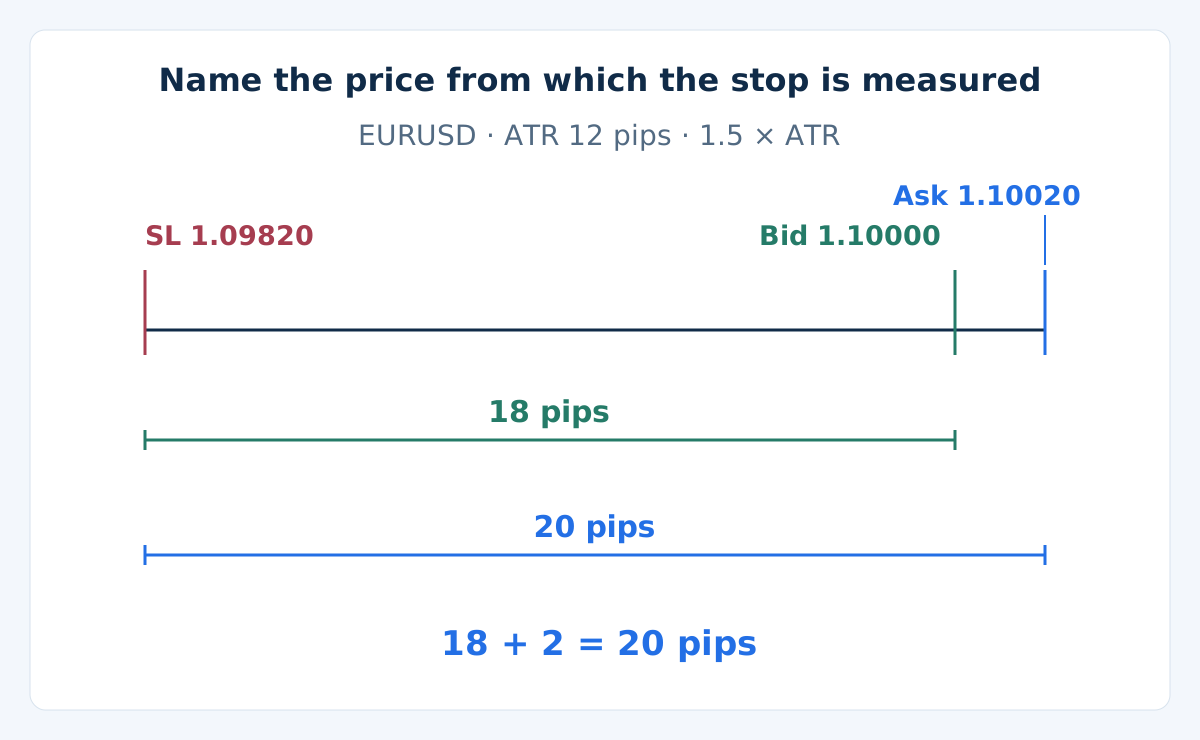
Assume simultaneous quotes of Bid 1.10000 and Ask 1.10020, a 2-pip spread. For a hypothetical buy, choose a stop 1.5 × ATR below the Bid reference: 1.10000 − 0.00180 = 1.09820. This deliberately chosen anchor must be written down.
A buy opens at Ask and closes through Bid. With an assumed entry at 1.10020 and exit at the stop price, the price loss is 20 pips, not 18. The extra 2 pips are the opening spread already included in the entry-to-stop distance. Do not add that spread again.
If the stop had instead been defined 18 pips below the Ask entry, it would be at 1.09840: a different stop rule. For a sell, use the Bid entry and Ask-side stop exit. Do not copy a Bid-chart distance to the opposite side without checking the quote convention.
4. Put the assumptions beside the money calculation
Assume $10,000 of account equity and an illustrative budget of $100, equal to 1%. This is a round teaching number, not a recommended risk percentage. The account currency is USD; the assumed contract is 100,000 EUR for one lot, giving $10 per pip per lot on EURUSD.
| Planning input | Assumed value | What it means |
|---|---|---|
| Entry to stop | 20 pips | Includes the 2-pip opening spread once |
| Extra adverse execution | 2 pips total | Combined allowance beyond the assumed entry and stop prices |
| Round-turn commission | $7 per lot | Opening and closing commission together |
| Financing | $0 in this exercise | Intraday assumption; change it if holding over rollover |
| Permitted volume | Minimum 0.01; step 0.01 lots | Illustrative broker limits, to be checked on the actual symbol |
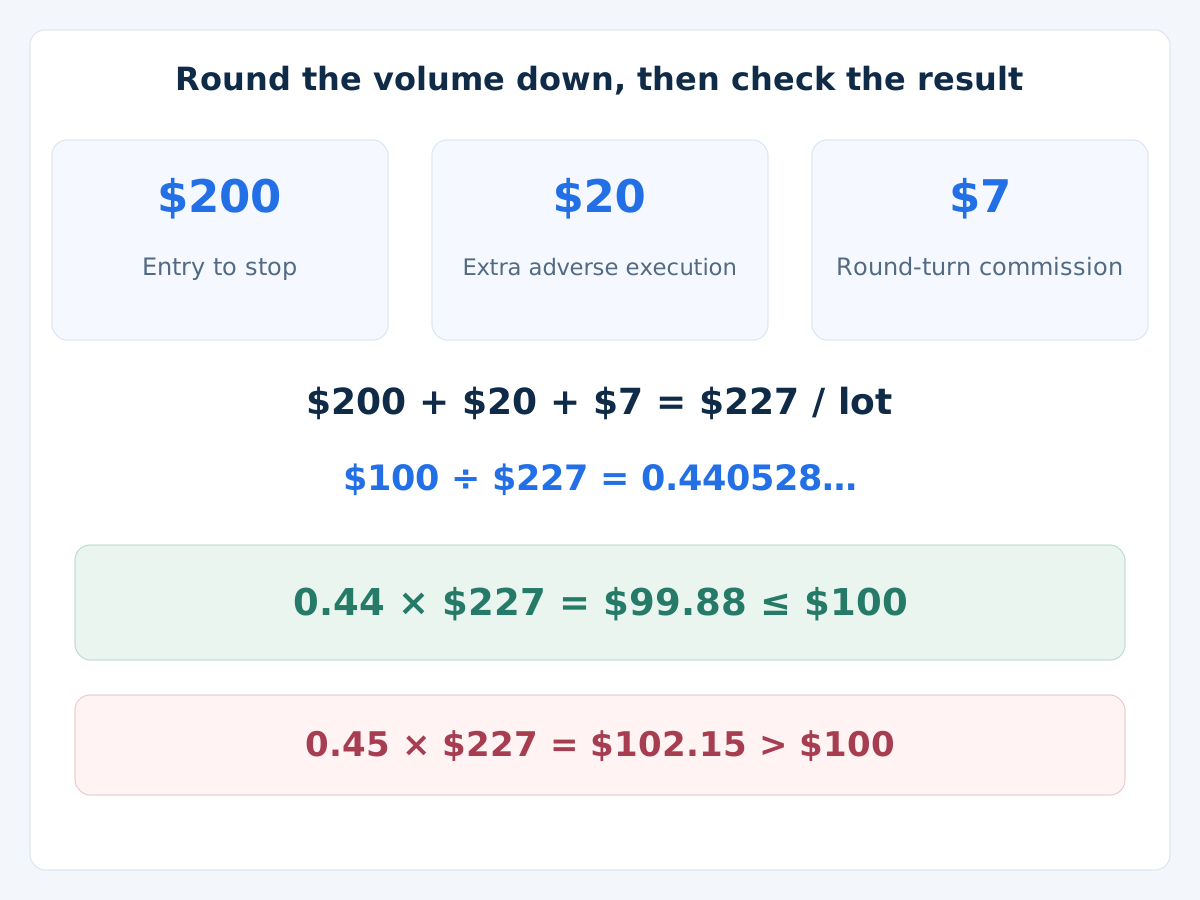
For one lot, the estimate is (20 + 2) × $10 + $7 = $227. In plain language: $200 to the planned stop, $20 set aside for worse execution, and $7 commission. The 2-pip allowance is an assumption, not a cap on slippage or losses.
Here the commission scales linearly with volume, with no minimum ticket fee. Other fee schedules, a different deposit currency or an overnight position need a revised calculation. The trading-cost guide explains how to avoid omitting or counting a cost twice.
5. Round the volume down, then check the result
Divide the budget by the estimate for one lot: $100 / $227 = 0.440528… lots. With a permitted 0.01-lot step, round down to 0.44 lots. Its estimated loss is 0.44 × $227 = $99.88.
Rounding up to 0.45 lots gives $102.15 and exceeds the stated budget. After selecting a valid volume, run the full money calculation again. A displayed two-decimal lot number is not proof that the broker accepts it or that it fits the budget.
If the smallest permitted lot is already too large, skip the trade under this plan. Do not round up to the minimum or tighten the stop merely to make the order fit. Our example assumes the stop price and volume are otherwise valid and enough free margin is available.
6. See what changes when volatility or spread increases
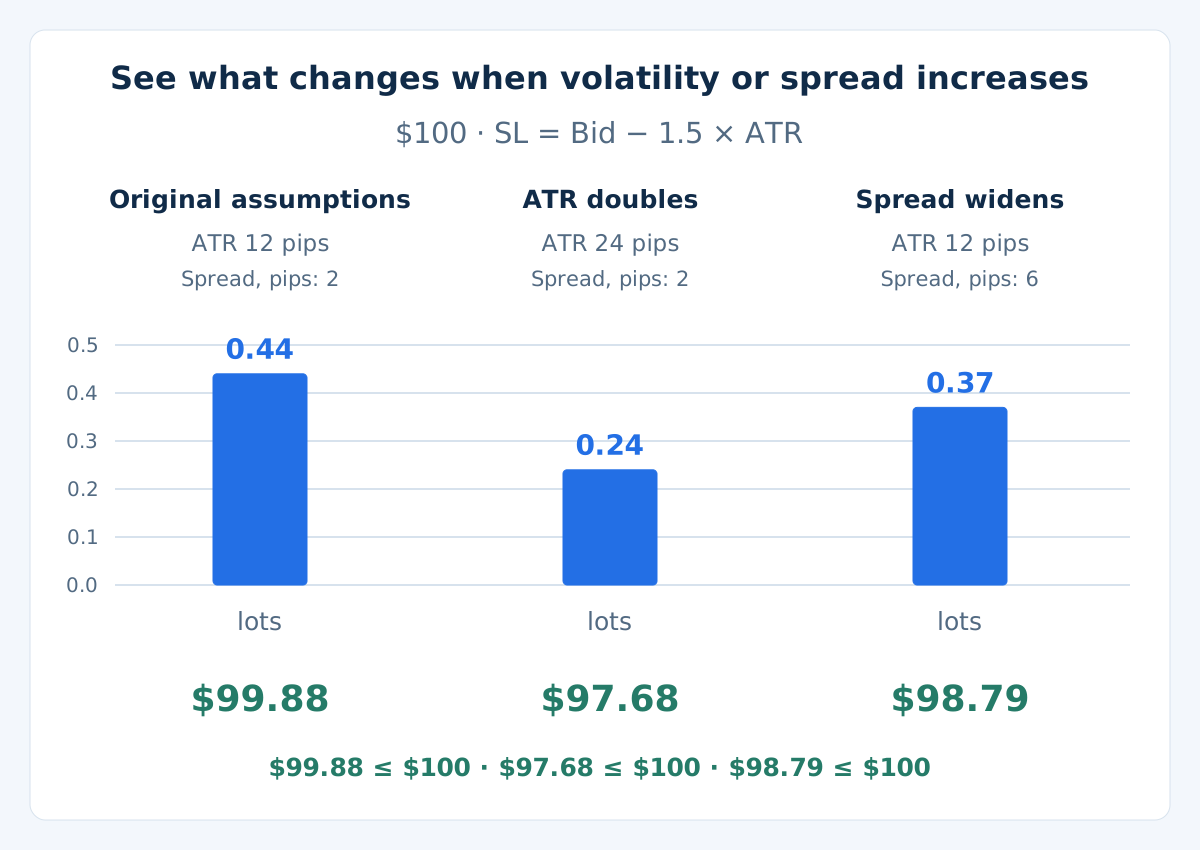
Keep the Bid anchor, multiplier, $100 budget, pip value, execution allowance and commission fixed. Change only the input named in each independent scenario. These are planning comparisons, not a sequence of executed trades.
| Scenario | ATR, pips | Spread, pips | Lots | Estimated loss, USD |
|---|---|---|---|---|
| Original assumptions | 12 | 2 | 0.44 | 99.88 |
| ATR doubles | 24 | 2 | 0.24 | 97.68 |
| Spread widens | 12 | 6 | 0.37 | 98.79 |
With ATR at 24 pips, the Bid-to-stop distance becomes 36 pips and the entry-to-stop distance 38. The one-lot estimate rises to (38 + 2) × $10 + $7 = $407. Size falls to 0.24 lots, for $97.68. Keeping the old 0.44 lots would instead estimate $179.08.
With the original ATR but a 6-pip spread, the entry-to-stop distance is 24 pips. One lot estimates $267, so 0.37 lots estimates $98.79. ATR alone did not reveal that cost change. The exact lot size need not halve when ATR doubles because spread, commission and rounding also matter.
7. Optional: check the formula and tick units
Show the technical calculation
Let d be the expected entry-to-stop price distance in pips, s the additional adverse execution allowance in pips, V the value of one pip for one lot in the account currency, c the round-turn commission per lot, and f the assumed financing cost per lot. Under the stated linear-cost assumptions, Loss1 = (d + s) × V + c + f, then RawLots = Budget / Loss1. Select an allowed volume no greater than RawLots and verify its estimated loss.
For a price-distance calculation, let τ be the tick size in price units and TV the account-currency value of that tick for one lot. Then PriceLoss1 = abs(Entry − Stop) / τ × TV. Our assumed τ is 0.00001 and TV is $1, so 0.00200 / 0.00001 × $1 = $200. This is the same price component as 20 × $10, before extra execution and fees.
MT4 documents MODE_TICKSIZE in points and MODE_TICKVALUE in deposit currency; SYMBOL_TRADE_TICK_SIZE is a price increment. Do not substitute a points count for a price distance. Verify the symbol's contract and conversion against broker specifications and a small demo calculation. Tick value and conversion can change; zero, missing or inconsistent values invalidate the estimate.
For our grid beginning at 0.01 with a 0.01 step, flooring to the step yields 0.44. Other minimum/step combinations need their actual permitted volume grid. Flat fees, tiered charges or nonlinear payoff rules require evaluating loss at the proposed volume rather than simply multiplying Loss1.
8. Check broker limits before accepting the plan
Confirm the tick grid, minimum and maximum lot, lot step, stop-distance rules, trading permissions and free margin for the exact broker symbol. Normalize the stop to a valid price tick, then recalculate the distance and volume. Decimal display precision alone does not define a valid tick grid.
In MT4, StopLevel and FreezeLevel affect order placement or modification. A zero reported StopLevel does not always mean unrestricted stops; the server may use a floating restriction. A rejected order is not permission to retry without a stop or enlarge risk. Correct the cause and recheck the plan.
Margin is collateral, not the planned loss at the stop. Higher leverage can reduce required margin without reducing the money lost per pip at the same volume. The risk-management guide covers the broader account limits.
9. Count the other positions as well
A $100 budget for one trade says nothing about the total account exposure. Add the planned losses of open and proposed positions using compatible account-currency assumptions. Include positions opened by other EAs and manual trades, not just the current chart or Magic Number.
Two EUR or USD trades can respond to the same event. Three positions each estimated near $100 can expose roughly $300 under their stated stop assumptions, with further loss possible in poor execution. Different pairs do not automatically diversify that exposure, and simple addition is not a worst-case guarantee.
Do not treat a stop already moved to entry as cost-free or risk-free. Commission, financing, gaps and execution still matter. A portfolio limit can require reducing or declining a trade even when its individual ATR calculation fits.
10. Stress the estimate and keep a record
For the original 0.44 lots, replace the 2-pip execution allowance with an adverse 8-pip outcome: 0.44 × ((20 + 8) × $10 + $7) = $126.28. This stress example shows why the planned $99.88 is not a guaranteed maximum loss. A stop price does not guarantee a fill at that price.
Before testing a rule, record the completed ATR timestamp and settings, Bid/Ask quotes, stop anchor and final tick-aligned price, currency and pip/tick values, fees, execution allowance, proposed lots, final money estimate and account exposure. Preserve the reason for skipping a trade as well.
Check wider spreads, gaps, changed conversion rates, a minimum lot that exceeds the budget and a stop rejected by the server. Compare the estimate with demo fills and later forward observations before drawing conclusions. The MT4 backtesting guide covers validation beyond this arithmetic. This page reports no live fills, backtest return or proven trading advantage.
11. Questions about ATR stops and lot sizing
Does an ATR stop make a trade safer by itself?
No. A wider stop at unchanged volume increases the planned price loss. ATR describes recent movement; the chosen stop rule, position size, costs, execution and total exposure determine the money estimate.
What ATR multiplier should a beginner use?
There is no universal multiplier. The 1.5 used here is an arithmetic assumption. Define where the trade idea fails, test the complete rule under realistic costs and avoid selecting a multiplier from a single attractive example.
Should I add the spread to the stop distance?
Check how the distance was measured. If it already runs from the Ask buy entry to the Bid-side stop, the opening spread is included. If it was measured from a Bid chart reference, account for the entry quote once. Check the opposite quote sides for a sell.
Why not always use $10 per pip for one lot?
That value belongs to the assumed EURUSD contract and USD account. Different symbols, contract sizes and account currencies need their own verified pip or tick value. Price digits alone do not establish the money value.
What if the calculated size is below the minimum lot?
Skip the trade under the stated plan. Rounding up would exceed its budget. A different instrument or revised rule requires a fresh calculation and evaluation, not an automatic workaround.
Does the calculated budget guarantee the maximum loss?
No. It is an estimate under recorded prices and cost assumptions. Gaps, worse execution, conversion changes, financing and other positions can produce a larger loss. Free margin and stop acceptance must also be checked separately.
12. Technical reference and scope
The official MQL4 symbol-properties reference defines the platform's price, volume and trading-limit fields. The examples here use explicitly assumed values; retrieve and verify the actual broker data before applying a calculation.
Forex and leveraged trading involve substantial risk. This guide is educational, not investment advice. Past or simulated results do not guarantee future performance.