

A CMO return can occur because an old change leaves its rolling window, even without a decisive new price move. This model therefore requires a fresh return from −50/+50 and a signal close beyond the previous H1 high or low. The historical comparison uses already retained USD/JPY quotes from 2024; its negative result is part of the lesson, not a setting to optimise away.
1. Read the negative result without changing the rules
The confirmed model entered 30 of 87 first daily attempts. Its total is -5.95 R before costs, -7.74 R at 2 pips and -9.52 R at 4 pips. At 2 pips, 30.0% of trades are positive after costs and maximum closed-trade drawdown is 7.74 R.
Removing only price confirmation increases the count to 68 and gives -9.93 R at 2 pips. The filter reduces trade count and drawdown in this sample, but both totals remain negative. Fewer losses in a comparison do not establish a profitable rule.
2. Fix the CMO return and prior-hour confirmation
The complete protocol was durably saved before the first replay: 14 changes, ±50 thresholds, 16-hour quality gate, one daily attempt, fixed hours, ATR risk, target, holding limit and 0/2/4 pip costs. No settings were changed after seeing this result.
- CMO14 equals 100 times the difference between summed positive changes and positive magnitudes of negative changes, divided by their sum. Use the latest 14 retained close-to-close changes: 15 closes for one reading, with no extra smoothing. A fully flat window is defined as zero. ATR14 starts from the first 14 available True Ranges, then uses Wilder smoothing. All retained hours advance calculations, including partial hours; require at least 1000 retained H1 closes.
- Consider H1 ends 07:00–15:00 UTC inclusive, Monday–Friday, without a seasonal time shift. The first numerical return in that window uses the UTC date’s only attempt before every rejection check.
- A long return requires previous CMO ≤ −50 and current CMO > −50. A short return requires previous CMO ≥ +50 and current CMO < +50. Arriving exactly at the threshold or remaining on the same side is not another event. Threshold comparisons use exact integer ratios, not rounded display values.
- Require all 16 retained H1 bars ending at the signal to contain 60 consecutive minutes each and to be adjacent exactly one hour apart. This covers both 14-change windows. A partial or nonadjacent earlier hour still rejects the date; complete final hours alone are insufficient.
- Round 1.5 × signal ATR14 upward to a multiple of 0.001 JPY/USD. Accept 10–80 pips inclusive; one USD/JPY pip is 0.01 JPY/USD. Unavailable or nonpositive ATR rejects the attempt.
- The confirmed model requires a long signal close strictly above the preceding H1 high, or a short close strictly below its low. Equality fails; use unrounded source prices. The comparison model omits only this price gate, keeping every other rule.
- Enter at the opening of the exact next M1 interval. If its record is missing, reject rather than substitute a later opening. Each model permits one open position and at most one entry per UTC date; rejected attempts and missed openings are never replaced.
3. Define risk and minute-level execution
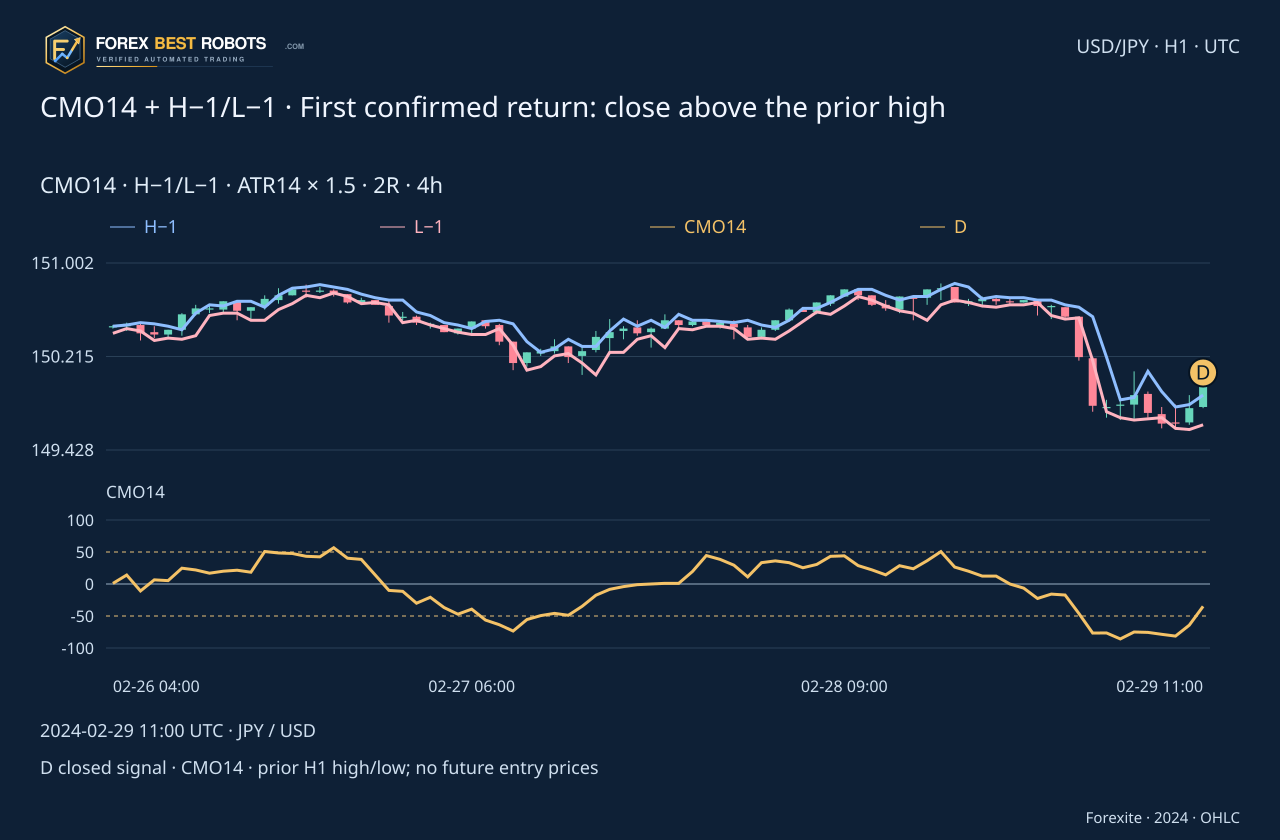
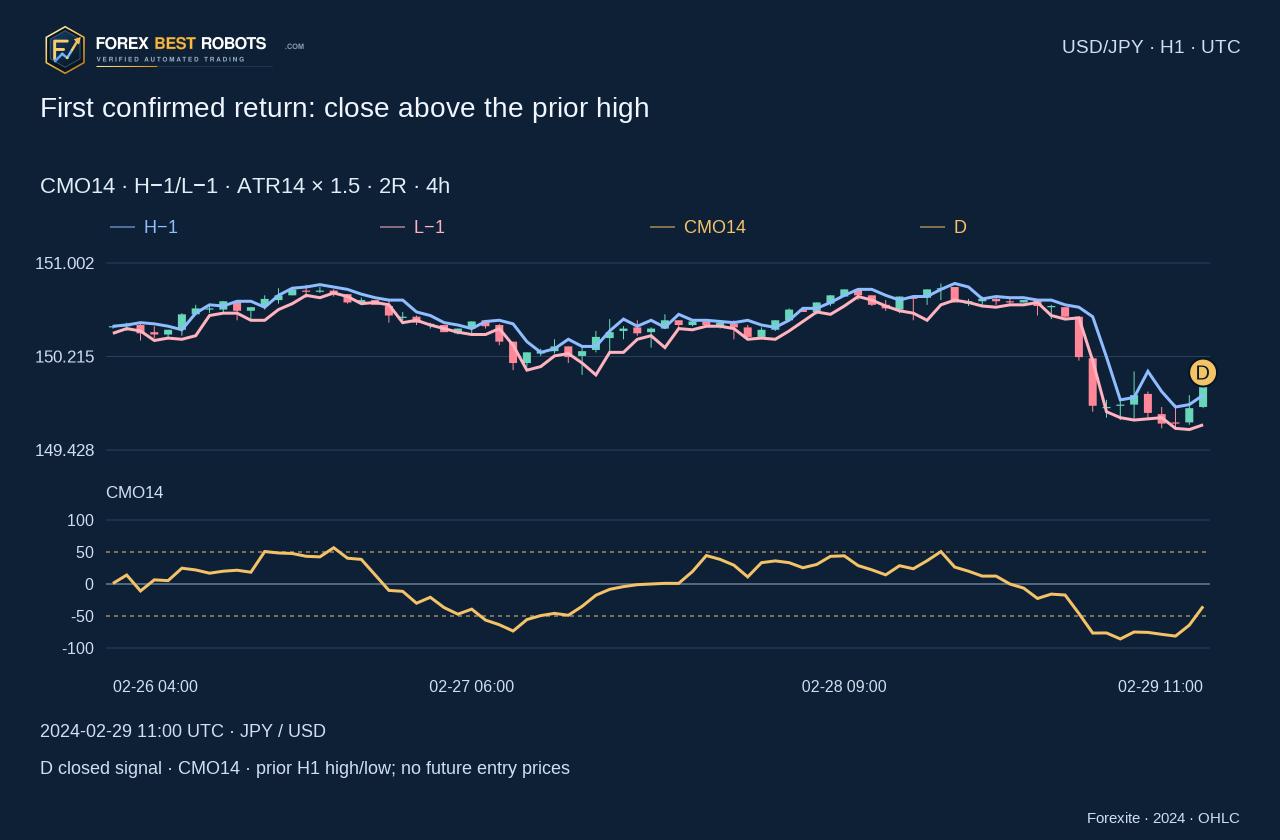
With interval-end labels, a signal at 11:00 uses the M1 record ending 11:01, whose reference opening is modeled at 11:00. Only then are the entry-based stop one rounded distance away and the 2 R target known. The preceding H1 chart does not reveal these future E/S/T prices.
Exit after four clock hours unless stop or target acts first; no trailing, break-even move or signal exit. At an observed open, a breached stop fills at that open, then a breached target at its fixed target without favorable improvement, then a due clock exit. Otherwise a held-path gap forces valuation at the next observed open. If a minute touches both stop and target, assume stop first.
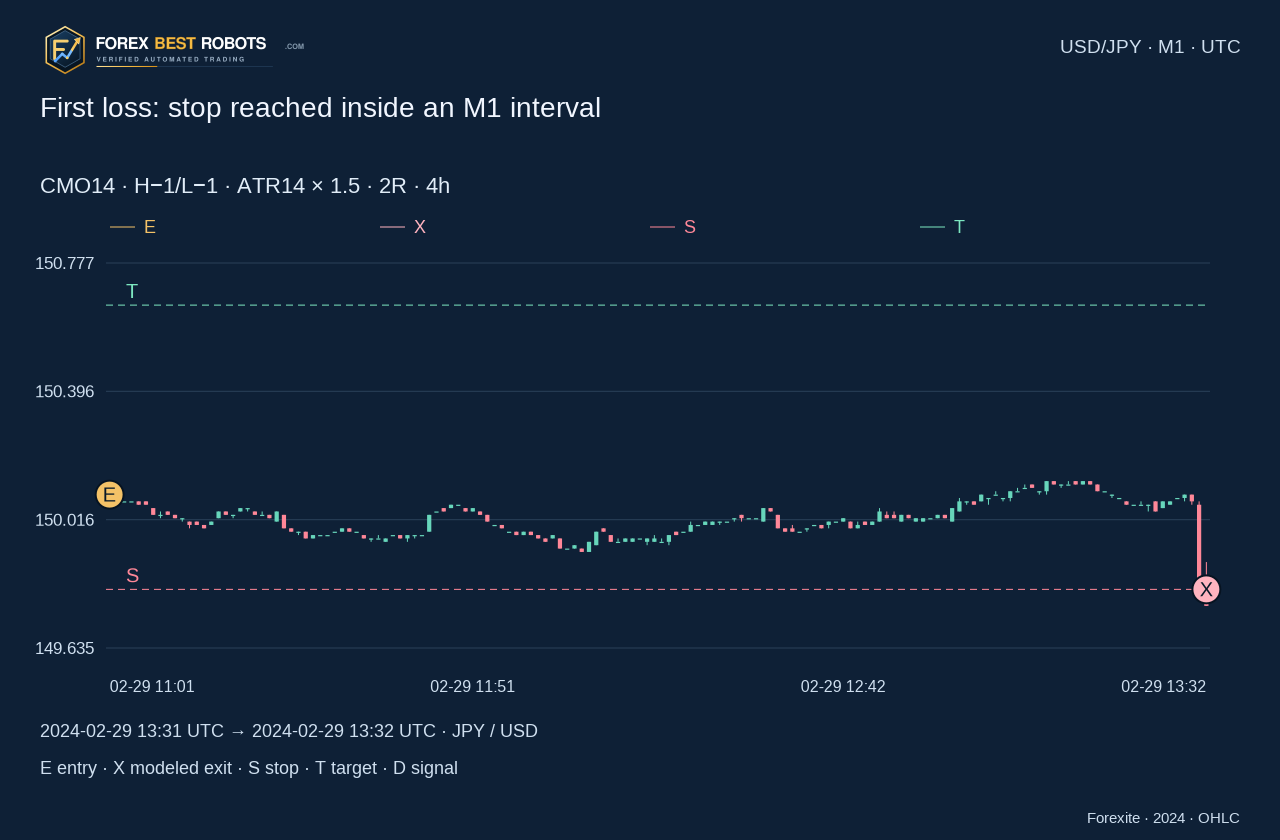
Keep any gap flag even when opening stop, target or time has priority. Neither model has a held-path gap, truncated trade or same-minute stop/target ambiguity in this replay. That does not supply ticks or execution seconds: a stop reached inside a minute retains an observation interval and an unknown exact second.
4. Inspect the first signal and its losing exit
The first confirmed trade follows the closed H1 signal 2024-02-29 11:00 UTC. CMO returns above −50 and price closes above the prior hour’s high. D marks the closed decision; the chart ends there, with no next-minute entry, stop, target or outcome shown.
First confirmed return: close above the prior high
The first trade is also the first net loss at 2 pips; these two examples intentionally show the same case from H1 and M1. Its stop reference is reached in 2024-02-29 13:31 UTC → 2024-02-29 13:32 UTC, giving -1.071 R after costs. X marks that stop level within the final minute, not an invented exact second.
First loss: stop reached inside an M1 interval
5. Compare fixed costs and the unfiltered model
Each cost row uses the same reference entries and exits for the selected model. Deduct 0, 2 or 4 pips once per completed round trip. These illustrative all-in deductions are not measured historical bid/ask, actual commissions, swap or a slippage distribution.
At 2 pips the confirmed model gives -7.74 R; at 4 pips, -9.52 R. A stopped trade can lose more than −1 R after costs, and a 2 R target nets less than 2 R. The separate two-model comparison holds cost at 2 pips; changing the display does not change the frozen rules.
| All-in cost · pip per round trip | Trades | Total net · R | Net result · pip | Wins · % | Maximum drawdown · R | Profit factor · net R |
|---|---|---|---|---|---|---|
| 0 | 30 | -5.952 | -183.3 | 30.0 | 6.729 | 0.584 |
| 2 | 30 | -7.737 | -243.3 | 30.0 | 7.737 | 0.504 |
| 4 | 30 | -9.522 | -303.3 | 30.0 | 9.522 | 0.436 |
| Fixed model | Trades | Total net · R | Maximum drawdown · R |
|---|---|---|---|
| CMO + price gate | 30 | -7.737 | 7.737 |
| Without price gate | 68 | -9.926 | 13.522 |
6. Keep the first price rejection without replacement
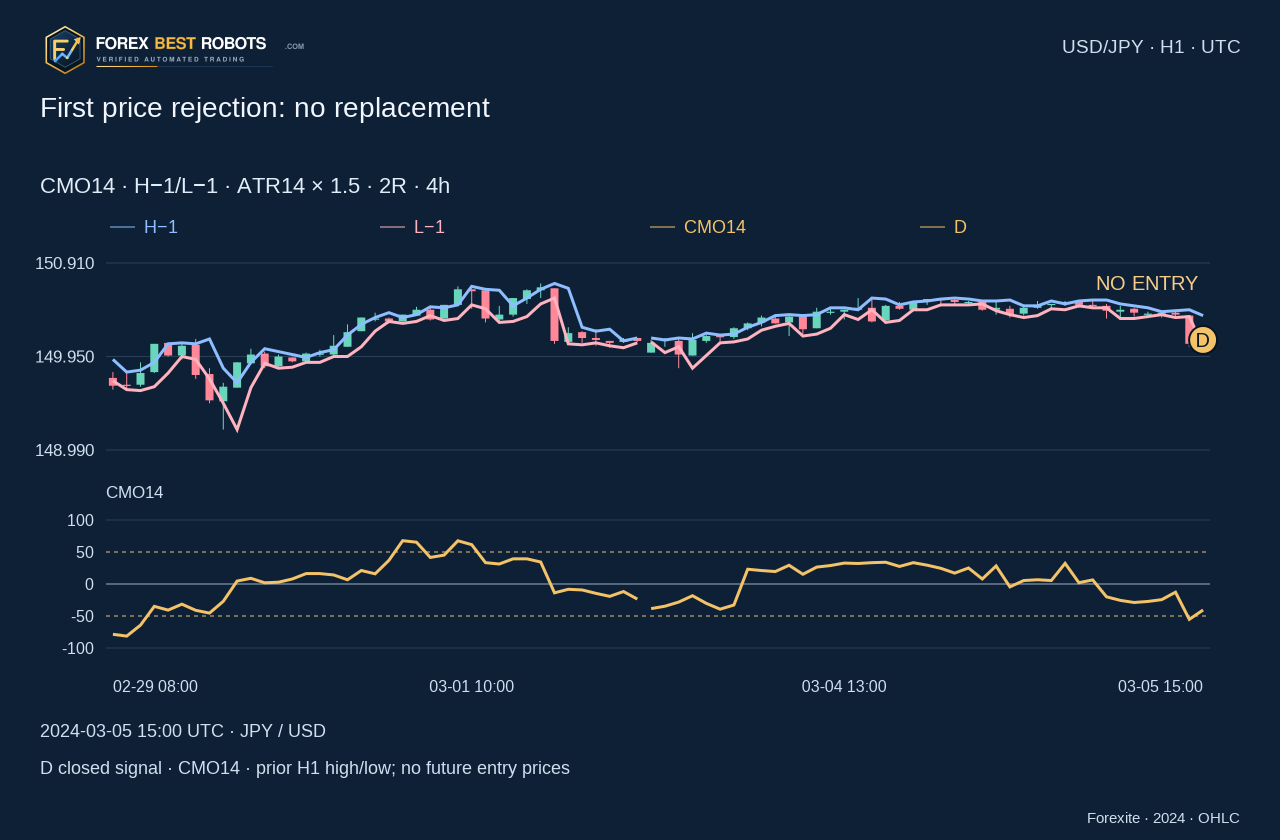
The first price-confirmation rejection is 2024-03-05 15:00 UTC. CMO returns from its extreme, but the signal close does not clear the required preceding high or low. D remains a valid recorded event. The confirmed model has no entry, stop, target or trade result for this attempt; the unfiltered model is a separate comparison.
Keep all 87 daily attempts. The confirmed model rejects 38 for price, 14 for window quality and 5 for risk distance. A more attractive later signal cannot replace the first attempt.
First price rejection: no replacement
7. Replay observed hours and minutes
Choose model, fixed cost and daily attempt. H1 ends at the selected recorded hour; later signal direction, decision and risk remain hidden before the signal close. Entry-based prices and the eventual result stay hidden throughout H1. Both prior-hour high and low are historical context, not future entry prices.
M1 is available only when the selected model entered. CMO and ATR remain the signal-hour values. The 40/80-bar view ends at the selected observation; the exit and result appear only at the exit interval. No synthetic candles fill missing timestamps. The gap button is disabled because neither accepted model has a held-path-gap example.
Loading historical test…
D closed signal · CMO14 · prior H1 high/low; no future entry prices
The visible chart ends at the selected observation.
No accepted trade crosses a held minute gap; the gap example is unavailable.
Entry and outcome are hidden in H1 view
This rejected attempt has no M1 execution or trading result.
The exit is beyond the selected replay minute.
- UTC date
- —
- Direction
- —
- Attempt status
- —
- Decision / exit
- —
- Selected observation · UTC
- —
- Close · JPY/USD
- —
- CMO14 · rolling sums
- —
- Previous recorded CMO
- —
- Prior H1 high · JPY/USD
- —
- Prior H1 low · JPY/USD
- —
- ATR14 · JPY/USD
- —
- Prior-high/low confirmation
- —
- Fresh CMO return · H1 end UTC
- —
- Rounded initial distance · pip
- —
- E · entry reference
- —
- Modeled entry time · UTC
- —
- S · stop reference
- —
- T · target reference
- —
- X · exit reference
- —
- Exit observation interval · UTC
- —
- Modeled exit time · UTC
- —
- Exit time precision
- —
- Gross result · R
- —
- Net result · R
- —
- Net result · pip
- —
- Held minute-path coverage
- —
8. Separate coverage, subperiods and verification
At 2 pips, January–June gives -5.35 R over 10 trades and July–December -2.39 R over 20. These are chronological diagnostics within the same previously examined year, not untouched out-of-sample validation. Both halves and all three total cost scenarios are negative.
All 30 confirmed trades have contiguous retained minute paths, while 14 first candidates fail the 16-hour quality rule. Quote OHLC still cannot establish the intraminute order of all ticks or live fills. Matching programs and 73 boundary fixtures verify this specified calculation, not future profitability.
| Calendar subperiod | Trades | Total net · R |
|---|---|---|
| January–June 2024 | 10 | -5.350 |
| July–December 2024 | 20 | -2.387 |
| Held-path coverage at 2 pips | Trades | Net contribution · R |
|---|---|---|
| No held gap | 30 | -7.737 |
| Flagged next-open valuation | 0 | +0.000 |
Frequently asked questions
Can CMO return without a decisive new price move?
Yes. An old gain or loss can leave the 14-change rolling window. This model separately requires a close beyond the previous H1 high or low. It uses unsmoothed rolling sums; a terminal version with different smoothing need not match.
Can a rejected first return be replaced?
No. The first numerical return in 07:00–15:00 UTC uses the date’s only attempt before quality, ATR, price and opening checks. Both CMO windows require 16 complete adjacent H1 bars.
How are the stop and target set?
Round 1.5 × ATR14 upward to 0.001 JPY/USD, require 10–80 pips inclusive, then measure the stop from the observed exact next M1 open; target 2 R. One pip is 0.01 JPY/USD.
Did price confirmation prove profitability?
No. The confirmed model gives -7.74 R at 2 pips and -9.52 R at 4 pips. The unfiltered total is also negative; fewer trades and lower drawdown do not establish profitability.
Is X an exact stop execution time?
For the first loss, no. The retained M1 high/low reaches the reference stop within 2024-02-29 13:31 UTC → 2024-02-29 13:32 UTC; its exact second is unknown. A known opening-time exit is labeled differently.
Are these account returns or new validation quotes?
No. R normalizes each trade by initial stop distance. The retained 2024 USD/JPY sample was used before; position sizing, compounding, live execution and an unseen holdout are not claimed.
Data, method and scope
Reuse 375702 retained Forexite USD/JPY M1 observations from the 2024 Trade/MetaStock archives. Fixed GMT+1 labels were shifted back one hour to UTC; minute labels are interval ends and H1 groups are (start,end]. The original daily ZIPs were not downloaded again.
The retained sample contains 6265 H1 bars: 6178 complete hours, 87 partial hours and 52 gaps before recorded hours. Calculations advance on every retained close, while candidates require the 16-hour complete adjacent union. No missing price is invented.
A sequential integer rolling-sum calculation with Decimal 55 ATR and a separate exact-prefix/telescoping CMO with Decimal 80 weighted-prefix ATR independently rebuild hours, daily attempts and reference fills. Exact rational R metrics match; 73 boundary fixtures passed. Both programs were authored by the same assistant, without external human or terminal certification.
Downloads include both models, every attempt and rejection, all trades, frozen protocol, retained minute inputs, original archive hashes and both programs. CSV prices ending _micro are integer millionths of JPY/USD; divide by 1000000. Reproduction commands stay inside the method ZIP.