

With a one-pip round-trip allowance, the rising-EMA13 model totals −3.15R across 59 resolved trades, despite an unweighted net sum of +10 pips. The baseline’s 134 resolved paths total +6.90R / +58 pips, with one additional ambiguous entry. These are different ways of weighting trades, and the incomplete baseline total must stay clearly labeled.
1. Separate the recovery from the EMA slope
Bears Power is the completed H1 Low minus EMA13 of Close. EMA13 starts with the average of the first 13 recorded closes; subsequent values follow E[t] = (Close[t] + 6 × E[t−1]) / 7. The first 12 readings are unavailable. Earlier observations remain in the EMA recurrence across gaps and month boundaries.
This study tests long entries only. A fresh recovery requires a negative current reading that rises after the previous reading had fallen or stayed unchanged. The baseline uses that event without an EMA-direction gate. The filtered model adds only E[t] > E[t−1]. Both already use EMA13 inside Bears Power, so the slope is not an independent source of market information.
2. Reserve the first observed recovery of the day
For each UTC evaluation date, choose the earliest observed event on an H1 candle ending from 07:00 through 17:00 inclusive. Let B denote Bears Power: B[t] < 0, B[t−1] < 0, B[t] > B[t−1] and B[t−1] ≤ B[t−2]. All three readings must exist. A current equality does not qualify; an equality in the preceding comparison does.
Reserve the date before checking data, entry, stop distance or EMA direction. Current and preceding two hours must be complete and adjacent, and the immediate next minute must exist. A rejected first event consumes that date. There is no later search, no short-side rule and no extra requirement for Close above EMA13. “First” means first in the recorded bars; missing history can hide events.
B[t] < 0; B[t−1] < 0; B[t] > B[t−1]; B[t−1] ≤ B[t−2]
3. Define the reference entry and minute-by-minute exit
Use the immediate next minute’s Open as a quote-based reference entry. Set the stop one pip below the signal Low. The entry-to-stop distance must be 5–50 pips inclusive; otherwise reject. Set the target at twice that initial distance and the deadline four clock hours after the signal end. The latest deadline is 21:00 UTC. Position size is fixed; there is no trailing stop, scaling or overnight extension.
Read each required minute in order. An Open at or below the stop exits at that adverse Open; an Open at or above the target exits at the target without a favorable gap bonus. Otherwise inspect High and Low: a single touched level resolves the exit, while both touched in the same minute leave the order ambiguous. A missing required minute makes the path unknown immediately. Level checks precede the deadline minute’s Close. These OHLC reference prices do not establish historical Bid/Ask fills or tick-level exit times.
4. Read costs and unresolved outcomes together
Across 335 evaluation dates, 450 observed recovery events produce 210 first candidates; 125 dates have no observed candidate. Common checks reject 75 candidates. Of these, 74 violate the fixed stop-distance bounds and two have incomplete signal-history hours; one belongs to both groups. The baseline enters 135 trades. EMA13 rejects 76 otherwise eligible entries and retains 59.
At the one-pip allowance, the baseline’s resolved subset totals +6.90R and +58 pips; its maximum cumulative-R drawdown is 17.09R. The filtered model totals −3.15R and +10 pips, with a 14.41R drawdown. Its net-R profit factor is 0.907, compared with 1.089 for the resolved baseline subset. A smaller drawdown here does not make the filtered model profitable in R.
The baseline entry dated 2024-03-08 touches both levels in the minute ending 13:31 UTC. It remains one ambiguous outcome, with no assigned net return. The filter rejects that candidate, but the unknown order does not prove that a loss was avoided. There are no missing-minute outcomes among entered trades. The baseline sums describe 134 resolved paths, not the full set of 135 entries.
At zero allowance, the EMA model totals +3.43R; at two pips it falls to −9.74R, while the resolved baseline falls to −9.07R. Each net-R result divides that trade’s pips by its own stop distance. Net pips give every pip equal weight; R gives relatively more weight to trades with smaller stops. The two sums can have different signs. Neither is an account return or a compounded portfolio.
Statistics use resolved trades only. Ambiguous and missing outcomes remain separate; drawdown is in cumulative R, not account percent.
| Model | Allowance · pip | Resolved / entered | Ambiguous / unknown | Positive / zero / negative | Positive outcomes · % | Net total · R | Net total · pips | Maximum drawdown · R | Profit factor · R |
|---|---|---|---|---|---|---|---|---|---|
| Without EMA filter | 0 | 134 / 135 | 1 / 0 | 58 / 1 / 75 | 43.28 | +22.87 | +192 | 9.91 | 1.334 |
| Without EMA filter | 1 | 134 / 135 | 1 / 0 | 58 / 0 / 76 | 43.28 | +6.90 | +58 | 17.09 | 1.089 |
| Without EMA filter | 2 | 134 / 135 | 1 / 0 | 56 / 2 / 76 | 41.79 | −9.07 | −76 | 24.26 | 0.896 |
| With EMA13 filter | 0 | 59 / 59 | 0 / 0 | 24 / 0 / 35 | 40.68 | +3.43 | +69 | 11.03 | 1.115 |
| With EMA13 filter | 1 | 59 / 59 | 0 / 0 | 24 / 0 / 35 | 40.68 | −3.15 | +10 | 14.41 | 0.907 |
| With EMA13 filter | 2 | 59 / 59 | 0 / 0 | 23 / 1 / 35 | 38.98 | −9.74 | −49 | 18.30 | 0.743 |
Every evaluation month · 1-pip allowance
| Month · UTC | Model | Resolved / entered | Ambiguous / unknown | Net total · R | Maximum drawdown · R |
|---|---|---|---|---|---|
| 2024-02 | Without EMA filter | 12 / 12 | 0 / 0 | +3.37 | 4.35 |
| 2024-02 | With EMA13 filter | 4 / 4 | 0 / 0 | +1.38 | 1.17 |
| 2024-03 | Without EMA filter | 13 / 14 | 1 / 0 | +5.34 | 4.75 |
| 2024-03 | With EMA13 filter | 5 / 5 | 0 / 0 | −0.32 | 3.40 |
| 2024-04 | Without EMA filter | 11 / 11 | 0 / 0 | +1.14 | 3.21 |
| 2024-04 | With EMA13 filter | 8 / 8 | 0 / 0 | −1.49 | 3.39 |
| 2024-05 | Without EMA filter | 13 / 13 | 0 / 0 | −2.47 | 7.06 |
| 2024-05 | With EMA13 filter | 6 / 6 | 0 / 0 | −3.00 | 3.05 |
| 2024-06 | Without EMA filter | 13 / 13 | 0 / 0 | −2.34 | 6.68 |
| 2024-06 | With EMA13 filter | 4 / 4 | 0 / 0 | −1.45 | 3.36 |
| 2024-07 | Without EMA filter | 11 / 11 | 0 / 0 | −0.87 | 2.82 |
| 2024-07 | With EMA13 filter | 6 / 6 | 0 / 0 | +1.07 | 1.12 |
| 2024-08 | Without EMA filter | 14 / 14 | 0 / 0 | −8.45 | 10.61 |
| 2024-08 | With EMA13 filter | 8 / 8 | 0 / 0 | −7.64 | 7.97 |
| 2024-09 | Without EMA filter | 13 / 13 | 0 / 0 | +4.38 | 2.78 |
| 2024-09 | With EMA13 filter | 7 / 7 | 0 / 0 | +5.06 | 1.09 |
| 2024-10 | Without EMA filter | 12 / 12 | 0 / 0 | +2.53 | 3.35 |
| 2024-10 | With EMA13 filter | 5 / 5 | 0 / 0 | +1.89 | 1.09 |
| 2024-11 | Without EMA filter | 13 / 13 | 0 / 0 | +4.52 | 2.30 |
| 2024-11 | With EMA13 filter | 4 / 4 | 0 / 0 | +2.73 | 1.09 |
| 2024-12 | Without EMA filter | 9 / 9 | 0 / 0 | −0.25 | 2.57 |
| 2024-12 | With EMA13 filter | 2 / 2 | 0 / 0 | −1.37 | 1.37 |
5. Inspect three examples selected by chronology
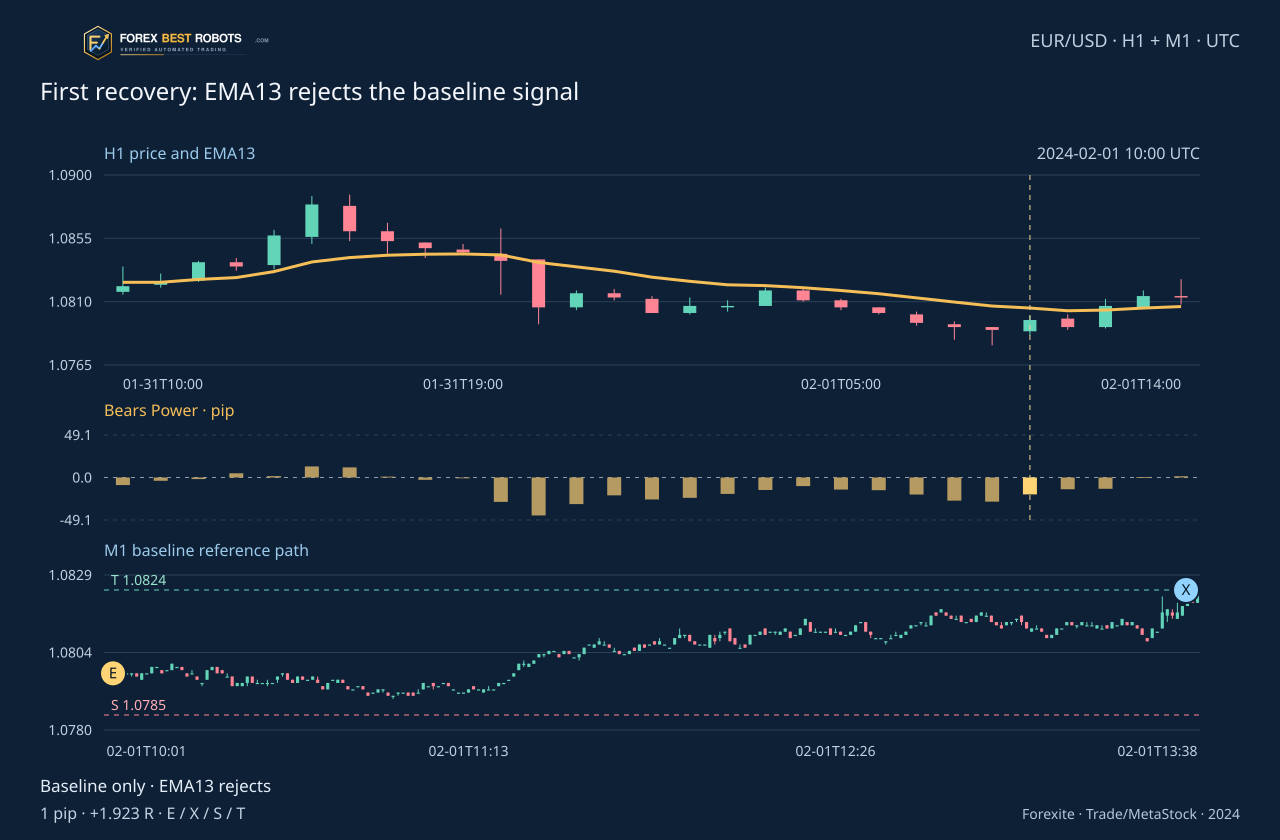
The figures use the first resolved baseline entry, the first different resolved entry retained by EMA13, and the first different resolved baseline entry rejected by EMA13. Chronology and model status determine selection; profit does not. Later candles show the subsequent historical path and were unavailable when the signal closed.
E: reference entry; X: exit minute; S: stop; T: target. UTC; USD per EUR. An X marker locates the minute interval, not a known tick-level fill.
First baseline reference entry
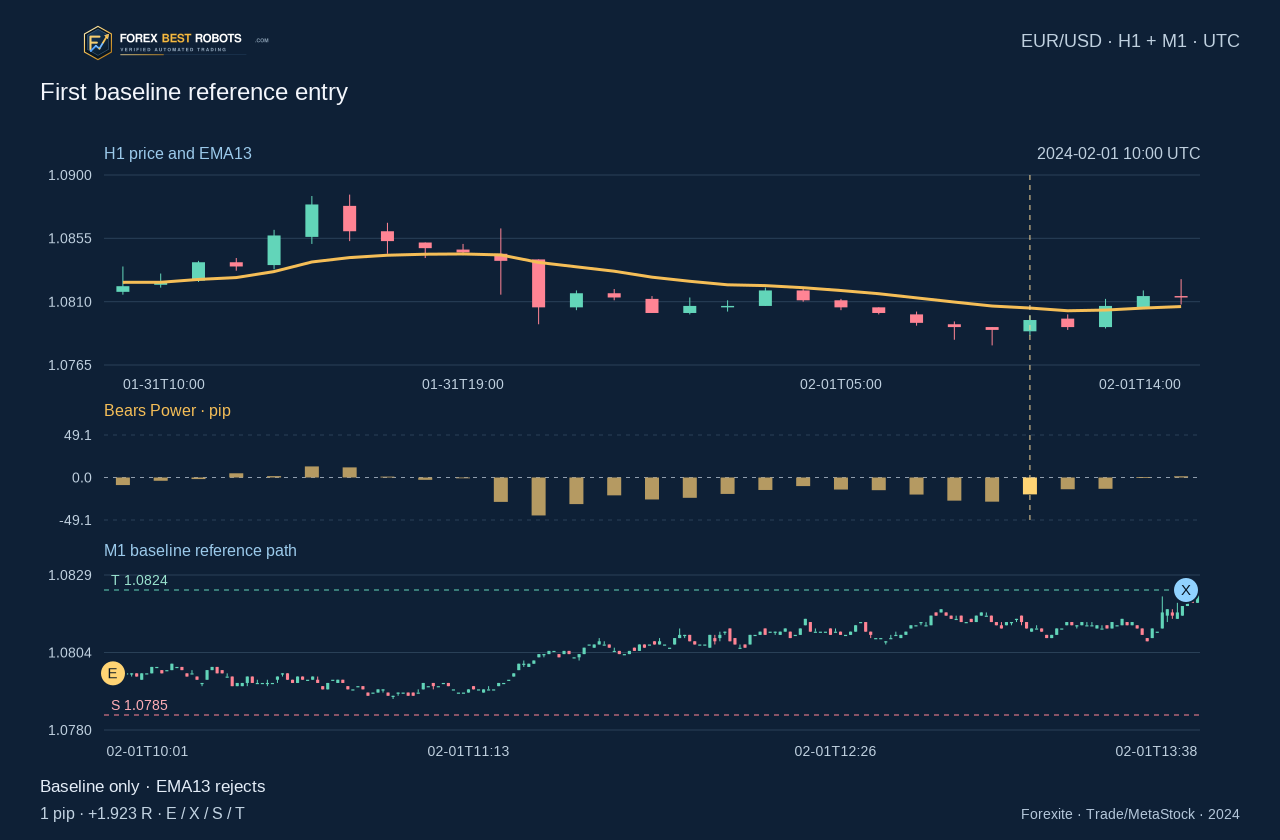
Signal end · UTC: 2024-02-01T10:00:00Z; Initial stop distance · pip: 13.00; Reference trade at the 1-pip allowance: +1.923 R; EMA13 condition: Reject
First different entry retained by EMA13
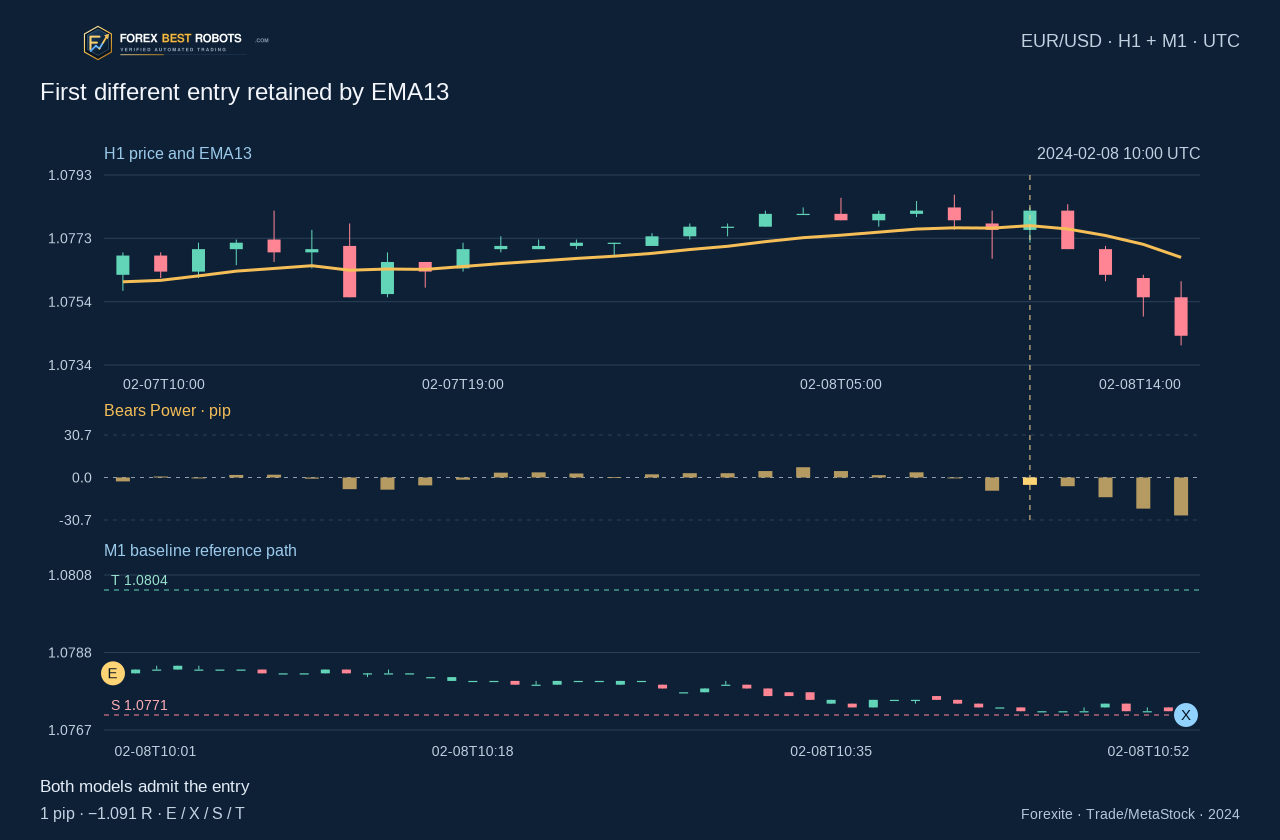
Signal end · UTC: 2024-02-08T10:00:00Z; Initial stop distance · pip: 11.00; Reference trade at the 1-pip allowance: −1.091 R; EMA13 condition: Pass
First different entry rejected by EMA13
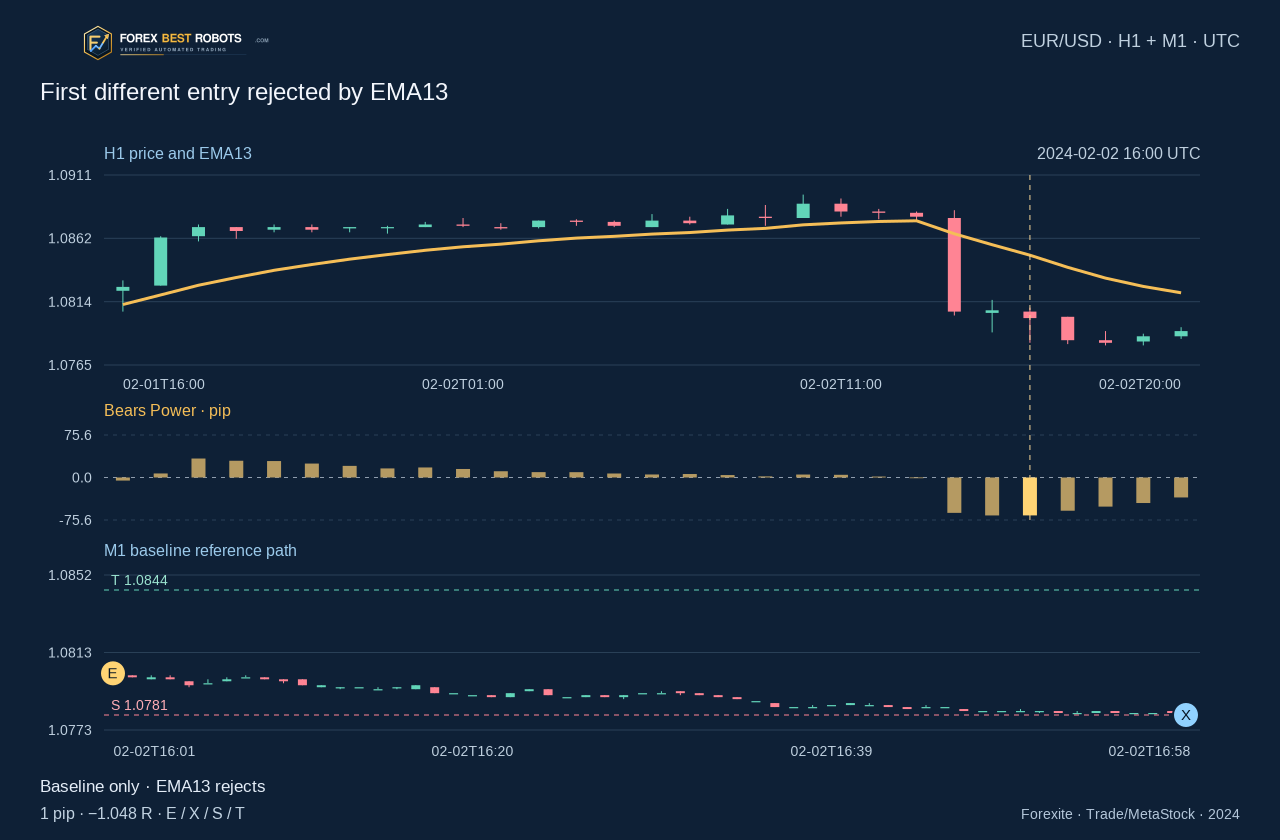
Signal end · UTC: 2024-02-02T16:00:00Z; Initial stop distance · pip: 21.00; Reference trade at the 1-pip allowance: −1.048 R; EMA13 condition: Reject
6. Check every date, candidate and reference path
Choose any evaluation date, including dates with no observed candidate. The cost selector changes only the resolved baseline reference result. A separate field shows whether EMA13 actually admits that trade. The H1 candle slider changes the inspected candle without rewriting the fixed candidate, entry or execution path. Labels identify interval ends in UTC; X locates an exit minute, not a known tick-level fill time.
Loading historical candidates…
The slider inspects recorded candles. The candidate and its reference execution stay fixed.
- Inspected candle end · UTC
- —
- OHLC · USD / EUR
- —
- EMA13 · USD / EUR
- —
- Bears Power · pip
- —
- Signal end · UTC
- —
- Bears t−2 / t−1 / t · pip
- —
- Signal Close / EMA13 · USD / EUR
- —
- EMA directional condition
- —
- Baseline model
- —
- EMA13 model
- —
- Reference entry · USD per EUR
- —
- S · stop
- —
- T · target
- —
- Initial stop distance · pip
- —
- Common data and risk checks
- —
- Full EMA history · gaps / partial hours
- —
- Baseline outcome status
- —
- Reference exit reason
- —
- Reference exit price · USD per EUR
- —
- Reference exit minute · UTC
- —
- Baseline gross result · R
- —
- Baseline result after allowance · R
- —
- EMA13 trade result after allowance · R
- —
7. Keep the limits of this test visible
The 0/1/2-pip allowances are fixed combined round-trip spread, commission and slippage scenarios, deducted once after the quote-based exit. They do not move the stop or target and do not reconstruct historical Bid/Ask execution. Financing is not modeled. One R is the initial price-distance risk, not one percent of account equity. Results on unresolved paths remain unavailable.
This is a retrospective single-pair test. The 2024 source archives were used in earlier research, and January EUR/USD was viewed for the guide. The complete protocol was durably frozen before this Elder-Ray strategy replay; no outcome-based adjustment followed. It is not an untouched holdout, prospective live result or native MT4 validation. Different price feeds, bar boundaries, history and execution assumptions can change the result.
Frequently asked questions
Is this a Bears Power zero-cross strategy?
No. The current and previous Bears readings must both remain negative. The event is the first rise after a fall or a flat reading. Crossing or touching zero does not satisfy this definition.
Does the strategy require Close above EMA13?
No. The only added filter is a strictly rising EMA13. Both models also need the same first candidate, complete adjacent hours, immediate next minute and permitted stop distance.
Did the EMA filter improve the result?
It reduced 135 baseline entries to 59, but its net-R result at the one-pip allowance is −3.15R. The resolved baseline subset is +6.90R, with one additional ambiguous outcome outside that sum. This comparison does not demonstrate an improvement in net R.
How can +10 pips coexist with negative R?
Each trade’s R result divides its net pips by its own initial stop distance. Variable stop distances weight trades differently from a plain pip sum. The filtered model’s +10-pip sum and negative-R sum are therefore compatible.
Why is there no later trade after a rejection?
The fixed calendar reserves the first observed event before the filters are checked. Taking a later candidate would change the opportunities as well as the filter and would be a different experiment.
Why not assume the stop happened first in the ambiguous minute?
The OHLC record does not reveal the order. Choosing a stop, target or zero return would add unsupported information. The entry remains visible and its performance value stays unavailable.
Data, frozen protocol and reproducible checks
The study preserves 366 original Forexite Trade/MetaStock daily archives for 2024. All were fetched again from the provider and matched the retained SHA-256 values. The 375 759 EUR/USD minute records rebuild 6,265 observed H1 bars: 6,192 complete, 73 partial and 52 gaps between recorded hours. Source labels use fixed GMT+1; shifting them back one hour and treating them as minute ends are explicit reconstruction assumptions. H1 groups use (start,end] in UTC, with no filled gaps.
January supplies indicator history; evaluation covers every UTC date from 2024-02-01 through 2024-12-31. Downloads retain original ZIPs and hashes, the frozen protocol, every calendar date, H1 values and trade/cost ledgers. A separate raw parser, exact integer weighted EMA and risk-normalized replay matched every decision and result; 43 mathematical boundary fixtures also passed. Both implementations and translations were written by the same assistant. No independent-human, native-speaker or native-terminal certification is claimed.