

A smooth, responsive Hull Moving Average does not establish a trading edge. Here a first daily HMA20 turn must pass HMA50 context and the immediately following closed hour. The full rules were saved before replay on retained USD/JPY quotes. The sample was negative in normalized R before and after the declared costs; the parameters were not adjusted to change that result.
1. Read the negative result first
The 130 first daily structural turns led to 12 entries: 8 long and 4 short, with 118 rejected attempts. At the main illustrative 2-pip round-trip deduction, total result was -1.66 R, win rate 58.3%, profit factor 0.69 and maximum closed-trade drawdown 3.15 R. The test did not establish an advantage under these rules.
Each R divides a trade’s result by its own initial stop distance, representing equal initial risk without account compounding. Gross normalized total is -0.46 R, while unweighted gross pips total +21.5. The signs differ because the sums weight different stop distances differently. After 2 pips, raw total is -2.5 pips. Neither R nor pips is an account-return percentage.
2. Define the turn and its next-hour confirmation
Calculate HMA(N)=WMA(r,2×WMA(h,C)−WMA(N,C)), where h=floor(N/2) and r=floor(sqrt(N)). Each WMA uses full windows with weights 1 through K from oldest to newest, divided by K(K+1)/2. Fixed HMA20 uses h=10,r=4; HMA50 uses h=25,r=7. There is no horizontal shift.
HMA20 first exists on retained bar 23 and HMA50 on bar 56. Unavailable values are not zero. The strategy requires 500 earlier recorded H1 bars. Every retained close, including a partial hour, advances the finite windows once; clock gaps are not padded. On weekdays search H1 ends 07:00–12:00 UTC. The current and previous two hours must all be complete, adjacent and end on the same UTC date.
- A fresh upward turn has current HMA20 change>0 and previous HMA20 change≤0. A downward turn has current change<0 and previous change≥0. Continuing in the same direction or becoming flat is not a new turn. The first turn in either direction consumes the date before context checks.
- At a long turn require Close>HMA50 and HMA50 rising; at a short require Close<HMA50 and HMA50 falling. Failure rejects the day’s attempt. A price cross of HMA20 or a crossover between the two HMAs is not the signal.
- Check exactly the next scheduled closed H1 hour. A missing, partial or nonadjacent hour rejects the attempt; a later hour cannot replace it.
- For long confirmation, both HMA20 and HMA50 must still rise, and Close must be strictly above both lines and above the turning candle’s close. Short confirmation reverses all inequalities. B marks the original turning close, not a rolling high or low.
- Only after confirmation define the stop: one pip below the lower low of the turn and confirmation candles for a long, or one pip above their higher high for a short. There is no order or protective stop while waiting for confirmation.
- A failed confirmation, rejected risk distance or later turn cannot replace the first daily attempt. At most one entry per UTC date and one open position; no second confirmation window or re-entry.
3. Set the stop after confirmation
Enter at the opening quote of the immediately following M1 interval. With minute-end labels, a confirmation at 09:00 uses the record ending 09:01, whose opening is modeled at 09:00. If that exact record is missing, reject instead of using a later opening.
One pip USD/JPY is 0.01 JPY per USD. The actual next-minute open must leave an initial stop distance of 10–80 pips inclusive. Keep that stop fixed and set a 1.5R target from the actual entry. Exit at the earlier of four clock hours after entry or 16:00 UTC, unless stop or target exits first. No trailing, break-even move or second entry.
Replay observed M1 OHLC. At an open, a breached stop fills at that open, then a breached target at its target without favorable improvement, then a due time exit at the open. Otherwise inspect the range; if both stop and target are touched, assume stop first. A held-path gap forces exit at the next observed open after those checks and is flagged. This sample had no held-path gaps, truncated trades or same-minute stop/target ambiguity.
4. Follow the first trade on H1 and M1
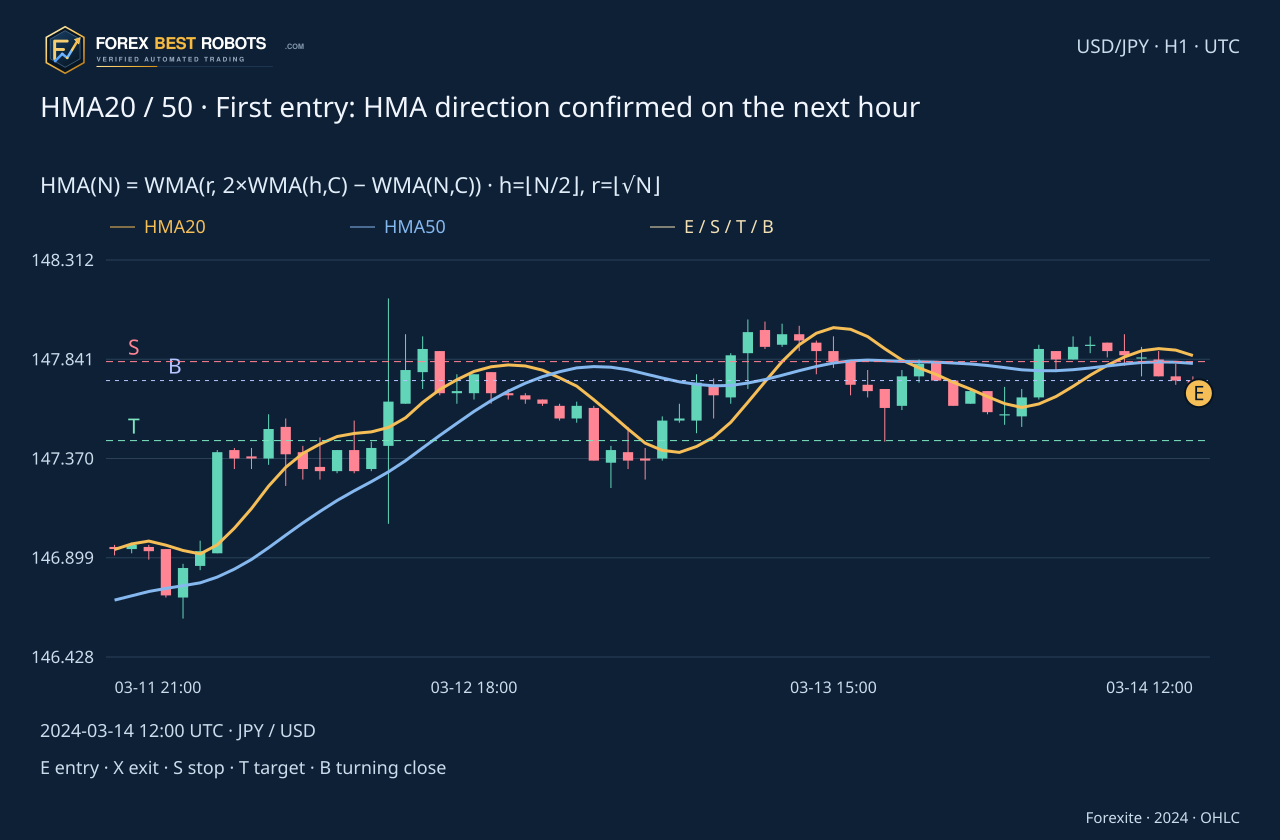
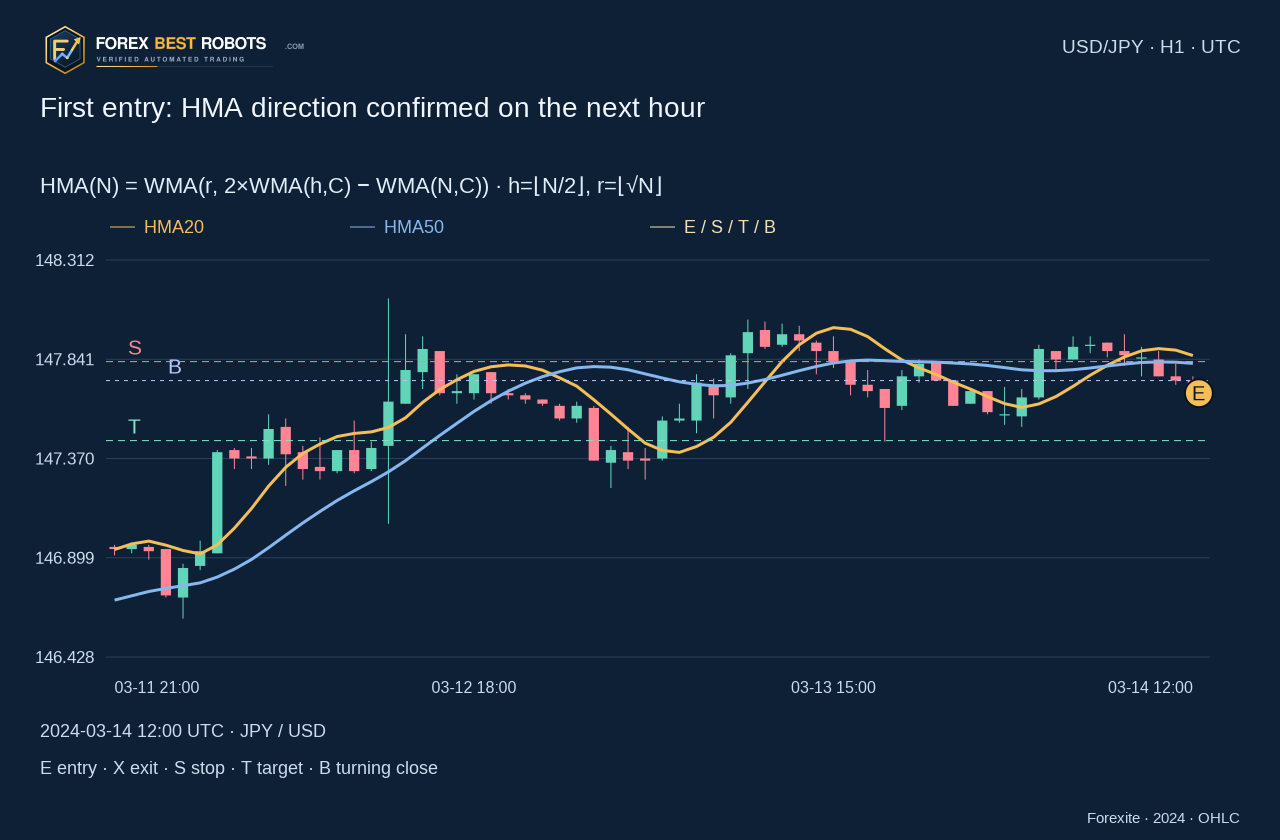
The first chronological trade is also the first loss after 2 pips: a short entered at 2024-03-14 12:00 UTC. The H1 chart ends at confirmation. B is the turning candle’s close, E the following M1 opening, S the stop set after confirmation and T the entry-based target. The H1 picture does not reveal a tick path.
First entry: HMA direction confirmed on the next hour
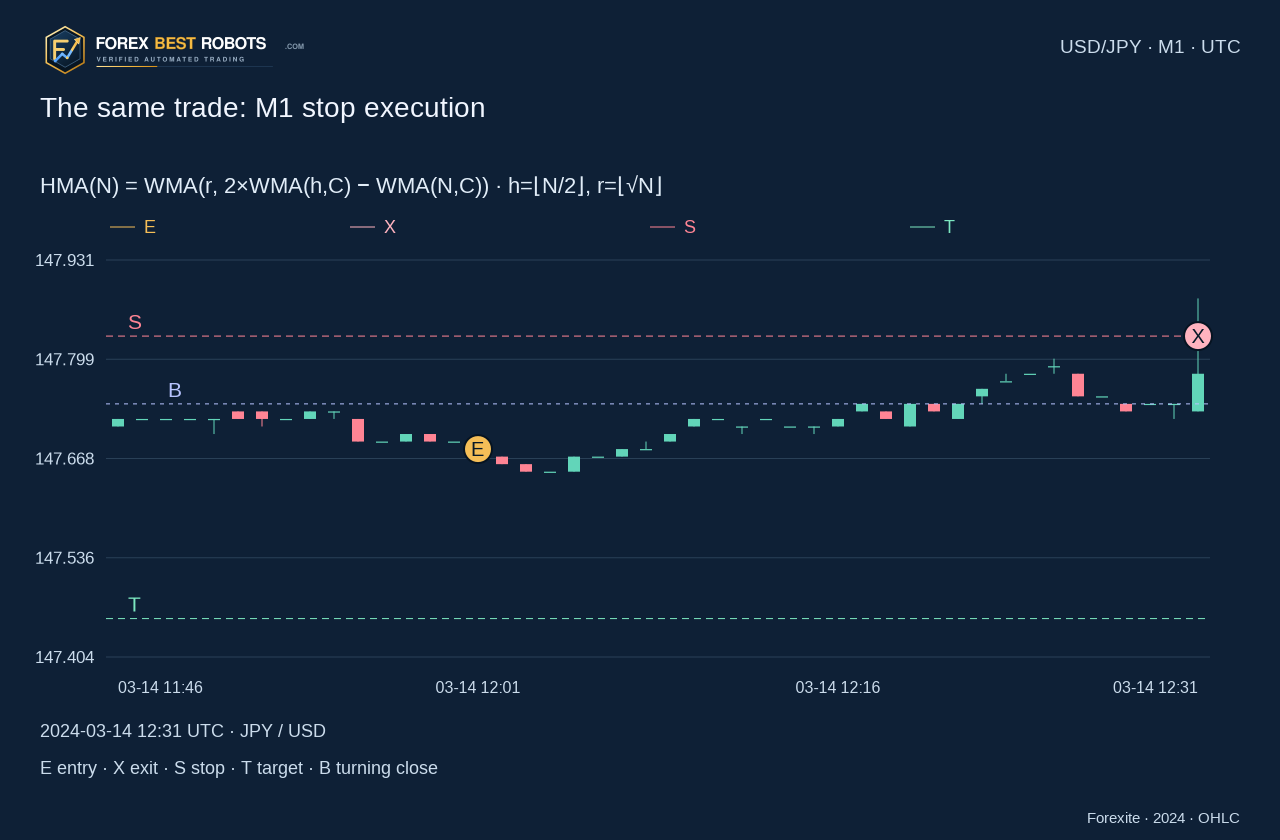
The M1 picture follows the same trade through the stop interval 2024-03-14 12:30 UTC to 2024-03-14 12:31 UTC. Its main-cost result is -1.133 R. E means entry and X modeled exit. Full OHLC of the exit minute is visible, but the exact stop-fill second is unknown. Two pictures explain one trade, not two independent examples.
The same trade: M1 stop execution
5. Compare costs on the same reference fills
All cost rows use identical attempts, entries, stops, targets and reference-price exits. Deduct 0, 2 or 4 pips once per completed round trip. These are illustrative combined spread, commission and slippage deductions, not measured broker fees or a reconstruction of historical bid/ask triggering.
The total is -0.46 R before deductions, -1.66 R at 2 pips and -2.85 R at 4. Costs make a reference stop worse than −1R and a 1.5R target smaller than 1.5R. The selector changes deductions and displayed results, not periods, rules or reference fills.
| All-in cost · pip per round trip | Trades | Total net · R | Net result · pip | Wins · % | Maximum drawdown · R | Profit factor · net R |
|---|---|---|---|---|---|---|
| 0 | 12 | -0.464 | +21.5 | 58.3 | 2.652 | 0.900 |
| 2 | 12 | -1.657 | -2.5 | 58.3 | 3.154 | 0.686 |
| 4 | 12 | -2.850 | -26.5 | 41.7 | 3.658 | 0.523 |
6. Keep rejected turning dates rejected
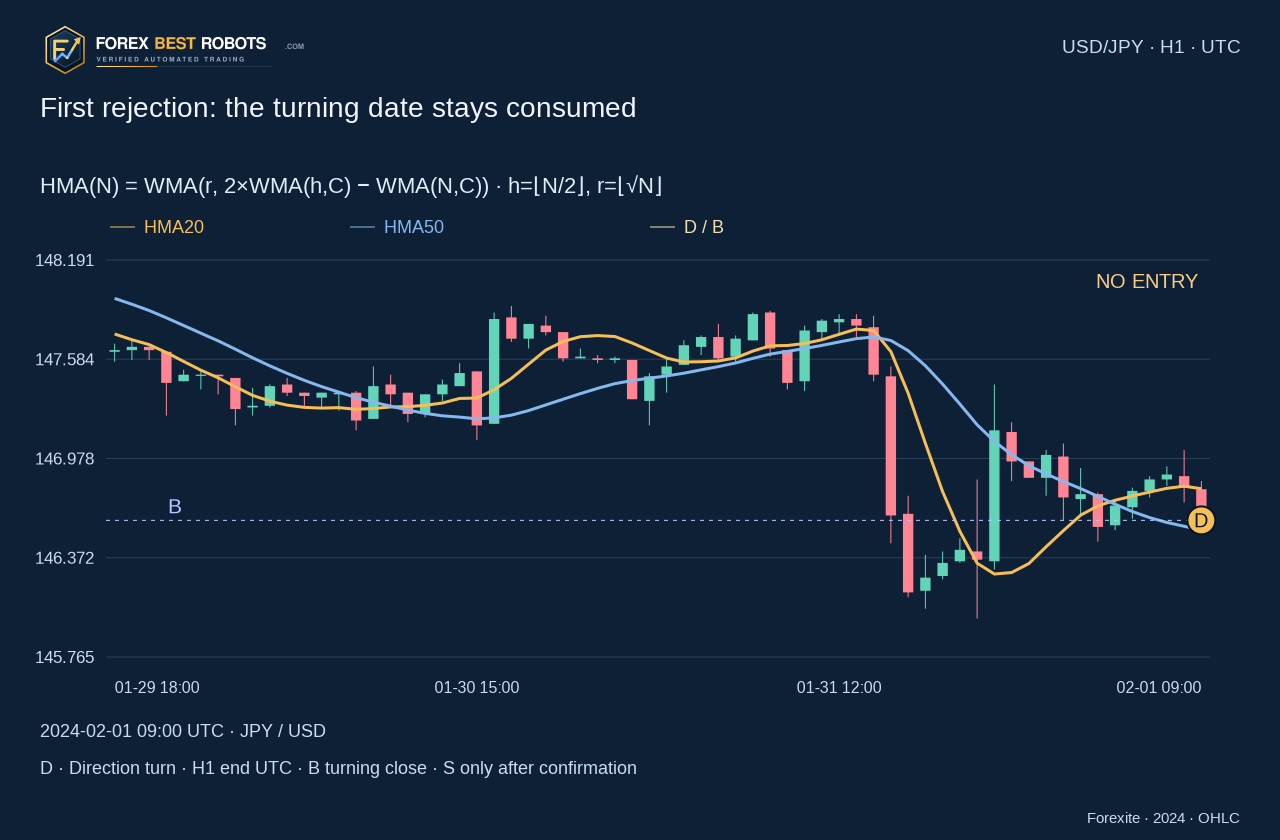
The first structural turn fails HMA50 context and produces no order or trading result. Its date remains consumed. D identifies the direction turn and B its close. No stop has been defined before confirmation; an unavailable stop is not zero or an executed position.
All 130 attempts remain in the ledger, including 118 rejections: 102 context failures, 14 failed next-hour confirmations and 2 rejected risk distances. A later attractive turn cannot replace a rejected date. These events are retained rather than removed to improve the total.
First rejection: the turning date stays consumed
7. Inspect all attempts without future prices
Choose an attempt, H1 setup or M1 execution, and a cost scenario. The minute chart ends at the selected observation. Before confirmation closes, its time, planned stop and entry prices remain unavailable; before the exit, final prices and results remain hidden. B and the turn-candle prices are already known. Rejected attempts have no M1 trading replay. Example buttons retain the selected cost.
Loading historical test…
E entry · X exit · S stop · T target · B turning close
The visible chart ends at the selected observation.
This rejected attempt has no M1 execution or trading result.
The exit is beyond the selected replay minute.
- UTC date
- —
- Direction
- —
- Attempt status
- —
- Decision / exit
- —
- Direction turn · H1 end UTC
- —
- Turning candle high
- —
- Turning candle low
- —
- B · turning candle close
- —
- Stop after confirmation
- —
- Next-hour confirmation · H1 end UTC
- —
- E · entry reference
- —
- Modeled entry time · UTC
- —
- S · stop reference
- —
- T · target reference
- —
- Initial stop distance · pip
- —
- X · exit reference
- —
- Exit observation interval · UTC
- —
- Modeled exit time · UTC
- —
- Exit time precision
- —
- Gross result · R
- —
- Net result · R
- —
- Net result · pip
- —
- Selected minute end · UTC
- —
8. Keep the sample within its limits
After 2 pips, January–June produced +1.07 R and July–December -2.73 R, six trades in each half. This is a chronological diagnostic on the same reused year, not untouched out-of-sample validation. Twelve trades, one pair and one year are too narrow to establish robustness.
Real retained quotes do not make these reference-price fills live trading. Fixed friction, minute-level ordering and missing full bid/ask history limit execution realism. The negative result is not a broker-native backtest or a forecast of all Hull MA trading. The three cluster tests use different rules; their totals do not establish which indicator is superior.
| Calendar subperiod | Trades | Total net · R |
|---|---|---|
| January–June 2024 | 6 | +1.071 |
| July–December 2024 | 6 | -2.729 |
Frequently asked questions
Is the signal a price or HMA crossover?
No. It is a fresh HMA20 slope turn, HMA50 context and confirmation on exactly the following closed H1 hour.
How are the HMA periods rounded?
Use floor(N/2) and floor(sqrt(N)): HMA20 uses 10 and 4; HMA50 uses 25 and 7. Each WMA gives the newest input the largest weight and requires a full window.
When is the stop known?
After confirmation, from the lower low or higher high of the turn and confirmation candles plus one pip. It is not known or placed while waiting. Entry then uses the next M1 open, subject to 10–80 pips initial risk.
Did the test show an advantage after costs?
No. The main 2-pip deduction gave -1.66 R over 12 trades. A 58.3% win rate did not make the total profitable. R is not a percentage return on an account.
Why are gross R and gross pips opposite in sign?
Each R result is divided by its own initial stop distance, whereas raw pips are not risk-normalized. The two totals weight trades differently.
Are these live or unseen validation data?
No. The retained 2024 USD/JPY quotes were already used in the guides and DEMA/TEMA tests. Two implementations were checked, without independent human or terminal certification.
Data, method and scope
Reuse the previously verified 375702 Forexite USD/JPY minute observations from 2024 Trade/MetaStock archives. Fixed GMT+1 labels were shifted back one hour to UTC; minute labels are interval ends and H1 buckets are (start,end]. These are reconstruction assumptions, not every broker’s convention.
The 6265 retained H1 intervals include 6178 complete and 87 partial hours, with 52 gaps before recorded hours. Each retained close advances the weighted windows, while signal and confirmation eligibility check completeness and adjacency. No prices are invented, and the original daily ZIPs were not downloaded again.
Download every trade, attempt or the data and method package. The protocol was saved before the first replay. An exact finite-kernel HMA calculation independent of the staged WMA loops and a separate date-based event replay matched the candidates, trades and totals. 49 boundary cases also check window availability, turning equality, next-hour limits, stop construction and execution priority. Reproducibility does not establish profitability.