

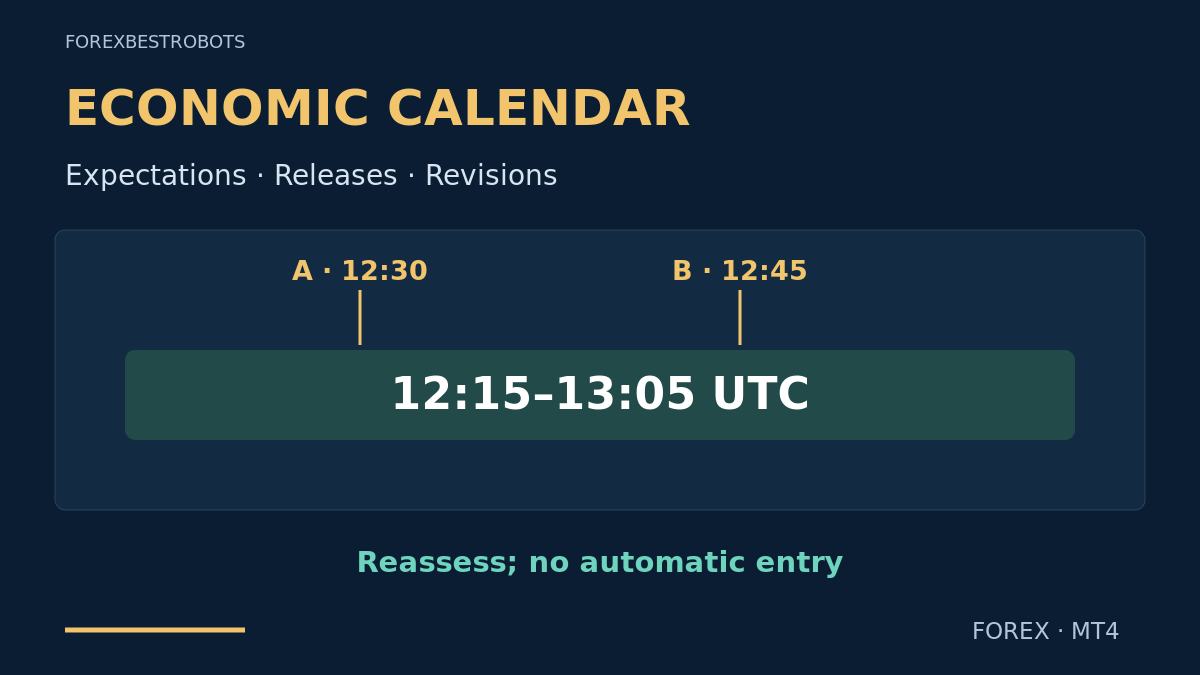
A calendar can tell you when an announcement is expected. It cannot tell you how far a currency will move, whether the first reaction will continue or what price your broker will fill. For a beginner, its first use is preparation: identify uncertainty before adding exposure.
Read it in this order: what is being released, which market it concerns, when it is due, what was expected, and what actually became available. This guide uses invented numbers and an illustrative exclusion window. It does not propose a news-trading entry method.
1. Separate scheduled events from unexpected news
Inflation reports, labour-market releases and central-bank decisions usually have published schedules. A calendar brings these events together, often with a currency tag and an expected-impact label. The label is the provider's classification, not a measured probability of a large move.
Unexpected policy comments, geopolitical developments or an unscheduled intervention can arrive outside that list. A blank calendar does not mean an absence of risk. Use scheduled-event checks as one layer alongside position limits, monitoring and execution controls.
2. Decide which events matter to your exposure
Start with both currencies in the pair, then consider wider market links and all positions already open. Several pairs can share the same currency exposure; adding another symbol does not necessarily diversify the news risk.
- Inflation and employment: read the exact measure and its components, not just the headline.
- Activity and spending: distinguish GDP, retail sales, business surveys and their different reference periods.
- Central banks: separate the decision, accompanying text, projections, press conference and later minutes.
- Other disruptions: check holidays, known speeches and instrument-specific notices; an economic calendar is not the broker's trading-hours schedule.
For EURUSD, EUR and USD events are an obvious starting point. A USD-tagged announcement can also affect broader markets, so a non-USD pair is not automatically insulated. Define a consistent relevance policy before observing the price reaction; account-level limits remain necessary. See the risk-management guide.
3. Read the fields before reading the colour
Calendar layouts differ. Confirm the provider's definitions instead of assuming that a green cell means “buy” or that two providers use the same forecasts.
- Event and reference period: identify the series, country and month or quarter being measured.
- Date, time and zone: distinguish a scheduled instant from “tentative,” “all day” or an unknown time.
- Forecast: an expectation, often a survey estimate, with its own source and update time.
- Actual: the value published for the current reference period; it can be preliminary and later revised.
- Previous: the earlier period's value, which the provider may replace when a revision arrives.
Check units, monthly versus annual changes, seasonal adjustment and the release version. An absent value is not zero. Two numbers with different definitions should not be subtracted merely because they appear in neighbouring columns.
4. Follow a small forecast-and-revision example
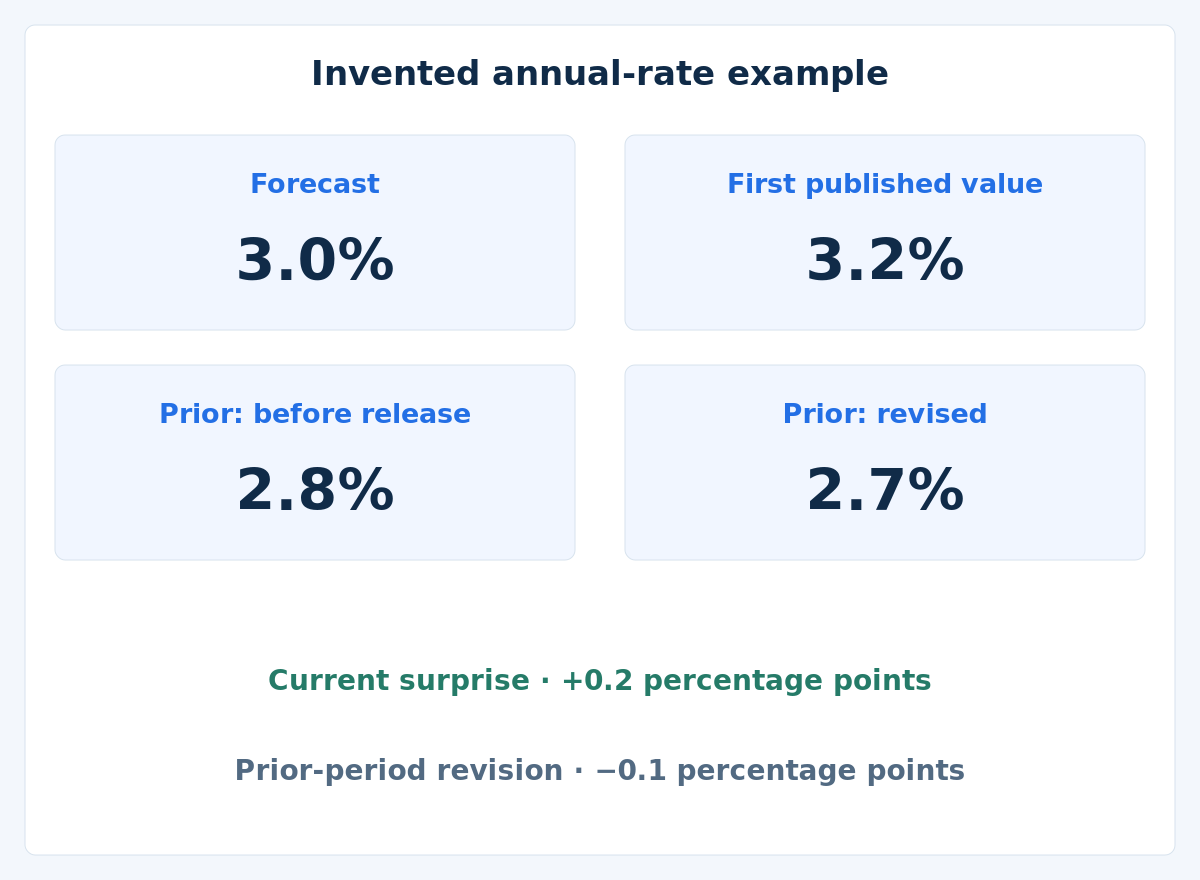
The following annual-rate indicator is entirely invented. All four values use the same percentage unit. The current period has a forecast and first published value; the previous period has a value known before this release and a revised value published with it.
| Calendar field | Invented value |
|---|---|
| Current-period forecast | 3.0% |
| Current-period first published value | 3.2% |
| Previous period, known before release | 2.8% |
| Previous period, revised at release | 2.7% |
The current surprise is 3.2 − 3.0 = +0.2 percentage points. The revision to the previous period is 2.7 − 2.8 = −0.1 percentage points. A percentage-point difference is not a relative percentage change; keep the unit attached to the result.
These calculations answer different questions. Do not replace the frozen forecast with the previous value, and do not add the revision to the current surprise as a mechanical score. The market can weigh components, positioning and policy implications differently. An above-forecast number does not guarantee a stronger currency or a profitable trade.
5. Verify the exact date and clock
Reuse the dated conversion process in the Forex sessions guide. For a hypothetical item at 08:30 America/New_York on 2026-03-16, the instant is 12:30 UTC. An explicitly assumed UTC+2 broker server reads 14:30. No real release is asserted for that date.
A calendar may display your browser's zone, a chosen zone or the publisher's local time. Verify its setting and the broker's dated offset. Record the scheduled time separately from actual publication and from the time your own system received the update. A scheduled timestamp is not proof that the release or a fresh quote has arrived.
6. Combine restrictions when announcements are close
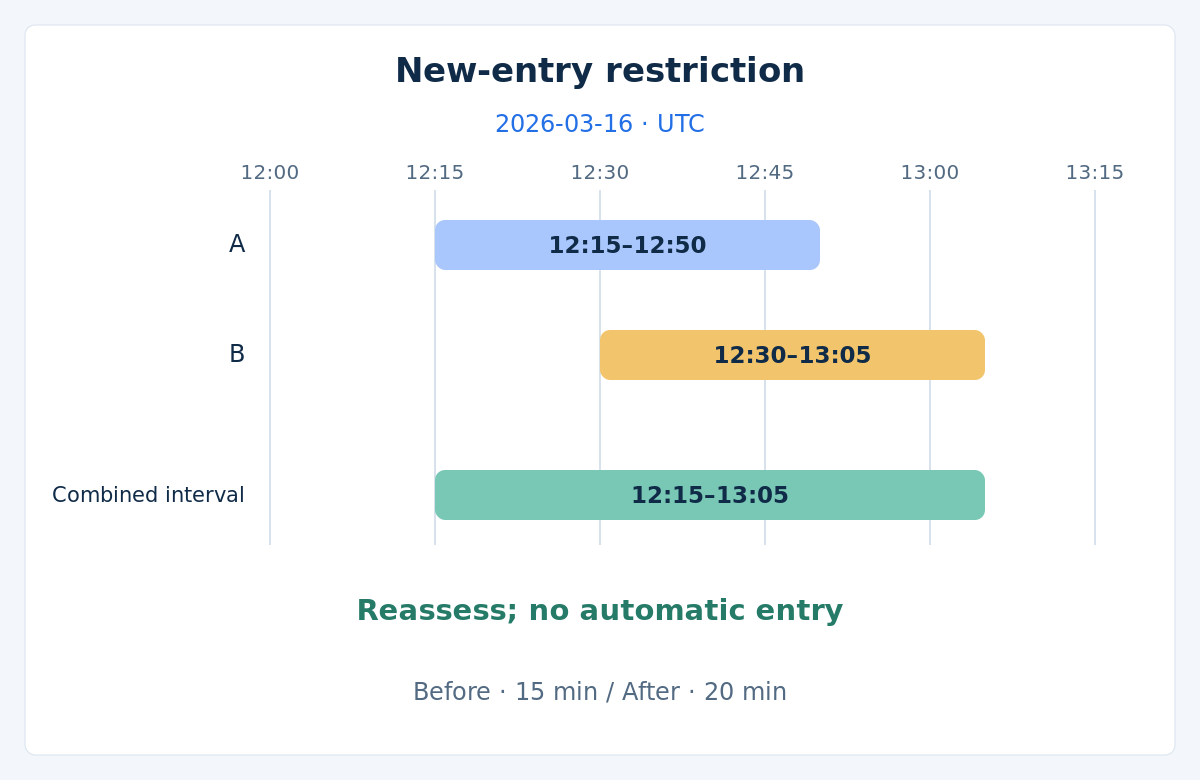
For this teaching example only, suppose new entries are excluded from 15 minutes before until 20 minutes after each selected scheduled event. These durations are author-chosen arithmetic inputs, not recommended settings or evidence of a safe waiting period. On the same hypothetical date, A is due at 12:30 UTC and B at 12:45 UTC.
| Event | Scheduled UTC | Excluded interval · UTC |
|---|---|---|
A | 12:30 | [12:15, 12:50) |
B | 12:45 | [12:30, 13:05) |
| A and B combined | — | [12:15, 13:05) |
A begins restricting entries at 12:15 and ends at 12:50. B begins at 12:30 and ends at 13:05. Their intervals overlap, so the combined restriction is [12:15, 13:05). At 13:00, B still blocks a new entry even though A's interval has ended. At 13:05, the clock restriction ends; all other checks still apply.
Optional: exact boundaries and duration
The opening bracket includes the start and the closing parenthesis excludes the end. Each individual interval lasts 15 + 20 = 35 minutes. Their overlap is 20 minutes, so the union lasts 35 + 35 − 20 = 50 minutes. Taking the union avoids an artificial reopening between overlapping events. This calculation assumes the two schedules remain valid.
7. Allow for delays and several stages of news
If an announcement is delayed, tentative or rescheduled, do not treat the old timer's expiry as evidence that the event risk has passed. Verify the updated schedule and apply a predefined response. If timing or required calendar coverage cannot be established, withhold new entries that depend on that information; continue the defined management of existing positions.
One policy decision can be followed by a press conference, while minutes appear later. A statistical release can publish several components and revisions together. Check the relevant sequence instead of reducing the whole event to one number. Later comments and unexpected headlines can still move prices after a planned waiting interval.
8. Separate new entries, pending orders and open positions
A rule that blocks new market entries does not automatically cancel pending orders already held by the broker. If the plan requires cancellation, define when to request it and verify the broker's accepted order status. A cancellation request can be delayed or rejected, and an order may fill before cancellation is confirmed.
For existing positions, decide in advance whether the method holds, reduces or closes exposure and how protection and monitoring continue. Each choice has costs and limitations; this guide does not prescribe a universal exit. Turning off an EA or disconnecting MT4 does not itself close broker-held positions or pending orders, and it can interrupt client-side management.
Spreads, available prices and execution can deteriorate around announcements. A stop price does not guarantee a fill at that price, and a candle's high or low does not reconstruct your executable Bid/Ask sequence. Include commission and slippage in evaluation; see trading costs and slippage and latency.
9. Reassess before resuming new entries
The end of a clock interval is permission to check again, not an order to trade. A simple review can ask:
- Is the event schedule verified, with no unresolved delay or relevant follow-up stage?
- Does the calendar cover the required currencies, dates and event types, with known update status?
- Are the broker clock mapping and the symbol's Bid/Ask quotes current and verified?
- Do spread, execution permissions and market availability meet the method's predefined limits?
- Are pending-order status, existing positions and aggregate account exposure reconciled?
- Does a fresh, valid setup still exist under the strategy's own rules? If a required check fails, skip the new entry.
10. Preserve what was known at the time
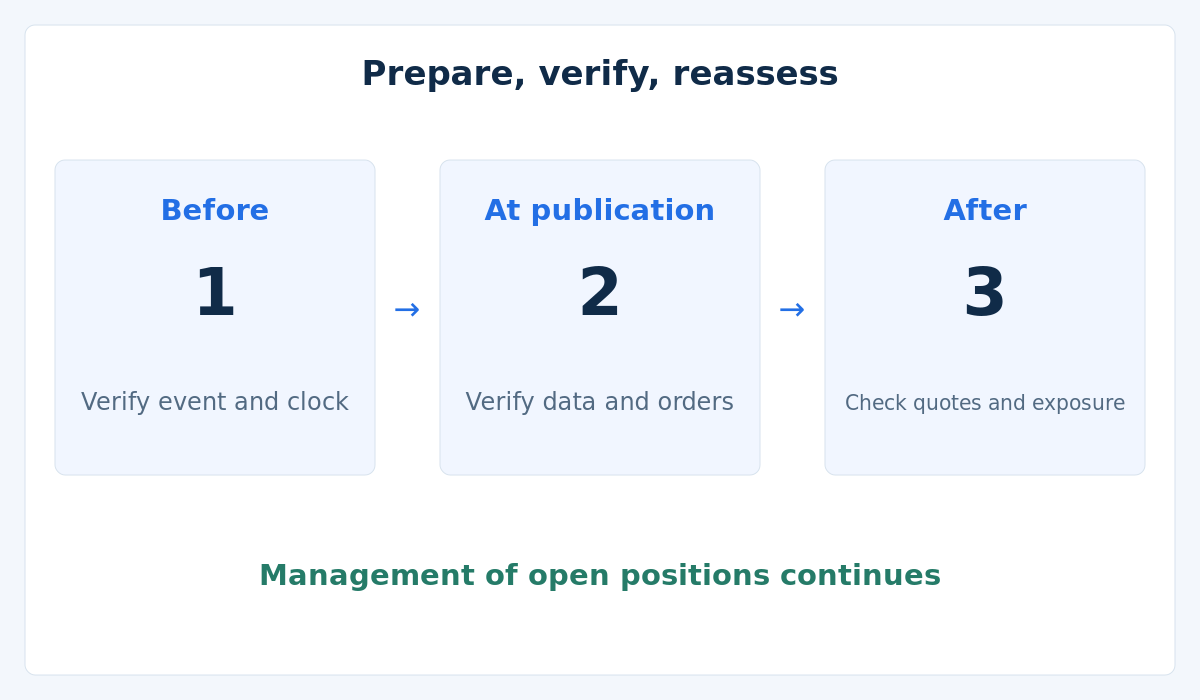
In the invented data example, a note saved at 12:10 UTC records forecast 3.0%, prior value 2.8% and no actual yet. A verified update received after 12:30 UTC contains actual 3.2% and revised prior 2.7%. These later values must not appear in the earlier decision record.
Keep the calendar source, event identifier, reference period, scheduled zone/UTC time, retrieval time, data version, chosen exclusions, quotes and decision reason. Save skipped candidates too. An empty event list and a failed download are different states; neither proves that there are no relevant announcements. See the EA monitoring guide for feed and status checks.
A current historical calendar may contain revised values or schedules that were unavailable then. Backtests need the information and availability times that the system could actually have known. If that history is missing, disclose the limitation instead of claiming a fully reconstructed news filter. Freeze the proposed rules, use realistic costs and separate later validation data; the MT4 backtesting guide explains the wider checks.
11. Questions about economic calendars
Is a 15-minute news pause enough?
There is no universal safe duration. The 15-minute lead and 20-minute lag here illustrate interval arithmetic only. A delay, follow-up announcement or poor execution can outlast them. Any proposed restriction needs evidence for the specific method, broker and data.
Does a red impact label mean buy or sell?
No. It is a provider's expected-impact classification. It does not specify the actual surprise, the price direction, the size of a move or the quality of an available fill.
What if the calendar has an unknown time or fails to update?
Treat the missing information explicitly. Verify the source and apply the method's predetermined fallback. If a required timing or coverage check cannot be completed, withhold dependent new entries while continuing the defined management of existing positions.
Can I avoid news risk by disabling the EA?
Disabling the EA does not remove positions or pending orders held by the broker. It may stop local monitoring or trailing logic. Exposure, order handling and continued management need their own verified plan.
12. References and scope
The official BLS release calendar is one example of a publisher's dated schedule; check its displayed time zone. The Federal Reserve meeting calendar separates policy statements, press conferences and minutes. These are selected primary starting points, not a complete global news feed. References checked on 2026-10-17.
This guide explains calendar interpretation and preparation. All numerical data, event times and restriction lengths in the worked examples are illustrative. A news filter cannot remove market, execution or account risk, and none of these examples establishes a trading edge.