
The Asian session often produces quieter two-way trade in major European pairs, while JPY, AUD and NZD pairs may remain active. This framework turns that tendency into testable rules rather than assuming every overnight range will hold.
How the Asian-session range framework works
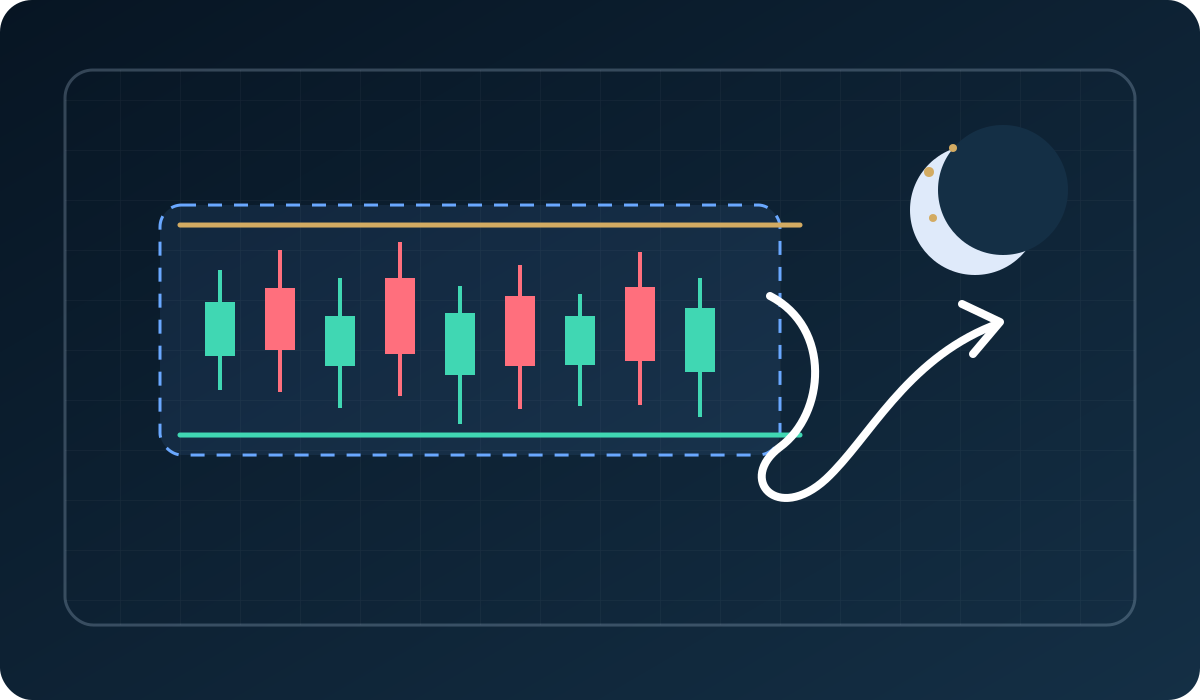
Mark the high and low formed during a fixed Asian-session window. Then choose one method before testing: trade rejection back into the range, or trade a confirmed breakout from it. Do not switch between the two after seeing which would have won. A range needs several contained candles and visible reactions at both sides; one random high and low is not enough.
Define the session in broker time and UTC
Forex has no single centralized session clock. Use one fixed window in UTC for research, then convert it to the broker server time used by the chart. Tokyo itself does not observe daylight saving time, but London, New York and many broker servers do. Therefore the relationship between the Asian range and the later London open can shift by one hour during the year.
USDJPY, AUDUSD, NZDUSD and selected JPY crosses.
M15 or M30 for the range; H1 or H4 for context.
ATR, prior-day levels and a maximum-spread rule.
Entry rules
BUY rejection checklist
- Price tests the lower range boundary without a decisive close below it.
- A bullish candle closes back inside the range.
- There is room to the midpoint or upper boundary after spread.
- Enter only after confirmation; do not buy every touch.
SELL rejection checklist
- Price probes the upper boundary and fails to hold above it.
- A bearish candle closes back inside the range.
- The next support leaves sufficient reward relative to risk.
- Skip a late entry after price has already crossed most of the range.
For a breakout version, require a candle close outside the range and either follow-through or a successful retest. Test breakout and rejection as separate systems because their expectancy and losing conditions differ.
Stop Loss and Take Profit
For a rejection, place invalidation beyond the failed test and a volatility buffer, not at the obvious boundary itself. Initial targets can be the range midpoint, opposite boundary or a tested risk multiple. For a breakout, invalidation usually belongs back inside the range beyond the retest structure.
Calculate lot size after the stop distance is known. If the required stop makes the position too small or the available reward too limited, skip the setup instead of forcing tighter levels.
Risk controls for session trading
Session strategies can cluster losses when market behavior changes. Define a maximum number of attempts and a daily loss limit. Never assume a narrow range guarantees a large move later.
When to avoid the setup
Avoid an undefined or unusually wide range, spreads that consume much of the target, a major scheduled announcement inside the holding window, and a setup directly against a dominant higher-timeframe trend. Holiday liquidity and rollover can also produce misleading spikes.
How to test it responsibly
- Store session boundaries in UTC and record the broker-time conversion.
- Separate JPY, AUD, NZD and European pairs instead of pooling everything.
- Include spread, commission, slippage and missed entries.
- Label rejection and breakout setups separately.
- Test several daylight-saving cycles and an out-of-sample period.
- Forward-test on demo before considering small live risk.
Session behavior changes with volatility, news and liquidity. No fixed win rate or return is implied.