
Liquidity often increases as London participants enter, but the first push beyond an overnight range can fail. A useful London breakout plan defines the range, confirmation, invalidation and maximum entry distance before the session begins.
What the strategy is trying to capture
The setup looks for expansion from a clearly defined pre-London consolidation. It is not a rule to buy every new high or sell every new low. The breakout must occur within the tested time window, close beyond the boundary and leave enough space before the next higher-timeframe barrier.
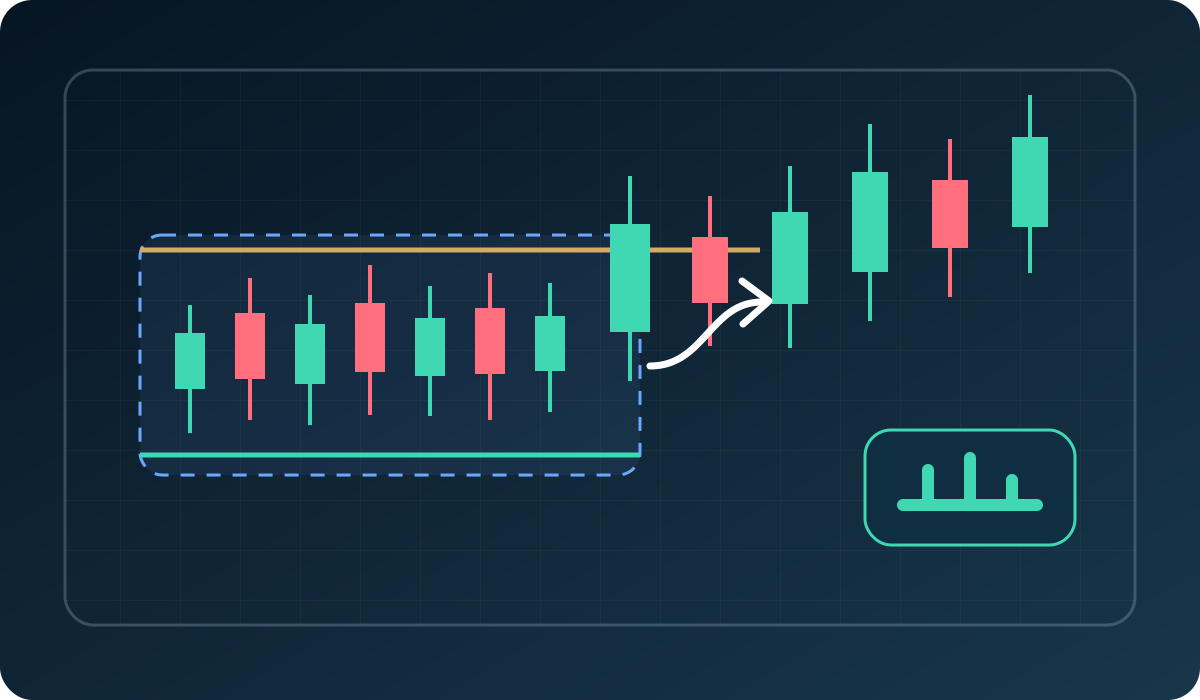
Build the pre-London range consistently
Choose a fixed UTC window that ends near the London open and use the same definition in every test. Convert it to broker server time with a documented daylight-saving rule. Mark the high, low and width of the range, then compare its width with recent ATR. An extremely wide range may have already spent the session’s available movement; an extremely narrow range can be vulnerable to noise.
EURUSD, GBPUSD, EURGBP and selected EUR or GBP crosses.
M15 or M30 entries with H1/H4 structure.
Range width, spread, news and nearby daily levels.
Entry rules
BUY checklist
- The pre-London range is objective and not already abnormally wide.
- A candle closes above the range rather than leaving only a wick.
- Spread remains within the tested limit.
- Enter on the close or a successful retest according to one predefined version.
SELL checklist
- The lower boundary has been defined before the active window.
- A candle closes below it with meaningful range expansion.
- The next support does not eliminate the expected reward.
- Enter only while price remains within the maximum tested distance.
A stop-entry variation can reduce hesitation, but it can also trigger on a short-lived spike. Model spread and slippage realistically and cancel the pending order when the setup window expires.
Stop Loss and Take Profit
Common invalidation points are back inside the range beyond the retest swing, or beyond the opposite side when the range is sufficiently narrow. A stop should reflect the setup logic, not an arbitrary number of pips. Targets can use the measured range width, the next daily level or a fixed risk multiple validated on the pair.
Consider partial profit only if the rule is included in every historical and forward test. Moving to breakeven too early can remove otherwise valid trades during the retest phase.
Filters for false breakouts
No filter removes every false break. The purpose is to define which failures belong to the tested system and to prevent emotional re-entry after a loss.
Risk controls
Set risk from stop distance and account equity. Count EUR and GBP positions that express the same directional idea as correlated exposure. Define one or two maximum attempts, a session loss cap and the time when all untriggered orders are cancelled.
A faster market can increase both breakout follow-through and adverse slippage. Reducing lot size is often more rational than widening every limit.
How to test it responsibly
- Use several years that include different volatility regimes.
- Record the exact range and entry window in UTC.
- Model variable spread, commission and adverse slippage.
- Separate close-entry, retest-entry and stop-entry variants.
- Keep an untouched out-of-sample period.
- Forward-test through at least one seasonal clock change.
A London breakout can lose repeatedly and does not guarantee a daily trade, fixed win rate or monthly return.