
The New York session begins while London remains active, creating one of the deepest liquidity windows in Forex. The same period can extend the European move or reverse it after US data, so continuation and reversal must be defined as separate rule sets.
Choose continuation or reversal before entry
A continuation setup requires a clear London trend, a controlled pullback and renewed momentum as North American liquidity arrives. A reversal setup requires exhaustion or a failed break at a meaningful daily level, followed by a structural change. Do not call a losing continuation a reversal after the fact.
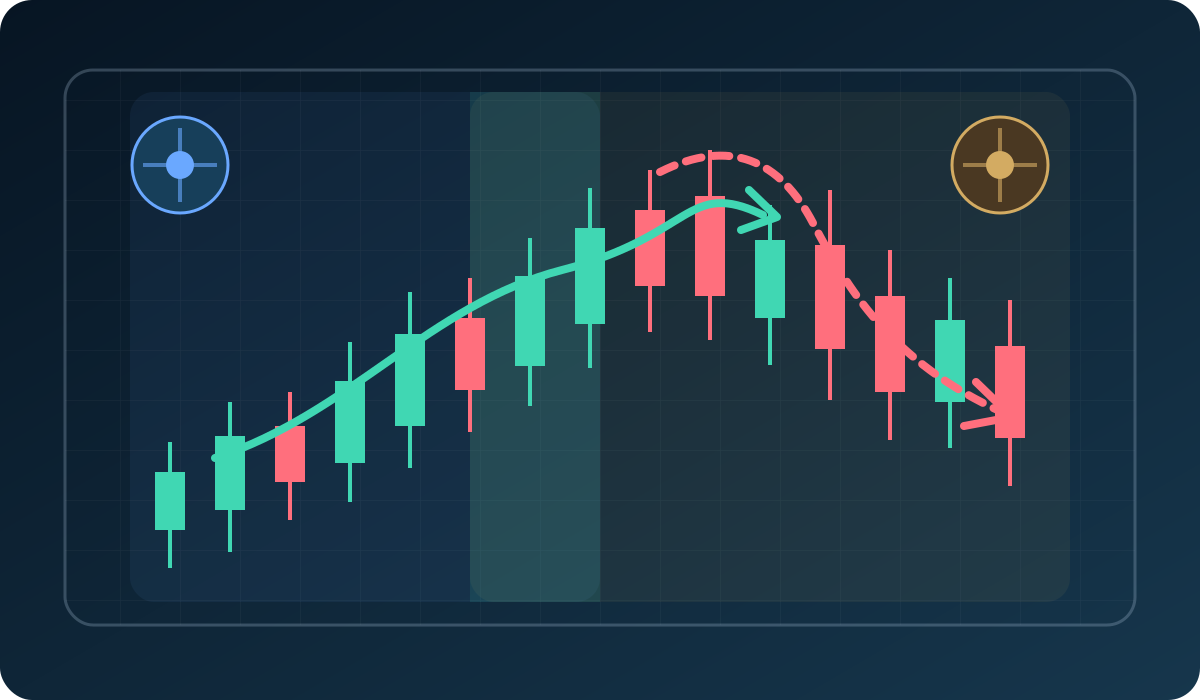
Map London structure before New York opens
Mark the London high, low, opening area, current daily range and nearby H1/H4 levels. Note whether Europe produced a trend, a balanced range or an exhausted one-directional move. Convert the New York window from UTC to broker time and account for the weeks when US and European daylight-saving changes do not occur on the same date.
EURUSD, GBPUSD, USDJPY, USDCAD and liquid USD crosses.
M15 or M30 triggers with H1/H4 context.
London structure, US releases, yields and daily levels.
Entry rules
Momentum continuation
- London establishes higher highs and higher lows above a relevant level.
- The pullback holds above the broken structure.
- New York participation produces a bullish close or tested momentum trigger.
- Enter only if the next resistance leaves adequate reward.
Failed-move reversal
- London extends into major resistance or an exhausted daily range.
- A new high fails and price closes back below the trigger zone.
- A lower high or support break confirms structural change.
- Enter on confirmation, not solely because the move looks overextended.
Mirror the rules for bearish continuation and bullish reversal. Keep the two models tagged separately in the journal so that their statistics cannot hide each other.
Stop Loss and Take Profit
For continuation, invalidation normally belongs beyond the pullback swing or back through the reclaimed London level. For reversal, it belongs beyond the failed extreme. Potential targets include the London high or low, session midpoint, daily open and the next H1/H4 zone.
Late entries after a large US impulse often offer poor reward relative to the logical stop. Missing the trade is preferable to shrinking the stop until ordinary volatility can hit it.
Handle US data and the cash-market open explicitly
Major US and Canadian releases can create spread expansion, gaps between ticks and rapid two-way movement. Define whether the system stands aside, waits for a post-release candle or trades only after a retest. The US equity cash open can also change risk sentiment, so the same setup may behave differently before and after it.
If the strategy trades announcements, use conservative slippage and spread assumptions. If it avoids them, encode a reproducible exclusion window.
Risk and portfolio controls
US dollar pairs can move together after a common catalyst. Three small positions may represent one large USD bet; size them as a portfolio rather than independent trades.
How to test it responsibly
- Classify each day as London trend, range or exhaustion before viewing the outcome.
- Store session times in UTC and document daylight-saving conversion.
- Tag continuation, reversal, news and non-news trades separately.
- Include spread, commission, slippage and unfilled orders.
- Validate on unseen months and different volatility regimes.
- Forward-test the complete routine, including days with no trade.
The overlap can be liquid and still produce losses, false breaks or no valid setup. This framework is educational, not investment advice.