

Does a Chandelier stop improve an otherwise identical trade? In this January–February 2024 GBP/USD H1 reference-price experiment, both models admit 28 entries. The same 27 resolved pairs total −14.33R with a fixed 2R target and −17.52R with Chandelier at an assumed 2-pip total cost. Both lose; one further entry is unresolved in both models. This small historical sample does not establish a durable edge.
1. Freeze a common daily entry calendar
Begin after 200 recorded H1 candles. For each UTC date of a signal candle’s start, retain only the first directional EMA50 pullback. A partial first signal, an invalid entry or out-of-range risk consumes that date; a later attractive signal cannot replace it. Indicators continue through dates and months.
Both models receive the same direction, next-minute entry, signal-candle stop and initial R. Each path lasts at most 24 clock hours and can cross a date or month. Paths may overlap: this is a comparison of independent price experiments, not a one-position account.
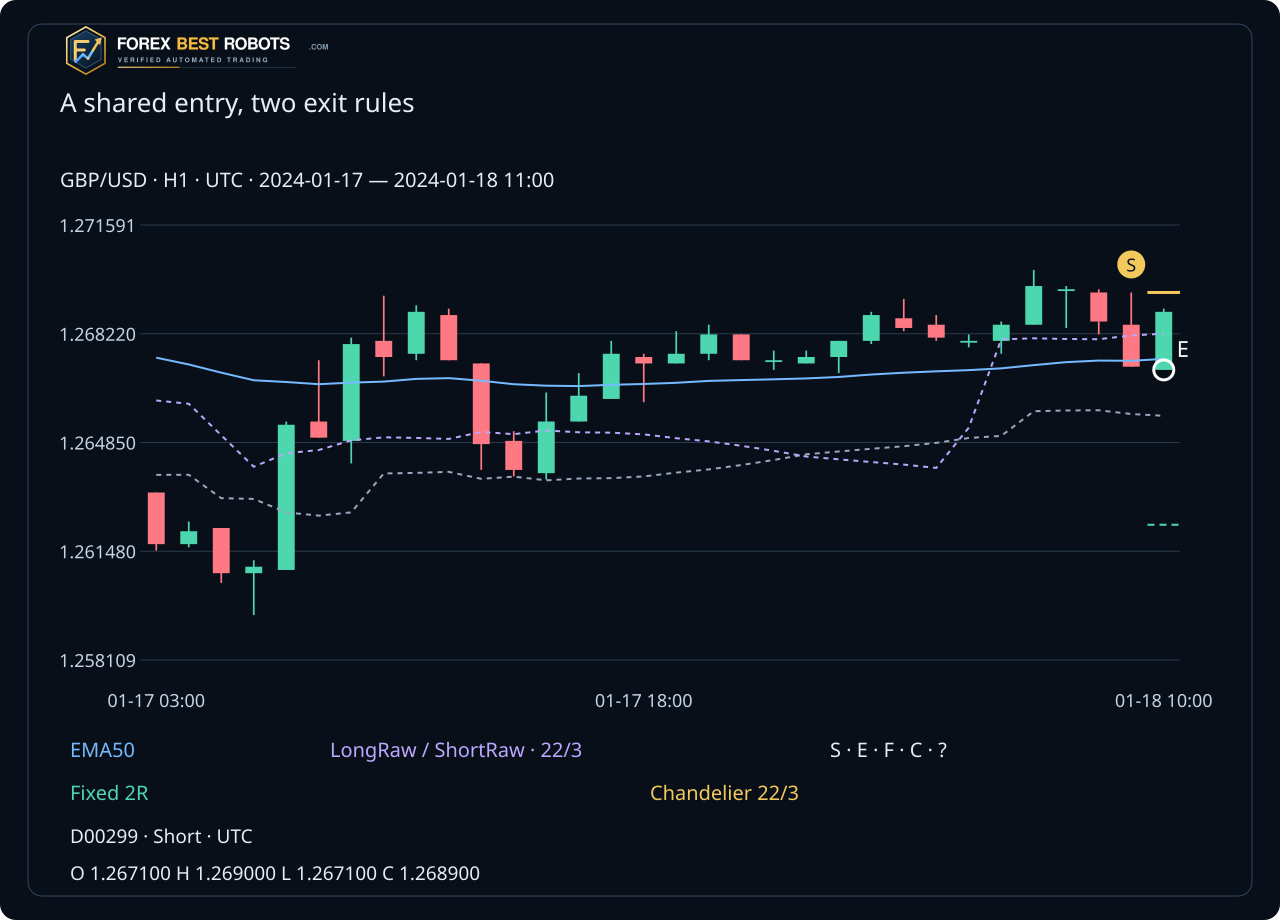
2. Set the EMA pullback, entry and initial risk
Long requires a rising EMA50, Close above EMA50, Low at or below EMA50 and Close above Open; short requires a falling EMA50, Close below it, High at or above it and Close below Open. An unchanged EMA50 or a Close equal to EMA50 does not qualify. Seed EMA50 with the first 50 recorded Closes, then use 2/51.
The selected signal hour must contain all 60 expected minutes. Enter at Open of the minute ending exactly one minute after signal close, without skipping a missing first row. Entry must share the signal-start UTC date. Set the common stop at signal Low for a long or High for a short; accept initial risk from 5 through 100 pips.
3. Separate raw Chandelier lines from the position stop
ATR22 starts with the mean of 22 true ranges; the first true range is High−Low. Later ATR=(21×previous ATR+TR)/22. LongRaw is the highest High of the last 22 recorded hours minus 3×ATR; ShortRaw is the lowest Low plus 3×ATR, including the completed current candle. Partial candles remain in indicator history; no artificial candles are added.
The fixed model keeps its initial stop and takes profit at 2R. Chandelier has no profit target. It starts with that same initial stop, then ratchets upward for longs or downward for shorts. Its first possible update is after the first entry hour closes, never at the signal close. A raw line may retreat; the position stop cannot loosen.
LongRaw[t] = HH22[t] − 3 × ATR22[t]
ShortRaw[t] = LL22[t] + 3 × ATR22[t]
StopLong[next] = max(StopLong[in], LongRaw[t])
StopShort[next] = min(StopShort[in], ShortRaw[t])
4. Replay minutes in the correct time order
Check every expected minute with the incoming stop. A stop gap exits at Open; otherwise an inclusive stop touch exits at its level. For the fixed model, a favorable target gap is capped at 2R; stop and target both touched within one minute leave their order unknown. A missing expected minute leaves the still-open arm unknown before any price or pending-exit test. Without an earlier exit, use minute 1,440’s Close.
Chandelier calculates its next stop only after a complete hour closes with the path still open. Apply it to the next minute. If the proposed long stop is at/above Close, or the short stop at/below Close, schedule an exit at the next expected Open; do not fill at a past raw level. At that Open an incoming-stop gap takes priority, then the scheduled exit. The 24-hour Close takes priority over a simultaneous update.
5. Keep rejected first candidates in the calendar
There are 31 first daily candidates: 28 admitted entries, three initial-risk rejections. The complete decision calendar is downloadable. No extra entries are awarded to either model when it exits earlier.
At 2 pips Chandelier does better on eight common known pairs, fixed 2R does better on five, and 14 pairs tie. Better can mean a smaller loss: the first Chandelier-better example loses under both exits.
| First terminal decision | Candidates |
|---|---|
| Valid shared entry | 28 |
| Initial risk outside 5–100 pips | 3 |
6. Compare January, February and common known pairs
January has 12 entries, all resolved: fixed −8.30R, Chandelier −10.61R at 2 pips. February has 16 entries, of which the same 15 pairs resolve: fixed −6.04R, Chandelier −6.91R. The remaining entry is unresolved in both models.
Across 27 common known pairs, the totals are −14.33R and −17.52R; Chandelier is lower by 3.18R. Both months are negative under both exits. Do not treat that unknown pair as zero or extrapolate this short, already available historical window into future returns.
| Entry month | Exit model | Admitted | Known | Unresolved | Common known pairs | Common-pair sum · R |
|---|---|---|---|---|---|---|
| 2024-01 | Fixed 2R | 12 | 12 | 0 | 12 | −8.30 |
| 2024-01 | Chandelier 22/3 | 12 | 12 | 0 | 12 | −10.61 |
| 2024-02 | Fixed 2R | 16 | 15 | 1 | 15 | −6.04 |
| 2024-02 | Chandelier 22/3 | 16 | 15 | 1 | 15 | −6.91 |
| 2024-01 / 02 | Fixed 2R | 28 | 27 | 1 | 27 | −14.33 |
| 2024-01 / 02 | Chandelier 22/3 | 28 | 27 | 1 | 27 | −17.52 |
Only pairs known under both exits enter these sums. Unresolved pairs remain separate.
7. Apply the same cost to each matched pair
Subtract a total round-trip assumption of 0, 1, 2, 3 or 5 pips once from each resolved arm, without changing entries or exits. One GBP/USD pip is 0.0001 USD per GBP. With initial risk of 20 pips, a 2-pip charge costs 0.10R.
Because each pair shares entry, initial risk and cost, its difference in net R is identical at every cost setting. Costs still worsen both absolute totals: at zero cost they are −9.00R and −12.18R, and at 5 pips −22.34R and −25.52R. These are sensitivity assumptions, not measured spread, swap or broker fills.
| Assumed total cost · pips | Fixed 2R · R | Chandelier 22/3 · R |
|---|---|---|
| 0 | −9.00 | −12.18 |
| 1 | −11.67 | −14.85 |
| 2 | −14.33 | −17.52 |
| 3 | −17.00 | −20.18 |
| 5 | −22.34 | −25.52 |
R_net = side × (exit − entry) / initial_risk − cost_pips / risk_pips
8. Inspect four views of three real events
The frozen retrospective selection shows the first case with known results under both models where Chandelier performs better, the first where fixed 2R performs better, the first long with an applied ratchet, and the first unresolved case. The fixed-better and ratchet views are both D00443; four views represent three events, not four observations.
S marks the completed signal, E entry, F the fixed-model exit, C the Chandelier exit, and ? a missing-path boundary. Dashed lines show the two raw Chandelier values, red the initial fixed stop, green the fixed 2R target and gold the actual ratchet. A vertical step at an hour close becomes effective for the next minute.
S: signal · E: entry · F: fixed exit · C: Chandelier exit · ?: unknown
Chandelier reduces a loss
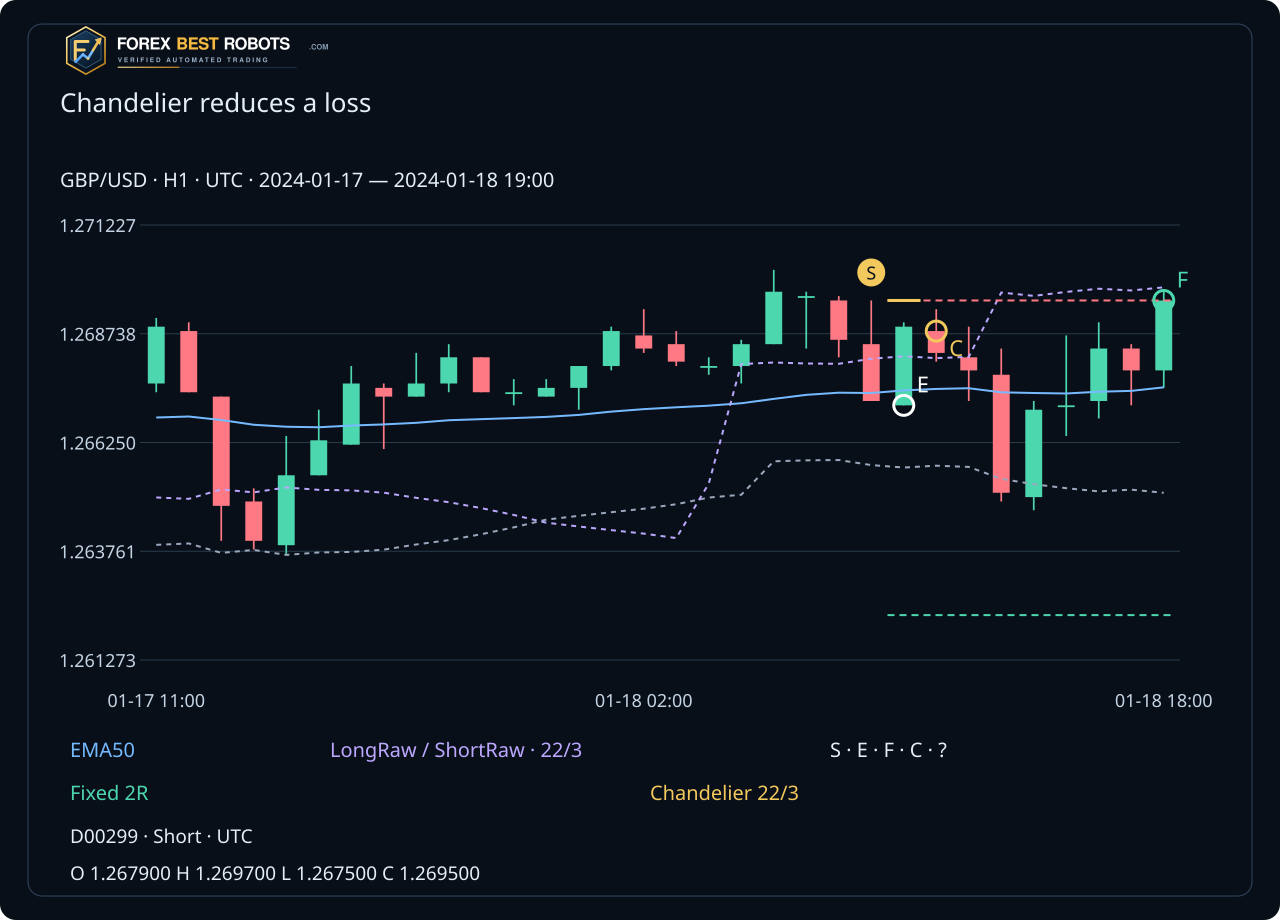
| D00299 | Exit model |
|---|---|
| Modeled entry | 2024-01-18 10:00 UTC · 1.267100 |
| Initial fixed stop | 1.269500 |
| 2R target | 1.262300 |
| Initial risk · pips | 24.00 |
| Fixed 2R · outcome / R | −1.08 |
| Chandelier · outcome / R | −0.79 |
Fixed 2R exits before the reversal
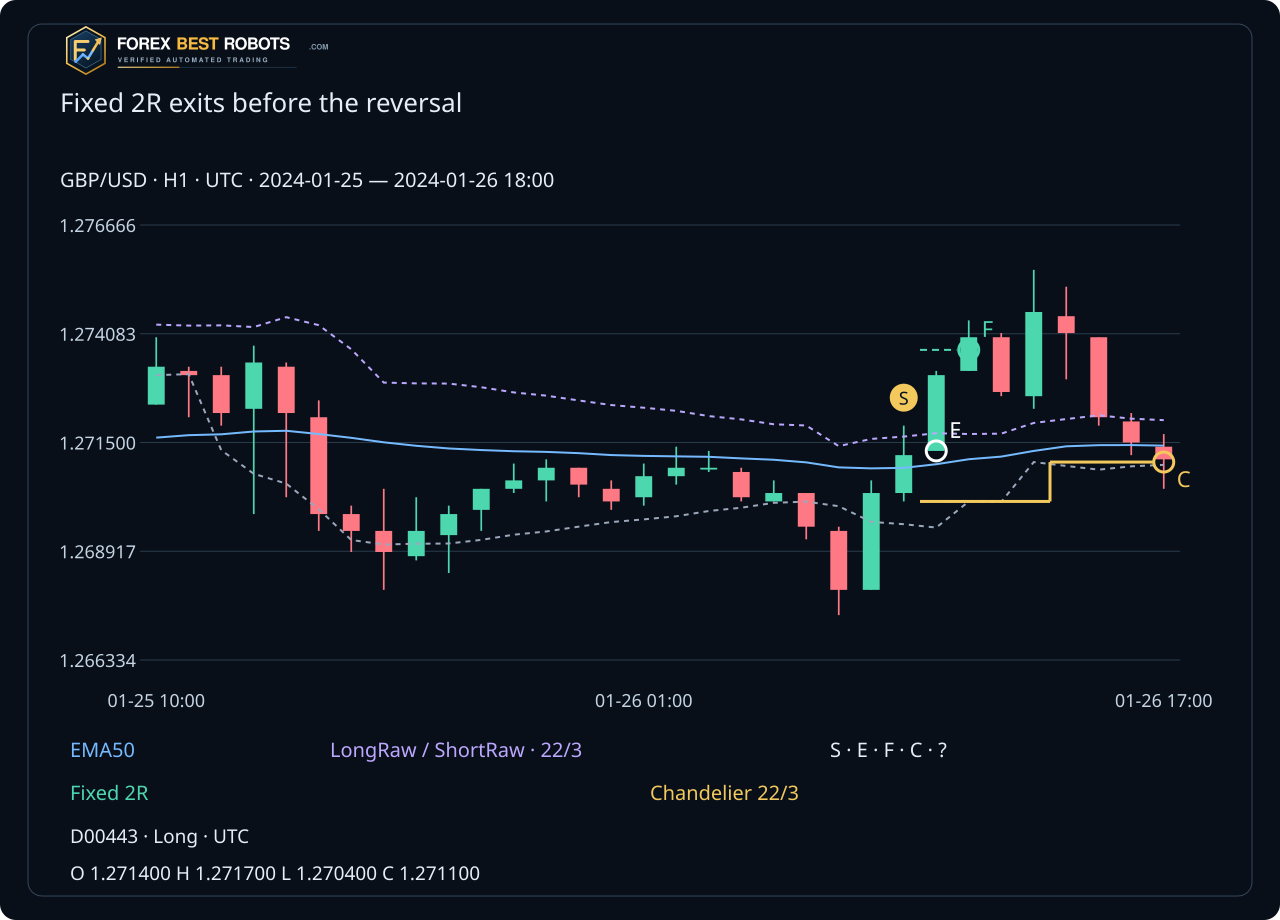
| D00443 | Exit model |
|---|---|
| Modeled entry | 2024-01-26 10:00 UTC · 1.271300 |
| Initial fixed stop | 1.270100 |
| 2R target | 1.273700 |
| Initial risk · pips | 12.00 |
| Fixed 2R · outcome / R | 1.83 |
| Chandelier · outcome / R | −0.39 |
A ratchet starts after the hour closes
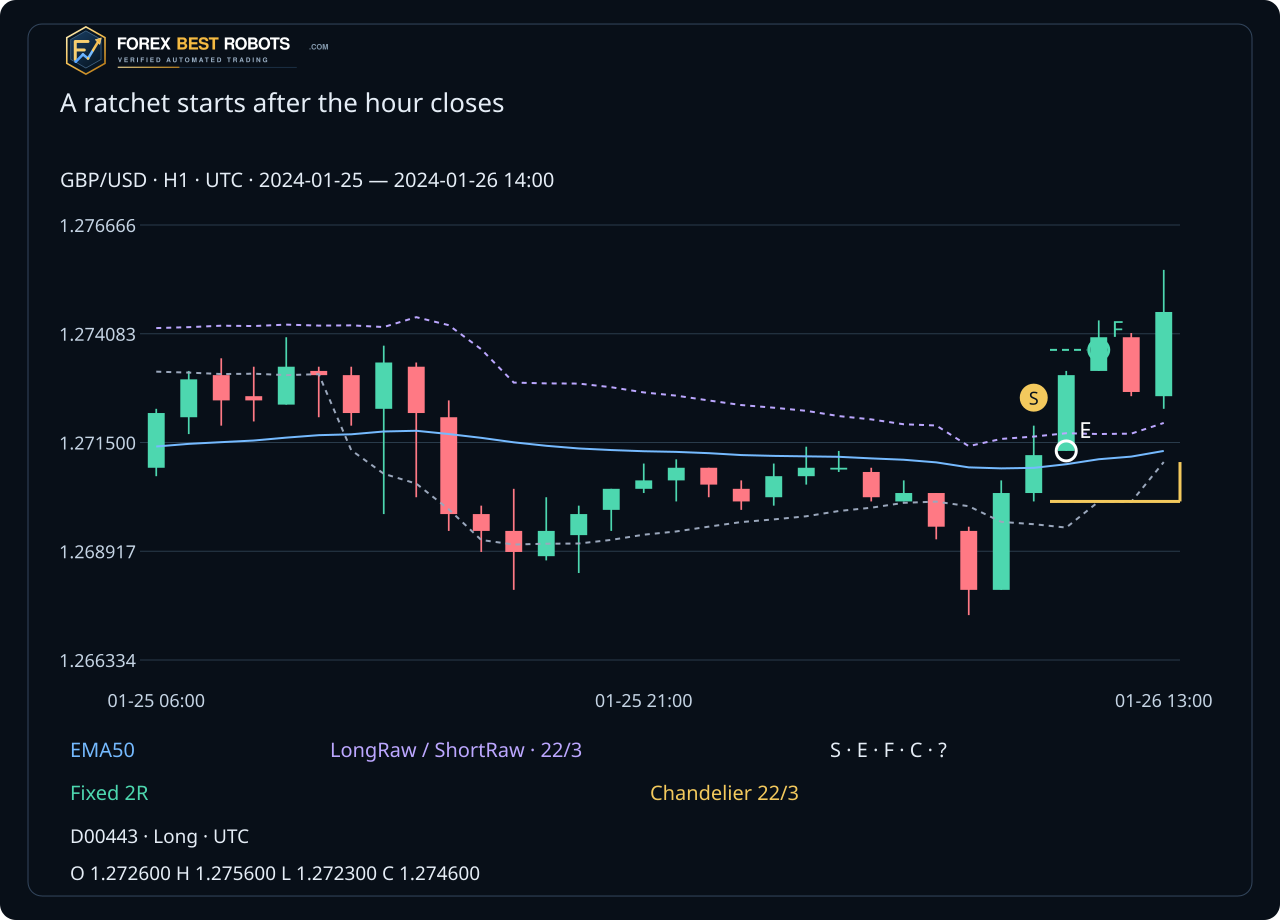
| D00443 | Exit model |
|---|---|
| Modeled entry | 2024-01-26 10:00 UTC · 1.271300 |
| Initial fixed stop | 1.270100 |
| 2R target | 1.273700 |
| Initial risk · pips | 12.00 |
| Fixed 2R · outcome / R | 1.83 |
| Chandelier · outcome / R | −0.39 |
Both paths meet a missing minute
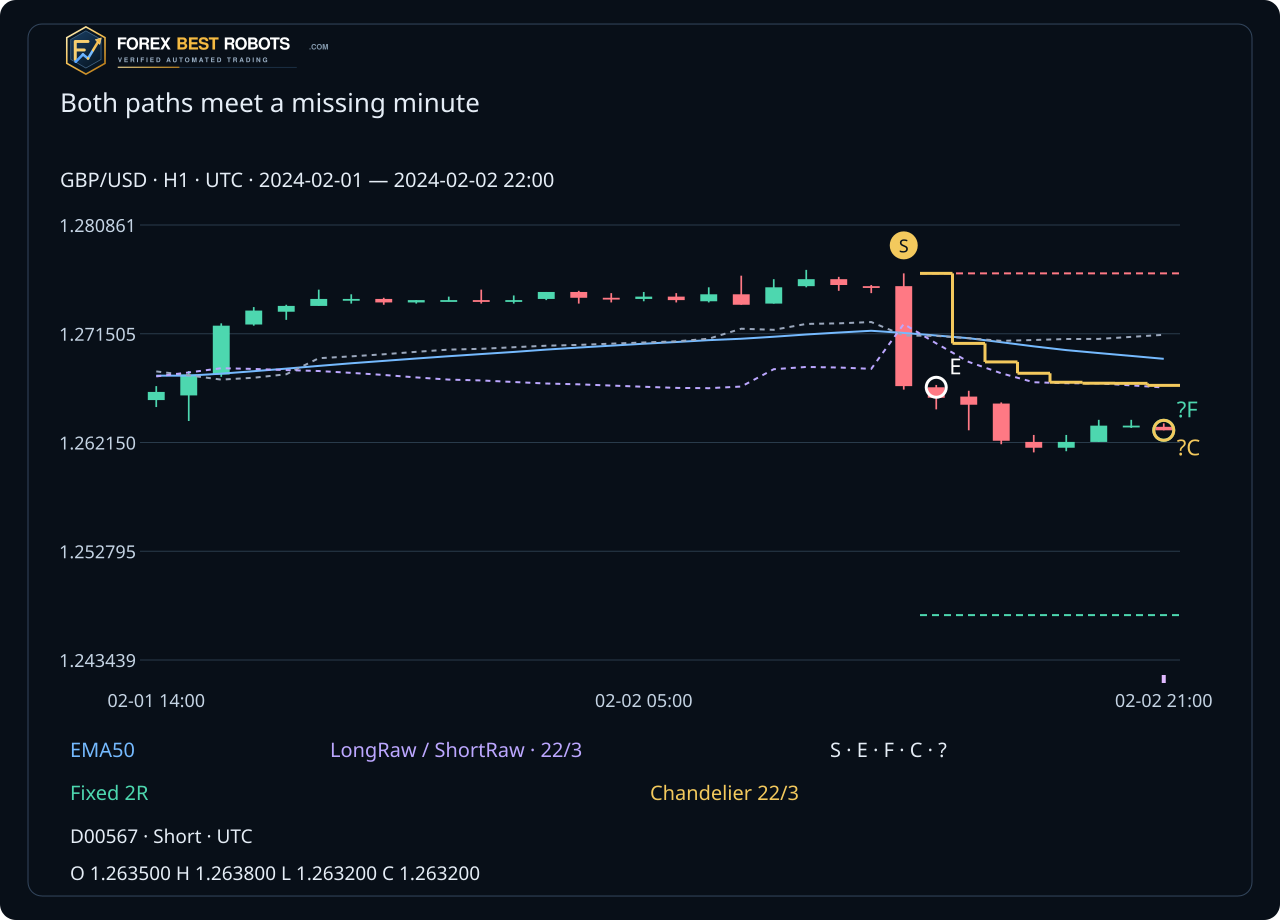
| D00567 | Exit model |
|---|---|
| Modeled entry | 2024-02-02 14:00 UTC · 1.266900 |
| Initial fixed stop | 1.276700 |
| 2R target | 1.247300 |
| Initial risk · pips | 98.00 |
| Fixed 2R · outcome / R | — |
| Chandelier · outcome / R | — |
9. Check the original quotes and study limits
All 61,972 retained GBP/USD minute rows were checked against all 60 original daily archive hashes. They form 1,033 recorded H1 groups: 1,025 complete and eight partial. The source labels its clock GMT+1; subtract one hour for UTC. Treating row timestamps as minute ends is a declared research convention, not a guaranteed source statement.
These are MetaStock Trade reference quotes, not executable Bid/Ask. Fractional stop calculations do not create finer source precision. Two separately authored implementations by the same assistant agree on indicators, the calendar and 56 arm paths; 42 hand-declared boundary scenarios also pass. This is not independent human review, native-platform certification or unseen forward validation.
| Entry month | Recorded H1 | Complete H1 | Partial H1 |
|---|---|---|---|
| 2024-01 | 530 | 526 | 4 |
| 2024-02 | 503 | 499 | 4 |
10. Move the cutoff through completed hours
The slider reveals completed H1 candles only. Before S closes, no selected-trade levels appear. Initial stop becomes known after S; entry, risk and 2R target wait until the first entry minute is observed. Each arm’s outcome appears only after its exit minute, or after the first missing interval becomes identifiable.
The values distinguish the stop incoming into the selected hour from the stop calculated at its close for the next minute. A newly calculated stop never applies to the earlier range of that same hour. The chart scale also excludes future prices and future levels.
Frequently asked questions
Is Chandelier 22/3 profitable here?
No. The 27 common known pairs sum to −17.52R at an assumed 2-pip cost, versus −14.33R with fixed 2R. One further pair remains unresolved.
Does Chandelier receive extra entries after an early exit?
No. Both exits use the same first daily EMA50 pullback calendar, with no replacement after rejection or exit.
Can the current hour’s Chandelier update stop out its earlier wick?
No. Replay the hour with its incoming stop first. An update calculated at its close affects the next minute only.
What if the proposed stop is beyond the closing price?
Schedule a modeled exit at the next expected minute Open. Do not assume a fill at the proposed raw level; a missing next minute makes the outcome unknown.
Why is the paired difference unchanged by costs?
Both arms share initial risk and the same total pip charge. The cost terms cancel in each paired difference, while both absolute returns still fall.