

Does Parabolic SAR help filter an inside-bar breakout? In this January–February 2024 USD/JPY H1 reference-price study, Base admits 82 paths and SAR keeps 52. At an assumed total cost of 2 pips, known-path sums are −5.55R and +2.20R; each arm still has two unresolved paths. February is negative with SAR. This short historical comparison does not establish an enduring edge or account return.
1. Define the mother candle and strict inside bar
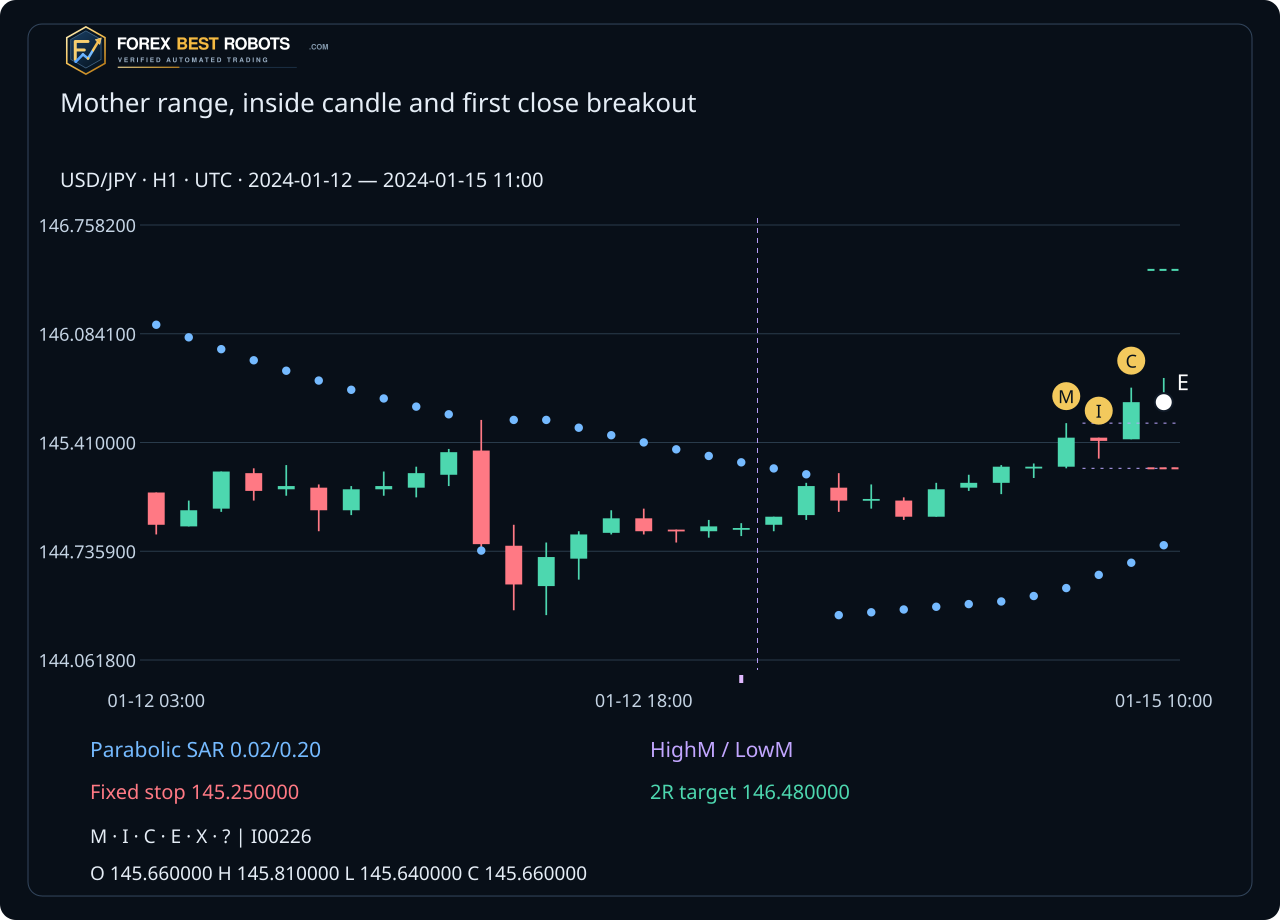
M is the immediately preceding H1 candle; I qualifies only when HighI<HighM and LowI>LowM. Equality at either boundary does not qualify. M and I must be complete adjacent clock hours. Freeze HighM and LowM when I closes. Consecutive nested inside bars can create separate candidates with different mothers; none is selected by its eventual result.
Start the calendar after 200 recorded H1 candles. Keep partial groups and missing-hour gaps in the indicator history, but cancel a setup when a required hour is missing or partial. No candles are manufactured. This is an explicitly defined close-based breakout, not a simulated stop order inside a candle.
2. Wait for the first close outside the frozen range
Search only the next six clock hours after I. C is the first completed candle with Close>HighM for a long or Close<LowM for a short. A wick through a boundary or an equal Close does not confirm. There is no requirement for a green or red candle body. Before C, even wicks through both sides do not cancel the range.
Missing or partial required hours and a change of month cancel before the price test. Expiry, a failed SAR gate, a missing first entry minute or invalid risk consume that first candidate. Do not choose a later breakout instead. Setup and entry stay in I’s month; an already admitted price path may continue across a month boundary.
3. Apply SAR only after the breakout hour closes
Use the guide’s declared SAR convention: start=step 0.02 and cap 0.20. Seed direction from the first two Closes; equality seeds down. Project from previous SAR, EP and AF, clamp to the previous two recorded Low/High values, then test a strict High/Low reversal. Equality does not reverse; an updated AF affects the next projection. Native terminal parity is not assumed.
At C Close, keep a long only when the new SAR state is up and CloseC>SARdotC; keep a short only when state is down and CloseC<SARdotC. Use the completed current dot, not the incoming projection. No flip, ADX, RSI or slope condition is added. Base ignores SAR; its path is retained even when SAR rejects it.
SAR_raw[t] = SAR[t−1] + AF[t−1] × (EP[t−1] − SAR[t−1])
AF_start = AF_step = 0.02; AF_max = 0.20
4. Fix the entry, stop, target and minute-path order
Entry is the first recorded minute Open assigned to the interval starting exactly at C’s end. If the row ending one minute later is absent, there is no entry and no jump to later quotes. The fixed stop is LowM for a long and HighM for a short. Admit initial risk from 5 to 200 pips inclusive; target is 2R and the maximum holding time is 24 clock hours.
Replay consecutive minutes with Open first. An adverse stop gap uses that Open; a favorable target gap is capped at the target. Otherwise an inclusive single touch exits at its level; both barriers touched in the same minute leave the order unknown. The first missing minute also leaves the result unknown. Without a barrier, use minute 1,440’s Close. Never turn an unknown result into zero.
5. Read every first decision, including rejections
The frozen calendar contains 109 strict inside-bar candidates after warmup; 82 reach a valid entry. The table lists each candidate’s first terminal decision, not all visually attractive breakouts. Rejected and expired patterns stay in the downloadable calendar.
SAR keeps 52 entries and rejects 30. All 30 rejected Base paths have known outcomes; their total at 2-pip cost is −7.76R, although nine are positive. The filter therefore removes winners as well as losers. These counts are a matched-path comparison, not a portfolio with one open position.
| First terminal decision | Candidates |
|---|---|
| Valid model entry | 82 |
| Incomplete or nonadjacent mother/inside pair | 2 |
| No close breakout within six hours | 14 |
| Required hour missing or partial | 9 |
| Setup crossed the month boundary | 2 |
6. Separate January, February and unresolved paths
January has 39 Base paths and 20 SAR paths, all known. Their sums at 2 pips are −4.69R and +4.55R. February has 43 Base paths, of which 41 are known, and 32 SAR paths, of which 30 are known. Both retain the same two unresolved paths; February’s known sums are −0.86R and −2.34R.
Combined known sums are −5.55R and +2.20R. The better combined SAR sum is driven by January and does not establish stable performance. Missing paths remain separate. The two months were already available historical data; February is not certified unseen validation or a live forward test.
| Entry month | Base path | Admitted | Known | Unresolved | Known-path sum · R |
|---|---|---|---|---|---|
| 2024-01 | Base | 39 | 39 | 0 | −4.69 |
| 2024-01 | With SAR | 20 | 20 | 0 | 4.55 |
| 2024-02 | Base | 43 | 41 | 2 | −0.86 |
| 2024-02 | With SAR | 32 | 30 | 2 | −2.34 |
| 2024-01 / 02 | Base | 82 | 80 | 2 | −5.55 |
| 2024-01 / 02 | With SAR | 52 | 50 | 2 | 2.20 |
Sums include known independent paths only. Unresolved outcomes are not zero.
7. Change costs without changing the candidate calendar
Subtract assumed total round-trip friction of 0, 1, 2, 3 or 5 pips once from each known path. Entries, thresholds, exits and the common candidate calendar do not change. With SAR, the combined known sum falls from +6.46R at zero cost to +2.20R at 2 pips and −4.18R at 5 pips.
One USD/JPY pip is 0.01 JPY per USD. A 2-pip charge costs 0.05R when initial risk is 40 pips. These are sensitivity scenarios, not measured spreads, swaps, financing or broker execution. Independent paths may overlap and oppose each other; summed R is not account profit, return or drawdown.
| Assumed total cost · pips | Base · R | With SAR · R |
|---|---|---|
| 0 | 1.21 | 6.46 |
| 1 | −2.17 | 4.33 |
| 2 | −5.55 | 2.20 |
| 3 | −8.94 | 0.08 |
| 5 | −15.71 | −4.18 |
R_net = R_gross − c_pips / r_pips
8. Inspect four views of three real events
The fixed retrospective selection takes the first known positive Base case at 2-pip cost, the first negative case, the first known SAR-rejected case and the first unresolved case. The negative and rejected views are the same event, I00203, shown for two different decisions. They are not four independent observations.
M marks the mother, I the inside candle, C the closed-hour breakout, E the model entry, X a known exit and ? the boundary where the path becomes unknown. The rejected-SAR chart shows Base’s counterfactual path only; SAR makes no trade and receives no profit or loss for that path.
M: mother candle · I: inside candle · C: close breakout · E: entry · X: exit · ?: unknown
Known positive path: fixed 2R target
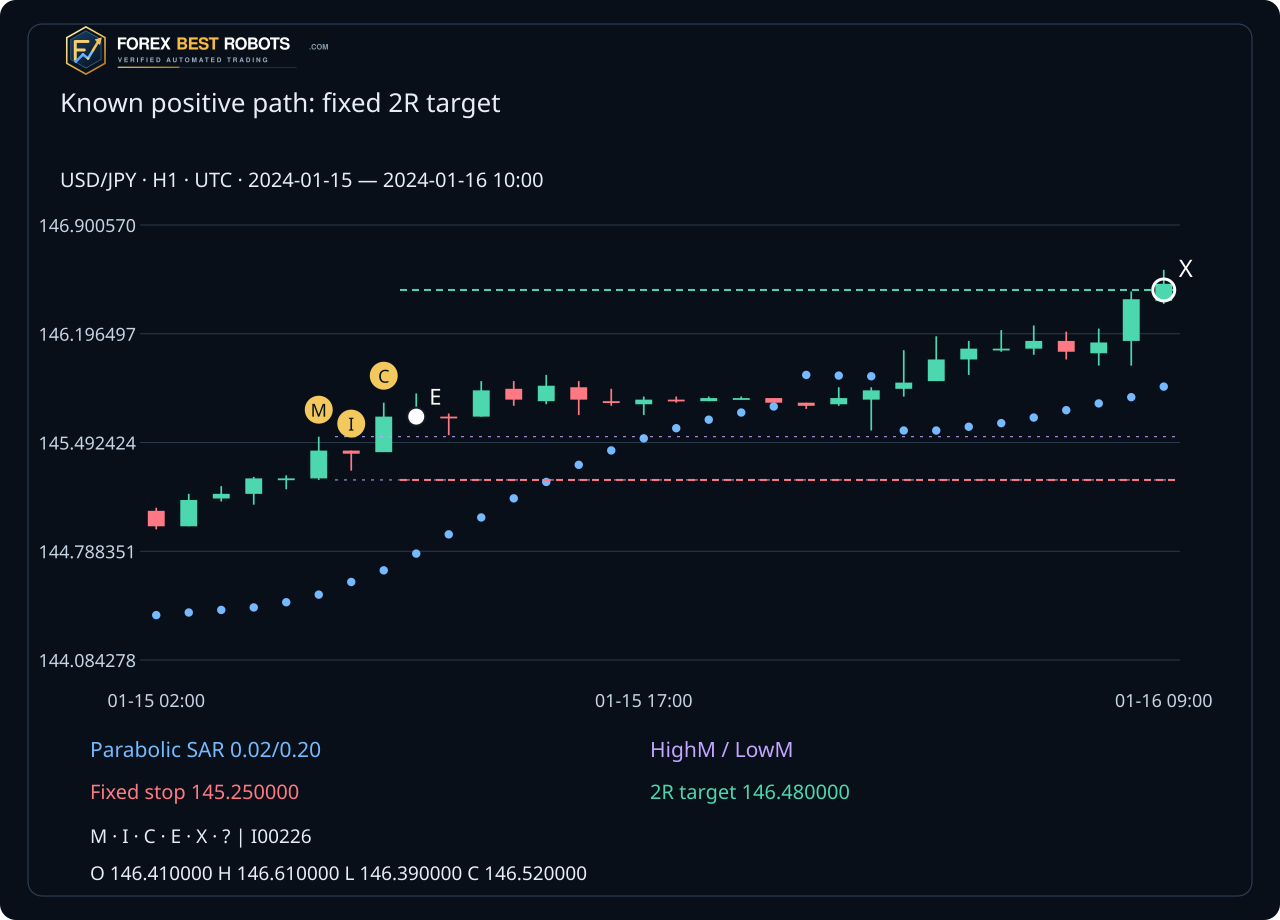
| I00226 | Base |
|---|---|
| Modeled entry | 2024-01-15 10:00 UTC · 145.660000 |
| Fixed stop | 145.250000 |
| 2R target | 146.480000 |
| Initial risk · pips | 41.00 |
| SAR decision | Kept |
| Base result at 2 pips · R | 1.95 |
Known negative Base path: fixed stop
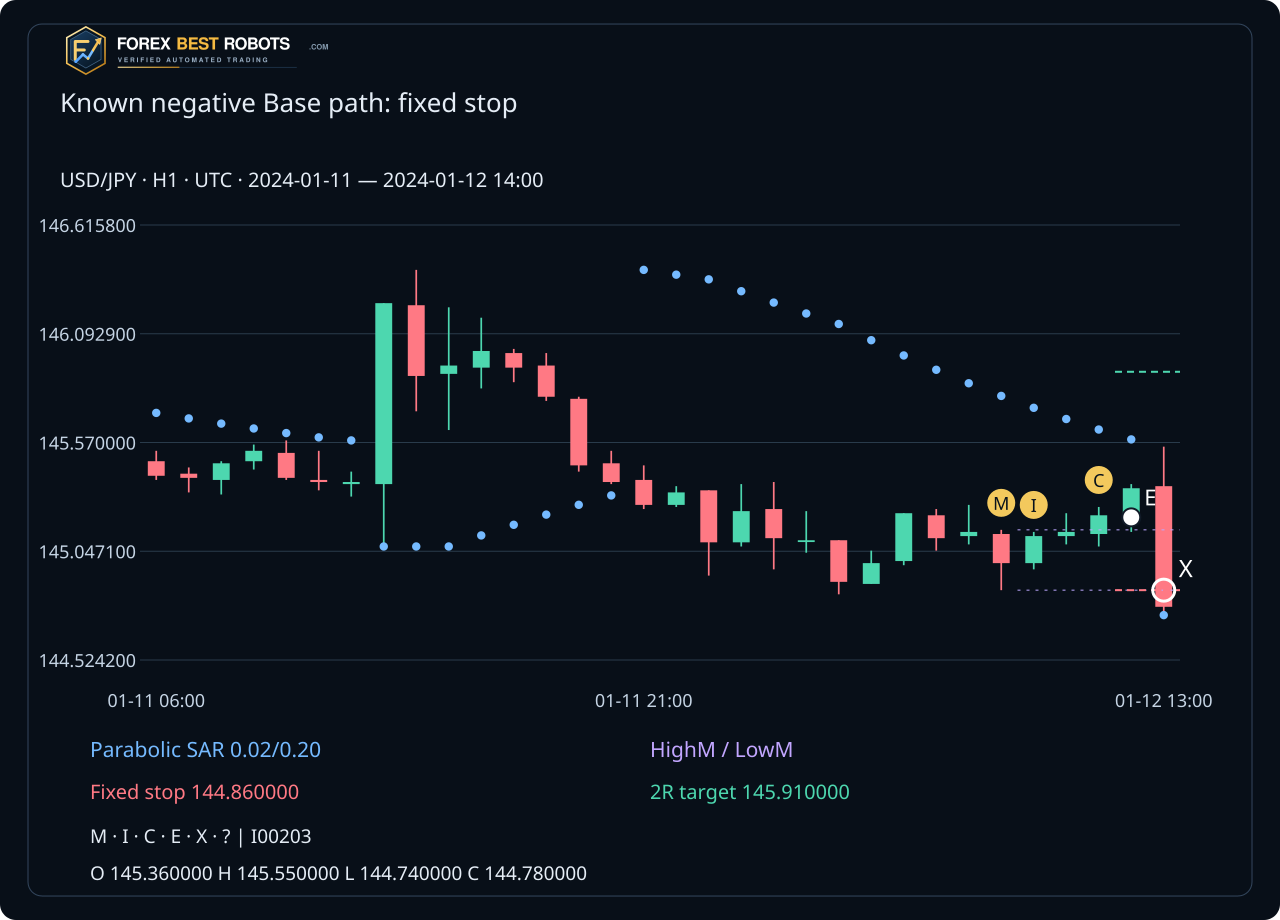
| I00203 | Base |
|---|---|
| Modeled entry | 2024-01-12 12:00 UTC · 145.210000 |
| Fixed stop | 144.860000 |
| 2R target | 145.910000 |
| Initial risk · pips | 35.00 |
| SAR decision | Rejected · no SAR entry |
| Base result at 2 pips · R | −1.06 |
Same negative event: SAR rejects the entry
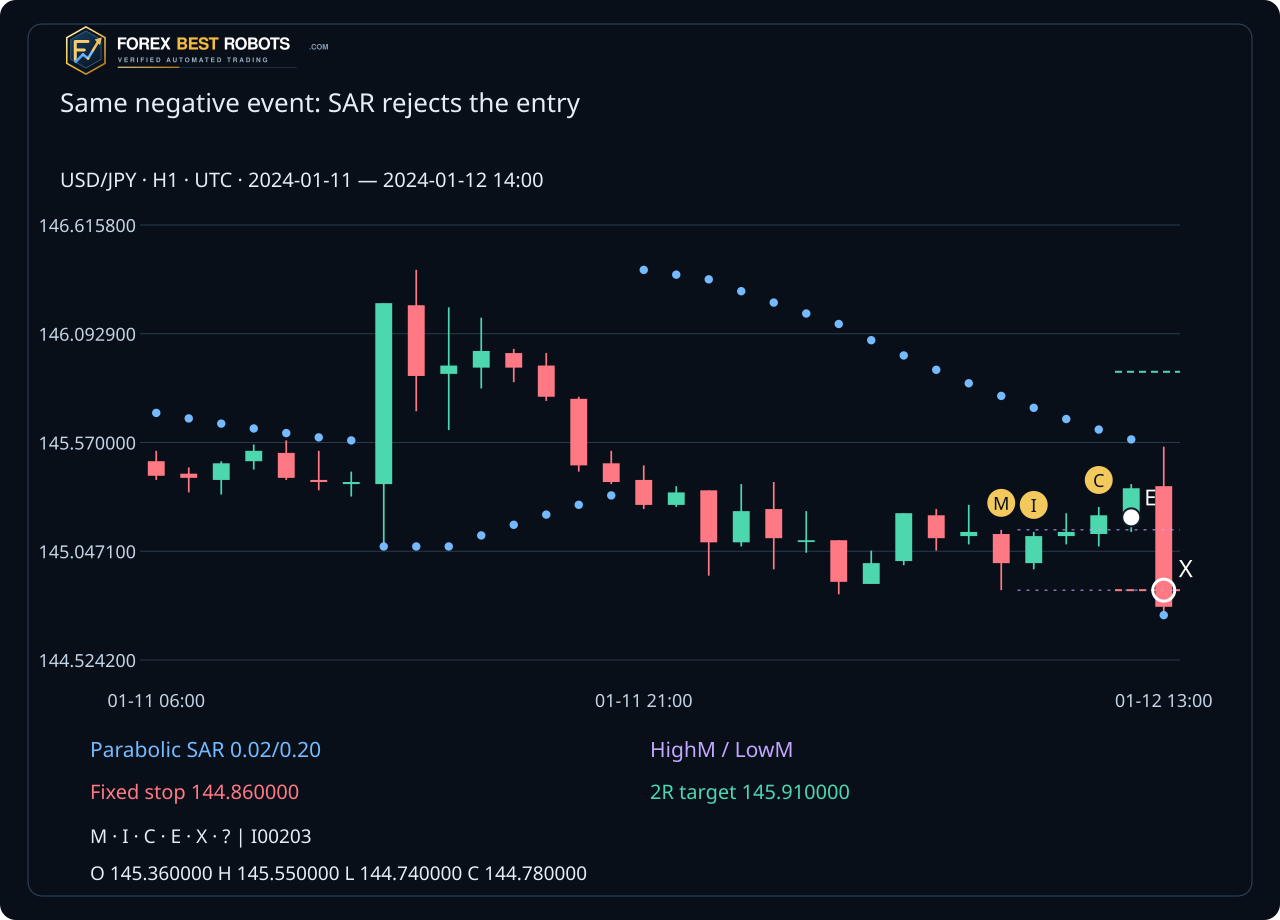
| I00203 | Base |
|---|---|
| Modeled entry | 2024-01-12 12:00 UTC · 145.210000 |
| Fixed stop | 144.860000 |
| 2R target | 145.910000 |
| Initial risk · pips | 35.00 |
| SAR decision | Rejected · no SAR entry |
| Base result at 2 pips · R | −1.06 |
Missing minute: result remains unknown
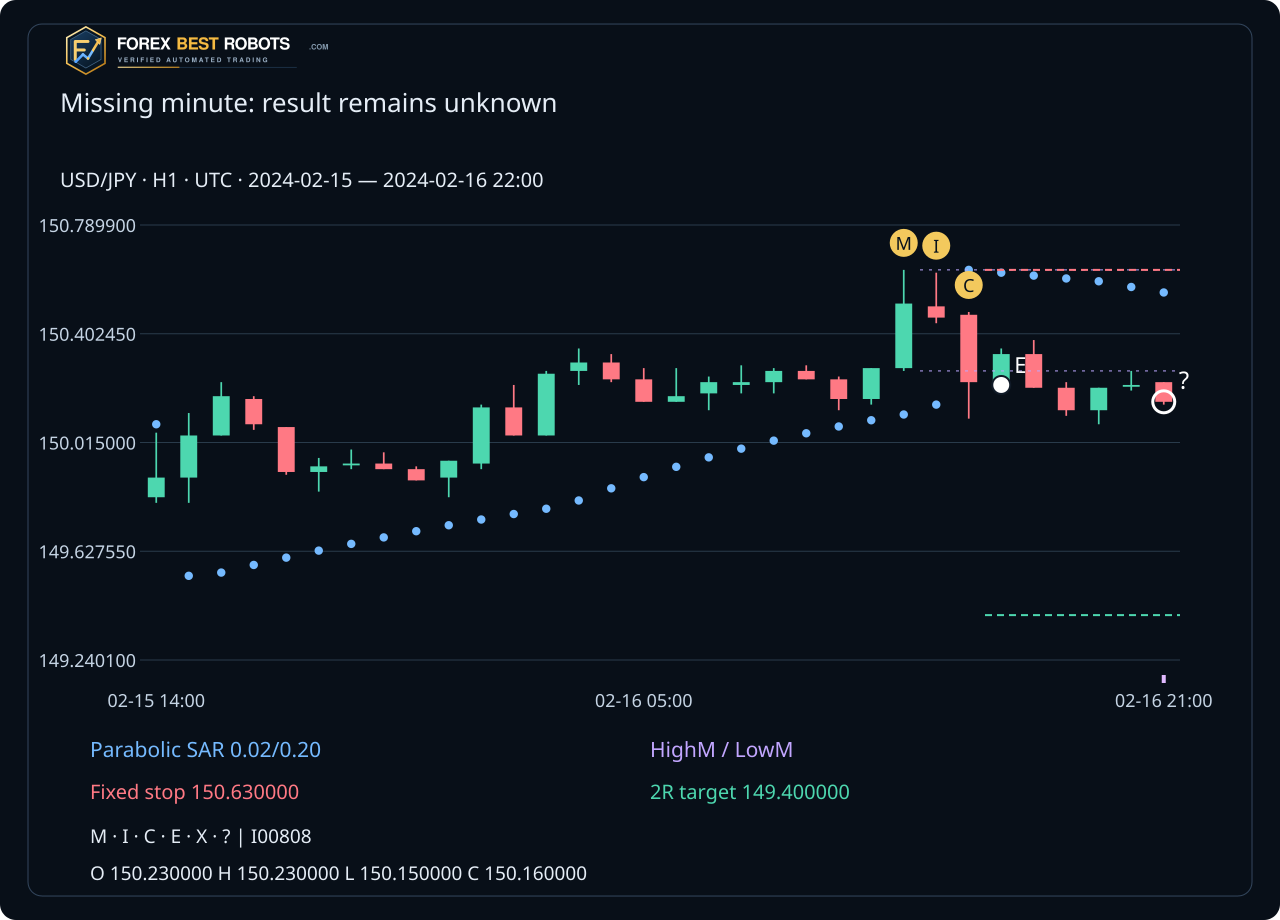
| I00808 | Base |
|---|---|
| Modeled entry | 2024-02-16 16:00 UTC · 150.220000 |
| Fixed stop | 150.630000 |
| 2R target | 149.400000 |
| Initial risk · pips | 41.00 |
| SAR decision | Kept |
| Base result at 2 pips · R | — |
9. Check source coverage and limits
All 61,972 retained USD/JPY minute rows from January–February 2024 were compared with all 60 original daily archives and their stored hashes. They produce 1,033 recorded H1 groups: 1,025 complete and eight partial. No missing hours are filled. The source’s two-decimal quotes do not gain precision because the calculations display six decimals.
Forexite labels are fixed GMT+1; subtract one hour to obtain UTC, without DST. Treating labels as minute ends is an explicit research assumption. MetaStock Trade OHLC is one reference stream, not executable Bid/Ask. The short winter sample covers neither all market regimes nor measured trading costs.
| Entry month | Recorded H1 | Complete H1 | Partial H1 |
|---|---|---|---|
| 2024-01 | 530 | 526 | 4 |
| 2024-02 | 503 | 499 | 4 |
10. Explore only completed historical hours
Choose a view and move through completed recorded hours. Candles, SAR dots, chart scale and event markers use information available by the selected hour’s end. Mother levels appear only after I is known; entry and terminal markers wait for the relevant minute information.
A separate implementation matched all 109 calendar decisions and 82 paths. Downloads retain every decision, admitted path, cost scenario and the frozen rules.
Frequently asked questions
Does the positive combined SAR sum prove profitability?
No. At 2-pip assumed cost the known sum is +2.20R, but February is −2.34R and two paths are unresolved. This short reference-price study does not establish a full-sample or account return.
Does an equal High or a wick count as an inside-bar breakout?
No. I must lie strictly inside M. The trigger then requires a completed Close strictly outside the frozen mother range within six clock hours; wick-only penetration and equality are insufficient.
Does SAR trail the stop or allow a replacement entry?
Neither. SAR is a gate checked only at the first C Close. Both models use the same fixed mother-based stop and 2R target. Rejection consumes that candidate.
Are missing paths counted as zero?
No. Their results remain unknown and are excluded from known-result sums. Stop/target order unknown within one minute is also unresolved; no favorable sequence is assumed.
Why do two illustrations show I00203?
The frozen selection picks the first negative and the first known SAR-rejected path. They happen to be the same event. The page states this explicitly and shows Base’s loss separately from the filtered model’s decision not to enter.