

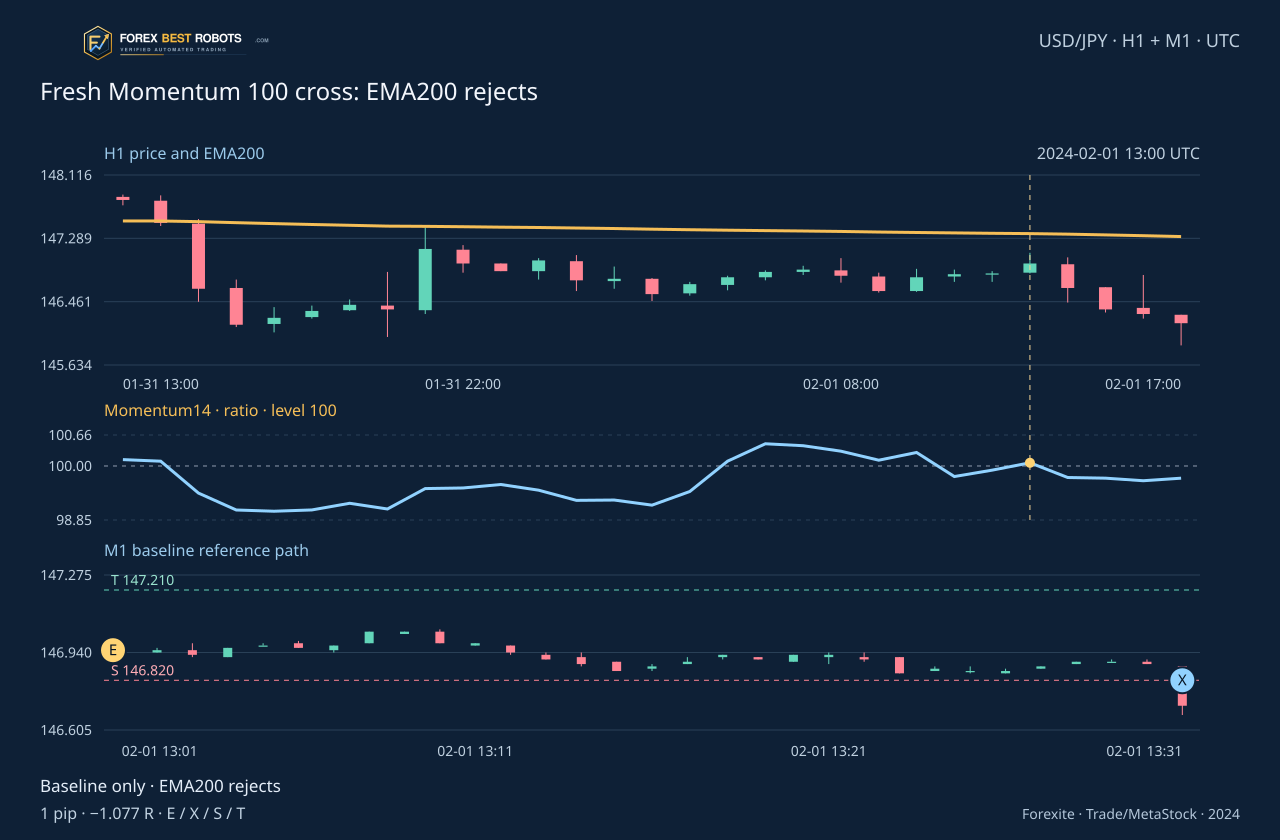
At a one-pip round-trip allowance, the EMA200 model has 66 resolved trades and +10.38R. The baseline has 96 entries, of which 95 resolve for +6.80R and one remains unknown because a required minute is missing. The baseline figure is therefore a resolved subset, not a complete result for all entries. These are retrospective quote-based results, not an account return or a promise.
1. Define Momentum14 and the EMA200 condition
Momentum14[t] = 100 × Close[t] / Close[t−14], using recorded H1 bars. It first exists on bar 15; a crossing needs the previous reading as well. Momentum 100.1 means +0.1% ROC, not +100.1%. A nonpositive denominator makes the reading unavailable. EMA200 starts at the mean of the first 200 recorded closes, then E[t] = (2 × Close[t] + 199 × E[t−1]) / 201. Earlier EMA values remain unavailable; history is retained across gaps.
This is a long-only comparison. The baseline uses the fresh cross after common checks; the filtered model adds only Close[t] > EMA200[t]. Equality rejects. There is no EMA-slope or extra Momentum-rise condition. Both indicators use closing prices; they are not independent evidence.
2. Reserve a fresh upward 100 cross
Let M be Momentum14. Require M[t−1] ≤ 100 and M[t] > 100 without rounding. A prior 100 is allowed; a current 100 touch or a continuing reading above 100 is insufficient. Each UTC date reserves the earliest observed cross on a candle ending from 07:00 through 17:00 inclusive, before data, risk or EMA checks. A rejected first event cannot be replaced later that date.
Bars t, t−1, t−14 and t−15 must contain all 60 minutes. Only t and t−1 must be adjacent clock hours. Other partial bars remain in history. The lag counts 14 recorded bars across gaps or weekends; it need not span 14 clock hours. The explorer reports both lag spans. The immediate entry minute must exist. All 335 evaluation dates remain visible; missing history may conceal events.
M[t−1] ≤ 100; M[t] > 100
3. Set entry, stop, target and exit priority
Use the immediate next minute’s Open as the reference entry. Stop = signal Low − 0.01, one JPY pip. Initial risk must be 5–50 pips inclusive without rounding; target = entry + twice that risk. Exit by signal end + four clock hours, no later than 21:00 UTC. Fixed size; no trailing, scaling or overnight extension.
Process each required minute in order. Missing data makes the outcome unknown immediately. Open at/below Stop exits at that adverse Open; Open at/above Target exits at Target without a favorable gap bonus. Otherwise, a sole touched level determines the exit; both levels in the same minute leave ordering ambiguous. Level checks precede the deadline minute’s Close. E/X markers identify minute intervals, not verified tick-level fills or historical Bid/Ask execution.
4. Compare costs, coverage and every month
Across 335 dates there are 170 observed upward crosses and 123 reserved candidates; 212 dates have no observed candidate. Common checks reject 27 candidates: 22 have an invalid stop distance and five have incomplete ratio-input bars. A candidate can have more than one incomplete-bar reason. The baseline enters 96 times. EMA200 rejects 30 otherwise eligible entries and retains 66, all resolved. The outcome of one baseline entry, on 2024-12-02, becomes unknown at the missing minute ending 10:58 UTC; it was rejected by EMA200. No entered path has ambiguous ordering.
At one pip, the 95 resolved baseline trades total +6.80R / +227 pips, with 8.74R drawdown and 1.169 net-R profit factor. The 66 filtered trades total +10.38R / +213 pips, with 7.36R drawdown and 1.392 profit factor. The unresolved baseline trade is excluded from all performance metrics, including drawdown and positive-outcome percentage. Its missing return is not zero; the full baseline result and cumulative-R path remain undetermined.
At two pips, the resolved baseline subset falls to +0.03R and EMA200 to +5.14R. The filtered result is positive in this sample, with fewer trades and lower cumulative-R drawdown, but this does not establish an advantage in future data. Pip totals and R totals weight trades differently: each trade’s net pips are divided by its own initial risk for R. Neither is compounded account performance. All February–December months are reported.
Statistics use resolved trades only. Ambiguous and missing outcomes remain separate; drawdown is in cumulative R, not account percent.
| Model | Allowance · pip | Resolved / entered | Ambiguous / unknown | Positive / zero / negative | Positive outcomes · % | Net total · R | Net total · pips | Maximum drawdown · R | Profit factor · R |
|---|---|---|---|---|---|---|---|---|---|
| Without EMA filter | 0 | 95 / 96 | 0 / 1 | 51 / 0 / 44 | 53.68 | +13.57 | +322 | 6.87 | 1.368 |
| Without EMA filter | 1 | 95 / 96 | 0 / 1 | 47 / 4 / 44 | 49.47 | +6.80 | +227 | 8.74 | 1.169 |
| Without EMA filter | 2 | 95 / 96 | 0 / 1 | 45 / 2 / 48 | 47.37 | +0.03 | +132 | 10.61 | 1.001 |
| With EMA200 filter | 0 | 66 / 66 | 0 / 0 | 39 / 0 / 27 | 59.09 | +15.62 | +279 | 5.70 | 1.648 |
| With EMA200 filter | 1 | 66 / 66 | 0 / 0 | 36 / 3 / 27 | 54.55 | +10.38 | +213 | 7.36 | 1.392 |
| With EMA200 filter | 2 | 66 / 66 | 0 / 0 | 35 / 1 / 30 | 53.03 | +5.14 | +147 | 9.03 | 1.177 |
Every evaluation month · 1-pip allowance
| Month · UTC | Model | Resolved / entered | Ambiguous / unknown | Net total · R | Maximum drawdown · R |
|---|---|---|---|---|---|
| 2024-02 | Without EMA filter | 11 / 11 | 0 / 0 | −4.26 | 5.09 |
| 2024-02 | With EMA200 filter | 9 / 9 | 0 / 0 | −3.22 | 4.01 |
| 2024-03 | Without EMA filter | 6 / 6 | 0 / 0 | −2.94 | 2.94 |
| 2024-03 | With EMA200 filter | 4 / 4 | 0 / 0 | −2.60 | 2.60 |
| 2024-04 | Without EMA filter | 10 / 10 | 0 / 0 | +1.60 | 3.38 |
| 2024-04 | With EMA200 filter | 10 / 10 | 0 / 0 | +1.60 | 3.38 |
| 2024-05 | Without EMA filter | 8 / 8 | 0 / 0 | +3.48 | 1.17 |
| 2024-05 | With EMA200 filter | 7 / 7 | 0 / 0 | +4.52 | 1.17 |
| 2024-06 | Without EMA filter | 10 / 10 | 0 / 0 | +0.89 | 3.42 |
| 2024-06 | With EMA200 filter | 9 / 9 | 0 / 0 | +1.93 | 2.38 |
| 2024-07 | Without EMA filter | 6 / 6 | 0 / 0 | −0.34 | 1.35 |
| 2024-07 | With EMA200 filter | 1 / 1 | 0 / 0 | +0.92 | 0.00 |
| 2024-08 | Without EMA filter | 11 / 11 | 0 / 0 | +2.19 | 3.33 |
| 2024-08 | With EMA200 filter | 1 / 1 | 0 / 0 | +1.86 | 0.00 |
| 2024-09 | Without EMA filter | 7 / 7 | 0 / 0 | −0.35 | 2.36 |
| 2024-09 | With EMA200 filter | 4 / 4 | 0 / 0 | +0.62 | 1.03 |
| 2024-10 | Without EMA filter | 10 / 10 | 0 / 0 | −0.40 | 2.18 |
| 2024-10 | With EMA200 filter | 10 / 10 | 0 / 0 | −0.40 | 2.18 |
| 2024-11 | Without EMA filter | 9 / 9 | 0 / 0 | +6.36 | 1.35 |
| 2024-11 | With EMA200 filter | 4 / 4 | 0 / 0 | +4.58 | 0.00 |
| 2024-12 | Without EMA filter | 7 / 8 | 0 / 1 | +0.57 | 2.13 |
| 2024-12 | With EMA200 filter | 7 / 7 | 0 / 0 | +0.57 | 2.13 |
5. Read three chronological examples
The frozen selection is chronological: first resolved baseline entry, first different resolved entry admitted by EMA200, then first different resolved baseline entry rejected by EMA200. Profit does not select the examples. Later candles are retrospective context unavailable at the signal.
E: reference entry; X: exit minute; S: stop; T: target. UTC; JPY per USD. X locates an interval, not a verified tick-level fill.
First baseline entry: EMA200 rejects
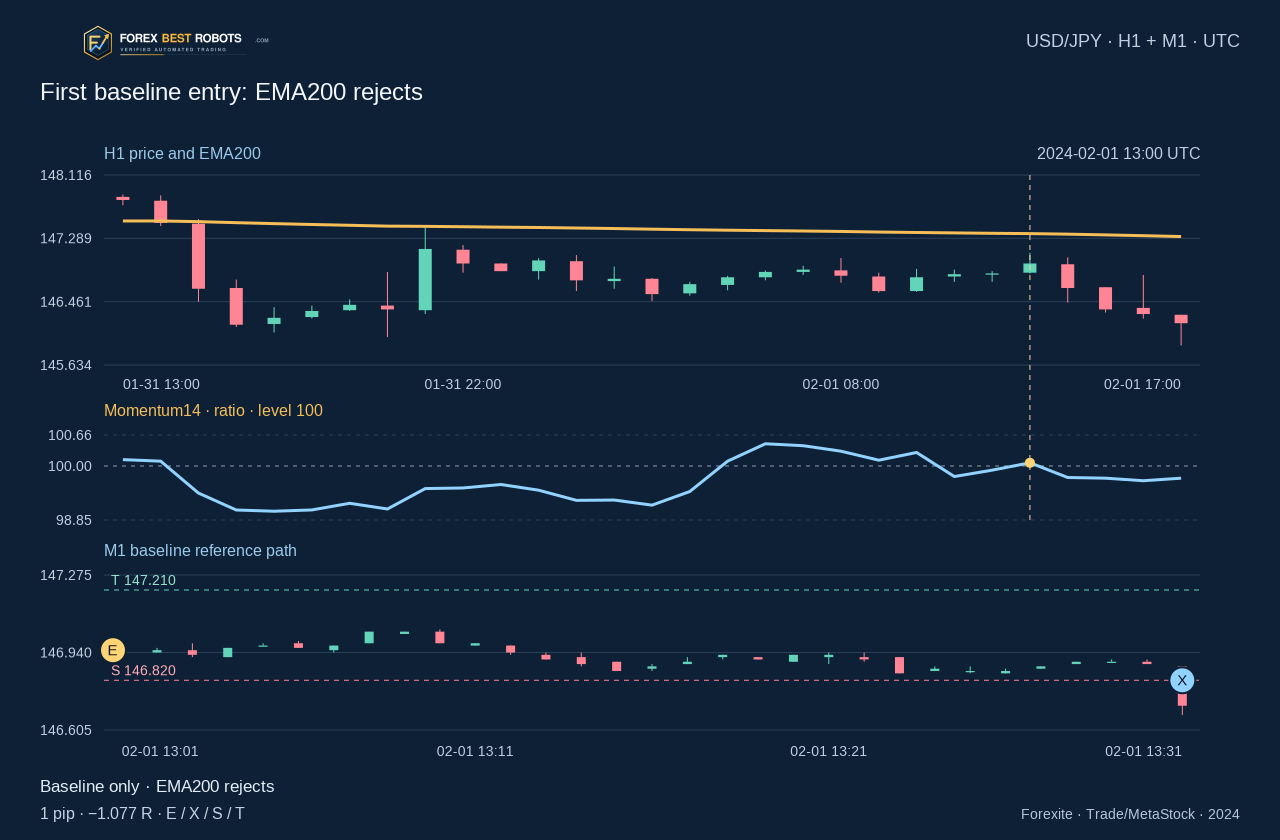
Signal end · UTC: 2024-02-01T13:00:00Z; Initial stop distance · pip: 13.00; Reference trade at the 1-pip allowance: −1.077 R; EMA200 condition: Reject
First different EMA200 entry: a weekend-spanning lag
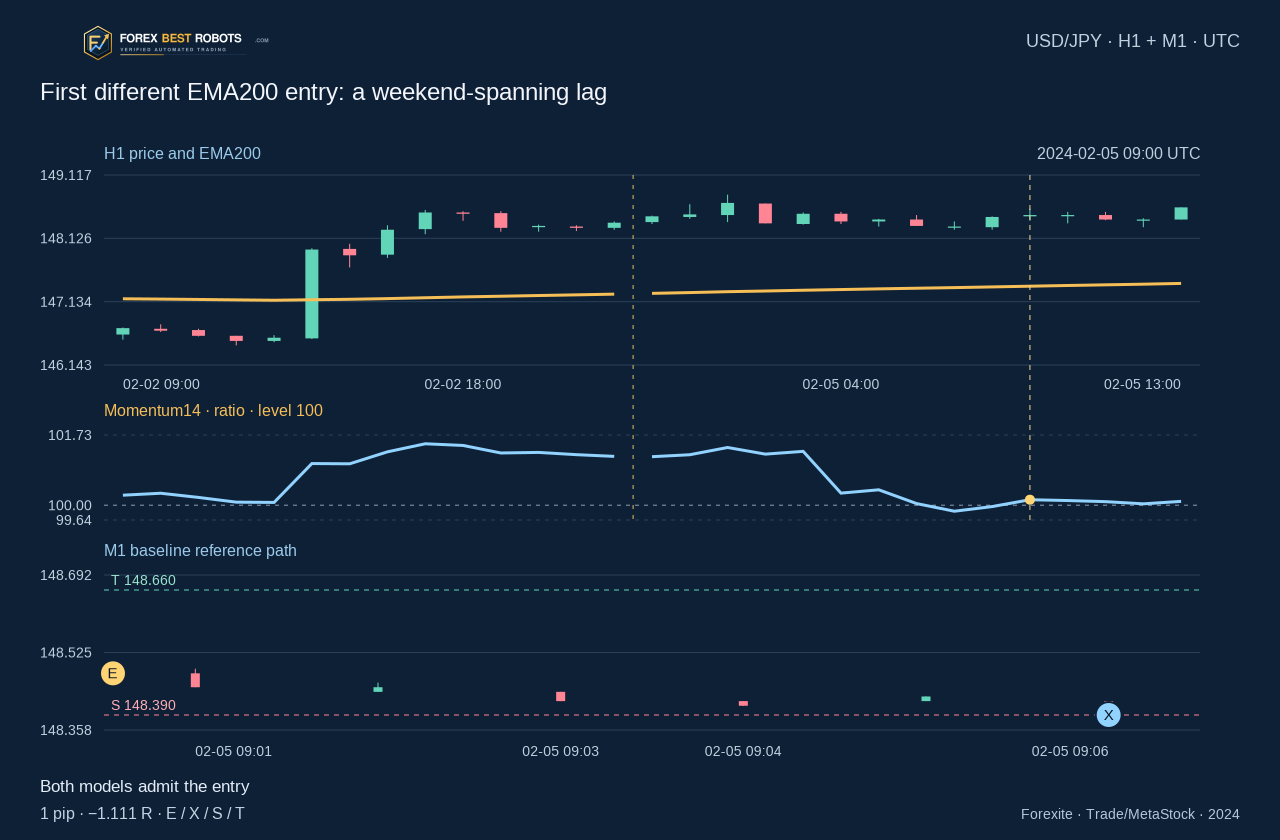
Signal end · UTC: 2024-02-05T09:00:00Z; Initial stop distance · pip: 9.00; Reference trade at the 1-pip allowance: −1.111 R; EMA200 condition: Pass
First different rejection: the four-hour deadline
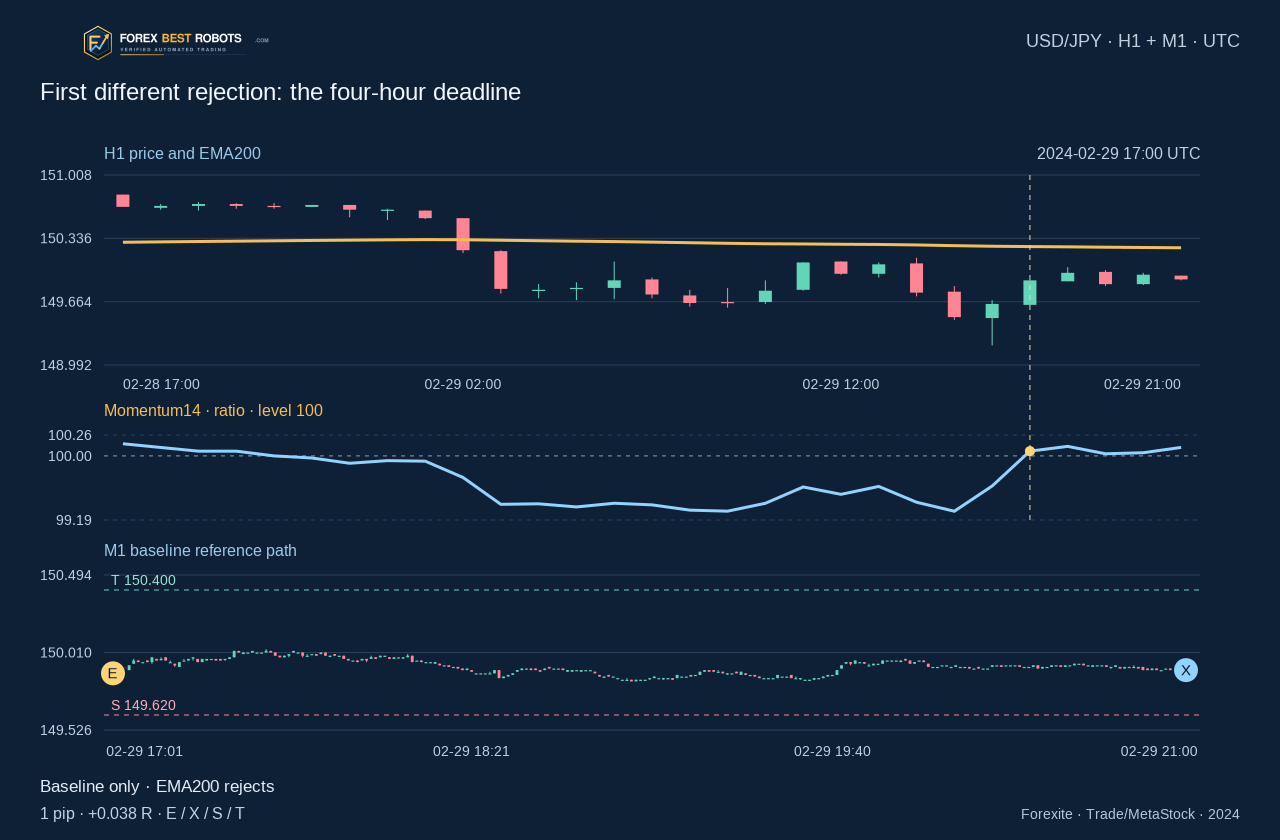
Signal end · UTC: 2024-02-29T17:00:00Z; Initial stop distance · pip: 26.00; Reference trade at the 1-pip allowance: +0.038 R; EMA200 condition: Reject
6. Inspect dates, lagged closes and execution
Choose any date and a 0, 1 or 2-pip round-trip allowance. Costs change resolved net returns, never levels or outcome status. The slider inspects recorded H1 prices, EMA200, lagged Close, Momentum14 and ROC without changing the reserved event. Inspect 2024-12-02 to see the real missing-minute outcome and unavailable return; 2024-02-05 illustrates the 62-hour lag.
Loading historical candidates…
The slider inspects recorded candles. The reserved event and reference execution remain fixed.
- Inspected candle end · UTC
- —
- OHLC · JPY / USD
- —
- EMA200 · JPY / USD
- —
- Close[t−14] · JPY / USD
- —
- Momentum14 · ratio
- —
- ROC14 · %
- —
- Signal end · UTC
- —
- Momentum14 t−1 / t · ratio
- —
- 14-bar lag spans t−1 / t · hours
- —
- Signal Close / EMA200 · JPY / USD
- —
- Close-above-EMA200 filter
- —
- Baseline model
- —
- EMA200 model
- —
- Reference entry · JPY per USD
- —
- S · stop
- —
- T · target
- —
- Initial stop distance · pip
- —
- Common data and risk checks
- —
- Full indicator history · gaps / partial hours
- —
- Baseline outcome status
- —
- Reference exit reason
- —
- Reference exit price · JPY per USD
- —
- Reference exit / first missing interval · UTC
- —
- Baseline gross result · R
- —
- Baseline result after allowance · R
- —
- EMA200 trade result after allowance · R
- —
7. Understand the limits of this test
One allowance combines spread, commission and slippage and is deducted once. These are fixed scenarios, not measured Bid/Ask costs; financing is not modeled. R is initial price-distance risk, not an account percentage. A missing-minute or ambiguous path receives no invented return. The baseline’s one unknown outcome also makes its complete cumulative performance unavailable.
This retrospective long-only USD/JPY test reuses 2024 archives from earlier research; January USD/JPY was already viewed for the Momentum guide. The full protocol was saved before this replay and was not tuned afterward. This is not an untouched holdout, live performance or native-MT4 certification. Feed, time boundaries, initialization and execution assumptions may change outcomes.
Frequently asked questions
Why is the threshold 100 rather than zero?
This Momentum is a price ratio multiplied by 100. Equal current and lagged closes give 100. Subtract 100 to obtain percentage ROC; a price-difference oscillator would be another indicator.
Does 14 mean exactly 14 clock hours?
No. It means 14 recorded H1 bars. In the 2024-02-05 example both lags span 62 clock hours. Gaps are not filled. Current and previous bars must be adjacent and all four ratio-input bars complete.
What does EMA200 add?
Only Close[t] > EMA200[t]. Equality or an unavailable EMA rejects the filtered model. There is no slope condition. Only long entries are tested.
Did the filter improve this sample?
At one pip, its 66 resolved trades give +10.38R and lower cumulative-R drawdown. The baseline’s 95 resolved trades give +6.80R, but the outcome of one of its 96 entries remains unknown. The complete baseline result is unavailable, and this retrospective comparison does not prove future profitability.
What happened to the unknown trade?
The 2024-12-02 baseline path lacks the minute ending 10:58 UTC. Processing stops there and the return remains unavailable. EMA200 had rejected that entry. Later prices cannot repair the missing execution history.
Why not use another cross after rejection?
The first observed event reserves the date before completeness, risk or EMA200 checks. Replacing it with a later favorable event would change the declared experiment.
Data, frozen protocol and reproducible checks
The source retains 366 original Forexite Trade/MetaStock daily ZIPs for 2024 with hashes and URLs. Provider copies were checked in V279; this study verifies every retained original again and parses USD/JPY separately. Its 375 702 minutes produce 6,265 H1 bars: 6,178 complete, 87 partial and 52 gaps between recorded hours. Fixed GMT+1 labels are shifted back one hour to UTC. Minute-end labels and H1 (start,end] groups are explicit reconstruction assumptions; no gaps are filled.
January supplies indicator history; evaluation covers every UTC date from 2024-02-01 through 2024-12-31. Downloads include the full protocol, original archives, indicators, calendar and cost ledgers. A separate raw-byte parser, exact-rational EMA200/Momentum calculations and risk-normalized replay matched all decisions and statistics; 54 boundary fixtures passed. Both implementations, translations and reviews were produced by the same assistant, without independent-human, native-speaker or native-terminal certification.