

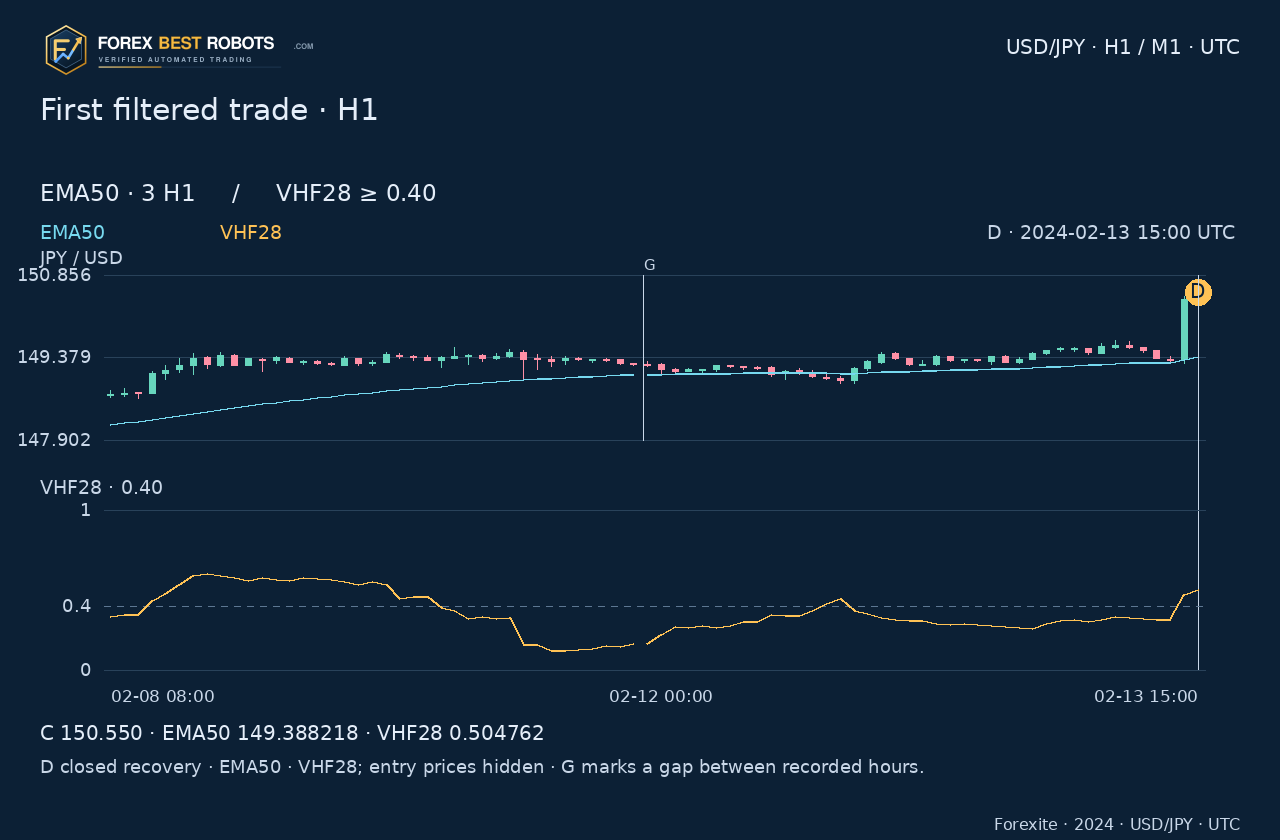
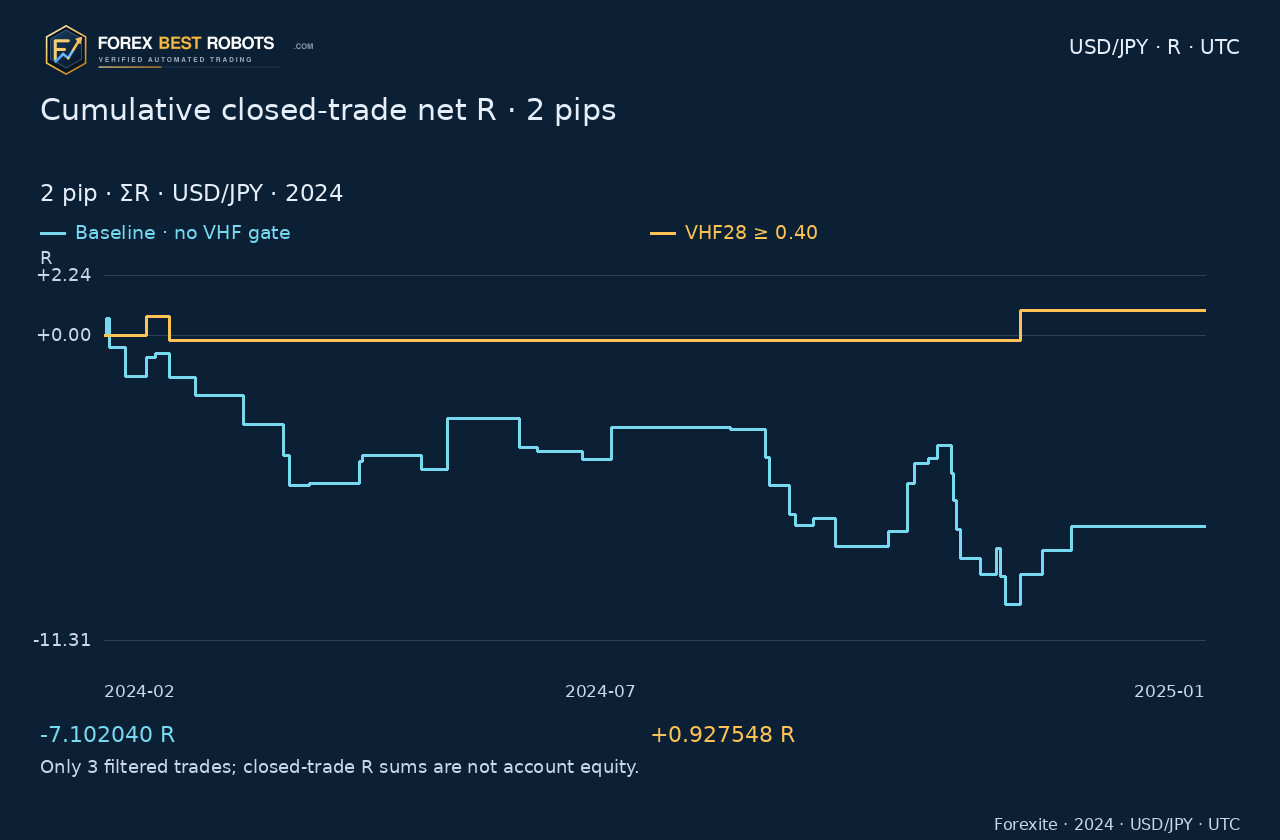
Price and EMA50 define a three-bar pullback; VHF28 only filters its trend context. This fixed USD/JPY H1 experiment retains 3 of 42 baseline trades. At 2 pips per round trip the totals are +0.93 R and -7.10 R. Three retained trades are too few to establish an edge. These normalized sums use reused 2024 quotes and are not account returns.
1. Read the result and its coverage together
The baseline has 42 entries, -7.10 R and 10.62 R closed-trade drawdown at 2 pips. VHF retains 3 entries, +0.93 R and 0.91 R drawdown. Neither model includes a conditional held-gap valuation in this replay.
The filtered sum is positive, but it rests on two net winners and one net loser. This is a description of three observations, not evidence that the filter reliably improves performance. The first rejected baseline trade is itself a winner; inspect the complete record rather than one appealing example.
| Fixed model | Trades | Total net · R | Maximum drawdown · R | Profit factor · net R | Flagged next-open valuation |
|---|---|---|---|---|---|
| Baseline · no VHF gate | 42 | -7.10 | 10.62 | 0.66 | 0 |
| VHF28 ≥ 0.40 | 3 | +0.93 | 0.91 | 2.02 | 0 |
Only 3 filtered trades; closed-trade R sums are not account equity.
2. Define the pullback before applying VHF
Initialize from retained January H1 data, then inspect February–December 2024. The three-bar pattern is a declared research rule. “First daily” means the first completed pattern in the UTC session, not the first pullback of an entire trend.
- VHF28 divides the range of the latest 28 closes by 28 absolute close changes, reaching one close further back. A zero denominator is unavailable; zero range with a positive denominator is a valid zero. EMA50 starts with the mean of the first 50 closes, then (49 × previous EMA + 2 × close)/51. ATR14 starts with the first 14 True Ranges and continues with Wilder smoothing. No daily reset or invented missing bar is used.
- Inspect completed H1 endpoints 07:00–15:00 UTC inclusive, Monday–Friday, without a seasonal shift. The first numerical three-bar candidate consumes its date before quality, ATR, risk, VHF, exact-opening or position checks.
- Long: at t−2, close > EMA50 and EMA50[t−2] > EMA50[t−3]; at t−1, low ≤ EMA50; at t, close > EMA50 and close > high[t−1]. Short mirrors every inequality: prior close below a falling EMA, pullback high ≥ EMA, then close below EMA and the prior low. The touch is inclusive; all direction, slope and recovery comparisons are strict. The pullback close need not lie on a prescribed side.
- All 29 recorded H1 bars t−28 through t must be complete and adjacent at one-hour intervals. This covers VHF and its earlier anchor. It does not make the older recursive EMA/ATR history complete; every retained bar still advances those states.
- Round 1.5 × signal ATR14 upward to a multiple of 0.001 JPY/USD. Accept 10–80 pips inclusive; one USD/JPY pip is 0.01 JPY/USD. Unavailable or nonpositive ATR rejects the attempt.
- The filtered model additionally requires unrounded VHF28 ≥ 0.40. Equality passes; unavailable VHF rejects. The baseline omits only this gate. Integer comparison of 5 × close range against 2 × absolute-change sum avoids display-rounding decisions. VHF provides no long/short direction.
- Enter at the opening of the exact next M1 interval. If its record is missing, reject rather than substitute a later opening. Each model permits one open position and at most one entry per UTC date; rejected attempts and missed openings are never replaced.
VHF28 = (max(C[t−27 … t]) − min(C[t−27 … t])) / Σ|C[j] − C[j−1]|, j = t−27 … t
EMA50[t] = (49 × EMA50[t−1] + 2 × C[t]) / 51
ATR14[t] = (13 × ATR14[t−1] + TR[t]) / 14
FILTER: VHF28 ≥ 0.40; 5 × range28 ≥ 2 × path28
3. Freeze ATR risk and minute-level exits
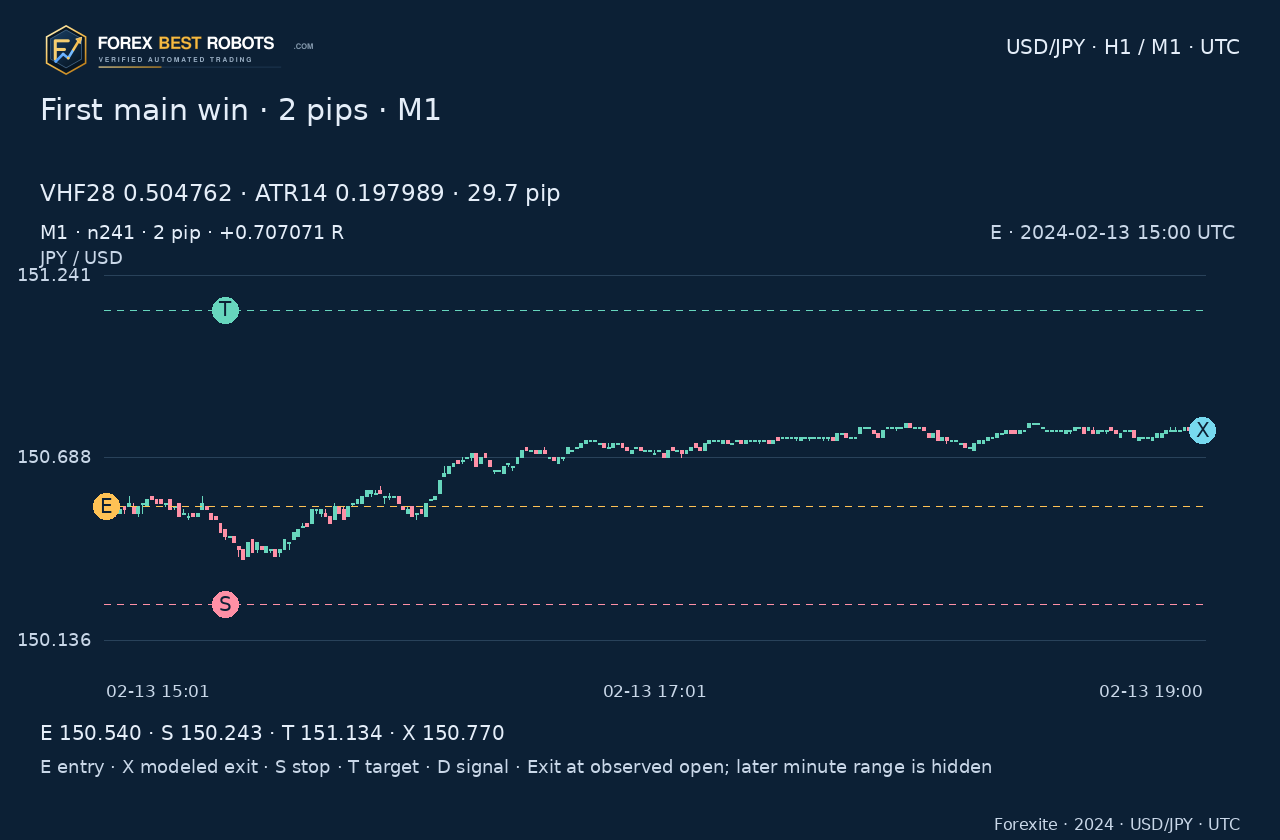
With interval-end labels, a signal at 14:00 uses the M1 record ending 14:01, whose reference opening is modeled at 14:00. Only then are the entry-based stop one rounded distance away and the 2 R target known. The preceding H1 chart does not reveal these future E/S/T prices.
Exit after four clock hours unless stop or target acts first; no trailing, break-even move or signal exit. At an observed open, a breached stop fills at that open, then a breached target at its fixed target without favorable improvement, then a due clock exit. Otherwise a held-path gap forces valuation at the next observed open. If a minute touches both stop and target, assume stop first.
Neither model has a held-path gap, truncated path or same-minute stop/target tie here. The rule nevertheless flags every missing held minute, including an opening exit with higher priority. An intraminute protective exit has an unknown second; an opening exit uses the observed interval start and does not use its later high or low.
4. Follow the first trade and first loss
The first retained trade is long at 2024-02-13 15:00 UTC. Close 150.550 is above EMA50 149.388218 and the previous high 150.470; VHF28 is 0.504762. The earlier context and touch are in the attempt record. The exact next M1 open is 150.540. ATR14 0.197989 produces 29.7 pips of rounded risk, stop 150.243 and target 151.134.
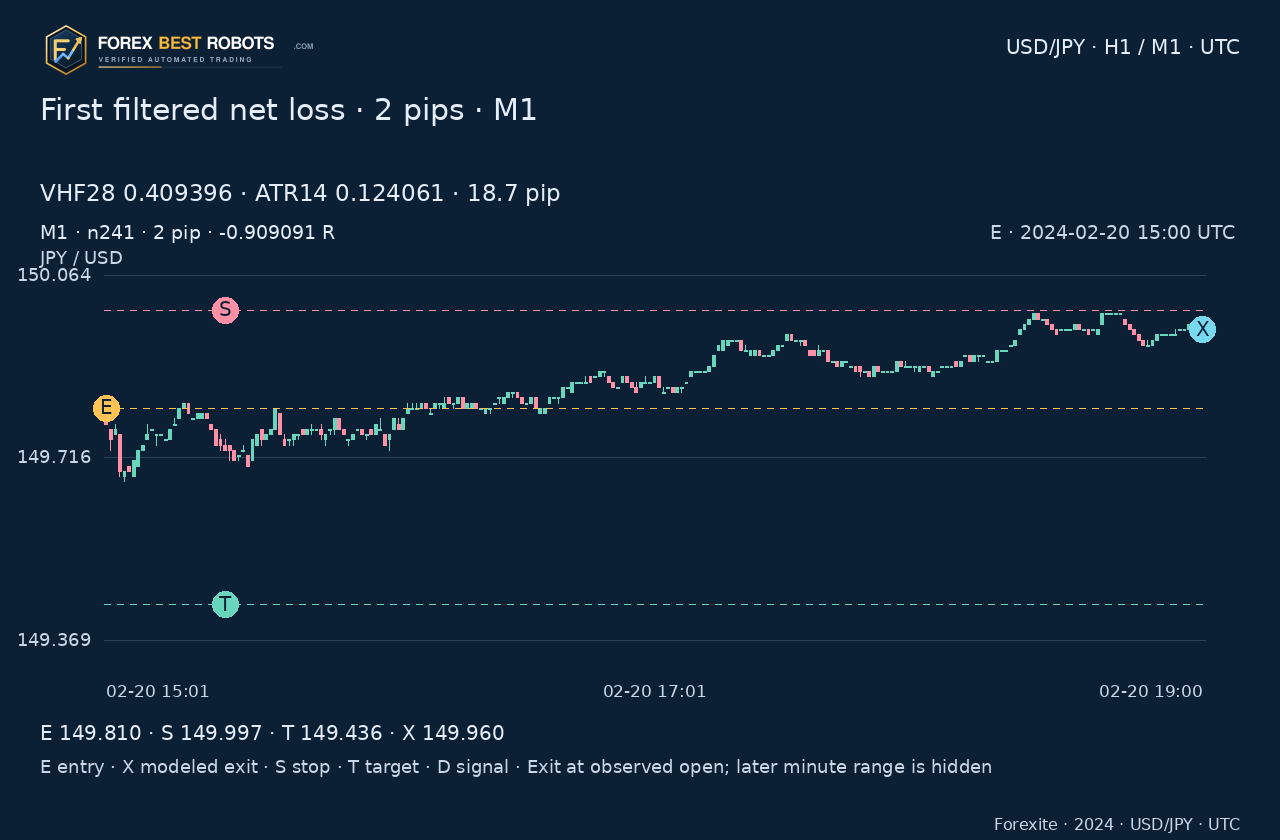
At the four-hour observed opening 2024-02-13 19:00 UTC, the exit is 150.770; net +0.707071 R at 2 pips. The first retained loss is a short from 2024-02-20 15:00 UTC, VHF28 0.409396. Its four-hour opening exit 149.960 at 2024-02-20 19:00 UTC gives -0.909091 R. This loss is a time exit, not a stop touch; the final minute shows only its known opening.
5. Compare costs and the two calendar subperiods
Each cost row uses the same reference entries and exits for the selected model. Deduct 0, 2 or 4 pips once per completed round trip. These illustrative all-in deductions are not measured historical bid/ask, actual commissions, swap or a slippage distribution.
At 4 pips the filtered total is +0.69 R and the baseline is -10.07 R. The three filtered entries and reference fills stay fixed across costs. The apparent resilience of three trades is not a robustness result. A stop can lose more than −1 R after costs; a gross 2 R target nets less than 2 R.
| All-in cost · pip per round trip | Trades | Total net · R | Net result · pip | Wins · % | Maximum drawdown · R | Profit factor · net R |
|---|---|---|---|---|---|---|
| 0 | 3 | +1.17 | +44.0 | 66.7 | 0.80 | 2.46 |
| 2 | 3 | +0.93 | +38.0 | 66.7 | 0.91 | 2.02 |
| 4 | 3 | +0.69 | +32.0 | 66.7 | 1.02 | 1.68 |
At 2 pips, February–June contains 2 filtered trades and -0.20 R; July–December contains 1 trade and +1.13 R. One later observation accounts for more than the full-year net gain. These are diagnostic parts of reused history, not independent validation samples.
| Calendar subperiod | Fixed model | Trades | Total net · R | Maximum drawdown · R | Flagged next-open valuation |
|---|---|---|---|---|---|
| February–June 2024 | Baseline · no VHF gate | 18 | -4.62 | 6.20 | 0 |
| February–June 2024 | VHF28 ≥ 0.40 | 2 | -0.20 | 0.91 | 0 |
| July–December 2024 | Baseline · no VHF gate | 24 | -2.49 | 6.59 | 0 |
| July–December 2024 | VHF28 ≥ 0.40 | 1 | +1.13 | 0.00 | 0 |
6. Keep rejected dates and missing paths visible
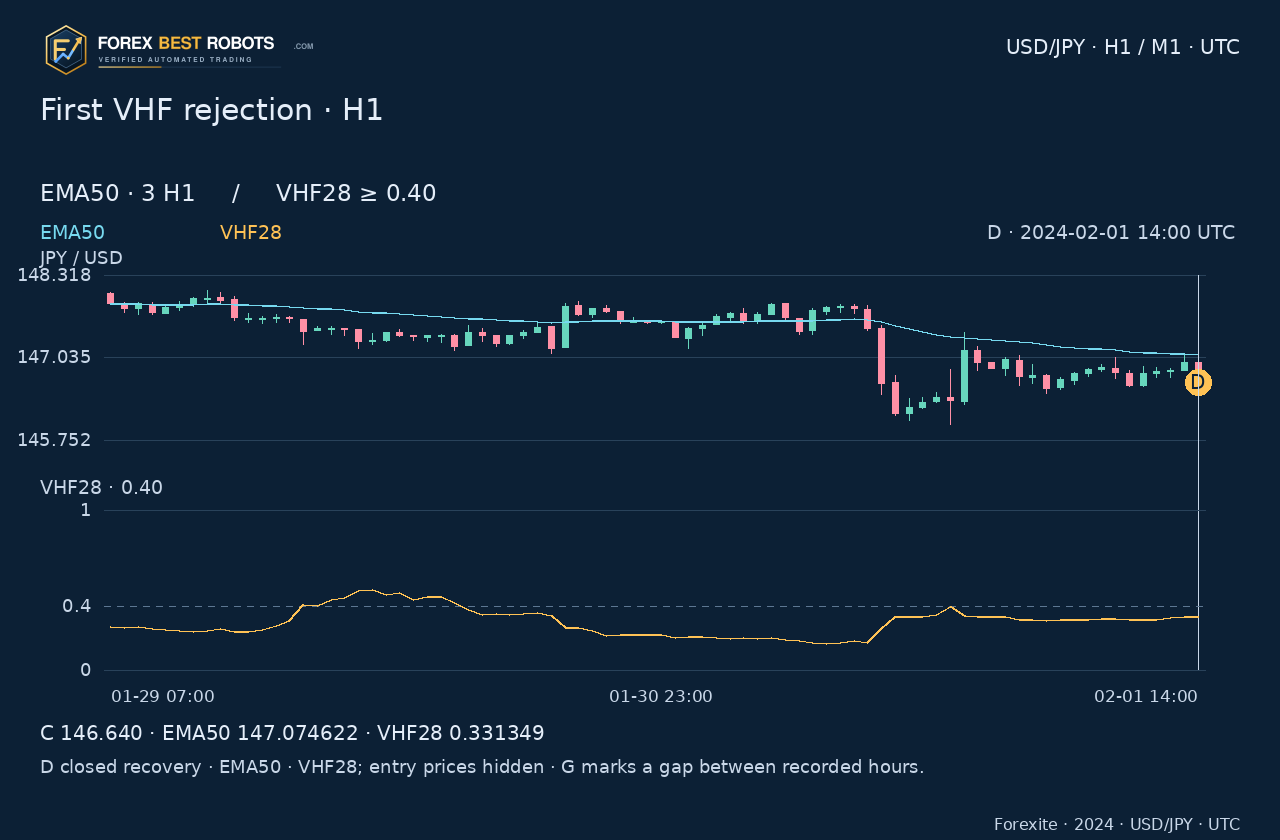
The first VHF rejection is a short at 2024-02-01 14:00 UTC. Close 146.640 is below the previous low 146.830 and EMA50 147.074622, but VHF28 0.331349 is below 0.40. The filtered model has no position or E/S/T prices. Select Baseline to inspect its separately admitted path, which nets +0.620843 R at 2 pips.
Of 59 first candidates, both models reject 15 for incomplete or nonadjacent hours and 2 for risk outside the limits. VHF removes 39 otherwise admitted entries, including 16 net winners at 2 pips. A rejected date never receives a later substitute.
| Decision / exit | Baseline · no VHF gate | VHF28 ≥ 0.40 |
|---|---|---|
| The 29 source hours are incomplete or nonadjacent | 15 | 15 |
| Risk distance outside 10–80 pips | 2 | 2 |
| VHF28 is below 0.40 | 0 | 39 |
| Fixed model | Held minute-path coverage | Trades | Net contribution · R |
|---|---|---|---|
| Baseline · no VHF gate | No held gap | 42 | -7.102 |
| Baseline · no VHF gate | Flagged next-open valuation | 0 | +0.000 |
| VHF28 ≥ 0.40 | No held gap | 3 | +0.928 |
| VHF28 ≥ 0.40 | Flagged next-open valuation | 0 | +0.000 |
7. Inspect the decision before the later path
Choose model, fixed cost and daily candidate. H1 displays only recorded bars through the selected observation, EMA50 and VHF28. Candidate direction, decision and planned risk remain hidden before the signal closes. Entry-based E/S/T and final results are hidden throughout H1.
M1 is available only for an entered candidate in that model. Advancing the observation reveals the outcome at its exit; an opening-exit frame hides the final minute’s later range. Missing records are not fabricated. The gap shortcut is disabled because none of the filtered trades has a held-path gap.
Loading historical test…
- Selected observation · UTC
- —
- First completed pullback · H1 end UTC
- —
- Direction
- —
- Attempt status
- —
- Decision / exit
- —
- Close · JPY/USD
- —
- Previous H1 high · JPY/USD
- —
- Previous H1 low · JPY/USD
- —
- VHF28
- —
- EMA50 · JPY/USD
- —
- 28-close range · JPY/USD
- —
- 28-change absolute sum · JPY/USD
- —
- Pre-pullback close t−2 · JPY/USD
- —
- EMA50 at t−2 · JPY/USD
- —
- EMA50 at t−3 · JPY/USD
- —
- Pullback extremum t−1 · JPY/USD
- —
- EMA50 at t−1 · JPY/USD
- —
- VHF trend gate
- —
- ATR14 · JPY/USD
- —
- Rounded initial distance · pip
- —
- E · entry reference
- —
- Modeled entry time · UTC
- —
- S · stop reference
- —
- T · target reference
- —
- X · exit reference
- —
- Modeled exit time · UTC
- —
- Exit observation interval · UTC
- —
- Exit time precision
- —
- Net result · R
- —
- Net result · pip
- —
- Held minute-path coverage
- —
Same reference trades · cost deductions
Only 3 filtered trades; closed-trade R sums are not account equity.
Open the complete attempt record
8. State what this experiment establishes
Three trades on one pair and one previously used year cannot establish repeatability, a dependable win rate or a validated VHF advantage. Two winners out of three is a count, not a reliable probability estimate. No threshold, period, session or exit was optimized after the first replay.
EMA50, the pullback and VHF all reuse closing-price information. They are not independent evidence. The 0.40 gate, five-condition pattern, 29-hour local quality check, ATR rounding and four-hour holding limit define this particular experiment. Changed rules need a separate declared study.
Frequently asked questions
Does a high VHF mean buy?
No. VHF is non-directional. This experiment gets direction from the pre-pullback close and EMA slope, the EMA touch and the completed recovery. The same VHF28 ≥ 0.40 gate applies to both directions.
What does first daily pullback mean here?
The first completed three-bar pattern between 07:00 and 15:00 UTC consumes the date before any rejection checks. It is not necessarily the first pullback of a trend. A failed candidate cannot be replaced later; 29 complete adjacent H1 bars are required locally.
How are the stop and target set?
Round 1.5 × signal ATR14 upward to a multiple of 0.001 JPY/USD and accept 10–80 pips inclusive; one pip is 0.01 JPY/USD. Measure the stop from the observed reference open of the exact next M1 interval and place the target 2 R away. If that record is missing, reject the attempt. These are modeled reference levels, not verified live fills.
Did VHF improve this result?
The fixed gate retained 3 of 42 baseline entries: +0.93 R versus −7.10 R at 2 pips. Only two winners and one loser remain. One later trade contributes more than the full-year gain, so these reused observations do not establish a dependable filter advantage.
Is X an exact execution time?
For an opening exit, X marks the observed interval start as a model reference time. Both displayed retained examples exit after four hours at an observed opening. An intraminute stop or target has only a minute interval, not a known second or verified live broker fill.
Are these account returns or new validation quotes?
No. R normalizes each trade by initial stop distance. The retained 2024 USD/JPY sample was used before; position sizing, compounding, live execution and an unseen holdout are not claimed.
Data and calculation method
Reuse 375702 retained Forexite USD/JPY M1 observations from the 2024 Trade/MetaStock archives. Fixed GMT+1 labels were shifted back one hour to UTC; minute labels are interval ends and H1 groups are (start,end]. The original daily ZIPs were not downloaded again.
The retained input reconstructs 6265 H1 bars: 6178 complete, 87 partial and 52 gaps before recorded hours. All retained bars advance the calculations; each candidate separately needs its 29-hour complete adjacent window. Calculated levels do not add observed precision to the original two-decimal quotes.
One program uses integer price components, 60-digit division and recursive EMA/ATR. A separate program regroups minutes, takes direct 28-close windows, uses exact Fraction gates and 80-digit weighted-prefix EMA/ATR, then reconstructs every decision and fill. Exact rational statistics agree; 62 boundary fixtures passed. Both programs were authored by the same assistant, without external human or terminal certification.
Downloads include both models, every attempt and rejection, all trades, frozen protocol, retained minute inputs, original archive hashes and both programs. CSV prices ending _micro are integer millionths of JPY/USD; divide by 1000000. Reproduction commands stay inside the method ZIP.