

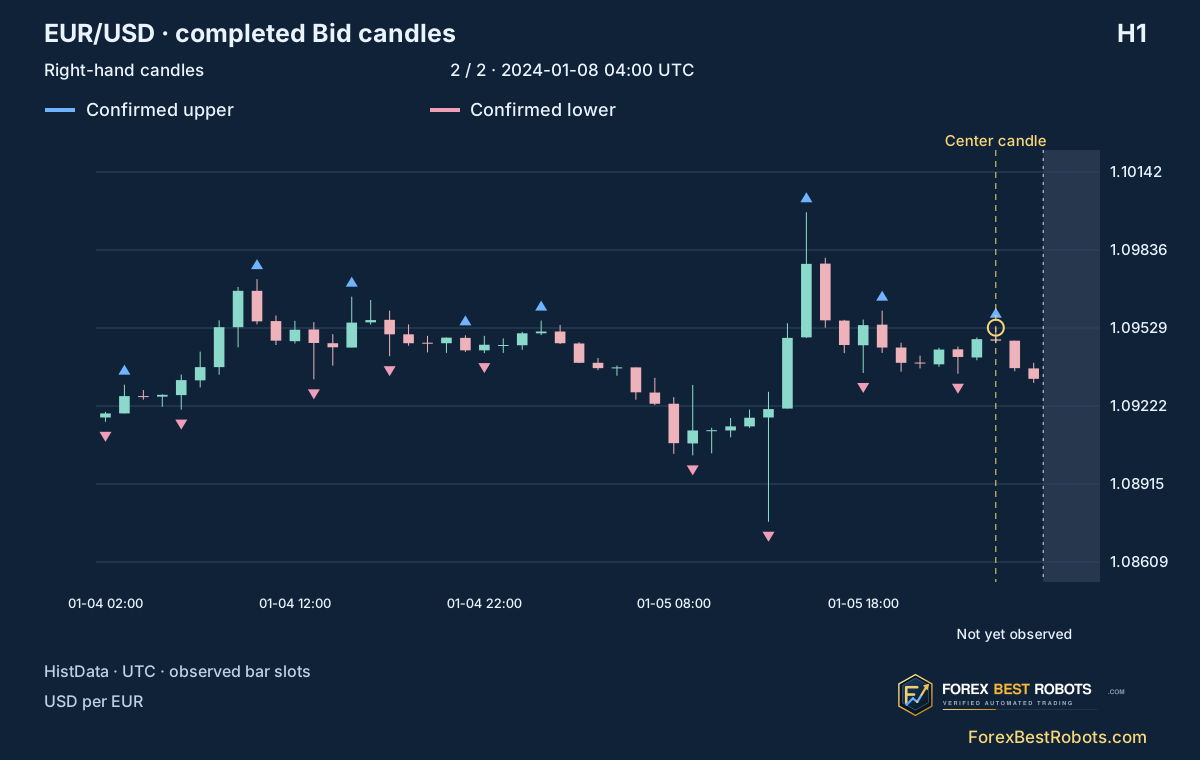
A fractal arrow is attached to an earlier price extreme, but it cannot be confirmed on that candle. This guide reconstructs a strict five-candle pattern from real EUR/USD Bid quotes and shows exactly when both required candles on the right have finished. The interactive viewer keeps the center candle separate from the historical information cutoff.
1. Separate the price extreme from its confirmation
The arrow identifies the central High or Low of a local pattern. Two candles to the left and two to the right are needed for the strict five-candle definition. An upper fractal marks a local high, not a forecast that the next trade must be short. A lower fractal does not by itself mean buy.
The drawing is retrospective: after confirmation, the marker is placed over the center candle. A static historical chart can therefore make a signal appear earlier than it was available. We display the center and the confirmation cutoff separately.
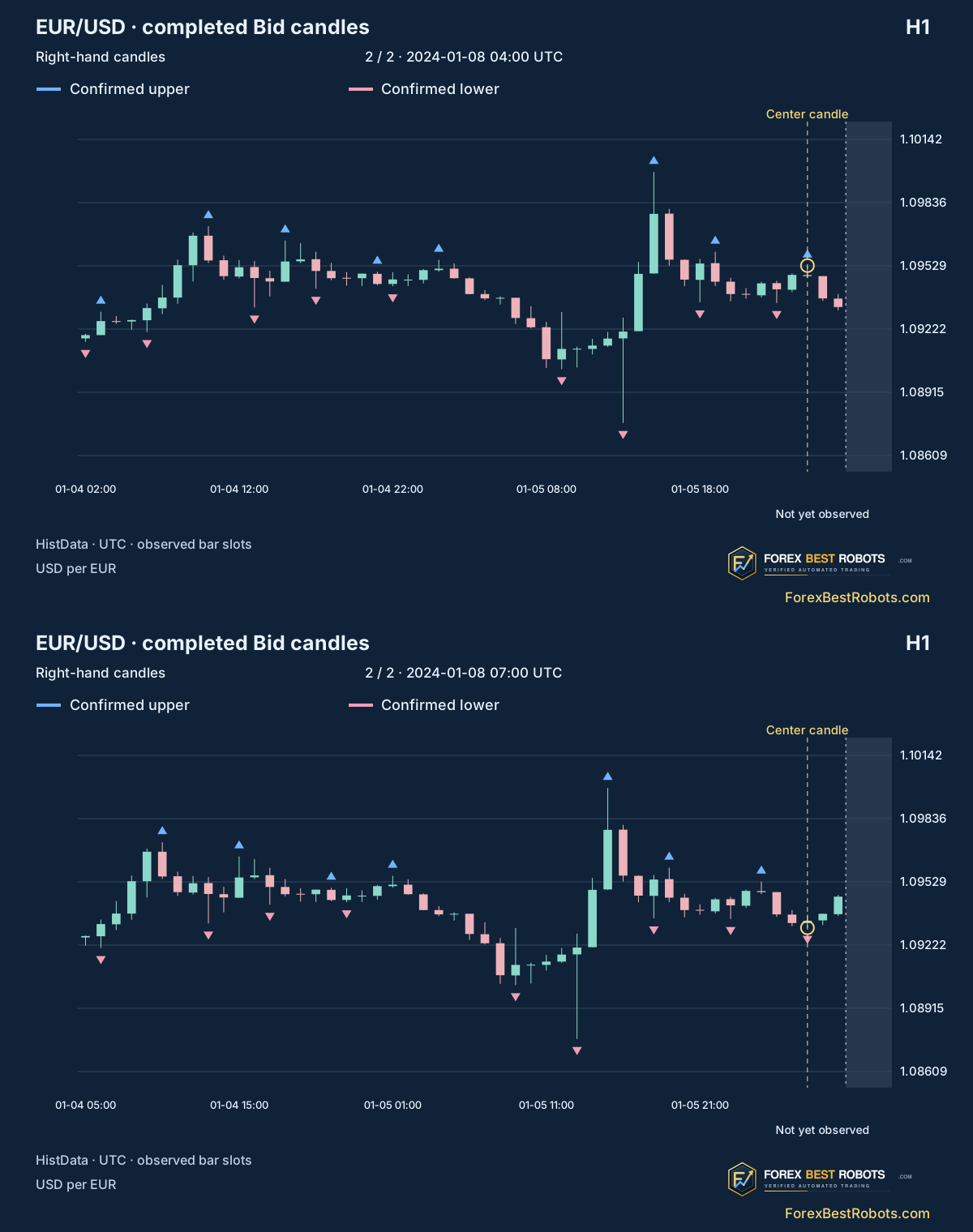
2. Define strict five-candle rules and equality
For an upper fractal, the center High must exceed each of the four neighboring Highs; for a lower fractal, the center Low must be below all four neighboring Lows. Equality is a rejection. The two tests are independent: one outside candle can satisfy both if all inequalities hold.
The default uses radius 2: two candles on each side. Radius 3 in the viewer is our strict seven-candle sensitivity comparison, with a longer confirmation delay. It is not a configurable period of MT4’s standard iFractals function, and this reconstruction is not claimed to match every installed indicator.
r=2: c−2, c−1, [c], c+1, c+2
r=3: c−3, c−2, c−1, [c], c+1, c+2, c+3
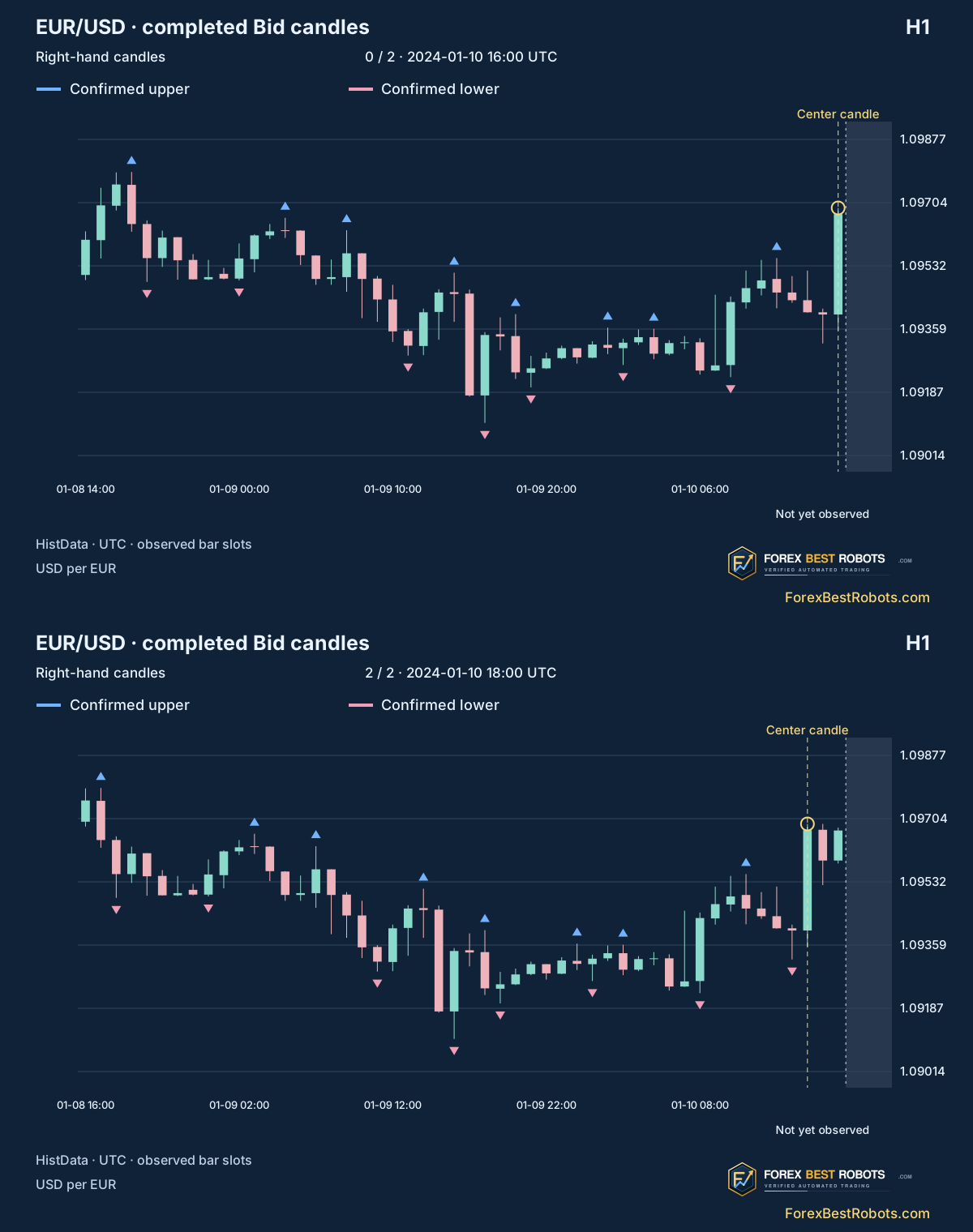
3. Inspect the neighbors and the two independent tests
For radius r, compare the center with the r observed bars immediately before it and the r immediately after it. No averaging, tick-volume weight or smoothing is used. Prices are compared in integer millionths before rounding; a small displayed difference must not be turned into equality by formatting.
Without enough left history, the result is unavailable. With the left condition satisfied but fewer than r completed right-hand candles, it is pending. An observed right-hand violation rejects it; confirmation requires all r right-hand candles to be complete and all comparisons to pass.
Upper[c]: High[c] > High[c+j]
Lower[c]: Low[c] < Low[c+j]
j ∈ {−r, …, −1, +1, …, +r}
t_confirm = end_UTC[c+r]
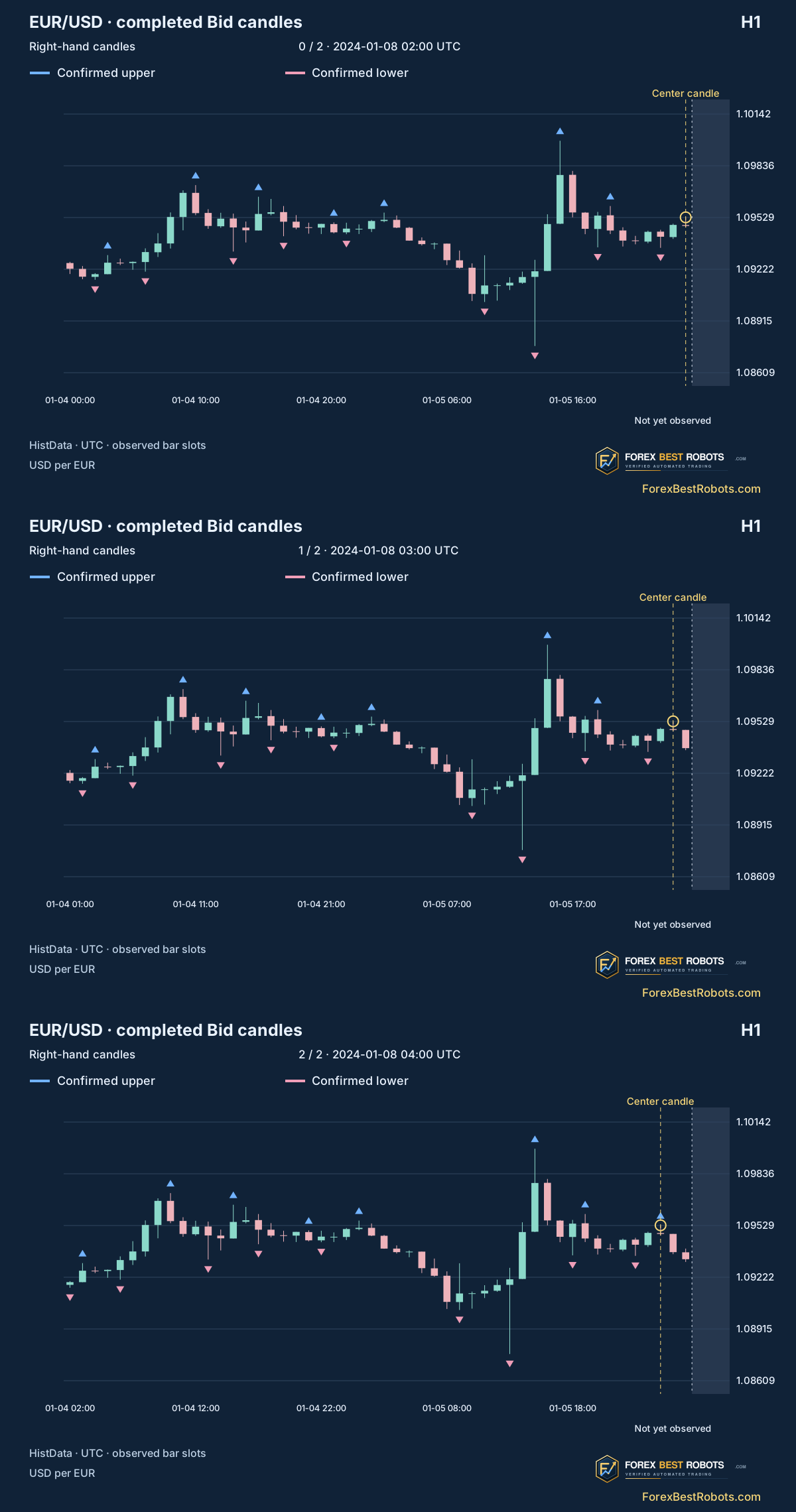
4. Follow the pattern as the right-hand candles close
At the end of center c, only the left condition is known. At the end of c+1, one right-hand candle is known. The strict default is confirmed at the end of c+2. In the viewer, the stage buttons reveal those actual historical candles one at a time; no future candle is drawn at an earlier cutoff.
A pending upper candidate disappears if a required right-hand High reaches or exceeds the center High. The lower case is reversed. This is why an early arrow using an unfinished right-hand candle can change. A confirmed result is fixed only while its historical inputs and definition remain fixed.
5. Distinguish a wick breach from a closing break
A confirmed upper level is the center High; a confirmed lower level is the center Low. In this study a level begins at recognition, not back at the center time. We inspect only later candles. A strict wick breach uses High>upper or Low<lower; a closing break uses Close beyond the same fixed level.
The first wick-breach candle and first closing-break candle can differ, and a later closing break may be absent. OHLC identifies the candle interval of a wick breach, not its exact tick time or the sequence of intrabar events. Equality is a touch, not a strict breach here. Here “wick breach” means an observed High or Low beyond the level; a gap beyond it also qualifies, without proving a transaction at the level.
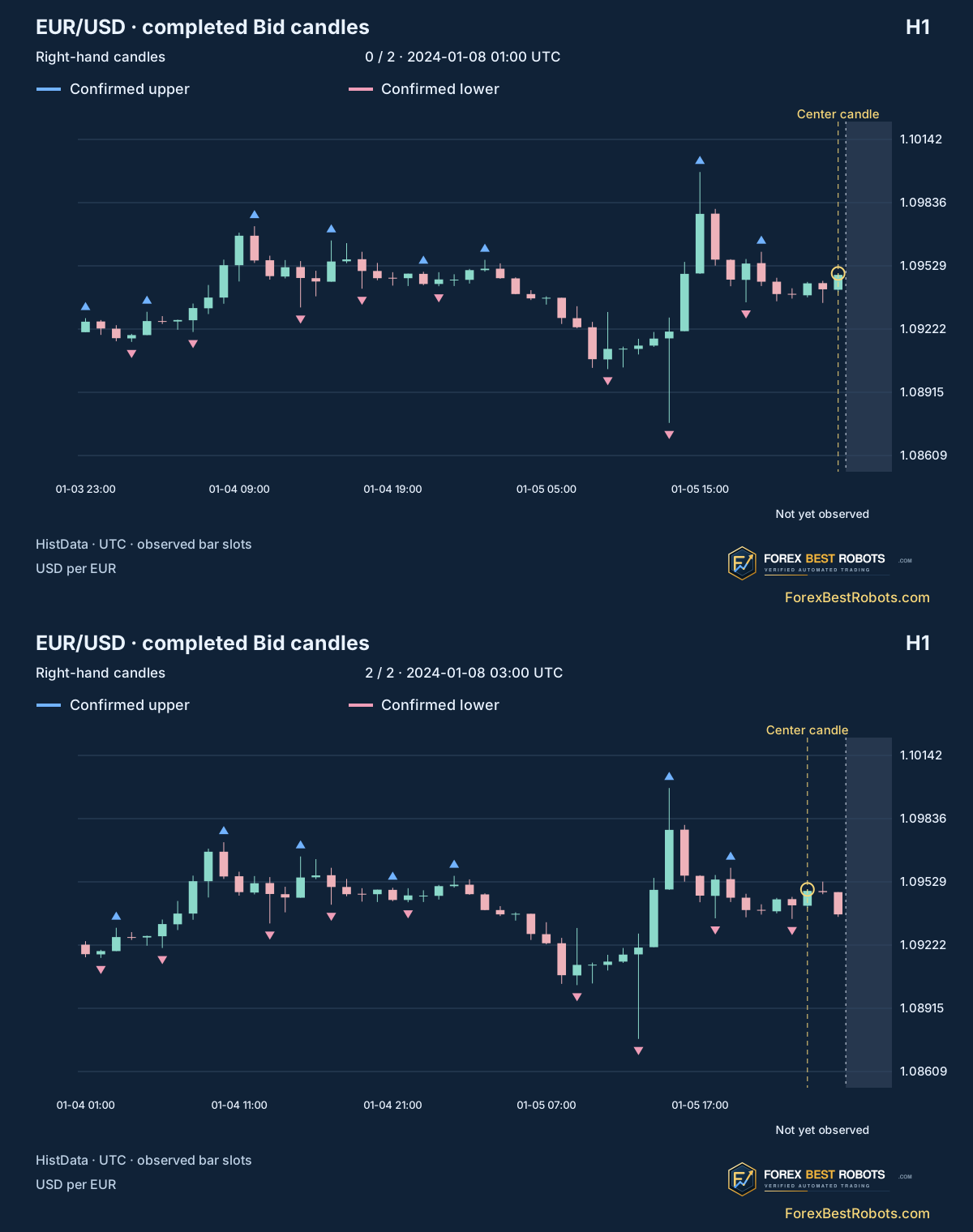
6. Compare H1 and H4 with explicit candle boundaries
Candle labels are UTC starts, and intervals exclude their end. An H1 center labelled 10:00 completes at 11:00; its two right-hand H1 candles complete at 12:00 and 13:00. Without missing intervals, the default becomes known at 13:00, not 10:00. Observed bar positions and elapsed clock time are different when gaps occur.
The retained EUR/USD archive uses fixed EST, UTC−05:00; we add five hours. H4 is rebuilt at 00:00, 04:00 and successive four-hour UTC boundaries. Empty intervals are omitted, not filled. H4 is calculated from its own Highs and Lows, and broker candle boundaries can differ.
7. Reveal the right-hand candles and inspect confirmation
Choose a center candle and a historical cutoff. The stage buttons show what was known after the center, after one right-hand candle and after all required right-hand candles. Previous/next moves the cutoff by one candle while keeping the center fixed.
Jump to a documented example:
Only candles completed by the chosen cutoff are shown. The center stays fixed when you move the cutoff or change the radius; changing the center or timeframe opens a new historical example. The chart shows the latest 50 observed candles; an older selected center can lie outside that window.
On a small screen, scroll the chart and table horizontally. Use the stage buttons to see exactly when another right-hand candle becomes available.
Selected center and available information
- Center interval — UTC
- —
- Current historical cutoff — UTC end
- —
- Selected pattern status
- —
- Completed right-hand candles / required
- —
- Confirmed level — Bid
- —
- First later strict wick breach — candle start UTC
- —
- First later strict closing break — candle start UTC
- —
Inspect every required neighbor
| Relative position | Candle start — UTC | Compared High or Low | Strict comparison with the center |
|---|
The chart axis uses five decimals; the comparison table and level use six, preserving the input precision. Comparisons use integer millionths. Breach times identify candle intervals, not exact executions.
8. Read MT4 arrows and iFractals without shifting time backward
The MQL4 iFractals interface selects a symbol, timeframe, upper or lower buffer and a bar index. It does not have a radius input. When index 0 is the currently forming candle, a center at index 2 still depends on that unfinished candle; a center at index 3 has two completed candles on its right under the five-candle definition.
Verify the installed indicator’s equality rules, history and empty-buffer convention before automating it. This guide uses the explicit strict comparisons above and does not claim a live MT4 test. An EA must record when it first observed a confirmed value instead of assigning its decision to the earlier arrow candle.
9. Add trend context and executable trade rules separately
A later Fractals and Alligator strategy must specify which confirmed level is eligible, when the filter is evaluated, how that time maps to the shifted Alligator lines, and whether entry needs a wick or a closing break. A newer confirmed fractal can replace a stored level only after it becomes known.
These are Bid candles. A long enters at Ask and exits at Bid; a short enters at Bid and exits at Ask. Pending-order triggers and stop rules need their correct quote side. Spread, commission, slippage and any overnight financing belong in a separate trade test. An arrow or line touch is not a fill.
10. Understand the sample and what it does not establish
The documented examples use the first upper and lower confirmations, first failed upper candidate and first equal-high local maximum from 2024-01-08 00:00 UTC on H1, plus the first H4 upper confirmation from that threshold. Selection uses pattern conditions, not later returns. An early-history example shows unavailable inputs.
The full retained OHLC series and confirmed-event list are downloadable. They demonstrate arithmetic, equality handling and information timing for one pair and one historical archive. There are no orders, account returns, win-rate estimates or validated trading advantages in this guide.
Frequently asked questions
When is a five-candle fractal confirmed?
When both required candles to the right of the center are complete and all strict comparisons pass. The center time and confirmation time are different.
Do equal highs count as an upper fractal?
Not in this reconstruction. The center must exceed all four neighboring Highs. Check the equality rules of the installed MT4 or custom indicator separately.
Can a fractal arrow change?
A candidate involving unfinished right-hand candles can change. With fixed completed inputs and fixed rules, a confirmed strict pattern is deterministic; revised history can change a reconstruction.
Why is bar index 2 unsafe for a completed MT4 signal?
If bar 0 is still forming, a center at index 2 uses that incomplete right-hand bar. Under the five-candle definition, index 3 has two completed bars to its right.
Is the seven-candle option standard MT4 Fractals?
No. Radius 3 is an educational strict-pivot comparison. The standard MQL4 iFractals call does not expose a radius parameter.
Does breaking a fractal level guarantee a good trade?
No. A breach is a price observation. Entry timing, quote side, stops, exits and costs need explicit rules and a separate evaluation.
Data, timing and reproducibility
Inputs: real EUR/USD Bid/Ask ticks from HistData’s January 2024 Generic ASCII archive, converted from fixed EST to UTC. Retained interval: 2024-01-02 00:00 ≤ time < 2024-02-01 04:00 UTC. The 527 H1 and 137 H4 Bid candles are the independently checked inputs used for our Alligator guide. Empty intervals are omitted; observed records do not certify complete market coverage.
CSV prices use integer millionths; one EUR/USD pip equals 100 such units. The event CSV records both the center start and recognition at the end of the final required right-hand candle. The method download includes derived inputs and a reproducible calculation, with the raw archive identified by SHA-256 rather than redistributed.
- EUR/USD H1 and H4 input candles — ZIP
- Confirmed fractal events with recognition times — CSV
- Inputs, calculation and method — ZIP