

A shallow Fibonacci pullback needs a rule for when the anchors become known, which attempt counts and when an entry can actually be modelled. This replay fixes those decisions first, then compares the same Base entries with an EMA50 filter. The aggregate of closed outcomes is negative, and missing coverage makes the later-year comparison inconclusive.
1. Read the result before the rules
The retained data cover 2024 and 2025, but the strict shared calendar admits only 9 Base entries: 7 resolved and 2 unresolved. EMA50 keeps 6, of which 5 resolve. At a one-time 2-pip cost allowance, the closed-only sums are -100 pips for Base and -152 pips for EMA50. These omit unknown paths.
The filter does not improve this small closed sample. In 2025 the only Base entry is unresolved and EMA50 rejects it; there are no closed 2025 outcomes to compare. The figures are a transparent test of declared rules on retained observations, not evidence of account returns or a reliable later-year validation.
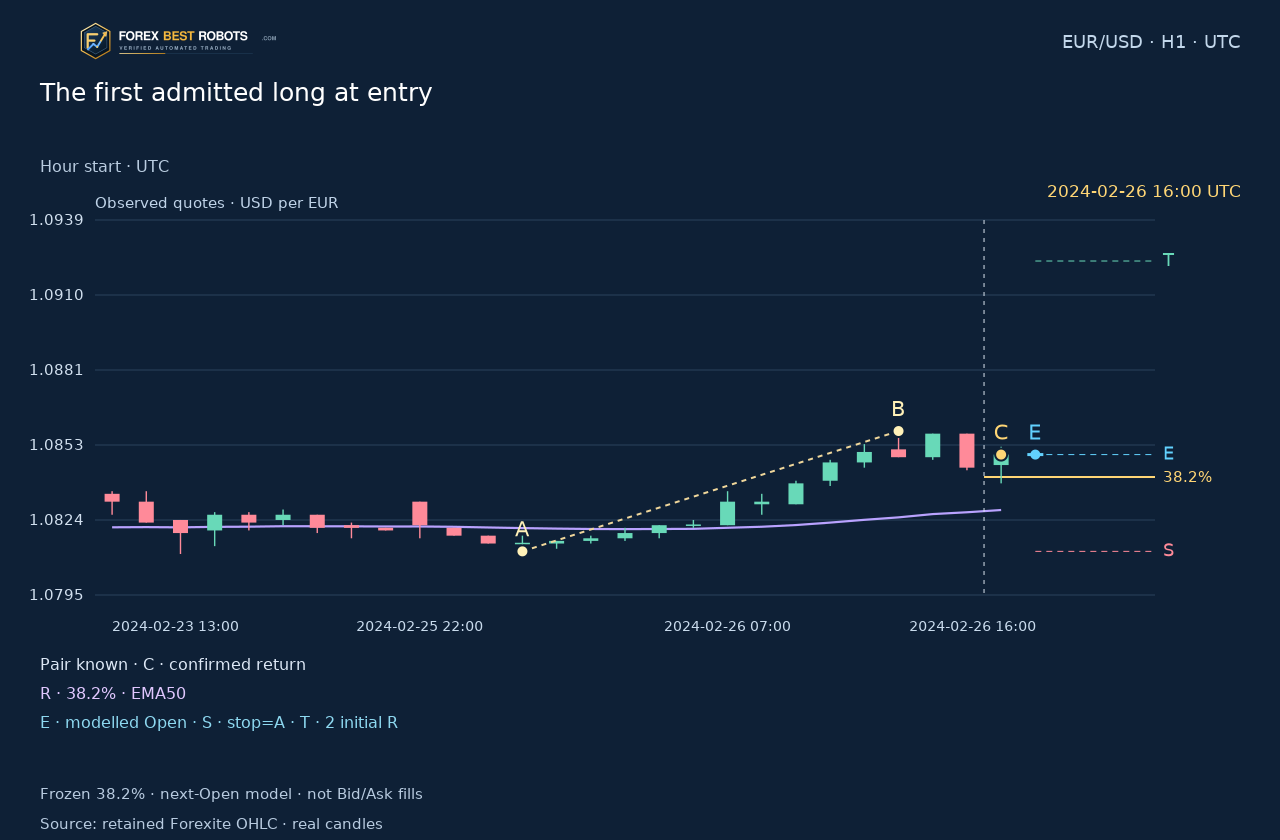
2. Confirm A and B before freezing 38.2%
A pivot must be strictly higher or lower than two complete consecutive hourly groups on each side. Equal comparisons fail that type; a center qualifying as both high and low is discarded. B becomes available only after its second right-hand hour ends. The complete interval from A through that confirmation must have no missing or partial hour.
With consecutive same-type pivots, retain only the strictly more extreme pending pivot. An opposite pivot may create an immutable A/B pair if the signed leg agrees with its types, its span is at least 30 pips and at least 200 recorded H1 groups have elapsed. R = B − 0.382 × (B − A). This is 38.2% from B back toward A, not an extension beyond B.
R = B − 0.382 × (B − A)
1 pip = 0.0001 USD/EUR
3. Consume the first pullback attempt only once
At activation inspect the already completed hours after B’s center through its confirmation. If the long-side Low has already reached or passed R, or the short-side High has done so, the pair is preconsumed. It cannot wait for a prettier second return. Otherwise search the next 12 clock hours for the first such retracement threshold.
A threshold crossing means an observed price range reaches or passes the reference; it does not prove an exact quote at the fractional calculated level. A missing or incomplete required hour cancels the event. Before confirmation, a long-side Low at or below A, or short-side High at or above A, invalidates it even when the same candle would otherwise confirm.
4. Require a completed return and then check EMA50
From the first pullback hour through its next two hours, use the first qualifying completed candle. For a long, Close must be above Open and above R; for a short it must be below both. Confirmation can occur on the first pullback hour. If the three-hour window expires, the first attempt is finished. No later signal replaces it.
EMA50 uses completed H1 closes, an arithmetic mean of the first 50 recorded closes as its seed and the recurrence EMA = previous EMA + (2/51) × (Close − previous EMA). Partial groups remain in indicator history and the EMA is not reset at gaps or New Year. At confirmation retain a long only above EMA50, a short only below it. No slope or extra crossover is added.
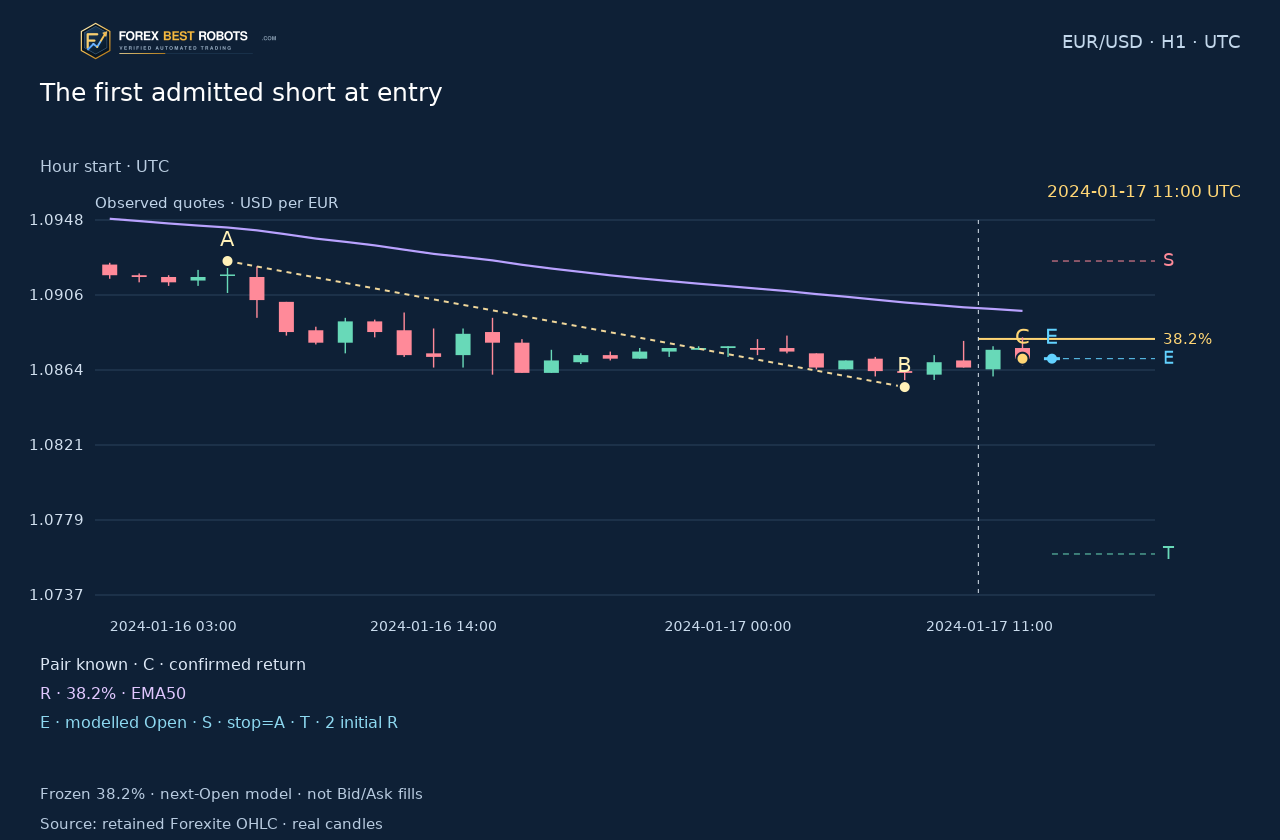
5. Enter at the next observed Open with fixed risk
Entry is the first Open of the immediately following complete clock-hour group. A missing next hour cancels it; the replay does not jump to Monday or use the confirmation Close. Stop is A. Reject initial risk below 5 or above 150 pips; both boundary values are allowed. Also reject an entry already at or beyond B in the leg’s direction. Target is entry plus twice the signed initial risk.
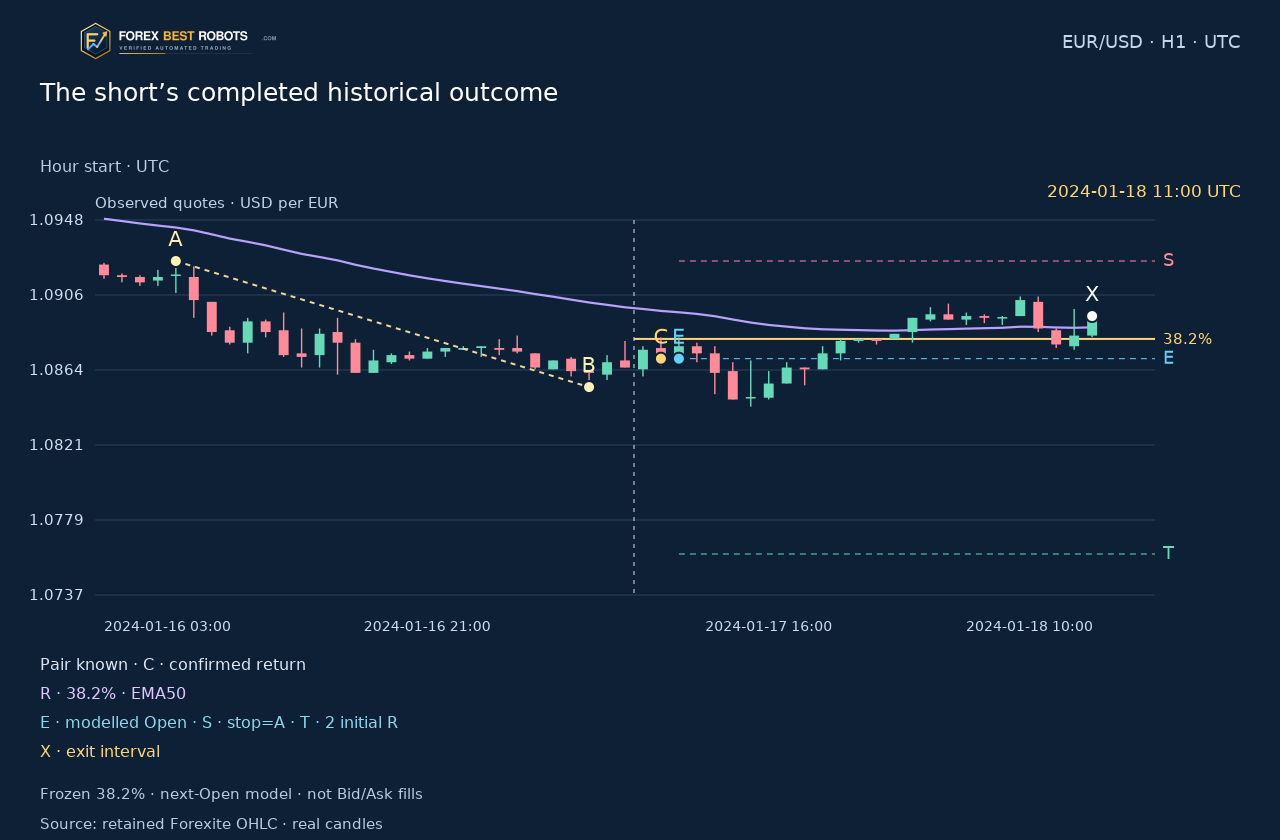
Replay the retained minute OHLC for at most 24 consecutive complete hours, counting the entry hour. At each minute, check Open first: an adverse stop gap uses that observed Open; a target gap receives only the target price. Otherwise one barrier determines the exit. If both barriers lie inside the same minute and Open resolved neither, the path is unknown. Without a barrier exit, use the last Close of hour 24.
6. Keep one common calendar for Base and EMA50
Sort eligible entries by time, then pair identifier. One shared Base slot prevents overlapping positions. A candidate cannot start at or before the previous admitted Base exit, even if EMA50 skipped that earlier trade. After an unresolved Base path, block the remaining candidates in that same year; reset the slot in the next year. This conservative rule was locked before calculation.
Consequently the later-year coverage gap prevents most of the available history from becoming a usable outcome sample. The comparison measures filtering on the frozen Base calendar, not a separately rescheduled EMA portfolio. Cancellations and the 94 blocked candidates remain in the downloadable calendar. All 878 qualifying pairs are accounted for, including 570 preconsumed pairs.
| Decision | Pairs |
|---|---|
| Pullback already used before activation | 570 |
| No first pullback within 12 hours | 106 |
| Admitted Base entry | 9 |
| Blocked by the common Base slot | 94 |
| First confirmation window expired | 54 |
| Entry at or beyond B | 9 |
| Missing/incomplete event hour | 27 |
| Missing/incomplete next entry hour | 1 |
| A invalidated before entry | 7 |
| Event crosses year boundary | 1 |
7. Compare resolved outcomes and unknown counts together
The results table keeps 2024, 2025 and the combined sample separate. Entries include unresolved positions; wins, losses, pips and R use resolved positions only. A row with no closed outcomes shows unavailable values rather than a zero return. Unknown outcomes are never entered into a sum as zero.
One initial R is the distance between the modelled entry and A. Adding closed-trade R values is not an account percentage, a compounded equity curve or a drawdown measure. With only 7 closed Base outcomes and 5 retained closed outcomes, the measured difference is too fragile to support a general claim about Fibonacci or EMA50.
| Period | Model | Cost · pips | Entries | Closed | Unknown | Net · pips | Net · R |
|---|---|---|---|---|---|---|---|
| 2024 | Base | 2 | 8 | 7 | 1 | -100.00 | -1.886 |
| 2024 | EMA50 | 2 | 6 | 5 | 1 | -152.00 | -3.080 |
| 2025 | Base | 2 | 1 | 0 | 1 | — | — |
| 2025 | EMA50 | 2 | 0 | 0 | 0 | — | — |
| 2024 + 2025 | Base | 2 | 9 | 7 | 2 | -100.00 | -1.886 |
| 2024 + 2025 | EMA50 | 2 | 6 | 5 | 1 | -152.00 | -3.080 |
8. Change the allowance without changing the trade
Compare round-trip allowances of 0, 1, 2, 3 and 5 pips. Subtract the selected value once from each resolved trade’s directional price difference; divide that net difference by initial risk for net R. The entry calendar, stop, target and original outcome remain fixed. This isolates the arithmetic effect of a cost assumption.
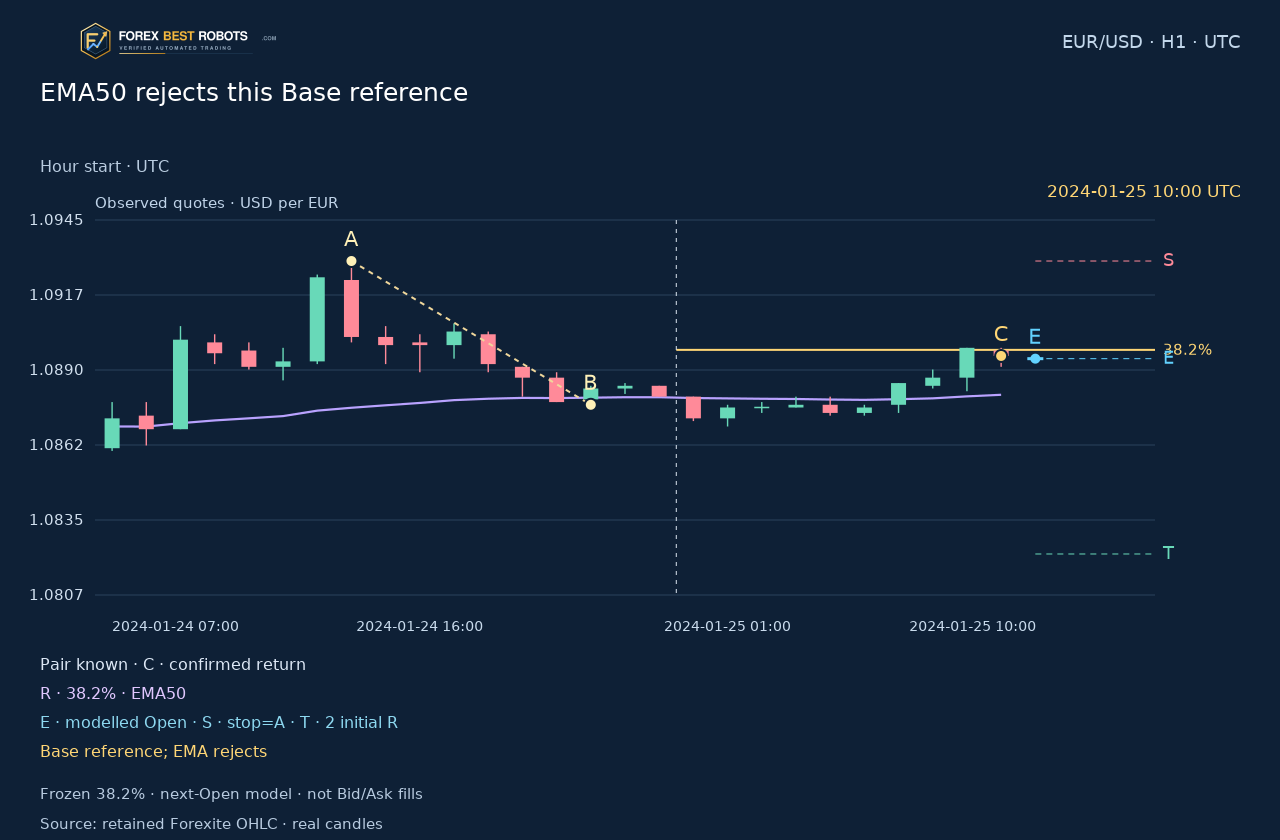
These are scenario allowances, not measured spreads or reconstructed Bid/Ask fills. They do not model the changing spread, commissions, latency, financing or every form of slippage. The first EMA-rejected admitted entry is shown because the selection rule requests it; its later profitable Base outcome is disclosed, so the filter’s omission is visible.
9. Preserve the data gaps and the year boundary
The corrected Forexite input contains 751593 minute observations and 12530 UTC H1 groups: 12400 complete and 130 partial. Source clock labels use fixed GMT+1; subtract one hour for UTC. The earlier input mistakenly applied summer-time changes. This correction shifts affected summer timestamps one hour later, preserving all quote prices and their order. Minute end-labelling remains an explicit research assumption; missing observations are not filled. Source quotes have four decimals; one pip = 0.0001 USD per EUR.
A winter and a summer original archive were reverified against saved hashes and raw quotes; the remaining archives were not downloaded again. Replaying the corrected clock leaves every admitted entry, its timestamps, all nine Base paths and every reported outcome unchanged; these entries occurred in winter. Original and corrected inputs and protocol records remain available, with trading rules unchanged. This is a one-stream OHLC model without verified Bid/Ask fills. Missing holding coverage or a year boundary still leaves an open path unresolved.
10. Treat this as a limited historical experiment
Both 2024 and 2025 are historical periods. The protocol was saved before this replay, but the data already existed; 2025 is not called a live forward test or a certified unseen holdout. The ratio, EMA period, windows, risk bounds, target and cost grid were not adjusted to rescue the observed results.
Independent calculation can verify that the stated rules were implemented on these retained observations. It cannot fix absent quotes, create unknown exits or establish future profitability. A broader test would require a newly declared protocol, adequate complete data and enough independent outcomes. It must not replace canceled first attempts with attractive later examples.
11. Inspect the decision in five clear steps
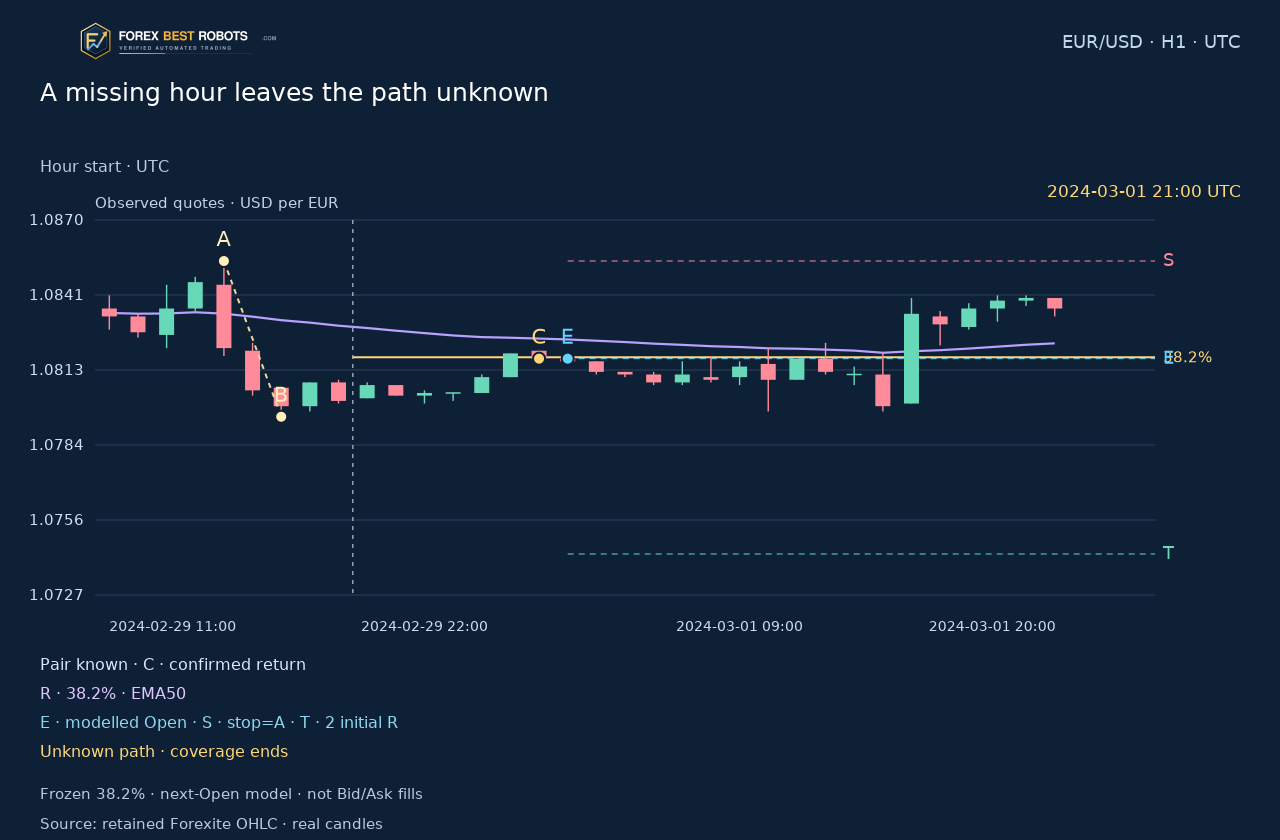
Choose an admitted Base entry, a comparison model and a round-trip cost allowance. Use the labelled steps to move from the known pair to pullback, confirmation, entry and the last available outcome. The explanation above the chart states what each step reveals. Candles after that cutoff stay hidden.
An EMA-rejected entry remains available as a clearly labelled Base reference path. It is not counted as an EMA trade, and its outcome is not shown as an EMA result. Before entry, entry/stop/target values are hidden. Before the outcome step, the final result is hidden. For unresolved paths the display gives the reason and no invented net value.
One decision, one visible step
Choose a Base-calendar entry. Step buttons reveal exactly which information is available; changing costs changes only resolved-result arithmetic.
The interactive replay could not load. Use the static charts and downloadable data.
0/1/2/3/5 are one-time round-trip scenarios, not measured spreads. Changing them does not move the original levels or calendar.
Load a declared example
- Current step
- —
- Information cutoff · UTC
- —
- Which path is displayed
- —
- A · price
- —
- B · price
- —
- R ·38.2% price
- —
- Confirmation complete · UTC
- —
- EMA50 at confirmation
- —
- E · modelled entry
- —
- S · stop
- —
- T · target
- —
- Initial risk · pips
- —
- Outcome state
- —
- Selected model net · pips
- —
- Selected model net · R
- —
Closed-only result. Allowance deducted once; this is not an account return.
Four-decimal source quotes; six-decimal levels add no quote precision. One pip =0.0001 USD per EUR.
On a narrow screen, scroll only the chart horizontally. The values above stay within the page.
An unknown Base path blocks later admissions in the same year. It is counted separately and never treated as zero.
Show the selected period and cost comparison
| Model | Entries | Closed | Unknown | Net · pips | Net · R |
|---|
Show admitted Base paths at the chosen allowance
| Pair | Entry UTC | Direction | EMA50 | Outcome | Net · pips |
|---|
Show the selected arithmetic
Questions about this test
Is this the existing 50–61.8% Fibonacci strategy?
No. This page tests a frozen 38.2% level, a first completed return and a paired EMA50 gate. The existing deeper-zone strategy remains a separate material.
Does EMA50 improve the result here?
No improvement is established. The resolved-only sum is worse for the retained EMA sample at the stated cost allowances, and unresolved paths prevent a complete strategy result.
Why is the 2025 result unavailable?
Its only admitted Base entry becomes unresolved before a known exit. EMA50 rejects that entry, and the frozen Base slot blocks later candidates that year. No closed outcome remains; unavailable is not break-even.
Can I treat the minute exit timestamp as the exact touch time?
It identifies the retained minute interval ending at that timestamp. OHLC does not establish the exact intraminute barrier time or ordering when both barriers occur. No live broker fill is claimed.
Why does an EMA rejection not free another entry slot?
The comparison deliberately freezes the Base admission calendar before applying EMA50. Otherwise the models would change both their filter and their entry opportunities, obscuring this paired comparison.
Do cost changes move the stop or target?
No. One round-trip allowance is deducted once from each resolved outcome. Initial entry, stop, target, risk, unresolved status and calendar remain unchanged.
Data, rules and reproducible results
The input CSV, its SHA-256, frozen protocol, all first-attempt decisions, modelled positions, cost scenarios and both independently written implementations are provided in the method download. Original minute OHLC remain unchanged.
The independent implementation rebuilds the hourly data and checks pair availability, first attempts, cancellation priorities, minute outcomes and shared-calendar admission. Agreement confirms the implementation within its declared scope, not a live execution record or terminal parity.
The static charts show only real observed candles. Their examples follow the predeclared selection rules: first admitted long, first admitted short, first EMA rejection and first unresolved path. Outcome-based illustrations are labelled retrospective.
- Download every first-attempt decision · CSV
- Download the admitted Base paths · CSV
- Download all cost scenarios · CSV
- Download source inputs, frozen rules and replay · ZIP