

The frozen Base rules admit 17 USD/JPY paths; all have known exits. The RSI14 midline filter retains 0. Its result is unavailable: no RSI trade sample exists here. This is a useful incompatibility finding, not evidence that avoiding every trade is a profitable strategy.
1. Read an empty filtered sample correctly
This study asks a narrow question: after an equal-leg price projection and a completed reversal confirmation, does a fixed RSI14 midline condition retain useful candidates? The answer in this dataset is that it retains none. We preserve that result rather than changing thresholds after seeing it.
Base admits 17 paths across 2024 and 2025, with 17 known exits and 0 unknowns. Its combined net at a single 2-pip allowance is -228 pips / -10.619 R. RSI has 0 entries and no outcome sum to compare. A blank RSI return is not break-even, account protection or proof of an edge.
An equal-leg geometry model is not the complete branded harmonic-pattern definition. The published rules below define our research construction; they add no reciprocal BC ratio, equal-time condition or divergence filter.
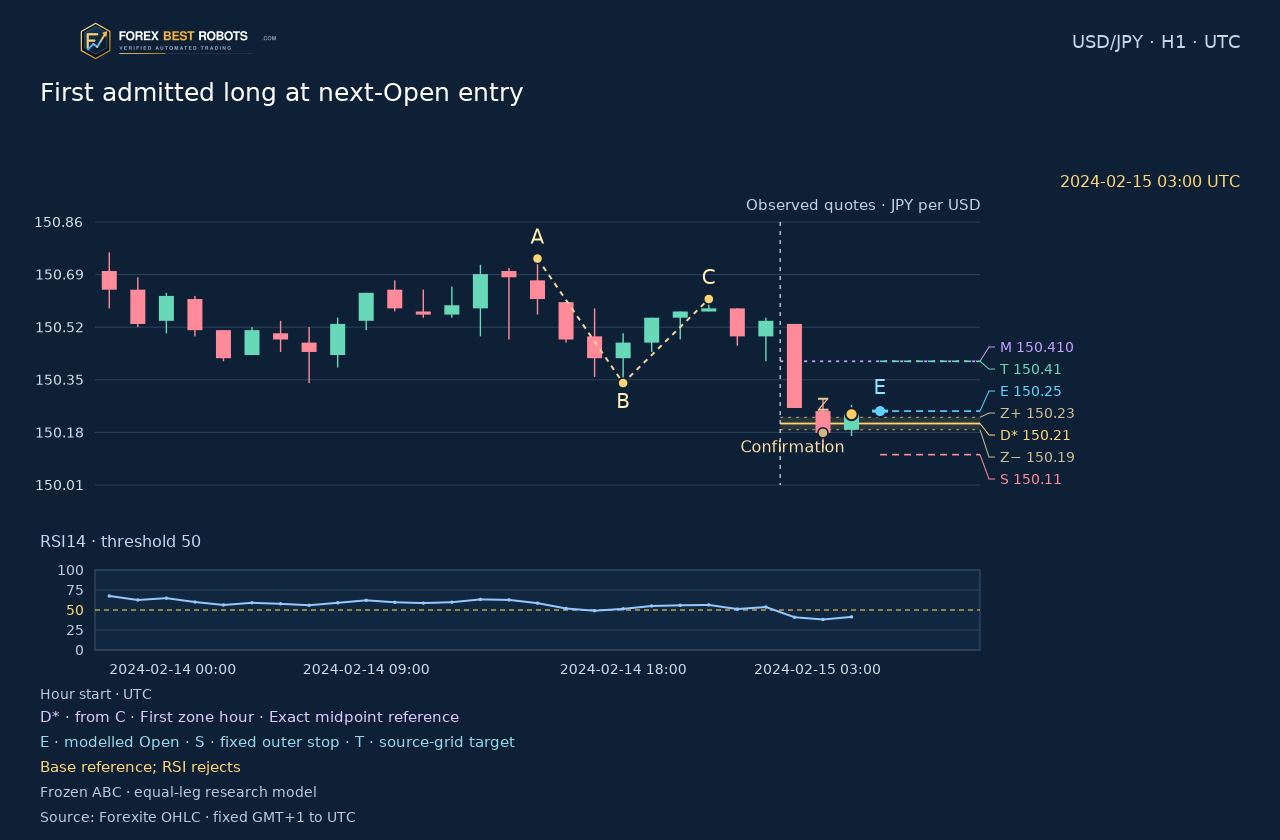
2. Freeze A/B/C before projecting D from C
Find strict two-left/two-right H1 pivots using five complete consecutive hours. Ties reject the relevant pivot type; a center that is both a strict high and low is rejected entirely. A pivot becomes available only at the end of the second right-hand hour.
Maintain alternating working pivots. A new same-type point replaces only the current last point, and only if strictly more extreme. On the next opposite-type pivot, freeze A/B/C permanently. Later working-pivot changes never redraw an emitted construction.
Require at least 200 observed H1 groups by availability, complete consecutive hours from A through C confirmation, |B−A| ≥ 30 pips, C strictly inside A/B, and |B−C|/|B−A| between 0.382 and 0.886 inclusive. These geometry gates precede every future-event search.
Project the signed displacement from C: D*=C+(B−A). A rising CD projection creates a short-reversal candidate; a falling projection creates a long candidate. Direction uses the actual sign of B−A. D* has no invented future time or confirmed extreme. The zone is [D*−2 pips,D*+2 pips].
D* = C + (B − A)
M = (C + D*) / 2
Zone = [D* − 2 pip, D* + 2 pip]
1 pip = 0.01 JPY/USD
| A · JPY per USD | B · JPY per USD | C · JPY per USD | ABC available · UTC | Projected D* | Zone Low | Zone High | Exact midpoint | Grid target |
|---|---|---|---|---|---|---|---|---|
| 147.09 | 147.95 | 147.56 | 2024-01-17 13:00 | 148.42 | 148.40 | 148.44 | 147.990 | 147.99 |
3. Consume the first zone interaction without backfilling
Before activation, inspect the C center through its confirmation hour. For rising CD, any High ≥ zone Low consumes the construction; for falling CD, any Low ≤ zone High does so. This includes a reached or passed area and does not prove that an exact quote occurred at D* or inside the zone.
Search only the next 24 clock hours after availability. Reject missing, incomplete or nonadjacent hours first, then a year crossing. Before the first interaction, cancel rising CD if Low ≤ C or falling CD if High ≥ C. This cancellation takes priority even when the same hour also intersects the zone.
The fixed outer invalidation is D*+10 pips for a short candidate and D*−10 pips for a long candidate. Reaching it cancels before a zone or confirmation decision. Otherwise the first complete H1 whose [Low,High] overlaps the zone is the event. A gap wholly past the zone cancels; a later return cannot replace it.
The zone event is known at that hour end. Its H1 range overlap is not an exact touch time, a zone-price fill or an immediate reversal signal.
4. Require a later reversal and check RSI on that hour
Only the next one to three complete consecutive clock hours can confirm. The zone hour itself cannot confirm. A short needs Close < Open and Close < zone Low; a long needs Close > Open and Close > zone High. Equality does not qualify. Missing data, a year crossing or outer invalidation cancels first.
The first valid confirmation is final. After the zone event, the old C-invalidation rule no longer applies; the outer stop reference still does. An expired confirmation, failed entry gate or RSI rejection never produces a later substitute.
RSI14 uses observed H1 close changes, with gains and positive loss magnitudes. Seed both averages with the first 14 changes at index 14, then update each as (13 × previous average + current change)/14. Use 100−100/(1+average gain/average loss). If both averages are zero, define RSI as 50; only zero loss gives 100, only zero gain gives 0.
Production uses Decimal48 and a separate implementation Decimal60. Quantize RSI to 12 decimal points with half-even rounding before the gate. Retain long if RSI ≥ 50 and short if RSI ≤ 50 on the same completed confirmation hour. No extra bar, slope or divergence is required. RSI is not a probability and exact native-platform parity is not claimed.
A small reversal candle can appear while smoothed RSI still reflects the preceding CD move. Here every Base long has RSI below 50 and every Base short above 50 at confirmation. The fixed gate therefore rejects all of them; it is not silently relaxed to create a filtered result.
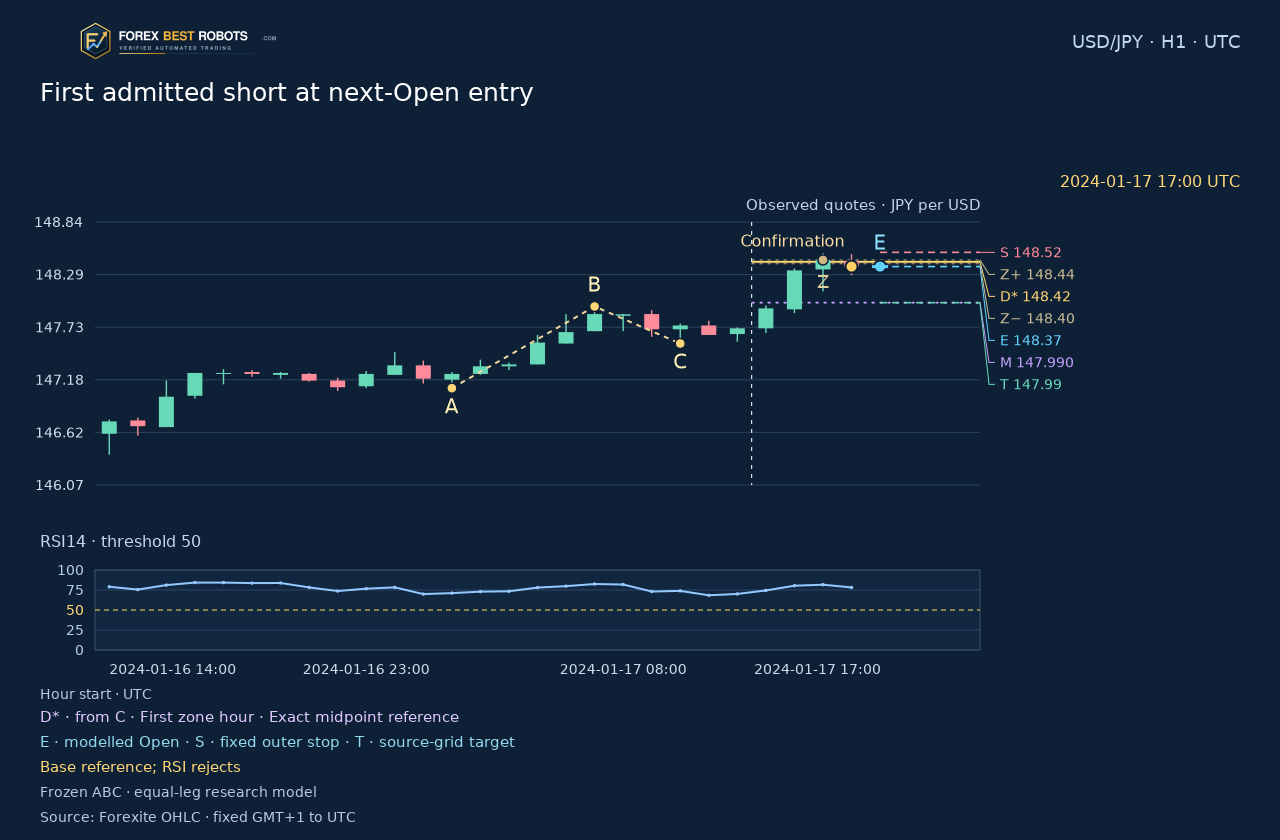
5. Use the next Open and fixed source-grid barriers
Entry is the next adjacent H1 Open, not the confirmation Close and not a jump to Monday after a gap. The research admission rule also requires that this next hour later has complete source coverage. That is a retrospective data-quality condition, not information a live trader knows at Open. The entry chart still shows only Open, with its future full candle hidden.
The short stop is D*+10 pips; the long stop is D*−10 pips. The exact target reference is (C+D*)/2. Round the target toward the potential entry on the original 0.01 source grid: long downward, short upward. Keep the exact midpoint separate from this model target.
Require initial risk from 5 to 150 pips inclusive, at least 10 pips remaining to the grid target, and remaining room at least equal to initial risk. Check exact integer distances at the first next Open. An Open back inside the zone is allowed if these fixed gates pass; there is no added outside-zone condition.
A failed first candidate stays consumed. The model does not move a stop to a later observed high/low or redesign the target around a favourable outcome.
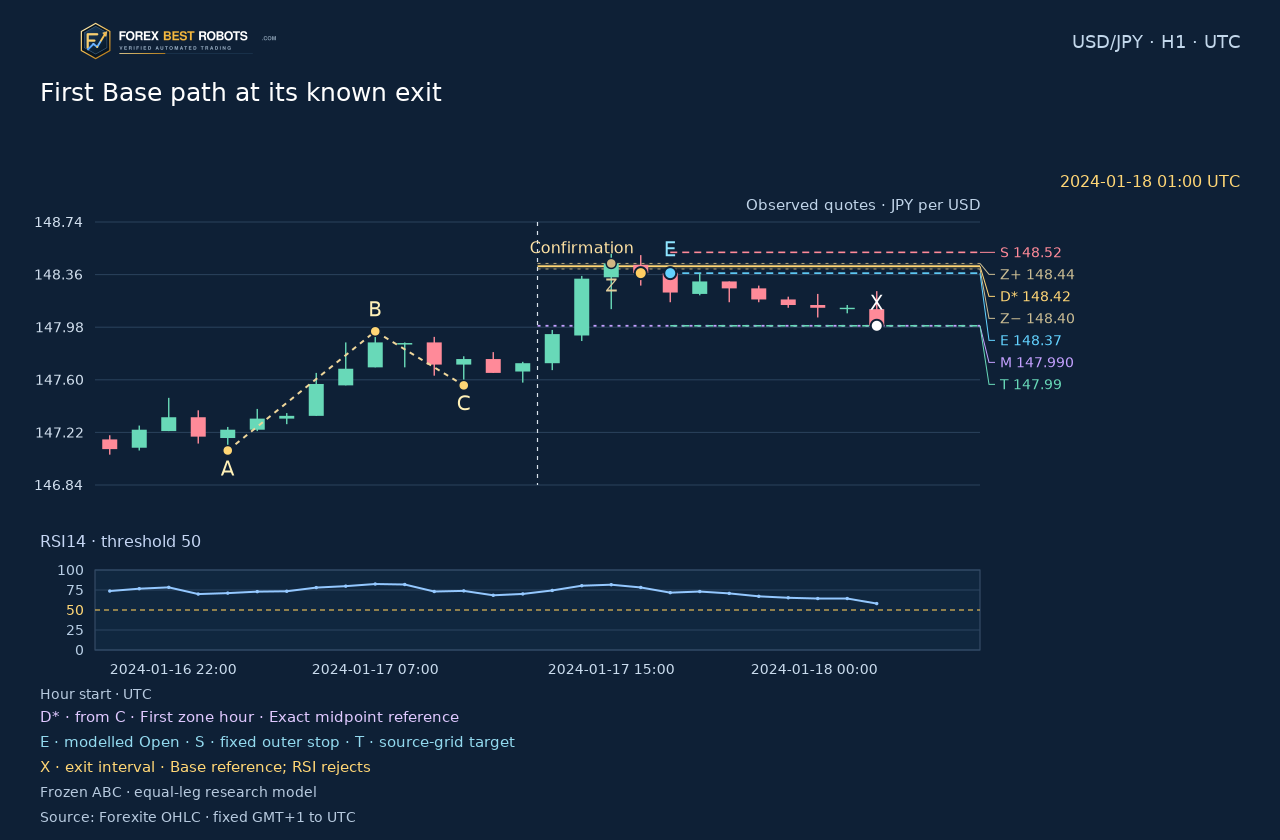
6. Compare RSI on the common Base calendar
After event, confirmation and risk/room checks, sort Base candidates by entry time then construction ID. Every admitted Base entry reserves the fixed half-open interval [entry,entry+24 clock hours). Entry exactly at the preceding window end is allowed.
The reservation remains the same after an early exit, an unknown path or an RSI rejection, without a New Year reset. This is an observation-window convention, not a claim that a position remained open for 24 hours. RSI keeps a subset of this calendar and does not reschedule its own portfolio.
There are 658 immutable ABC constructions but only 17 admitted Base paths. The calendar table includes every cancellation category, including categories with zero occurrences. No later attractive event replaces a failed first attempt.
| Decision state | Constructions |
|---|---|
| Zone already reached/passed before availability | 63 |
| C invalidated before first zone | 356 |
| Fixed outer-D limit reached | 122 |
| Zone passed without observed overlap | 0 |
| No first zone within 24 clock hours | 21 |
| No later confirmation within three hours | 0 |
| Missing/incomplete first-zone hour | 41 |
| Year crossed before first zone | 1 |
| Data ended before first zone | 0 |
| Missing/incomplete confirmation hour | 1 |
| Year crossed before confirmation | 0 |
| Data ended before confirmation | 0 |
| Missing/incomplete next-Open hour | 0 |
| Entry crossed the year | 0 |
| Data ended before next Open | 0 |
| Risk outside the fixed range | 0 |
| Less than 10 pips room | 18 |
| Room smaller than initial risk | 18 |
| Shared 24-hour window blocked entry | 0 |
| Outside declared years | 0 |
| Admitted to common Base calendar | 17 |
7. Keep the Base loss and unavailable RSI result visible
At one 2-pip allowance Base totals -228 pips / -10.619 R across 17 known exits. Its 2024 and 2025 net sums are -99 and -129 pips. Sum of risk-normalized outcomes is reported separately from pips; neither is account return or a compounded portfolio.
RSI admits 0 entries in each year and in the combined period. Display its net, profit factor and win rate as unavailable. An empty set can have an internal mathematical sum of zero, but that zero is not observed trading performance.
All Base paths have known exits here, so no unknown outcome is omitted from this particular Base sum. The sample is still small, retrospective and conditioned on declared source coverage. No out-of-sample success or future profitability follows.
| Period | Model | Allowance · pips | Entries | Known exits | Unknown paths | Net · pips | Net · R |
|---|---|---|---|---|---|---|---|
| 2024 | Base | 2 | 11 | 11 | 0 | -99.00 | -3.931 |
| 2024 | RSI14 subset of Base | 2 | 0 | 0 | 0 | — | — |
| 2025 | Base | 2 | 6 | 6 | 0 | -129.00 | -6.688 |
| 2025 | RSI14 subset of Base | 2 | 0 | 0 | 0 | — | — |
| 2024 + 2025 | Base | 2 | 17 | 17 | 0 | -228.00 | -10.619 |
| 2024 + 2025 | RSI14 subset of Base | 2 | 0 | 0 | 0 | — | — |
8. Deduct one allowance without changing the experiment
Compare 0, 1, 2, 3 and 5 pips as one round-trip allowance per known exit. Deduct it once from gross pips, then divide by that trade’s initial risk for R. These allowances are scenarios, not measured spread, commission or slippage.
Changing allowance moves only arithmetic. The projection, zone, entry, stop, target, calendar and reserved window remain fixed. A rejected RSI candidate has no RSI net value even when its Base reference is a winner.
9. Preserve the verified source clock and incomplete hours
The prepared Forexite input contains 751488 real minute observations and 12530 UTC H1 groups: 12372 complete and 158 partial. Original USD/JPY quotes have two decimals; one pip is 0.01 JPY per USD. Extra arithmetic precision does not create more precise source quotes.
The archive index labels fixed GMT+1. We recover the original local labels from the prior retained Europe/Paris mapping and subtract one hour for UTC, before this protocol was frozen. All prices and row order remain unchanged. Original winter and summer ZIP hashes and all 2880 USD/JPY rows match; the remaining 731 raw daily archives were not reverified.
Minute labels are explicitly treated as interval ends. That convention is an assumption, not proved by the archive index. Partial hours stay in RSI history, without gap/year resets, but required pivot/event/confirmation/entry/holding hours must be complete and adjacent. Never fill missing quotes.
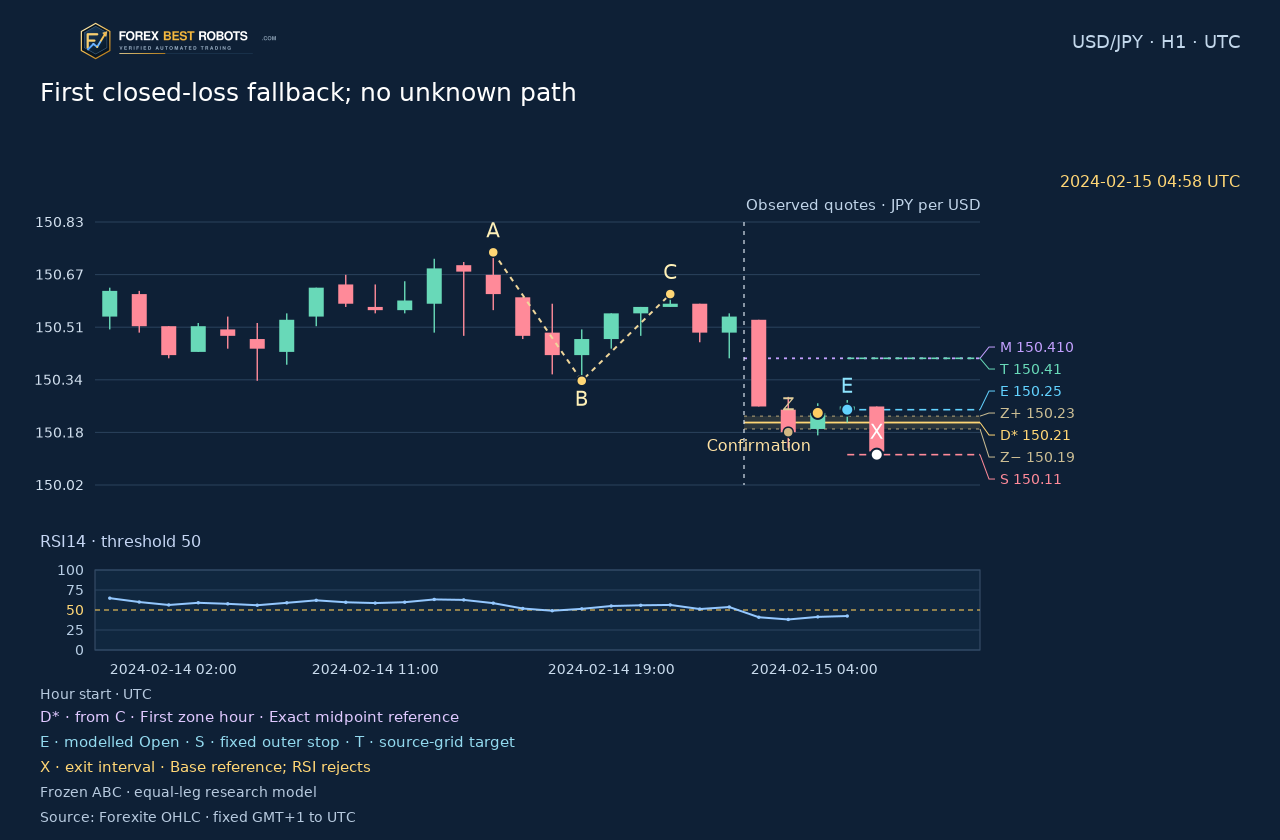
10. Replay minute paths without inventing execution
Hold at most 24 complete consecutive H1 hours, counting the entry hour as one. Check hour completeness and adjacency before inspecting that hour’s minutes. A gap, partial hour, year boundary or data end before a known exit leaves the path unknown. An exit in an earlier complete hour remains final.
Within each minute, check the minute-end year boundary before price events. Then inspect observed Open first: an adverse stop gap uses that Open; a target gap is capped at the model target. Otherwise a single reached barrier uses its model level. If both barriers lie inside the same minute and Open resolves neither, the order is unknown.
Without an earlier barrier, use the 24th complete hour Close, provided the year has not crossed. The recorded minute end identifies an interval, not an exact touch instant. These are one-stream OHLC assumptions; actual Bid/Ask execution and native terminal results are not established.
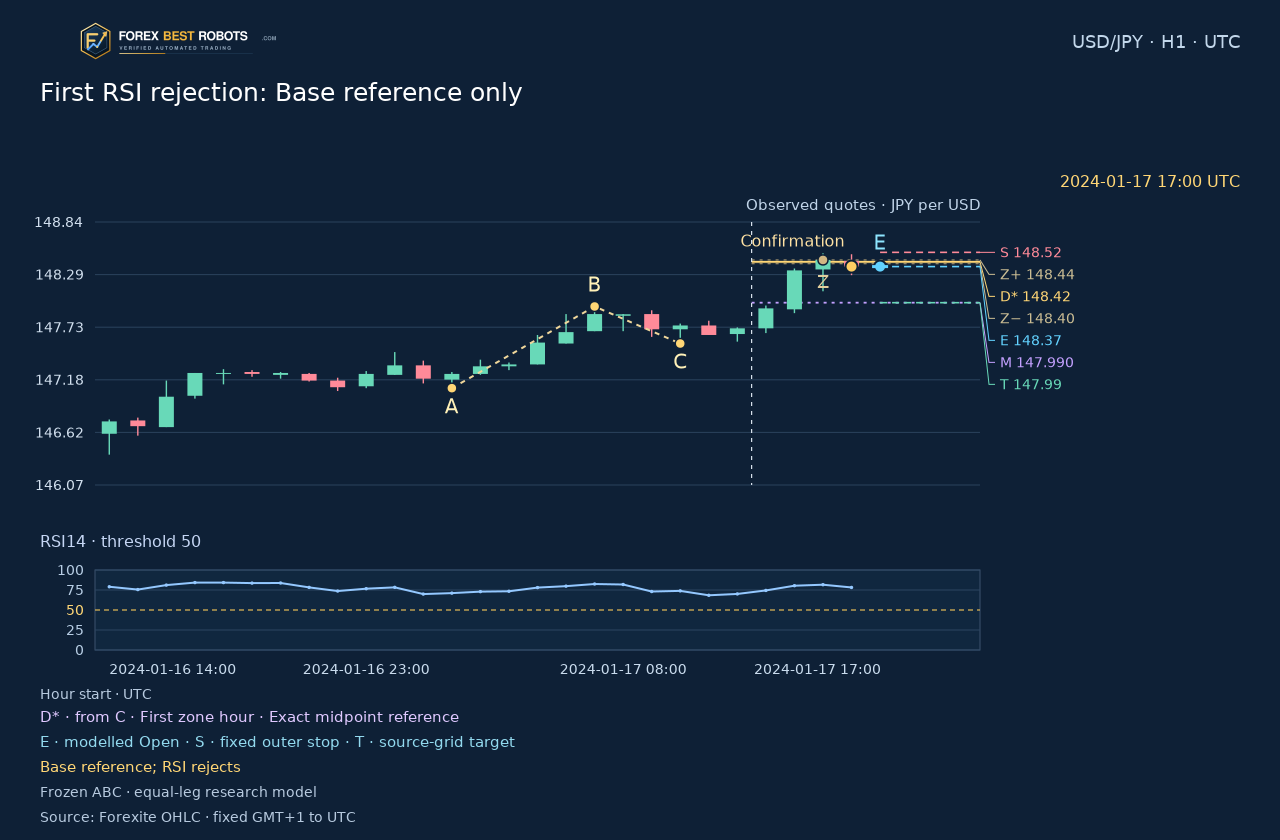
No unknown or time-exit path occurs among the 17 admitted Base examples. The fourth static figure therefore uses the predeclared fallback: first closed loss, ABC #33. It is labelled as an observed loss, never presented as an unknown or invented path.
11. Inspect five explicit decisions and every Base path
Choose a Base construction and follow ABC availability, the first zone hour, a later completed confirmation with RSI, next-Open entry and the known outcome. At entry, only the observed Open is added. A known exit-hour candle uses only the minute prefix through that exit interval.
The projected D*, zone and exact midpoint remain separate from entry and model target. Every candidate in this sample is rejected by RSI, so RSI mode displays the Base reference with no invented filtered trade. The closed-loss shortcut is the declared fallback because no unknown path occurs.
One construction, five explicit steps
Inspect a Base candidate. Separate the projected zone, first interaction, later confirmation and RSI decision, then examine next-Open risk and the actual recorded path.
The interactive replay could not load. Use static charts and the downloadable method.
0/1/2/3/5 are one-time round-trip scenarios, not measured spreads. Costs do not move levels, calendar or reserved windows.
Load a declared example
- Current step
- —
- Information cutoff · UTC
- —
- Which path is displayed
- —
- A · price
- —
- B · price
- —
- C · price
- —
- D* · projected price
- —
- Fixed zone Low
- —
- Fixed zone High
- —
- Exact midpoint reference
- —
- Source-grid target reference
- —
- First zone hour ends · UTC
- —
- Completed confirmation · UTC
- —
- RSI14 at confirmation
- —
- E · modelled entry
- —
- S · stop
- —
- T · model target
- —
- Initial risk · pips
- —
- Remaining room · pips
- —
- Shared window ends · UTC
- —
- Outcome state
- —
- Selected model net · pips
- —
- Selected model net · R
- —
One allowance deducted once. RSI has no admitted trade in this sample; a blank value is not zero return.
Two-decimal quotes. Exact midpoint uses three decimals for arithmetic, not added quote precision. One pip = 0.01 JPY per USD.
On a narrow screen, scroll the chart horizontally; the value cards stay within the page.
No unknown Base path occurs here. The fourth example is the first closed loss. If a replay path were unknown, its net would remain blank.
Show the selected period and cost comparison
| Model | Entries | Known exits | Unknown paths | Net · pips | Net · R |
|---|
Show all Base paths and RSI rejections at this allowance
| ABC | Entry UTC | Direction | RSI14 | Outcome | Net · pips |
|---|
Show this construction’s arithmetic
Questions about the equal-leg reversal test
Is this the full harmonic AB=CD pattern?
No. This is our declared equal-leg research model with D*=C+(B−A), confirmed pivots and a fixed C retracement gate. It does not claim the complete branded pattern, all reciprocal projections, timing rules or a certified reversal.
Why are there no RSI trades?
On each first eligible confirmation, the frozen long RSI ≥ 50 or short RSI ≤ 50 condition fails. All 17 Base candidates are rejected. We keep the protocol unchanged; the RSI result is unavailable, not zero return or proof of a successful filter.
Does the zone overlap prove a fill at D*?
No. A completed H1 range overlapping the zone is an observation event. D* is a projected price, and entry is a later observed Open after a separate confirmation. One-stream OHLC does not prove a Bid/Ask fill or exact touch time.
Why does the exact midpoint differ from T?
The arithmetic midpoint can lie between two original 0.01 quotes. The target is rounded toward entry to the actual source grid. This declared rounding is part of the model; extra formula decimals do not add quote precision.
Is every admission knowable at the entry Open?
No. The price rules use completed information and the next Open, but the study also requires complete coverage of that next H1 hour. That data-quality gate is checked retrospectively. It must not be represented as information available to a live trader at Open.
Can we call an empty RSI sample profitable?
No. With 0 entries there is no filtered outcome sample, win rate or return to evaluate. Base net totals -228 pips at the 2-pip allowance in this small historical test. Neither finding proves future profitability.
Data, method and complete first-attempt calendar
The downloads preserve every ABC decision and every admitted Base path, including all RSI rejections. The method ZIP reconstructs the source clock and contains two original independently written replay scripts with boundary checks. Synthetic fixtures test rules; they never supply the observed charts.
No terminal or account is needed to read the article or use its controls. The offline method explains assumptions and reproducibility; it does not verify native-platform, Bid/Ask or broker execution.
- Complete first-zone/reversal calendar · CSV
- Every admitted Base path · CSV
- Period, model and one-time cost scenarios · CSV
- Source, protocol and offline replay · ZIP