

This test waits for confirmed A/B/C, freezes a two-point 1.272 extension from A through B and uses the first completed close beyond it. ADX14 filters that same candidate. Its retained closed subset improves in this sample, but three unknown paths and very few outcomes prevent a conclusion about full strategy profitability.
1. Separate a better closed subset from a complete result
Base admits 12 entries: 9 resolved and 3 unknown. ADX14 keeps 9, with 6 resolved and 3 unknown. At a single 2-pip round-trip allowance, the combined closed-only sums are -6 pips / -1.209 R for Base and +61 pips / +0.500 R for ADX14.
That is an improvement within the small resolved subset. It is not the complete result of either model, because all three unknown paths remain outside those sums. The test does not establish future profitability, an account return or a general advantage of adding ADX to Fibonacci levels.
2. Freeze confirmed A/B/C and name the extension origin
Use strict two-left/two-right pivots on five complete consecutive H1 groups. Equal comparisons fail that pivot type; a center qualifying as both high and low is discarded. A pivot becomes available only after its second right-hand hour ends. Same-type working pivots are replaced only by strictly more extreme ones, and already emitted A/B/C sets never move.
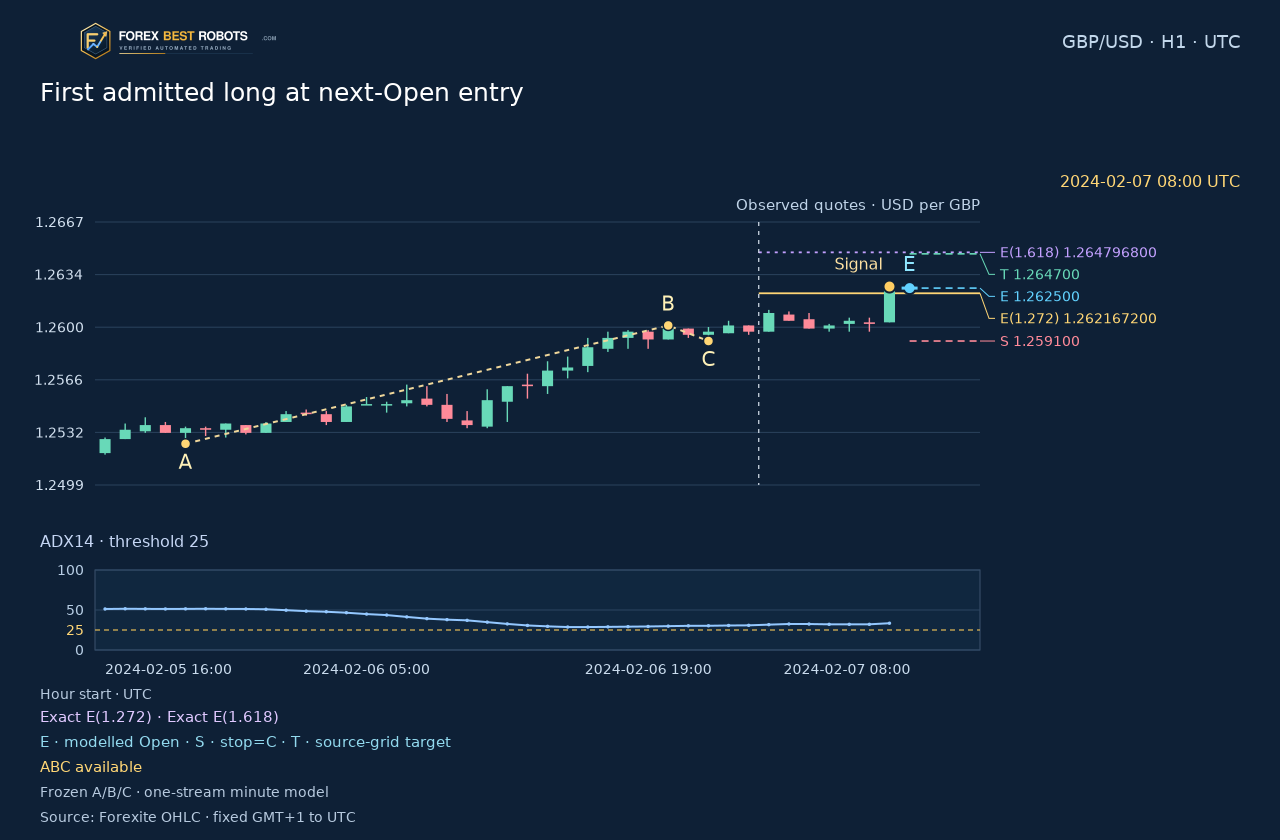
A candidate requires a correctly signed A-to-B leg of at least 30 pips, C strictly between A and B, complete consecutive coverage from A through C confirmation, and at least 200 recorded groups of indicator history. Both levels use E(q) = A + q × (B − A). C confirms the selected construction and later supplies the stop; it is not the origin of the extension formula.
E(q) = A + q × (B − A)
q ∈ {1.272, 1.618}
1 pip = 0.0001 USD/GBP| A · USD per GBP | B · USD per GBP | C · USD per GBP | ABC known · UTC | Exact E(1.272) | Exact E(1.618) | Grid target |
|---|---|---|---|---|---|---|
| 1.252500 | 1.260100 | 1.259100 | 2024-02-07 01:00 | 1.262167200 | 1.264796800 | 1.264700 |
3. Use the first completed close beyond 1.272
At activation, inspect completed hours after B’s center through C confirmation. A close at or beyond E(1.272) in the leg’s direction consumes that construction before a new entry can be considered. A wick passing the level without such a close does not consume this close-based candidate.
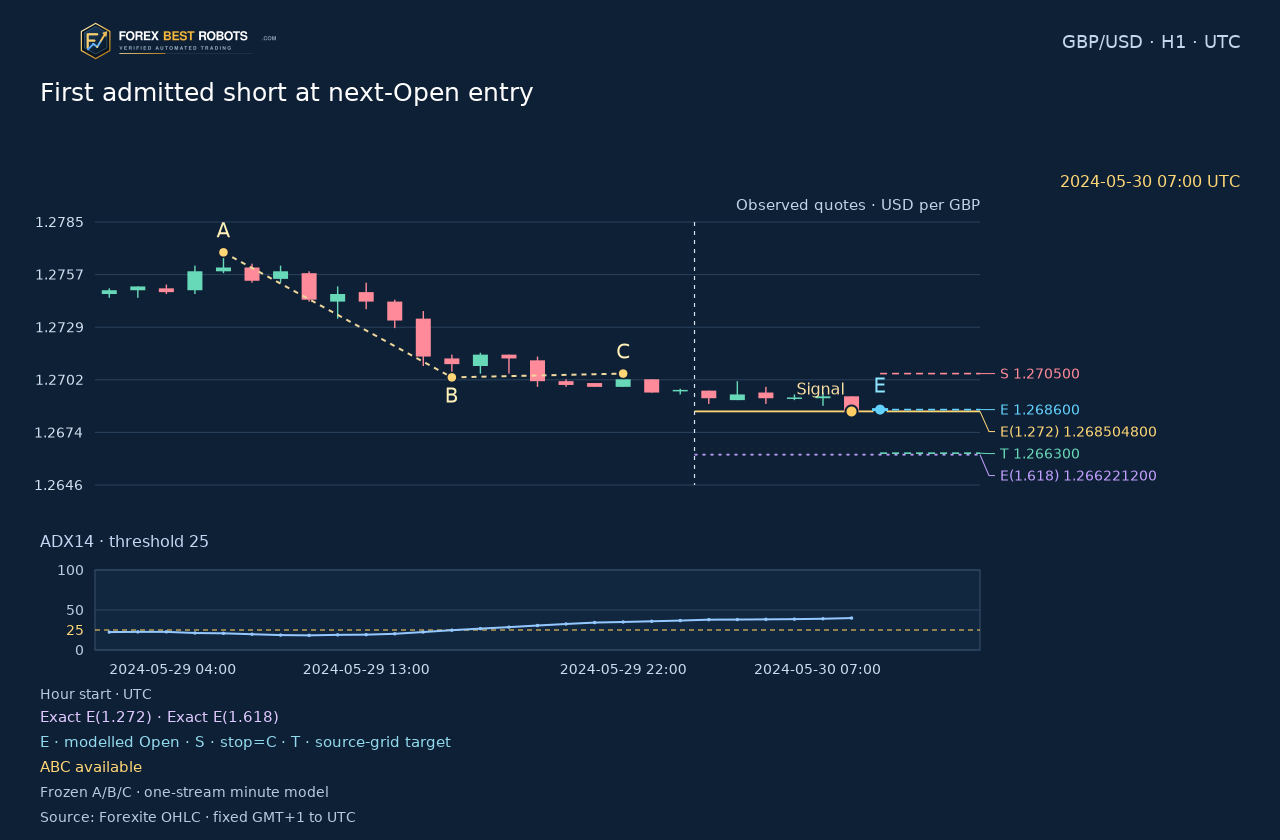
Otherwise search the next 12 clock hours. The first strict Close beyond the exact level is the signal; equality after activation is not a signal by itself. No candle-body direction or extra breakout buffer is required. Missing or incomplete coverage cancels first, then a year boundary, then C invalidation: a long-side Low ≤ C or short-side High ≥ C cancels even if that hour would also confirm a breakout.
4. Check ADX14 on the same completed signal hour
The replay declares Wilder-style 14-period smoothing. Seed smoothed True Range and directional-movement sums from groups 1–14; ties in directional movement set both sides to zero. Build DX from the directional indicators, seed ADX as the mean of DX 14–27, then update ADX = (13 × previous ADX + DX) /14. Partial groups stay in indicator history; gaps and New Year do not reset it.
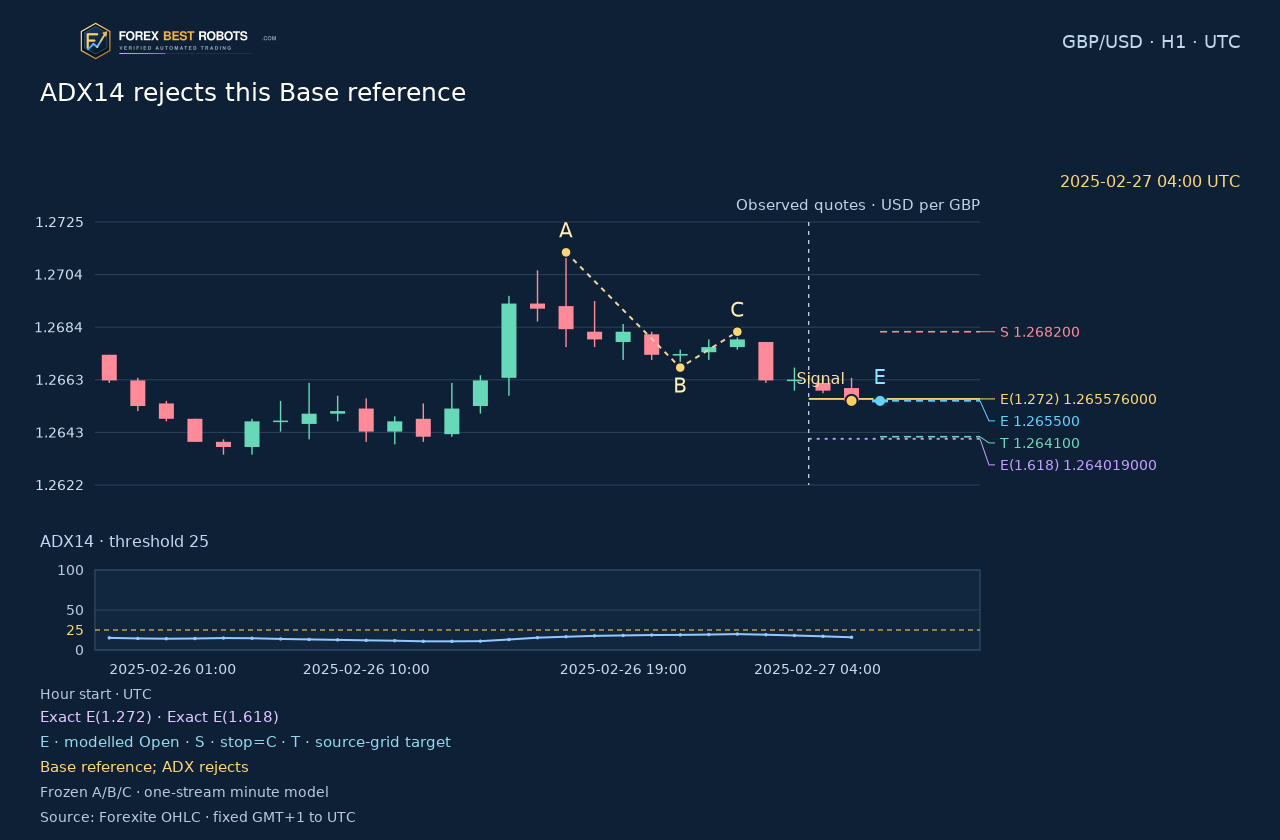
Retain the Base candidate when its signal-hour ADX14, quantized to 12 decimal places with half-even rounding, is at least 25. Equality is allowed. No ADX slope, DI direction or DI crossover is added. The price trigger and the ADX decision use the same completed hour; the separate interactive steps do not insert an extra waiting candle. This declared smoothing is not a claim of native terminal parity.
5. Use the next Open and check room to the grid target
Entry is the next complete adjacent H1 group’s observed Open, with stop at C. Initial risk must be between 5 and 150 pips inclusive. The source-grid target must leave at least 5 pips and at least 0.5 times the initial risk. An entry that fails either test is finished; no later replacement is allowed. The next Open may gap back inside E(1.272): this protocol adds no second beyond-level test at entry.
E(1.618) is an exact theoretical price reference. Before testing entry room, round it toward the potential entry on the four-decimal source grid: down for a long and up for a short. The resulting model target T is distinct from that fractional reference. The table and value cards show both. Neither a calculated reference nor a model barrier is represented as a verified Bid/Ask fill.
6. Reserve the same 24-hour window for both models
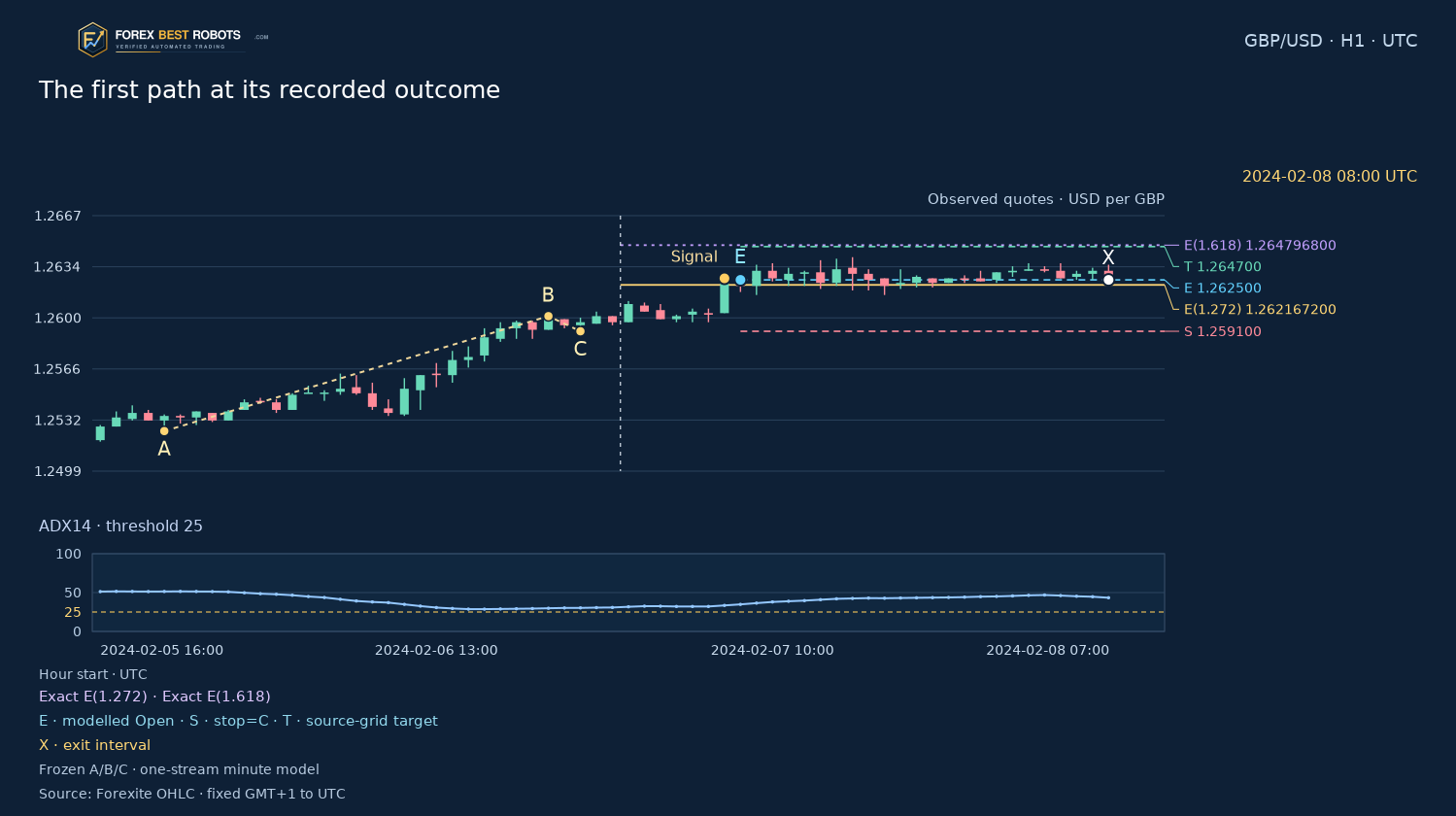
Sort valid first-entry candidates by entry time, then A/B/C identifier. Every admitted Base candidate reserves the half-open interval from entry through entry plus 24 clock hours. A new candidate can start exactly at that window’s end. Early exits, unknown paths and ADX rejections do not shorten the reservation or change which later candidates are admitted.
These are disjoint predefined research observation windows, not a separately rescheduled live portfolio. An unknown result stays unknown, while its planned observation window still ends by design; that is not an invented exit. The 718 frozen constructions and every cancellation remain in the downloadable calendar. Rules are held fixed across both historical years.
| Decision | Constructions |
|---|---|
| Close already at/beyond 1.272 before activation | 37 |
| No first close beyond within 12 hours | 99 |
| Missing/incomplete event hour | 41 |
| Missing/incomplete next entry hour | 0 |
| C invalidated before entry | 413 |
| Signal crosses year boundary | 0 |
| Risk outside 5–150 pips | 1 |
| Less than 5 pips to grid target | 25 |
| Remaining room below 0.5 initial R | 90 |
| Inside the reserved 24-hour window | 0 |
| Admitted Base entry | 12 |
7. Keep years, risk units and unknowns visible
In 2024 both models have only two resolved outcomes and two unknown paths; at 2 pips the closed-only sum is −23 pips for each. In 2025 Base has +17 closed-only pips but -0.045 R, while ADX14 has +84 pips / +1.664 R. An unknown path remains in each 2025 model. These are small historical subsets, not independent evidence of future performance.
Pips and R can disagree because the initial stop distances differ between trades. Summing net R values does not produce an account percentage, compounded balance or drawdown. Wins, losses and net values in the tables use resolved paths only; entry counts include unknown paths. A group with no resolved outcome is displayed as unavailable rather than break-even.
| Period | Model | Cost · pips | Entries | Closed | Unknown | Net · pips | Net · R |
|---|---|---|---|---|---|---|---|
| 2024 | Base | 2 | 4 | 2 | 2 | -23.00 | -1.164 |
| 2024 | ADX14 | 2 | 4 | 2 | 2 | -23.00 | -1.164 |
| 2025 | Base | 2 | 8 | 7 | 1 | +17.00 | -0.045 |
| 2025 | ADX14 | 2 | 5 | 4 | 1 | +84.00 | +1.664 |
| 2024 + 2025 | Base | 2 | 12 | 9 | 3 | -6.00 | -1.209 |
| 2024 + 2025 | ADX14 | 2 | 9 | 6 | 3 | +61.00 | +0.500 |
8. Deduct one allowance without moving any level
Compare one round-trip allowance of 0,1,2,3 or 5 pips. Subtract it once from each resolved directional price difference, then divide by initial risk for net R. The signal, entry, stop, rounded target, calendar and unknown status remain fixed. These are scenario allowances, not measured spreads, actual commissions or complete slippage and financing models.
In this sample the filter removes two losing closed paths and one winning closed path. The first rejected admitted candidate is shown by the predeclared illustration rule; it alone cannot prove that rejection is useful. The full Base table keeps the omitted winner visible. Assess the retained closed sum together with the unknown count and the number of outcomes.
9. Use the source clock and preserve missing observations
The retained GBP/USD input contains 751496 real minute records and 12530 H1 groups: 12375 complete and 155 partial. Source labels use fixed GMT+1; subtract one hour for UTC. The earlier retained Paris summer-time conversion was inverted before this test, preserving every quote and its order. A winter and a summer original archive were reverified against saved hashes and raw rows; the remaining archives were not downloaded again.
End-labelled minute intervals are an explicit research assumption. Original quotes have four decimals; one pip = 0.0001 USD per GBP. No missing quotes or hours are invented. During a position, require a complete adjacent holding hour before inspecting its minutes. An exit already resolved in an earlier complete hour stays final; a missing required hour or year boundary before a known exit makes the open path unknown.
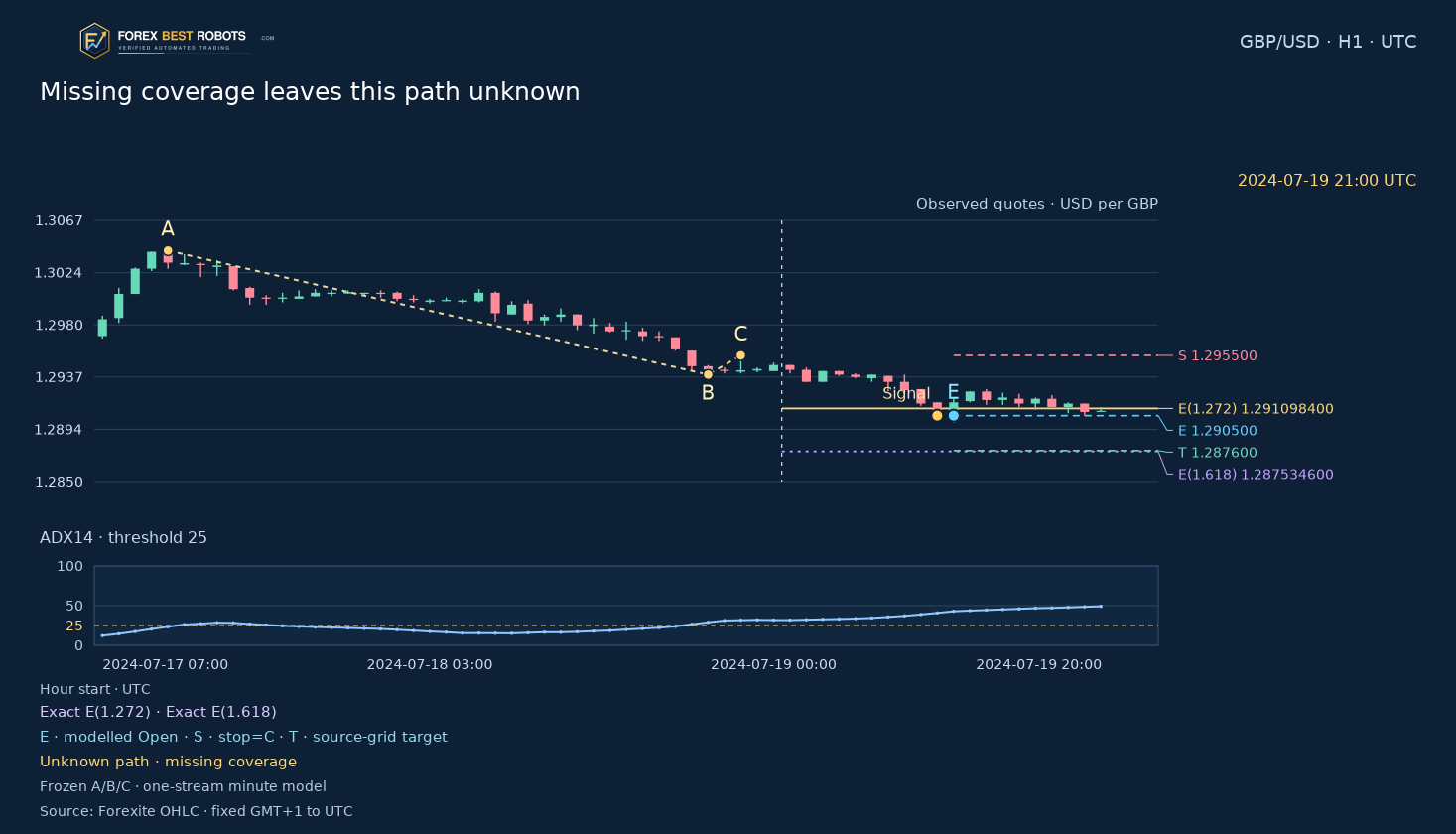
10. Replay observed minutes without inventing their order
Hold for at most 24 complete consecutive hours, counting the entry hour. Test each minute’s Open before its range. An adverse stop gap uses that observed Open; a target gap receives only the grid target. A single barrier inside the range resolves that model exit. If both barriers lie within one minute and Open resolved neither, the path is unknown. If no barrier resolves, exit at the final Close of hour 24.
The exit timestamp identifies the recorded minute interval, not an exact touch instant. Both 2024 and 2025 are historical. The protocol was saved before this replay, but the later year is not called live forward trading or a certified unseen holdout. Independent agreement checks implementation on these observations; it cannot supply missing prices or make a tiny sample reliable.
11. Inspect five labelled decisions
Choose an admitted Base candidate, model and cost allowance. Move through confirmed A/B/C, the first completed breakout, ADX on that same signal hour, next-Open entry and the final known or unknown cutoff. Before entry, its complete future candle is hidden: only the observed entry Open is added. An exit-hour candle uses only the minute prefix known through the displayed exit interval.
The exact 1.272 and 1.618 references stay separate from the grid target and the model entry. ADX-rejected cases remain available as clearly labelled Base reference paths, with no invented ADX trade result. Before the outcome step the final net value is hidden. Costs change resolved arithmetic only; unknown paths keep a blank net value.
One construction, five explicit steps
Choose a Base-calendar candidate. Separate the completed price signal from ADX on that same hour, then inspect next-Open risk and the recorded path.
The interactive replay could not load. Use static charts and the downloadable method.
0/1/2/3/5 are one-time round-trip scenarios, not measured spreads. Costs do not move the original levels, calendar or reserved window.
Load a declared example
- Current step
- —
- Information cutoff · UTC
- —
- Which path is displayed
- —
- A · price
- —
- B · price
- —
- C · price
- —
- Exact E(1.272) · price
- —
- Exact E(1.618) · price
- —
- Source-grid target reference
- —
- Completed breakout · UTC
- —
- ADX14 at the signal
- —
- E · modelled entry
- —
- S · stop
- —
- T · model target
- —
- Initial risk · pips
- —
- Remaining room · pips
- —
- Shared window ends · UTC
- —
- Outcome state
- —
- Selected model net · pips
- —
- Selected model net · R
- —
Resolved-only result. Allowance deducted once; not an account return.
Four-decimal quotes. Exact extensions use nine decimals for arithmetic, not added quote precision. The model target uses the 0.0001 source grid.
On a narrow screen, scroll the chart horizontally; the value cards stay within the page.
Unknown stays unknown. The fixed 24-hour observation window ends by design; that does not invent a missing exit.
Show the selected period and cost comparison
| Model | Entries | Closed | Unknown | Net · pips | Net · R |
|---|
Show every admitted Base path at this allowance
| ABC | Entry UTC | Direction | ADX14 | Outcome | Net · pips |
|---|
Show this construction’s arithmetic
Questions about the continuation test
Why wait for C when a two-point extension needs only A and B?
The formula needs only A/B, but this test deliberately waits for a complete confirmed A/B/C construction so its stop and availability are fixed before searching for the first breakout.
Is 1.272 measured from C here?
No. E(1.272) = A +1.272 × (B − A). A projection from C is a different construction and would produce another price.
Does the positive ADX closed sum prove the strategy is profitable?
No. It is a small resolved-only subset, while three paths remain unknown. It establishes neither a complete historical result nor future profitability.
Why round the 1.618 target?
The source prices lie on a 0.0001 grid. The model rounds the theoretical reference toward entry and checks room to that grid target. It does not assert execution at a fractional price never quoted in the source.
Can an early exit or unknown path free the next entry sooner?
No. Both models use the same full 24-hour reservation. The window ends by a predefined research rule even if a path stays unresolved; no unknown exit is invented.
Does ADX add a second confirmation candle or a DI crossover?
No. ADX14 ≥ 25 is evaluated on the same completed hour as the first close beyond E(1.272). This test adds neither another waiting hour nor a DI condition.
Data, frozen rules and reproducible results
The unchanged price observations, original retained timestamp file, explicit fixed-GMT+1 correction, two reverified sample archives, input hashes, frozen numerical protocol, full calendar, admitted paths and cost rows are included in the method download.
Two separately written implementations rebuild the groups, declared ADX smoothing, immutable anchors, first decisions, minute paths and shared reservations. The reference uses higher decimal precision and checks meaningful boundary scenarios. Agreement does not imply native platform parity or real execution.
All plotted candles are real observations. First-long, first-short and first-rejected examples follow the declared selection order. The unknown and completed-outcome illustrations use later information deliberately and are labelled retrospective.
- Download all first-breakout decisions · CSV
- Download admitted Base paths · CSV
- Download all cost scenarios · CSV
- Download inputs, fixed rules and both replays · ZIP