

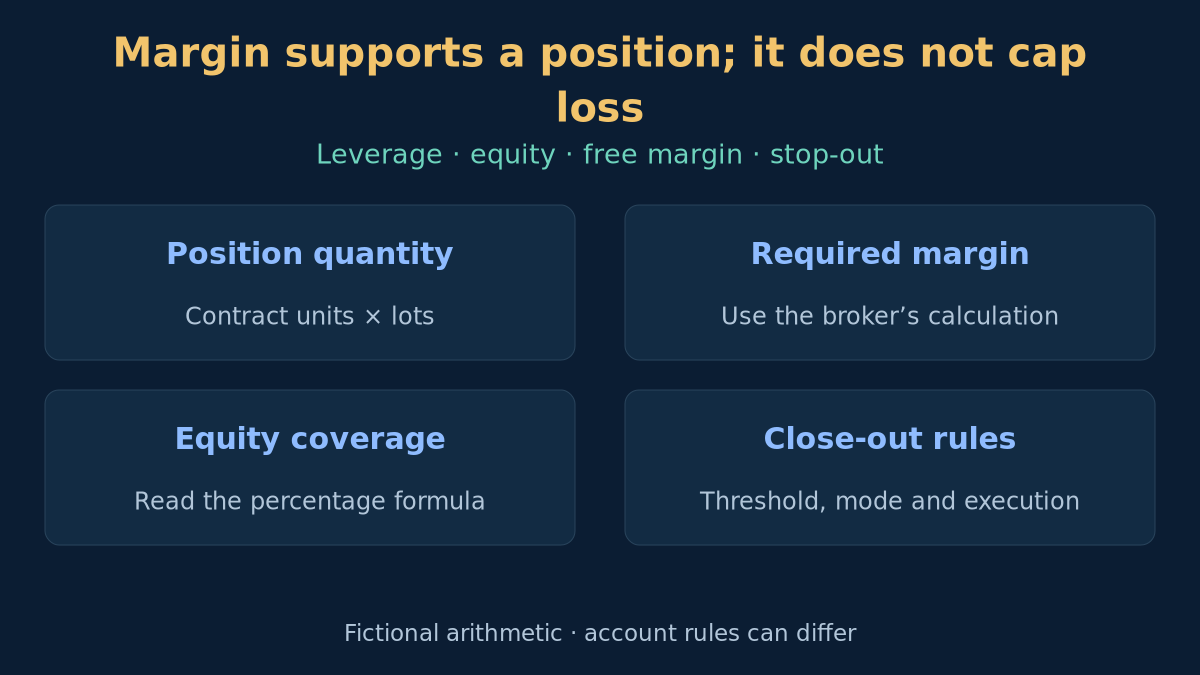
A small margin requirement can support a large cash exposure. This guide connects lot quantity to required margin, explains the account fields and distinguishes a warning from forced closure. The numerical cases deliberately separate leverage, falling equity and margin released by closing a position. They are calculations with stated assumptions, not a live margin calculator, a trading setup or a recommendation to increase leverage.
1. Margin and leverage describe different things
Required margin is the collateral the account must support for its positions under the broker’s rules. Leverage expresses a relationship between position value and required collateral in a simplified model. With leverage 1:100, the reciprocal margin rate is 1%. Neither number states how much a position can lose. A stop, position quantity, prices, costs and account conditions determine a different set of risks.
First establish the actual contract and lot quantity. The examples assume linear EURUSD with 100000 EUR per lot and 0.20 lot, giving 20000 EUR. For arithmetic only, value 1 EUR at 1.10000 USD, so the position is worth $22000. This is an assumed margin valuation, not a cash-exchange quote or a claim that a broker uses a chart close. Verify the symbol and contract specifications.
2. Compare leverage while keeping the position unchanged
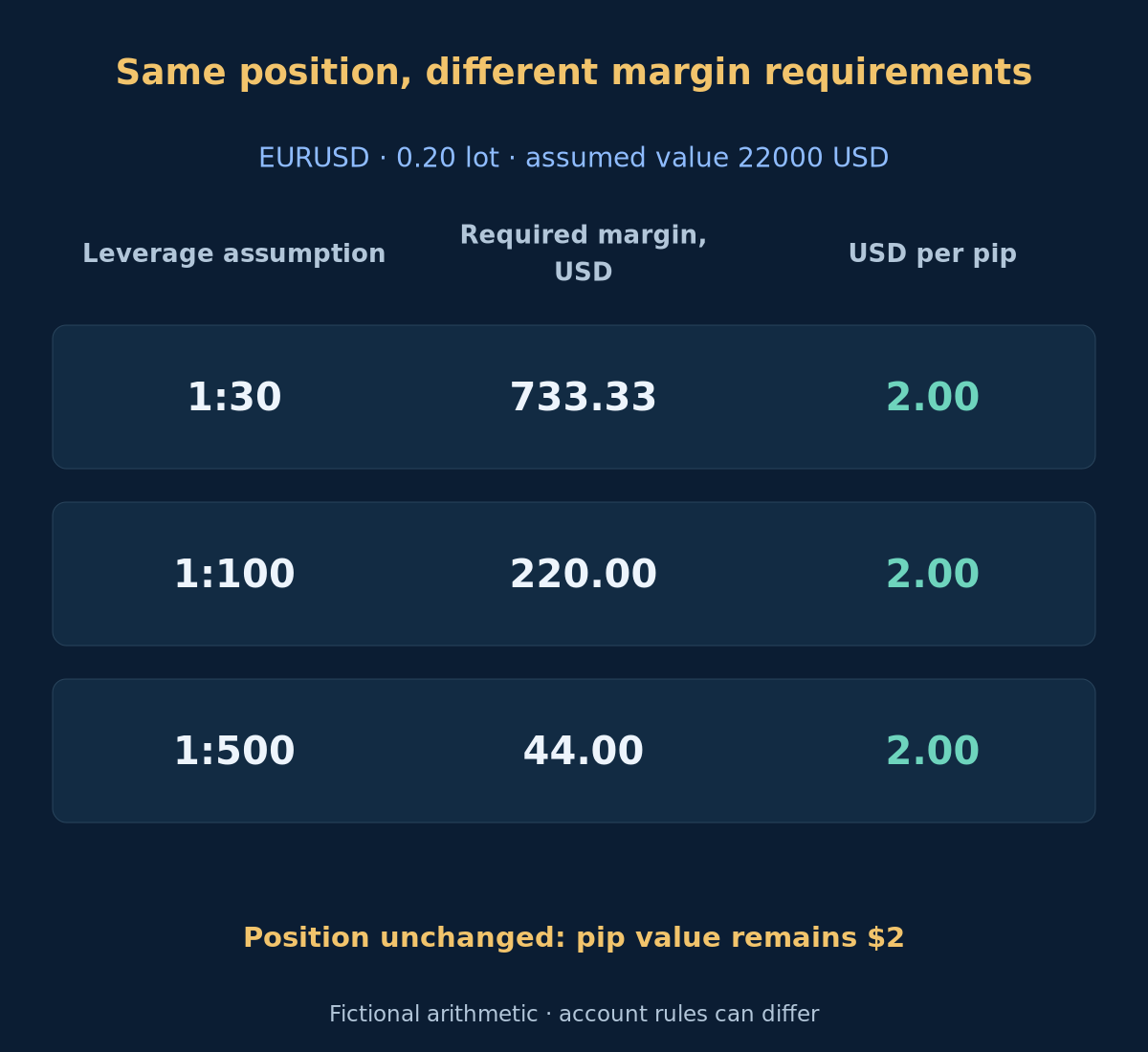
For the simple model, divide the position value in account currency by leverage. $22000 / 100 gives $220 of required margin. At 1:30 the result is about $733.33; at 1:500 it is $44. These illustrative leverage choices are not statements about legal limits or any broker’s available settings. Tiered or instrument-specific rules can override the shortcut.
| Leverage assumption | Required margin, USD | USD per pip |
|---|---|---|
| 1:30 | 733.33 | 2.00 |
| 1:100 | 220.00 | 2.00 |
| 1:500 | 44.00 | 2.00 |
The same 0.20 lot still represents the same EURUSD quantity. With a pip of 0.0001 and a USD account, its pip value stays $2 at all three leverage settings. Lower margin is not lower price-loss exposure. With equity of $1000, the $22000 position has effective exposure of 22:1, distinct from an account setting of 1:100. Review pip value and risk-based lot sizing before interpreting spare margin as capacity to trade.
3. Read balance, equity, used margin and free margin
Balance records posted account results. Equity includes the account’s current marked-to-market results under its calculation rules. In the simplified example, there are no credits or other adjustments: equity E equals balance plus floating profit or loss. A $1000 balance with a floating loss of $500 gives equity of $500. Do not use balance alone to judge the support for open positions.
Let M be used margin. Under the displayed coverage model, free margin is E - M and margin level is E / M × 100% when M is positive. With E = $1000 and M = $220, these are $780 and 454.55%. When M is zero, do not divide by zero or treat the missing ratio as a trading signal. The actual server’s equity, free-margin and margin rules remain authoritative.
4. Distinguish a margin warning from stop-out
A margin call or warning indicates a margin condition defined by the provider. Stop-out means the broker may automatically close positions according to its rules. A warning is not a promise of a telephone call, extra time or a guaranteed execution price. Read the threshold, formula, notification policy and closure process for the exact account; do not assume every account warns at 100% or closes at 50%.
Some interfaces show equity divided by margin, which falls as equity falls. Others show a differently defined margin-utilisation or close-out percentage that rises as the account approaches its limit. Similar percentage labels can describe different ratios. Compare the written formula and account rules, not just a displayed number. Our ladder uses the equity/used-margin coverage formula only.
5. Follow a fixed-margin arithmetic ladder
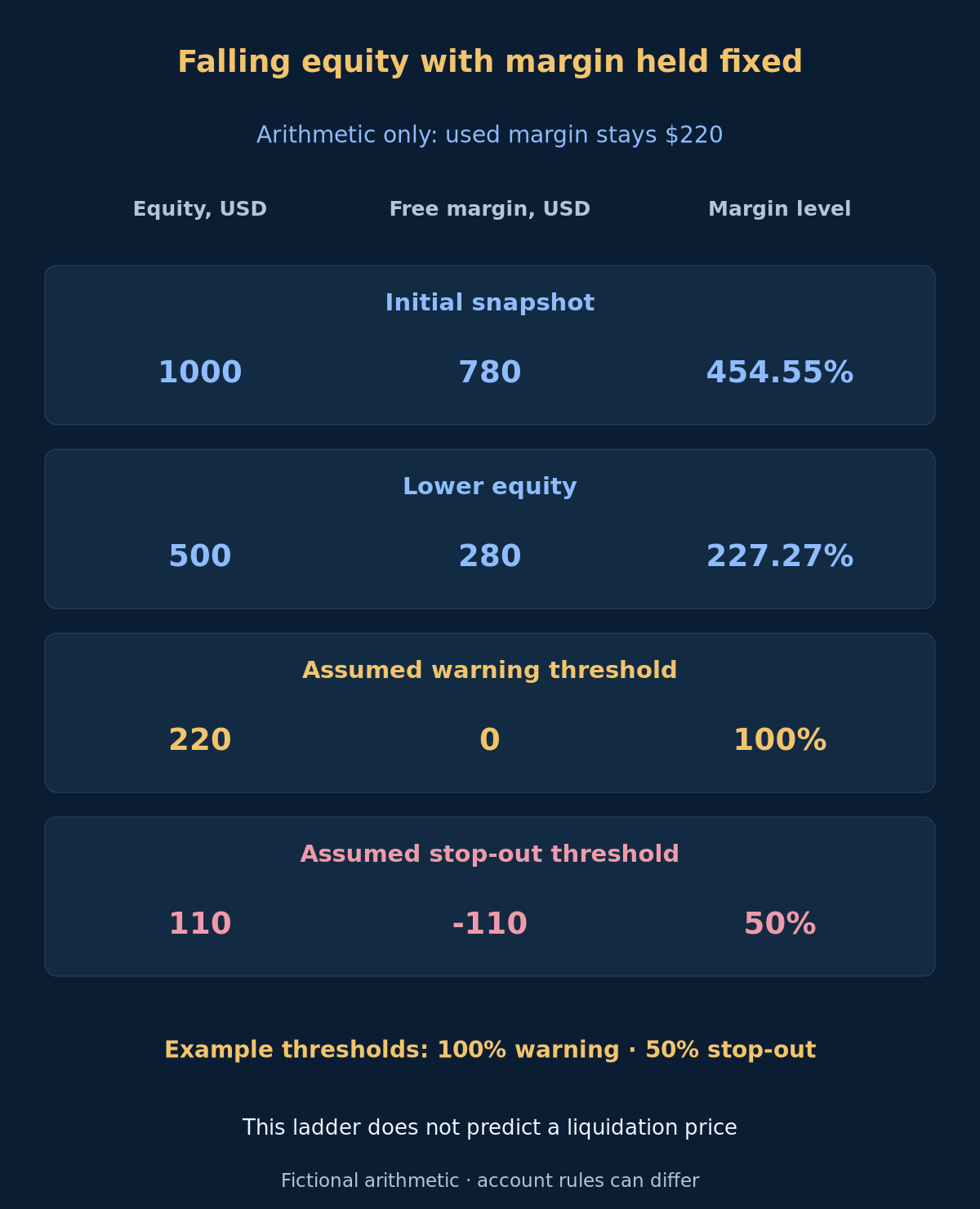
Assume used margin stays $220, with a hypothetical warning threshold of 100% and stop-out threshold of 50%. Equity of $1000 gives 454.55%; $500 gives 227.27%; $220 gives 100%; $110 gives 50%. Free margin is respectively $780, $280, $0 and -$110. Negative free margin and the percentage stop-out threshold are different conditions in this example.
| Equity, USD | Free margin, USD | Margin level |
|---|---|---|
| 1000 | 780 | 454.55% |
| 500 | 280 | 227.27% |
| 220 | 0 | 100% |
| 110 | -110 | 50% |
The ladder freezes margin only to isolate the arithmetic. Real required margin can change with valuation rates, position size, margin tiers and broker settings. There is no universal EURUSD liquidation price implied by these rows. Spreads, gaps, fees, other positions and execution timing can change the outcome. Manage the cash-loss budget separately instead of treating stop-out as a planned exit.
6. Releasing margin does not create a profit
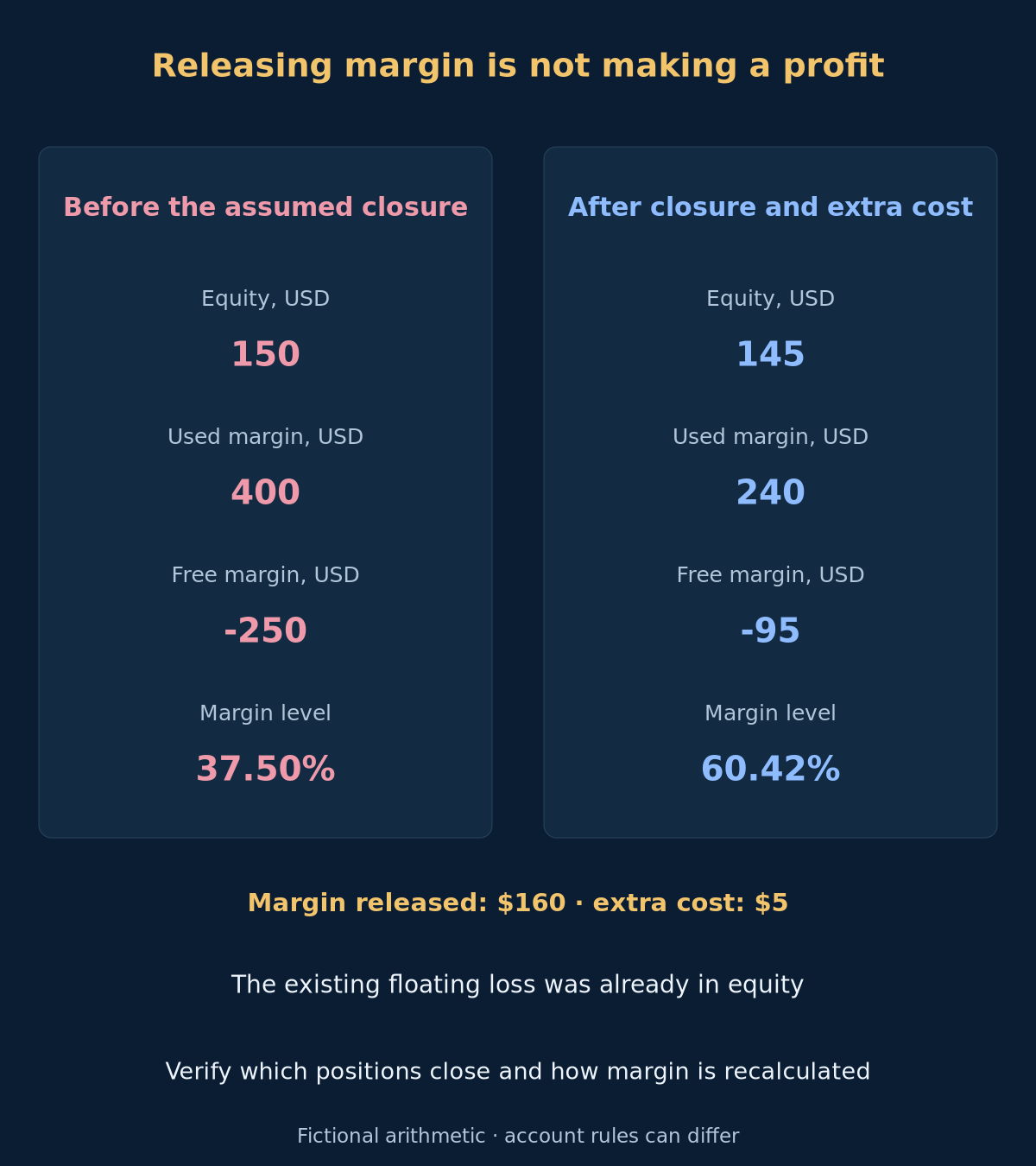
In a separate example, equity is $150 and used margin $400, giving 37.50% coverage. Suppose closing a position releases $160 of margin, adds $5 of costs and causes no further price movement. The resulting equity is $145 and margin $240: coverage becomes 60.42%. Free margin moves from -$250 to -$95. This illustrates the accounting, not which position a broker will close or whether liquidation will stop.
The position’s existing floating loss was already included in equity before closure. Realising that same loss transfers it into posted account results; do not subtract it from equity again. Additional execution loss or fees can reduce equity further. Margin released is collateral no longer required, not income. A real broker may close part of a position, several positions or all eligible positions under its account-specific process.
7. A position stop and account stop-out are separate
A position’s stop-loss refers to that position’s price-based exit instruction. Account stop-out is a collateral process across the account. Another position’s loss or a higher margin requirement can put the account under pressure before a particular stop is reached. Ordinary stops can also slip or encounter a gap. Do not infer guaranteed maximum loss or balance protection merely from a stop-out percentage.
Pending orders can add exposure when triggered. Opposite positions may still carry margin, spread, financing and closure risk; hedging does not automatically make margin zero. Consider combined exposure and the broker’s treatment of offsets before adding an EA or another pair. The cost assumptions and the lot-size budget still apply when there appears to be free margin.
8. Verify MT4 fields and stop-out mode
Read the current account’s equity, margin, free margin, leverage and stop-out settings together. MetaQuotes distinguishes AccountStopoutMode() = 0, a percentage calculation, from mode 1, an absolute free-margin comparison. Read AccountStopoutLevel() with its mode and units; a returned 50 is not automatically 50%. Confirm the provider’s operative policy as well as terminal values.
AccountFreeMarginCheck estimates free margin after a proposed BUY or SELL volume at current prices. It is not a guarantee of future margin, a loss cap or the eventual fill. MT4’s equity calculation depends on server settings. Missing, stale or inconsistent values require investigation. Linked platforms can use a provider’s separate system of record, so resolve differences with the actual account rules.
9. Check tiers, valuation and account-specific rules
The shortcut M = position value / leverage assumes a matching margin model and currency conversion. The margin currency need not be the quote or account currency. Obtain the broker’s valuation method and rates, then convert units consistently. Initial and maintenance requirements, instrument rates and volume tiers may differ. Do not extend the Forex example automatically to metals, indices or other contracts.
Record how offsets, weekend or event-related changes, pending orders and unavailable markets are handled. A close-out process may not be able to trade a suspended instrument immediately. Do not assume that adding funds, changing a leverage setting or placing an opposite order will execute in time. These are account-specific mechanics to verify, not a universal rescue procedure.
10. Keep an account-support checklist
Record the symbol, contract units, volume, account currency, valuation inputs, margin model and current equity. Then note used and free margin, the exact percentage formula, warning and stop-out rules, exposure from pending orders and the separate planned loss budget. Review the record after a fill, price shock, volume change or change in broker requirements.
Use a demo account to compare a small, verified example with the terminal and provider statements. Test the zero-margin case, a falling-equity case and the accounting after closure. A successful calculation is not evidence of strategy profitability or execution quality. This completes the cluster: pip value measures money per price unit, lot sizing chooses quantity from an explicit budget, and margin rules govern collateral support.
Optional: unit-checked equations for the examples
These are educational equations, not executable EA code. They assume the stated margin model and valuation. The equity ladder freezes used margin; the separate closure example assumes no price movement and only the specified extra cost.
base_units = 100000 × 0.20 = 20000 EUR
N = 20000 EUR × 1.10000 USD/EUR = 22000 USD
M = N / leverage = 22000 / 100 = 220 USD
pip_value = 100000 × 0.20 × 0.0001 = 2 USD/pip
E = balance + floating_PnL; FM = E − M
ML = E / M × 100%; only when M > 0
E = 110 USD; M = 220 USD; FM = −110 USD; ML = 50%
closure: E_after = 150 − 5 = 145 USD; M_after = 400 − 160 = 240 USD
ML_after = 145 / 240 × 100% ≈ 60.42%; FM_after = 145 − 240 = −95 USD
AccountStopoutMode(): 0 = percentage; 1 = absolute free-margin comparison
11. Forex margin and leverage questions
Does higher leverage reduce the loss per pip?
Not for an unchanged position and conversion basis. In the example, 0.20 lot has a pip value of $2 under all leverage settings. Required margin changes; the position’s price sensitivity does not.
Does zero free margin always mean stop-out?
No universal conclusion follows. In the percentage example, zero free margin means equity equals used margin and coverage is 100%, while the assumed stop-out threshold is 50%. Other modes and provider rules may differ.
Is margin level the same as a margin close-out percentage?
Not necessarily. Interfaces can use different numerators and denominators, so one measure may fall while another rises as the account weakens. Read the formula and threshold for the exact account.
Is released margin a profit after closing a losing position?
No. It is collateral no longer required. Equity already includes the floating result before closure; only additional changes such as price movement or costs alter that value in the simplified comparison. Do not count the same loss twice.
12. Sources and scope
Primary references: MetaQuotes stop-out modes, stop-out level, AccountFreeMarginCheck, server-dependent equity, OANDA’s account and percentage-definition differences and OANDA’s margin-tier and close-out explanation. Checked 2026-10-19. Broker examples establish that rules differ; they are not universal account terms. The numerical cases are our own unit-checked calculations.
Forex and leveraged trading involve substantial risk. This material is educational, not investment advice. Prices, balances, leverage choices, fees and thresholds are hypothetical; they are not live terms, guaranteed limits or performance evidence.