

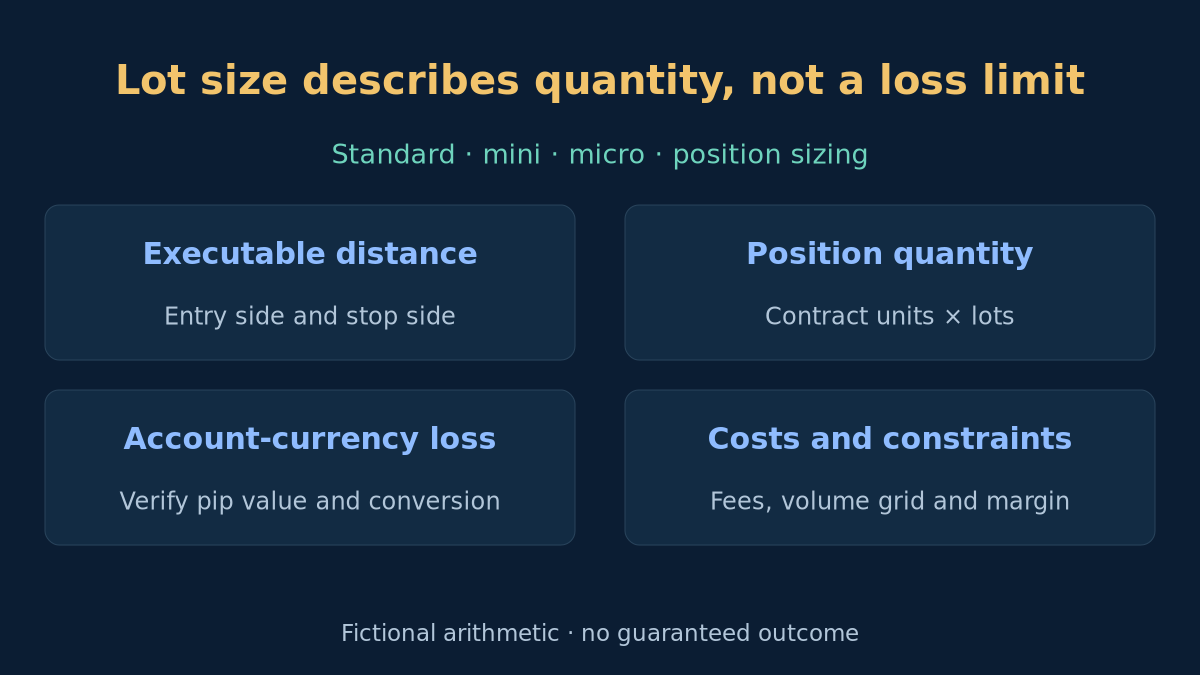
A fixed 0.01 lot is a quantity, not a universal risk setting. Its cash exposure changes with the contract, stop distance, conversion rate and other positions. This guide explains standard, mini and micro lots, then works through a cost-aware position-size calculation. The risk percentage, prices and fees are chosen only to make the arithmetic reproducible. This is an educational calculation, not a live lot-size calculator or a trading signal.
1. What is a lot in Forex?
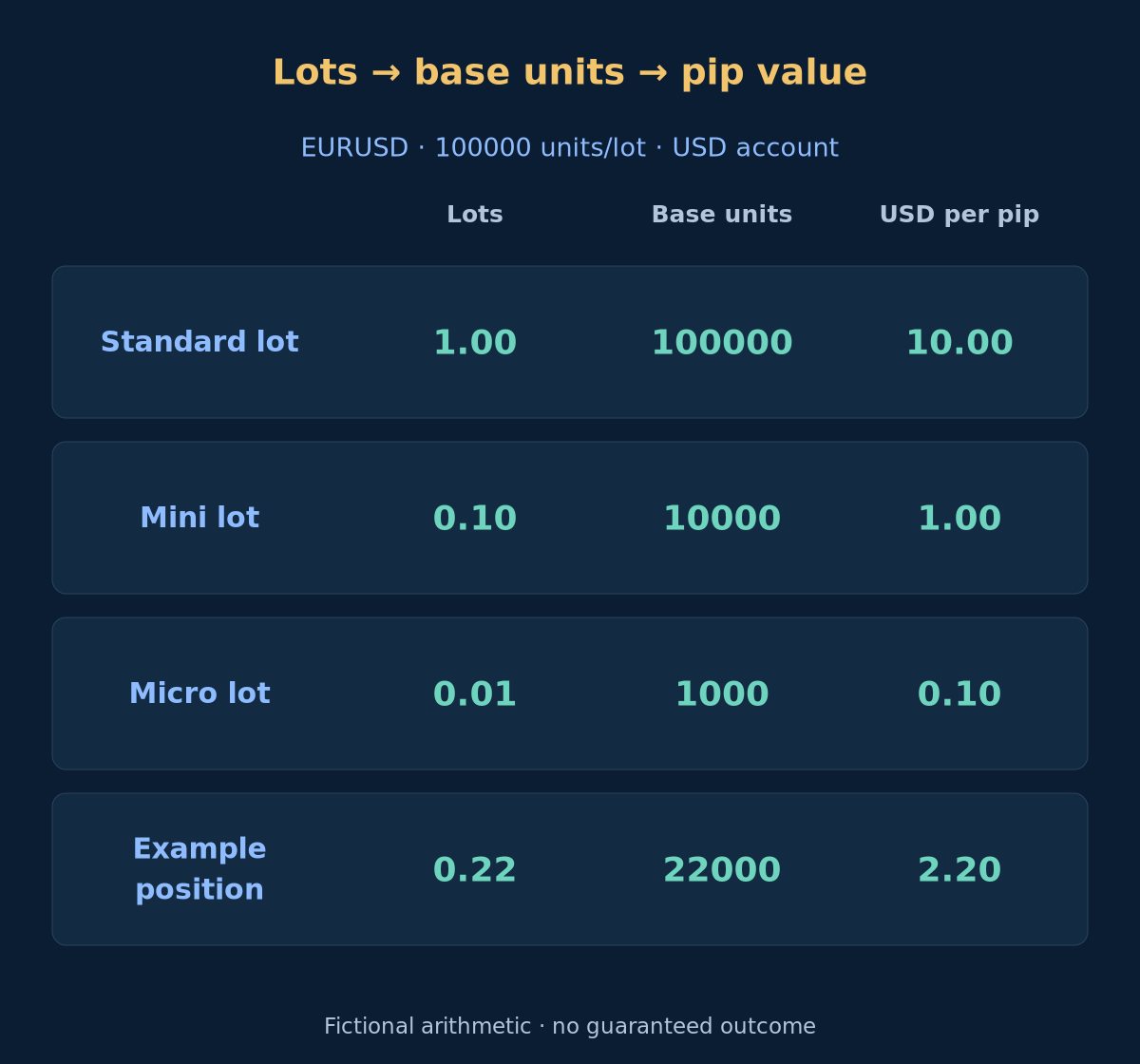
A lot expresses trade volume relative to a contract. The common retail Forex convention is 100000 units of the base currency for a standard lot, 10000 for a mini lot and 1000 for a micro lot. In EURUSD, those units are EUR; they are not automatically USD deposited or at risk. Under this convention, an MT4 volume of 0.10 means a fraction of a standard lot, not 0.10 of an additional mini-lot contract.
Use the exact symbol and account specification before converting lots to units. A platform that accepts currency units may use a different order-entry scale from a lot-based platform. Account labels such as cent, mini or standard do not establish the contract multiplier. Metals, indices and unusual contracts need their own rules. Start with the broker’s symbol and contract specifications.
2. Convert lots into units and pip value
Let C be base-currency units per lot and L the number of lots. Position quantity is C × L. With C = 100000, a volume of 0.22 lot represents 22000 base units. The table assumes EURUSD, a pip of 0.0001 and a USD account; its dollar pip values are valid for these assumptions, not every pair or account.
| Volume, lots | Base units, EUR | USD per pip |
|---|---|---|
| 1.00 | 100000 | 10.00 |
| 0.10 | 10000 | 1.00 |
| 0.01 | 1000 | 0.10 |
| 0.22 | 22000 | 2.20 |
For a linear Forex contract, multiplying base units by pip size gives pip value in the quote currency. Convert that amount into the account currency where necessary. Pip, platform point and minimum price increment (tick size) are distinct quantities. Decimal precision alone does not determine trade volume or a universal $10 pip value. The first guide explains pip value, units and currency conversion.
3. State the cash risk budget before sizing
Choose and record the capital basis E and a risk fraction r. The illustrative budget R = E × r uses current equity of $5000 and a chosen 1%, giving $50. The percentage is an assumption, not a recommendation or a safe threshold. Balance excludes floating results; equity reflects them according to the account’s calculation. Record which basis was used rather than silently switching between the two.
This is a planned loss budget for a specified scenario, not a guaranteed maximum loss. Reserve capacity for existing positions and pending orders before allocating a new trade. Correlated exposures can lose together. A low margin requirement does not establish a small cash risk. The broader risk-management framework should determine the budget and conditions for taking no trade.
4. Measure the stop using executable prices
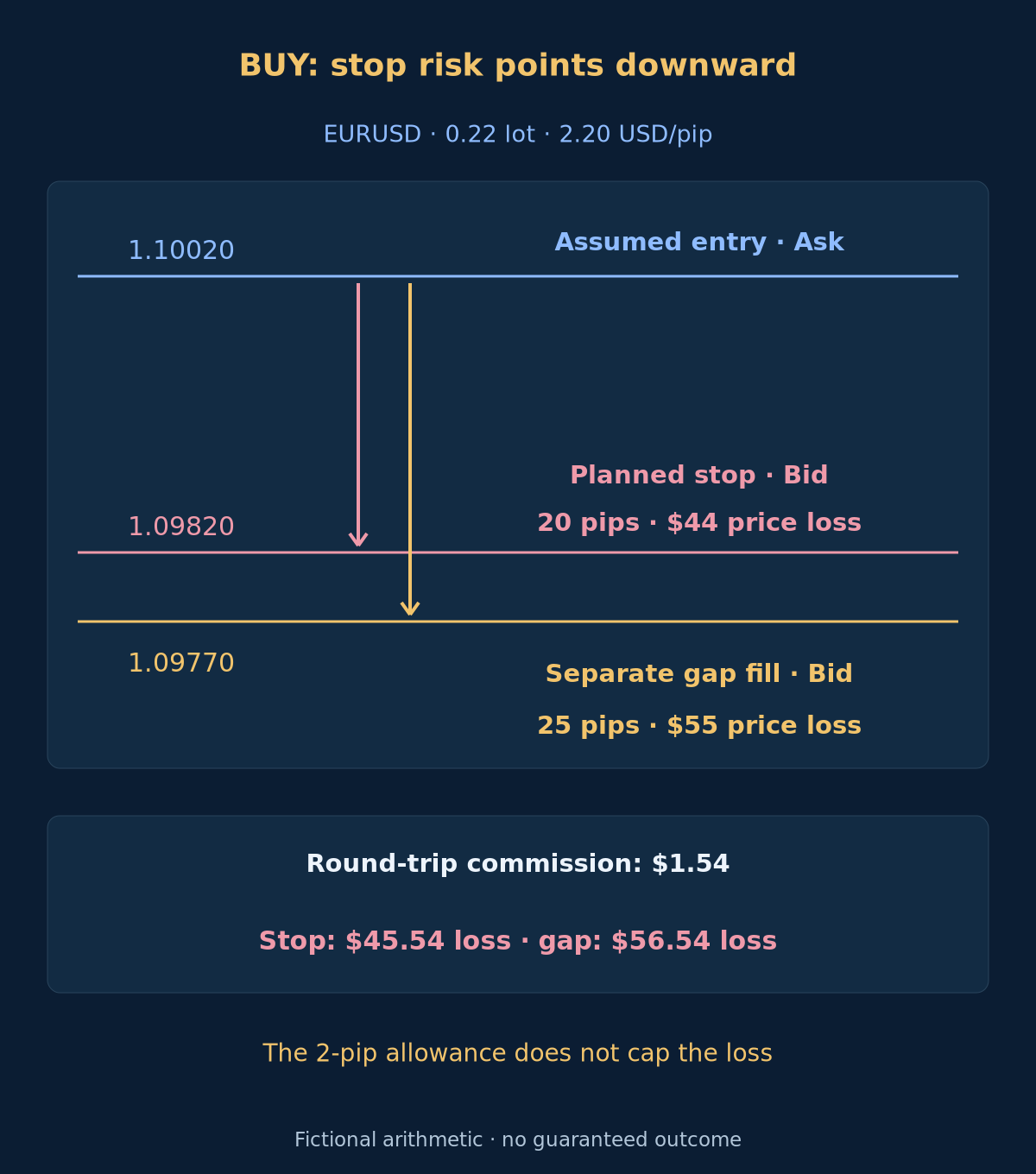
For the fictional EURUSD BUY, the initial quote is Bid 1.10000 / Ask 1.10020. Expected entry is Ask 1.10020 and the planned closing side is Bid 1.09820. The loss distance is 20 pips, not the 18 pips between the initial Bid and the stop. For SELL, entry is on Bid and closing is on Ask. Use the correct side and actual fills when they become available.
Ordinary stops can fill beyond the requested level. The example reserves another 2 pips for an adverse fill, making 22 pips in the sizing model. This allowance is a chosen stress assumption, not a guarantee or a broker execution rule. At 0.22 lot, a separate gap exit at Bid 1.09770 would lose 25 pips plus costs, exceeding the $50 budget. A wider required stop means recalculating size rather than moving it merely to fit a preferred lot.
5. Include costs without counting spread twice
Let D be the executable entry-to-stop distance in pips, A the extra adverse-fill allowance in pips, V the loss-side pip value in account currency per lot, and K the assumed round-trip cost in account currency per lot. With linear costs and no fixed fee, the modeled loss per lot is (D + A) × V + K. Divide R by that amount to obtain the raw lot limit. Every input must refer to the same contract, currency and volume basis.
Spread is already represented when distance uses the entry Ask and closing Bid for BUY, or entry Bid and closing Ask for SELL. Do not add that same spread again. Include opening and closing commission once, plus relevant financing, conversion and other fees. Minimum commissions, fixed charges and tiered pricing need a candidate-by-candidate calculation, not blind use of a linear formula. See the trading-cost guide.
6. Work the example, then round down
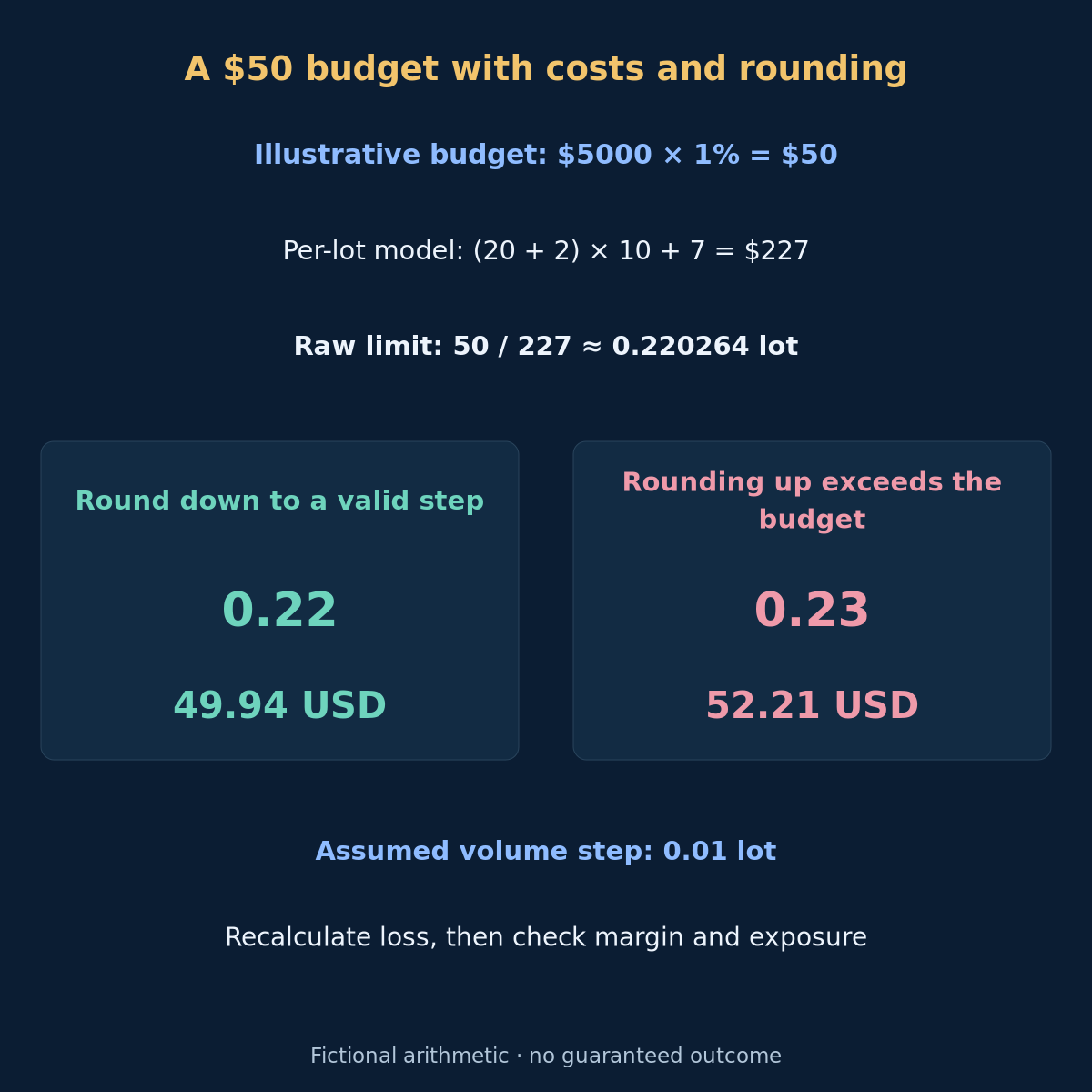
Assume R = $50, D = 20 pips, A = 2 pips, V = $10 per pip per lot and K = $7 per lot for opening and closing combined. There is no swap, conversion charge or other fee in this example. The denominator is 22 × 10 + 7 = $227 per lot. The raw limit is 50 / 227 ≈ 0.220264 lot. A calculation that ignores the allowance and commission would instead give 0.25 lot and would exceed the chosen modeled budget.
Assume permitted volumes are multiples of 0.01 lot with a minimum of 0.01. Rounding down gives 0.22 lot, or 22000 EUR, with a modeled price loss of $48.40 and commission of $1.54: $49.94 total. Rounding up to 0.23 gives $50.60 plus $1.61, or $52.21. Recompute the cash amount after rounding. Values below the budget are not proof that the trade is suitable or that a real fill cannot cost more.
7. Respect minimum, step and maximum volume
In MT4, inspect MODE_LOTSIZE, MODE_MINLOT, MODE_LOTSTEP and MODE_MAXLOT for the actual symbol. Read the permitted volume grid and check it with the broker; decimal formatting alone is not validation. Choose a valid volume no greater than the raw risk limit or the applicable maximum, then recalculate its cost. The assumed 0.01 grid is only the example’s specification.
If the smallest permitted position exceeds the budget, the calculation produces no acceptable order. For example, a raw limit of 0.04 lot cannot justify increasing to a minimum of 0.10 lot. Invalid or missing contract data also requires investigation, not a guessed default. Do not split orders to bypass a limit or forget their combined exposure. Stop-distance rules, price increments and other order constraints need a separate check; repeat sizing if the valid stop changes.
8. Use the account currency, including JPY crosses
For a standard 100000-unit GBPJPY contract and pip size 0.01, one lot has a pip value of 1000 JPY. That is not $1000 and not automatically $10. As an illustrative cash exchange, covering a JPY loss by selling USD at USDJPY Bid 149.98 means 1000 / 149.98 ≈ 6.66756 USD per pip per lot. Broker profit conversion may use a different route, time or fee policy; verify its loss-side value before sizing.
The pip value used in the denominator must match the account currency of R. If rates vary, allow for that uncertainty and review size when the order or stop changes. Do not assume the cash conversion of a gain is identical to the funding of a loss. Do not apply a current conversion rate to every past trade. The arithmetic is only as reliable as the contract and conversion inputs.
9. Check margin and combined exposure separately
A position that fits the planned loss budget can still fail the margin check. MT4’s AccountFreeMarginCheck estimates free margin after a proposed BUY or SELL volume at current prices. It does not certify the trade’s cash-loss limit or reserve future margin through a gap. Review the broker’s margin and stop-out conditions, existing exposure and an explicit operating buffer. A successful order check does not guarantee the eventual fill.
Fixed lots repeat quantity; risk-based sizing recalculates quantity as equity, stop distance and pip value change. Neither makes risk constant in every market condition. Before adding an EA or another pair, consider simultaneous losses and pending-order activation together. Lowering each ticket’s lot while opening more tickets may leave total exposure unchanged or higher.
10. Keep a short, reproducible sizing record
Record the symbol, account currency, equity or other capital basis, chosen budget, contract units, expected price sides, pip size, stop distance, fill allowance and all fees. Then record the raw volume, permitted grid, rounded volume, recalculated cash loss, margin check and aggregate exposure decision. After a fill, compare actual quantity and price with the plan; changes require a fresh risk review.
A demo calculation can expose unit mistakes before real money is involved. It cannot prove execution quality or strategy profitability. Check a BUY and a SELL, a non-account quote currency and a below-minimum case using verified specifications. For a method that selects the stop from volatility, see ATR stops and position sizing; keep the stop-selection rule distinct from converting the resulting distance into volume.
Optional: unit-checked arithmetic for the example
These are calculation relationships, not executable EA code. The formula assumes a linear contract and proportional costs. For a fixed fee or nonlinear charge, evaluate each permitted candidate against the full modeled loss. Never round upward just to make an order valid.
base_units = C × L; pip_value_quote_per_lot = C × p
R = E × r = 5000 × 0.01 = 50 USD
D_BUY = (entry_Ask − stop_Bid) / pip_size = 20 pips
loss_per_lot = (D + A) × V + K = (20 + 2) × 10 + 7 = 227 USD/lot
L_raw = R / loss_per_lot = 50 / 227 ≈ 0.220264 lot
L = 0.22 lot; model_loss = 0.22 × 227 = 49.94 USD
L = 0.23 lot; model_loss = 0.23 × 227 = 52.21 USD
BUY gap: (1.10020 − 1.09770) / 0.0001 = 25 pips
gap_loss = 25 × 10 × 0.22 + 7 × 0.22 = 56.54 USD
loss_currency_example: 1000 JPY / 149.98 JPY/USD ≈ 6.66756 USD
11. Forex lot-size questions
How many units are 0.01 lot and 0.10 lot?
With a contract of 100000 base units per lot, 0.01 is 1000 units and 0.10 is 10000. The unit currency is the pair’s base currency. Verify the contract; an account name does not establish these quantities.
Is 0.01 lot safe for a small account?
There is no universally safe lot size. Calculate account-currency loss from the contract, executable stop distance and costs, then consider gaps, margin and combined exposure. The minimum permitted size may still exceed the chosen budget.
Should I round a calculated lot size to the nearest step?
Rounding to the nearest step can round upward and exceed the modeled budget. Choose a valid volume at or below the calculated limit, then recompute the cash loss. If no permitted size fits, the result is no acceptable order.
Does a stop loss guarantee the risk percentage?
An ordinary stop does not guarantee its fill price. Gaps, slippage, conversion changes and fees can push the actual loss above a planned percentage. The example’s allowance is a modeling assumption, not guaranteed protection.
12. Sources and scope
Primary references: OANDA’s lot and unit relationships, MetaQuotes symbol properties, OrderSend price and stop requirements, AccountFreeMarginCheck, and OANDA’s ordinary-stop and gap-risk explanation. Checked 2026-10-19. The sizing equations and fictional numerical cases are our own unit-checked calculations, not broker-specific execution promises.
Forex and leveraged trading involve substantial risk. This educational material is not investment advice. All capital amounts, prices, fees and percentages are illustrative; they are not live quotations, performance evidence or a recommendation to take a position.