

Managing an open trade changes its payoff distribution. Moving a stop to entry can avoid one later loss while cutting off another trade that would have reached its target. Closing part of a position reduces both remaining exposure and participation in later gains. These tools need explicit rules and evidence rather than a promise of safer profits.
1. Define the management policy before entry
Keep the entry rule, initial stop, position quantity and initial price risk R0 unchanged when comparing management alternatives. Specify an activation threshold, the price side that measures it, update frequency, exit priority and what happens when a modification fails. “Manage dynamically” is not a reproducible instruction.
Choose whether updates occur on incoming quotes or completed bars. If the rule uses a bar’s high or low, that complete bar becomes available only at its close. You cannot retroactively move a stop earlier within that bar because its later high looks favourable.
2. Price break-even is not cash break-even
Assume a one-lot EURUSD BUY filled at Ask 1.1002, a USD account and USD 10 per pip. A stop at Bid 1.1002 yields zero gross price profit if filled exactly. With USD 7 round-trip commission, the net outcome is −USD 7, even without swap or slippage. The opening spread is already reflected in the executable entry and exit.
Covering that assumed commission needs 0.7 pip, so an exact Bid fill at 1.10027 would be cost-neutral under these assumptions. This is not a guaranteed break-even stop: future charges, tick alignment, broker distance limits and worse fills can change it. A SELL requires the corresponding adjustment below its Bid entry, measured at Ask exit.
commission_offset = 7 USD / (10 USD per pip) = 0.7 pip = 7 points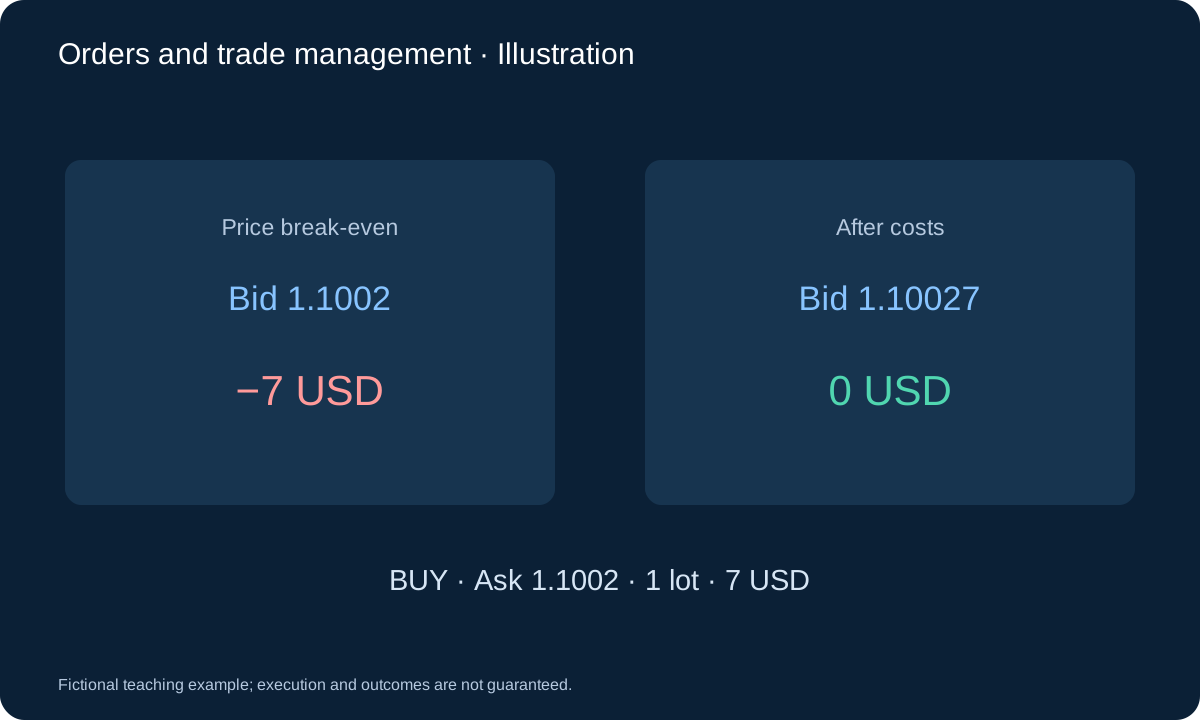
3. Separate activation from the trailing distance
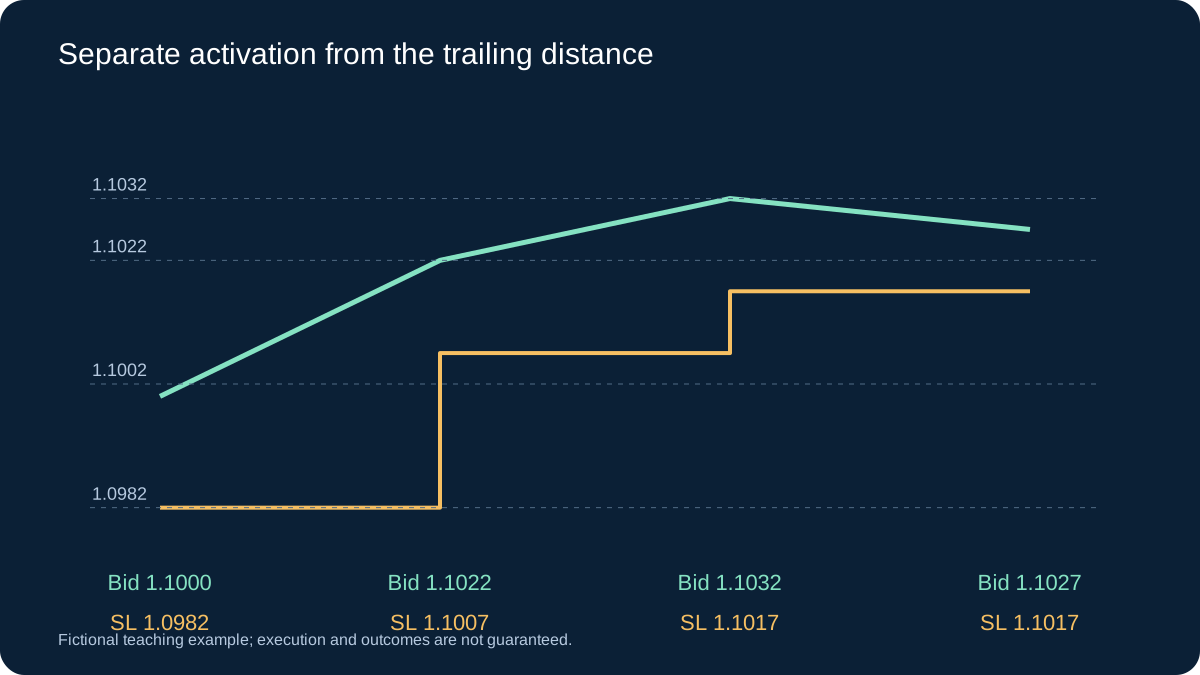
Our custom example activates when Bid reaches 1.1022, 20 pips above the BUY entry. It trails 15 pips behind the highest observed Bid since activation. At Bid 1.1022 the proposed stop is 1.1007; at 1.1032 it rises to 1.1017; a retreat to 1.1027 does not lower it. The initial stop was 1.0982.
This is an example EA policy, not MT4’s built-in Trailing Stop algorithm. The built-in tool starts after profit reaches its selected trailing distance. On five-decimal EURUSD, 15 pips equal 150 points. For a custom SELL trail, use the lowest observed Ask plus the distance and never move the stop upward to loosen it.
BUY stop_new = max(stop_old, highest_Bid_since_activation − 0.0015)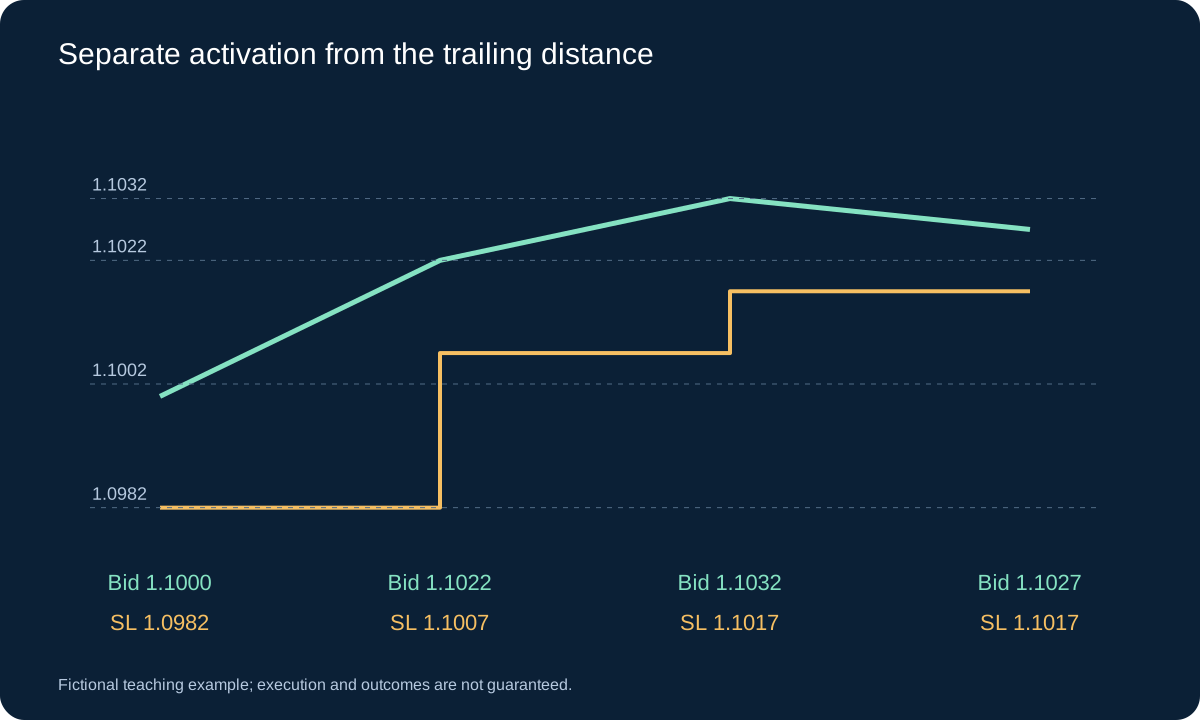
4. Mirror a custom trail using Ask
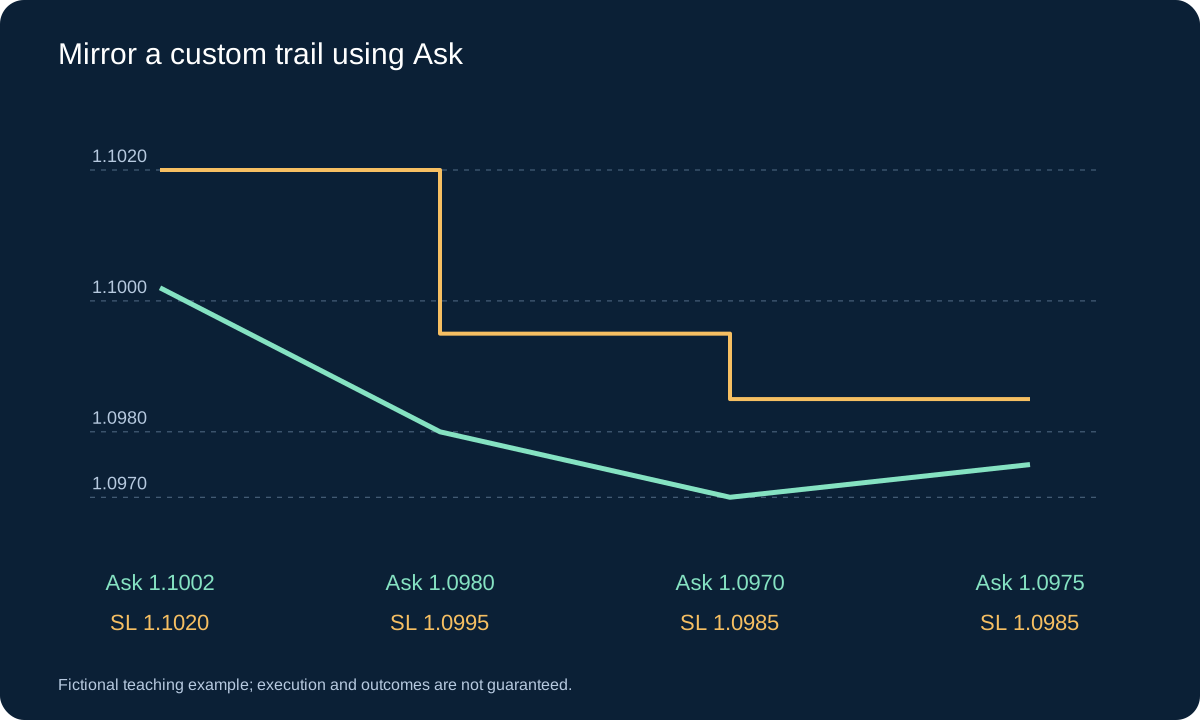
For a SELL entered at Bid 1.1000, assume initial Ask 1.1002 and initial stop 1.1020. A custom 20-pip activation occurs when Ask falls to 1.0980. With a 15-pip distance, the proposed stop is 1.0995. A new lowest Ask of 1.0970 lowers it to 1.0985; a rebound to 1.0975 leaves it at 1.0985. The stop never moves upward to give back protection. This is the SELL counterpart of the custom BUY example, not an additional platform default.
Price break-even for this SELL is an exact Ask exit at 1.1000. With the same one-lot USD 7 commission, cost-neutral price would be Ask 1.09993 before any other charges or slippage. The amount is 0.7 pip below entry. Do not add the opening spread a second time to a calculation already using Bid entry and Ask exit. A proposed cost-neutral level can still be invalid under the current stop-distance rules.
5. Partial closing changes the weighted result
Keep R0 as the original full-position price risk. If half closes at +1R0 per original unit and the remaining half at +2R0, total gross return is 0.5 × 1 + 0.5 × 2 = +1.5R0. Holding the full position to that same final target would produce +2R0, before costs and assuming the same fills.
If the remainder instead hits the original −1R0 stop, the weighted result is zero gross. If its stop was successfully moved to exact price entry, the result is +0.5R0 gross. All are conditional paths, not forecasts. Subtract actual commissions, financing and slippage on the quantities closed; do not automatically charge a full original-position fee to every partial exit.
0.5 × 1 + 0.5 × 2 = 1.5; 0.5 × 1 + 0.5 × (−1) = 0; 0.5 × 1 + 0.5 × 0 = 0.5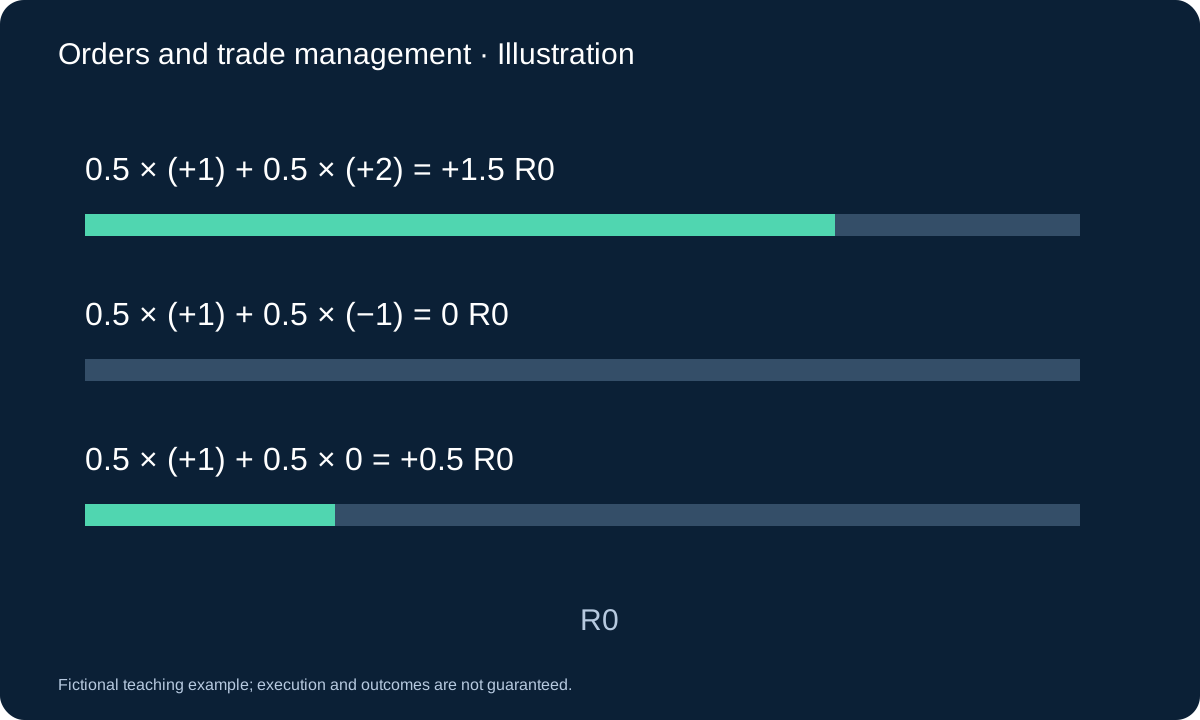
6. A concrete comparison on the same three paths
Use the same one-lot BUY entry 1.1002, initial stop 1.0982 and target 1.1042. Initial gross R0 is USD 200 at USD 10 per pip. Compare: fixed full-position exits; a full-position stop moved to entry after +1R0; and a half close at +1R0 with the remainder’s stop moved to entry. Assume every change succeeds, every fill is exact, total round-trip commission is USD 7 proportional to quantity, and no other costs.
| Observed Bid path | Fixed full size | Break-even full size | Half close + break-even |
|---|---|---|---|
| +1R0 → 0 → +2R0 | 393 USD | −7 USD | 93 USD |
| +1R0 → −1R0 | −207 USD | −7 USD | 93 USD |
| +1R0 → +2R0 | 393 USD | 393 USD | 293 USD |
The path describes hypothetical Bid observations; zero means the original entry price, not zero net profit. If a policy has already closed its trade, later movement cannot restore it. In the first row, the fixed trade survives the retreat to entry and later reaches target, while break-even has already exited. In the second, protection avoids a larger loss. In the third, taking half early reduces the gain. More protected trades and better expectancy are different claims.
7. Distinguish server protection from local updates
An accepted Stop Loss resides on the trading server. MT4’s built-in trailing logic runs in the client terminal and needs incoming quotes and a working connection to send changes. If that terminal stops, previously accepted protection can remain, but further trailing adjustments stop. A locally simulated exit has its own availability requirements.
Confirm each change on the server instead of assuming a sent request succeeded. Avoid two EAs or manual trailing tools competing over one stop. Identify order ownership with symbol and Magic Number, retain state after restart, and reconcile the actual remaining quantity and protection before resuming management.
Review order states and accepted server protection in the order-types guide.
8. Check quantity constraints and failed actions
A partial close must satisfy minimum lot and volume step for both the closed amount and the remainder, subject to the broker’s rules. Half of 0.03 lot is 0.015, which is invalid with a 0.01 step. Choosing 0.01 and leaving 0.02 is not a 50% close and must be reflected in the payoff calculation.
If a partial close fails, do not mark it completed or blindly repeat it. Read the server records and remaining volume first. Brokers may represent a remainder differently; do not assume the original ticket is the only record to inspect. A rejected stop move leaves the old protection in force if it was previously accepted.
9. Specify action priority and restart recovery
Several conditions can become true on one quote. A reproducible policy must say which action is attempted first. For an illustrative combined policy, first reconcile whether the server has already closed the position; then send at most one scheduled partial-close request; confirm its result and remaining quantity; finally evaluate protection for the actual remainder. This declared sequence is only an example. Changing it can change execution and must be tested as a different policy.
On restart, read the open orders and account history before restoring an “activation completed” flag. A request sent just before a disconnect may have succeeded. Recover the accepted stop and remaining volume from server records, not only from an in-memory intended value. If ownership or status is uncertain, suspend new management requests and resolve the discrepancy. Keep any confirmed existing protection visible; never label a rejected change as a successful reduction of risk.
10. Compare alternatives on the same price paths
Run fixed exits, break-even, trailing and partial-close variants against the same frozen entries and chronological data. Keep a list of every tested variant. Report net expectancy, drawdown, tail losses, duration, turnover and the number of trades, not only the fraction that avoids a full stop.
Tick sequence matters when activation and stop-out can occur inside one candle. OHLC may not resolve which happened first. Use appropriate Bid/Ask data or a documented conservative ambiguity policy. Include disconnects and failed modifications in operational testing, then validate the selected policy on untouched data and forward records.
11. Build a practical management record
For each position, log initial entry and stop, R0, initial volume, activation time, observed extreme, proposed stop, server-accepted stop, partial fills, remaining lots and final net result. Store signal timestamps separately from request and fill timestamps so a favourable backtest does not conceal impossible sequencing.
Before going live, check restart recovery, duplicate commands, volume rounding and a connection outage. Decide what to do when an intended change becomes invalid because the price has moved. No exit technique removes gap risk or supplies an edge by itself; it changes the outcomes of the entry rule you still need to validate.
Questions
Does the trailing stop keep updating with MT4 switched off?
The built-in client-terminal calculation does not. The last Stop Loss already accepted by the server can remain active, but new updates need the operating terminal. Verify separately any broker-provided or hosted implementation.
Does taking partial profit improve expectancy?
Not automatically. It reduces the remaining quantity, which can soften some reversals and reduce later gains. Compare the net distribution against unchanged entries; a higher win rate alone is not enough.
Sources and scope
MetaQuotes documents client-terminal trailing and order modification/closing functions. Our activation threshold, 15-pip custom trail, weighted returns and audit protocol are educational constructions, not a claim that a particular exit is superior.
Fictional teaching example; execution and outcomes are not guaranteed.