

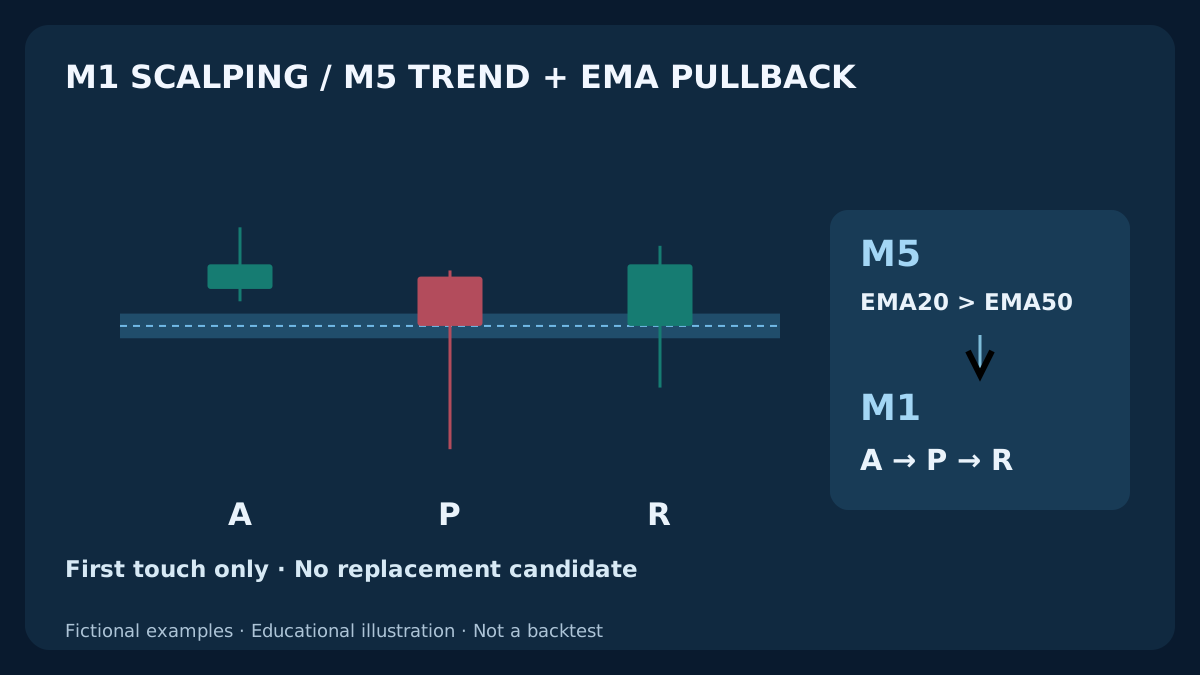
A touch of an EMA is not enough. This research template separates a completed M5 trend, an armed M1 reference, the first pullback and a later closed reaction. Follow the exact entry clock, executable quote sides, fixed boundaries and complete cost plan before interpreting any outcome.
1. What this 1-minute scalping strategy actually proposes
This 1-minute Forex scalping strategy is a research template: a completed M5 trend provides direction, a first M1 pullback reaches a frozen EMA reference, and a separate closed M1 reaction provides confirmation. M1 describes the signal chart, not a promise to close every position within one minute. The planned holding limit in this version is five minutes after the actual fill, subject to an executable exit being available.
The hypothesis is that a short pause within an established direction may be followed by continuation. That is an idea to test, not evidence of an edge. EMA periods, price bands, cost limits and times below are deliberately explicit so a reviewer can reproduce or reject the method. They are illustrative choices, not optimized settings, broker measurements or a recommendation to trade a particular account.
All prices, indicator snapshots, fills and cash outcomes are fictional. No profitable backtest is presented. The M1 versus M5 scalping guide explains why short targets are sensitive to execution. Here the main question is whether the complete sequence remains valid when information availability, quote sides, costs and cancellation are taken seriously.
2. Define the instrument, clock and research settings
The worked instrument is EUR/USD with 1 pip = 0.0001, a five-decimal point of 0.00001 and a price tick of 0.00001. Use Bid candles for both signal charts, EMA calculated from closing prices, and no horizontal indicator shift. The example research window is 09:00–11:00 UTC; it is a fixed sample definition, not a claim that these are the best trading hours. Verify the historical mapping from broker time to UTC before applying it.
Use M5 EMA20 and EMA50 for context and M1 EMA20 for the pullback reference. The frozen band is 0.2 pip either side of the M1 reference; the stop buffer is 0.3 pip and the target offset is 8 pips from the reaction close. Candidate entry requires spread at most 0.9 pip, documented quote age at most 2 seconds, and a request before 10 seconds have elapsed after the reaction’s nominal close. Planned adverse entry reserve is 0.2 pip; maximum planned entry distance from the reaction close is 1.5 pips. Round-trip commission is 0.6 pip, future adverse exit reserve 0.4 pip, and the minimum planned net reward/risk ratio is 1.1. These are test inputs, not universal safety thresholds.
Keep one position at a time and at most one candidate per M5 context block. There is no averaging down, grid or second entry to repair a loss. Save contract specifications, the data source and every parameter before testing. The guide to scalping pairs, sessions and cost filters explains why the same numerical assumptions cannot simply be carried across symbols or accounts.
| Setting | Illustrative value | Interpretation |
|---|---|---|
| Context | M5 EMA20 / EMA50 | Completed candles only; one context block until the next M5 boundary |
| Pullback reference | M1 EMA20(A) ± 0.2 pip | Freeze after A; first P and immediately following closed R |
| Entry gates | 0.9 pip / 2 seconds / 10 seconds / 1.5 pips | Maximum spread, documented quote age, exclusive request window and maximum planned distance |
| BUY boundaries | P.low − 0.3 pip / R.close + 8 pips | Fixed Bid stop and target; broker restrictions can cancel the entry |
| Cost plan | 0.2 / 0.6 / 0.4 pip; net ratio ≥ 1.1 | Entry reserve / commission / future exit reserve; no double counting |
| Exposure and exit | 1 position; 5 minutes after fill | No grid or second candidate; time exit needs an executable quote |
3. Read the completed M5 trend and freeze its block
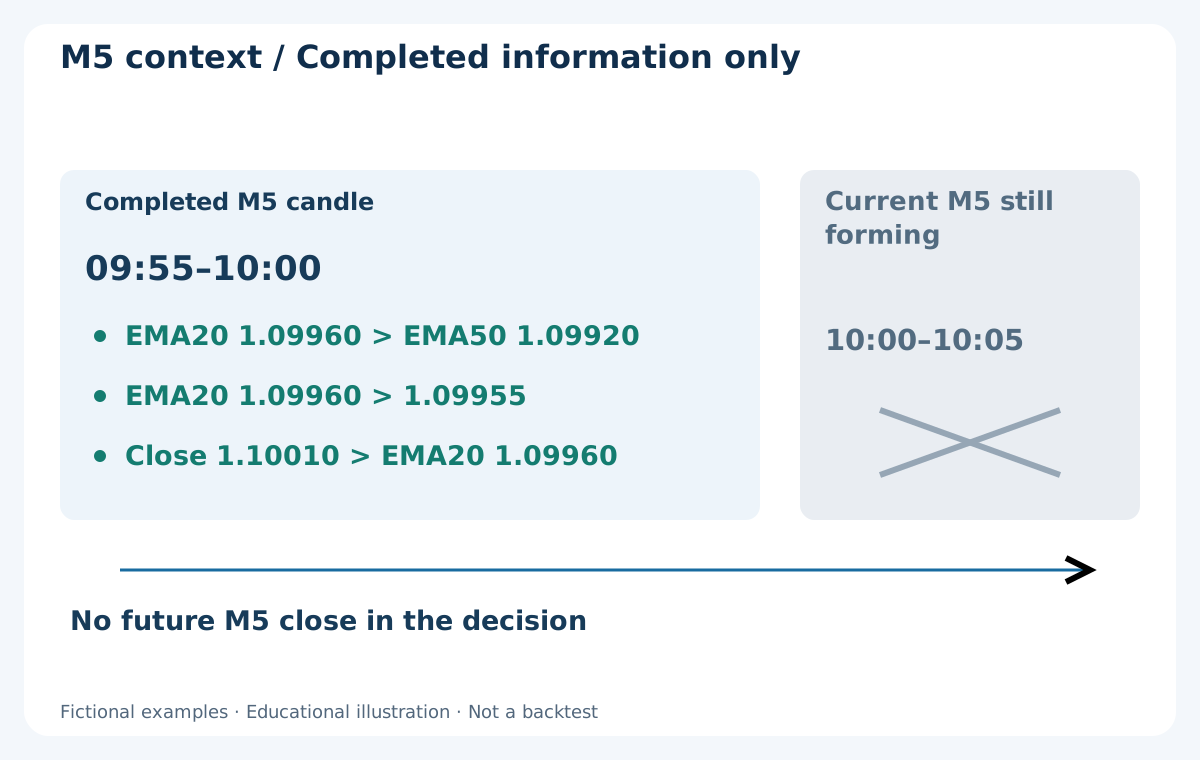
At a newly observed M5 boundary, inspect the candle that has just completed. BUY context requires EMA20 above EMA50, EMA20 above its value on the preceding completed M5 candle, and the completed close above EMA20. SELL requires all three inequalities reversed. Equality or a missing input means no context. Do not use the current forming M5 candle to strengthen a weak reading.
For the fictional BUY snapshot, the M5 candle 09:55–10:00 closes at 1.10010; EMA20 is 1.09960, its previous completed value 1.09955, and EMA50 is 1.09920. All three BUY conditions hold. These are supplied indicator snapshots from an assumed warmed-up history, not EMA values calculated from the few candles drawn in an illustration. The M5 candle 10:00–10:05 is still forming and cannot supply its eventual close.
This context block runs from 10:00 until, but not including, 10:05. Activate it only while flat and with continuous, valid observation; after a restart in the middle of a block, skip to a fresh boundary. At the next boundary any unfilled candidate expires, even if the new trend has the same direction. An existing position keeps its original protection and holding clock; a new M5 candle neither extends the setup nor automatically closes the trade.
4. Arm once and freeze the M1 EMA reference
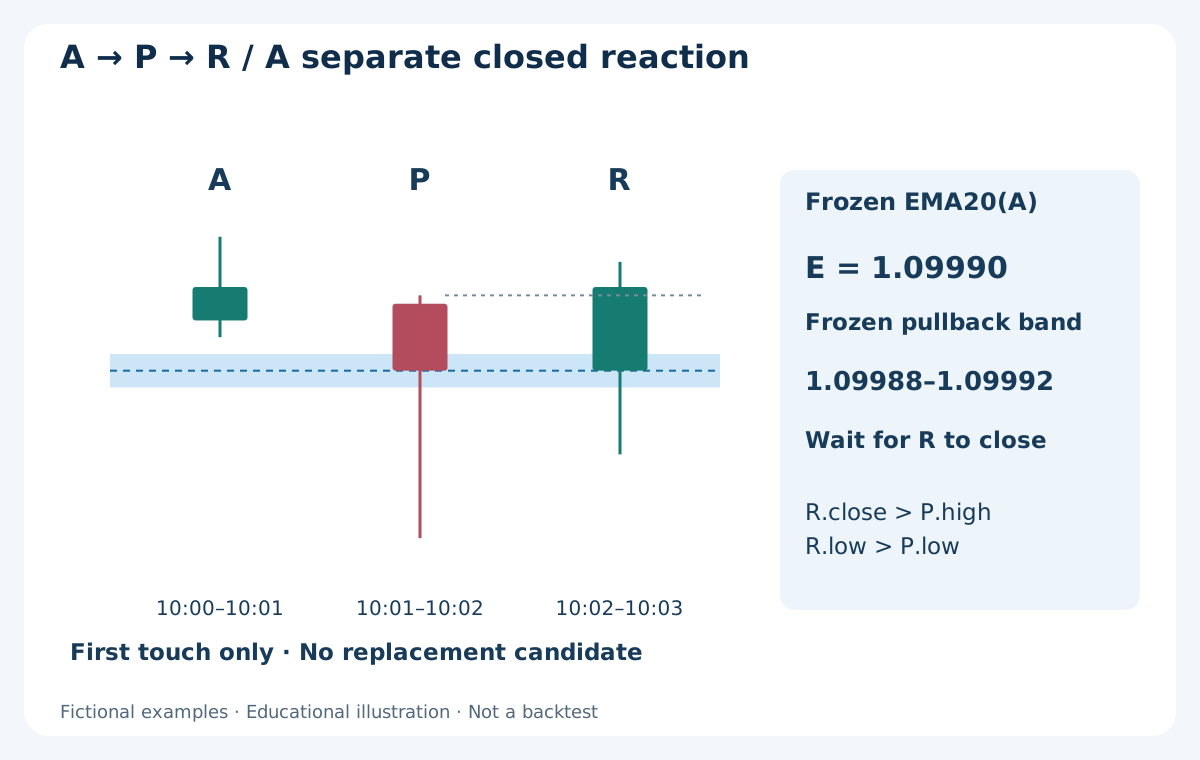
Within the block, find the first completed M1 candle A whose opening time is at or after the block’s start and whose entire Bid range is on the trend side of its own completed EMA20 band. For BUY, A.low must be strictly above EMA20(A) + 0.2 pip. For SELL, A.high must be strictly below EMA20(A) − 0.2 pip. A is an arming event, not an entry signal.
Once A has completed and is observable, freeze E = EMA20(A). Do not slide the band along later EMA values to make a missed pullback appear eligible. In the BUY example E is 1.09990, so the band is 1.09988–1.09992. Candle A spans 10:00–10:01 with Open 1.09996, High 1.10006, Low 1.09994 and Close 1.10000. Its low is above the upper band edge, so it arms the block.
Only subsequent completed M1 candles can become the pullback. The first observed quote after a boundary makes the prior candle available; a bar timestamp alone does not prove that its final value was known earlier. The broader moving-average strategy covers trend and pullback ideas at a different scope. This version adds a frozen reference, a first-touch rule and a short expiry to prevent discretionary relabelling.
5. The first pullback P needs a separate reaction R
P is the first subsequent completed M1 candle whose Bid range overlaps the frozen band: its low is at or below the upper edge and its high at or above the lower edge. For BUY, P must close at or above the lower edge; for SELL, at or below the upper edge. A first touch that fails this close condition consumes the opportunity. A BUY bar entirely below the band, or a SELL bar entirely above it, also cancels the block without an overlap; do not ignore it and select a prettier later pullback.
For BUY, the immediately following M1 candle R must be bullish, close strictly above P.high and the upper band edge, and keep its low strictly above P.low. For SELL, R must be bearish, close strictly below P.low and the lower edge, and keep its high strictly below P.high. Equality fails every strict comparison. R must open exactly one minute after P opened; a missing minute cannot be replaced by the next available candle.
The fictional BUY P at 10:01–10:02 has Open 1.09998, High 1.09999, Low 1.09970 and Close 1.09990. R at 10:02–10:03 has Open 1.09990, High 1.10003, Low 1.09980 and Close 1.10000. P touches and closes back inside the band; R passes all four reaction conditions. A wick alone, P alone or a later recovery after R fails cannot authorize entry.
6. Entry is a fresh-quote decision, not the old closing price
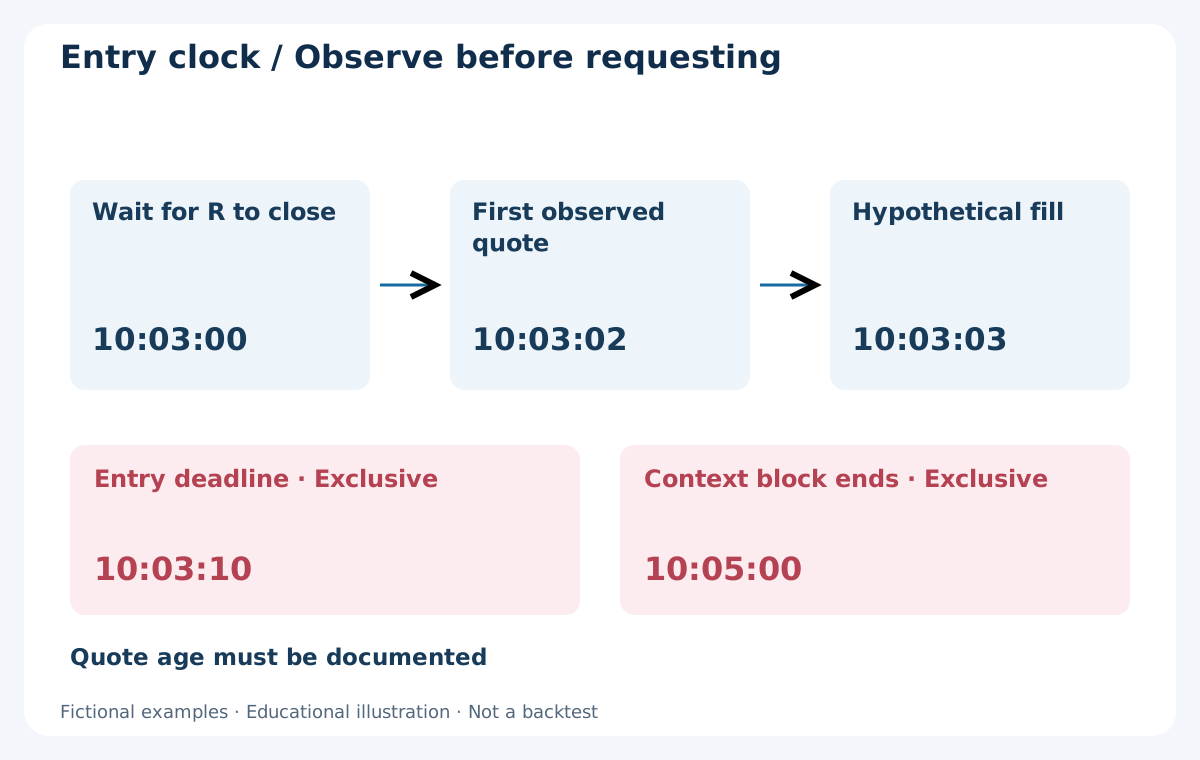
Assess only the first observed current-symbol quote after R has completed. If it lacks a valid paired Bid/Ask, cancel for missing evidence. Its time must be earlier than both the block’s end and R’s nominal close plus 10 seconds, and inside the research window. At or beyond either deadline, cancel. The quote must be no more than 2 seconds old under a documented measurement; a fresh local receipt timestamp and the server event time answer different questions, so do not subtract unrelated clocks.
For BUY, current Bid must still be above P.high and the upper band edge; for SELL, current Bid must remain below P.low and the lower edge. Protective and target boundaries must not already have been crossed on their relevant executable side. If the first quote fails spread, freshness, distance, cost, margin or broker restrictions, cancel the candidate instead of waiting for a more attractive quote. One candidate permits at most one request, not an unlimited sequence of retries.
In the example, R closes nominally at 10:03:00, the first observed quote arrives at 10:03:02 and a hypothetical fill follows at 10:03:03. A request at 10:03:10 is too late, and one at 10:05:00 is outside the old context block. These times illustrate order, not measured latency. The slippage and latency guide explains why missing confirmation must not be treated as permission to send a duplicate order.
7. Fix protection and assess planned prices before sending
For BUY, freeze the protective Bid stop at P.low − 0.3 pip and the Bid target at R.close + 8 pips. For SELL, freeze the Ask stop at P.high + 0.3 pip and the Ask target at R.close − 8 pips. Both signal charts remain Bid-based, so SELL cash distances must be recalculated; a graphical mirror does not imply identical economics. Check legal price increments and minimum stop distances. If these exact levels are not permitted, reject rather than widening a stop or shifting a target to force acceptance.
Define the planned entry E* as current Ask + 0.2 pip for BUY, or current Bid − 0.2 pip for SELL. The directional distance is E* − R.close for BUY and R.close − E* for SELL; require it to be between zero and 1.5 pips inclusive. This reserve is a planning assumption, not a guaranteed fill cap. A broker request or slippage field does not replace verification of the actual price.
Compute gross stop distance and gross target distance from E*. Add 0.6 pip commission and 0.4 pip future exit reserve to the loss, and subtract them from the potential gain. Require positive distances and planned net gain / planned net loss at least 1.1 before sizing. Place protection with the request only where the documented account workflow supports it. Do not silently substitute an unprotected-entry procedure. After a fill outside the admitted plan, classify an execution exception and follow the predefined exit/reconciliation rule, counting its costs.
8. Worked BUY: signal, quotes and executable boundaries
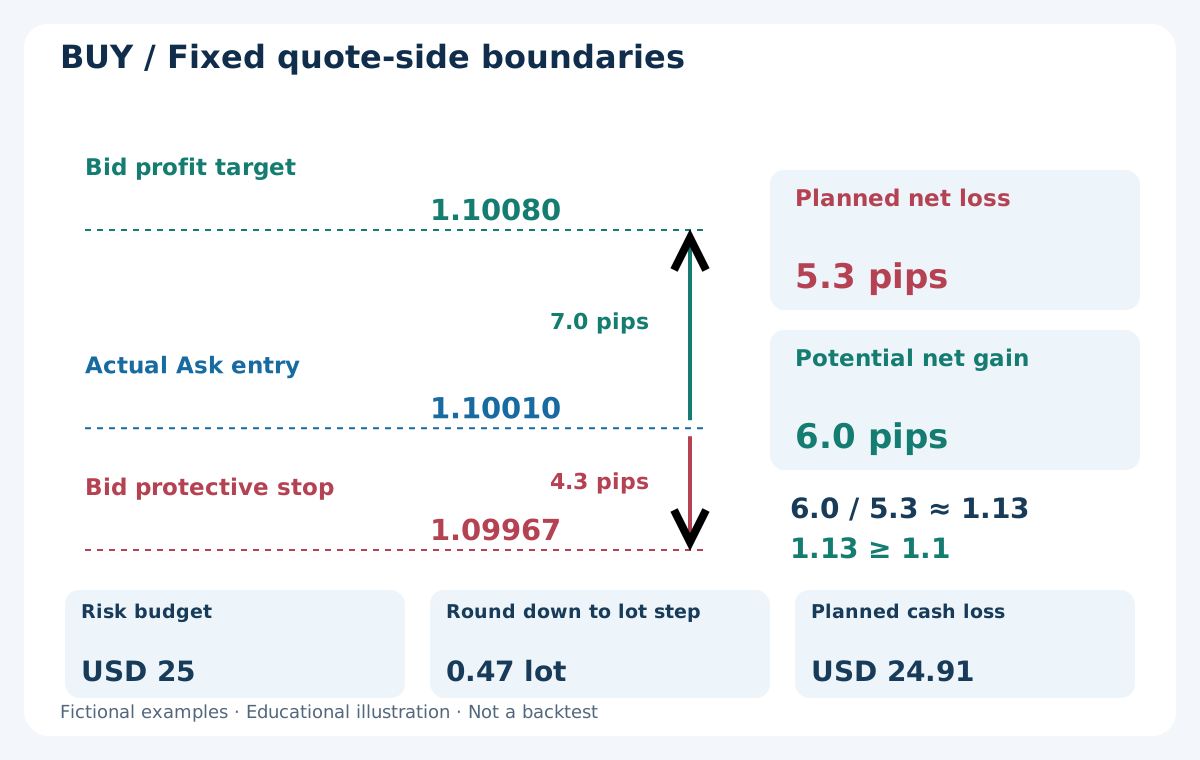
Use the completed M5 context and A/P/R sequence above. Assume documented freshness, legal protection and sufficient margin for the calculated volume. The decision quote is Bid 1.10000 / Ask 1.10008, so spread is 0.8 pip and the quote-side condition still holds above P.high 1.09999. Planned E* is 1.10010. Suppose the actual BUY fill is exactly 1.10010; it includes the spread and the assumed adverse entry deviation. Stop is Bid 1.09967 and target Bid 1.10080, frozen from the earlier signal candles.
The gross risk is (1.10010 − 1.09967) / 0.0001 = 4.3 pips; potential gross reward is (1.10080 − 1.10010) / 0.0001 = 7.0 pips. Planned loss after commission and future exit reserve is 4.3 + 0.6 + 0.4 = 5.3 pips; potential net gain is 7.0 − 0.6 − 0.4 = 6.0 pips. Their ratio is 6.0 / 5.3 ≈ 1.13, so this illustrative candidate passes the 1.1 gate.
The stop is below the actual Ask entry and target above it. The asymmetry is intentional: the target was fixed from the Bid reaction close, while entry occurred on Ask with an adverse deviation. Do not subtract spread or entry reserve again from these actual-fill distances. A gap, rejected close or execution problem can exceed the future exit reserve, so this is a plan rather than a guaranteed pair of outcomes.
9. A later price can fail even when spread and distance pass
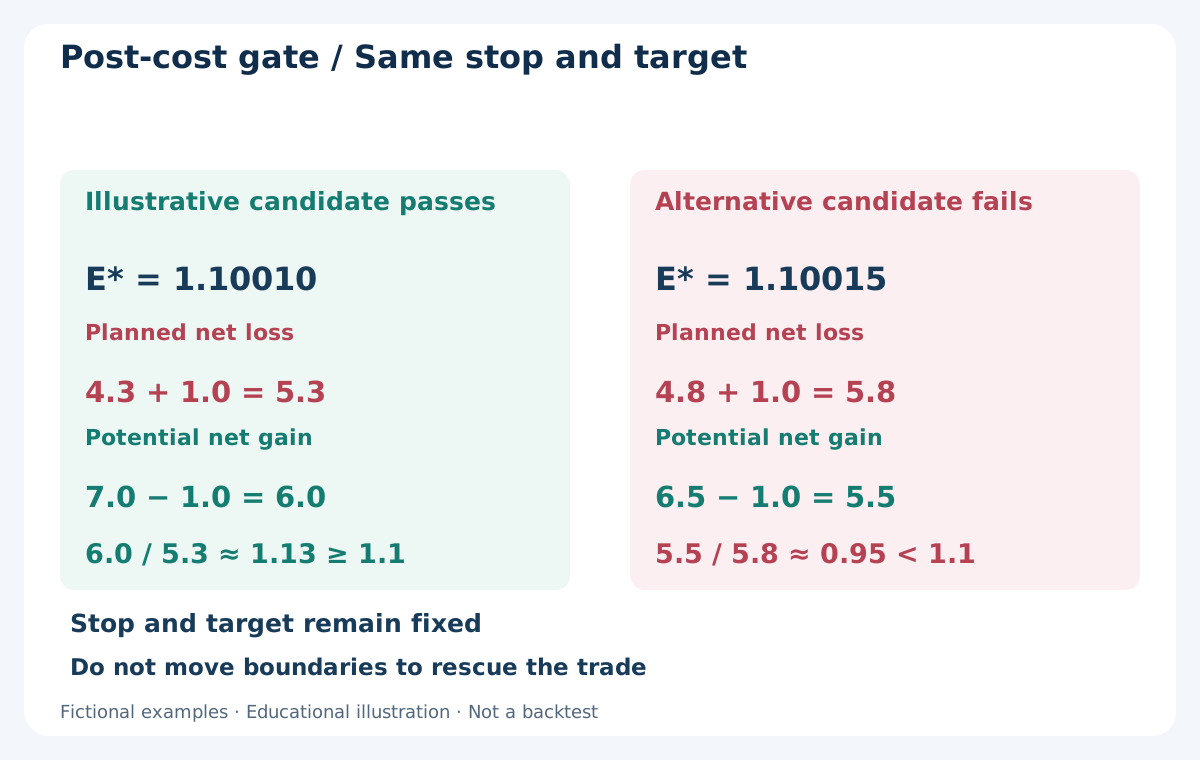
Keep the same candles, stop and target, but suppose the first decision quote instead is Bid 1.10005 / Ask 1.10013. Spread remains 0.8 pip. Planned E* becomes 1.10015, exactly 1.5 pips above R.close, so the spread and maximum-distance checks alone would pass. The two quotes are alternative fictional scenarios, not a rule allowing a second attempt after the first one fails.
From that planned entry, gross risk is 4.8 pips and gross reward 6.5 pips. With the same 1.0 pip of commission plus future exit reserve, planned loss is 5.8 pips and potential net gain 5.5 pips. The ratio 5.5 / 5.8 ≈ 0.95 fails 1.1. Reject the candidate; do not extend the target, move the stop closer or lower the threshold to restore an attractive result.
A small price difference can matter because the target is short and fixed. A wider spread can also change eligibility without any change in the candle pattern. Keep price, spread, entry deviation, future exit reserve and booked fees distinct. The guide to spreads, commissions and swaps explains the difference between reference-movement accounting and the profit already embedded in actual fill prices.
10. Size from the complete planned loss, then round down
For the worked BUY, assume a standard EUR/USD lot of EUR 100000 and USD 10 per pip in a USD account. Planned loss of 5.3 pips is therefore USD 53 per lot. With an illustrative cash budget of USD 25 and a 0.01 lot step, 25 / 53 ≈ 0.4717 lot rounds down to 0.47 lot. Planned loss is 0.47 × 53 = USD 24.91, not the whole nominal budget.
At the same volume, the conservative target amount is 0.47 × 6.0 × 10 = USD 28.20. These are teaching calculations, not verified profits or a recommended position size. Check minimum volume, maximum volume, free margin and actual contract value separately. If rounding produces a size below the account minimum, skip; rounding up to qualify would change the stated risk plan.
For another account currency or contract, convert the pip value correctly before sizing. Do not assume USD 10 applies to every symbol. Costs that are charged per ticket or subject to minimum fees may not scale linearly with lots; incorporate their actual schedule. The position-sizing guide explains the general calculation. Neither the cash budget nor the stop guarantees a maximum realised loss.
11. SELL uses Bid entry and Ask exits
SELL context reverses the completed M5 inequalities. Arm with A.high below the lower frozen band, take the first overlapping P that closes at or below the upper edge, then require the immediately following bearish R below P.low and the lower edge, with R.high below P.high. The first decision Bid must still satisfy the downward break. Confirmation remains a closed Bid-candle event; execution and protection use their proper sides.
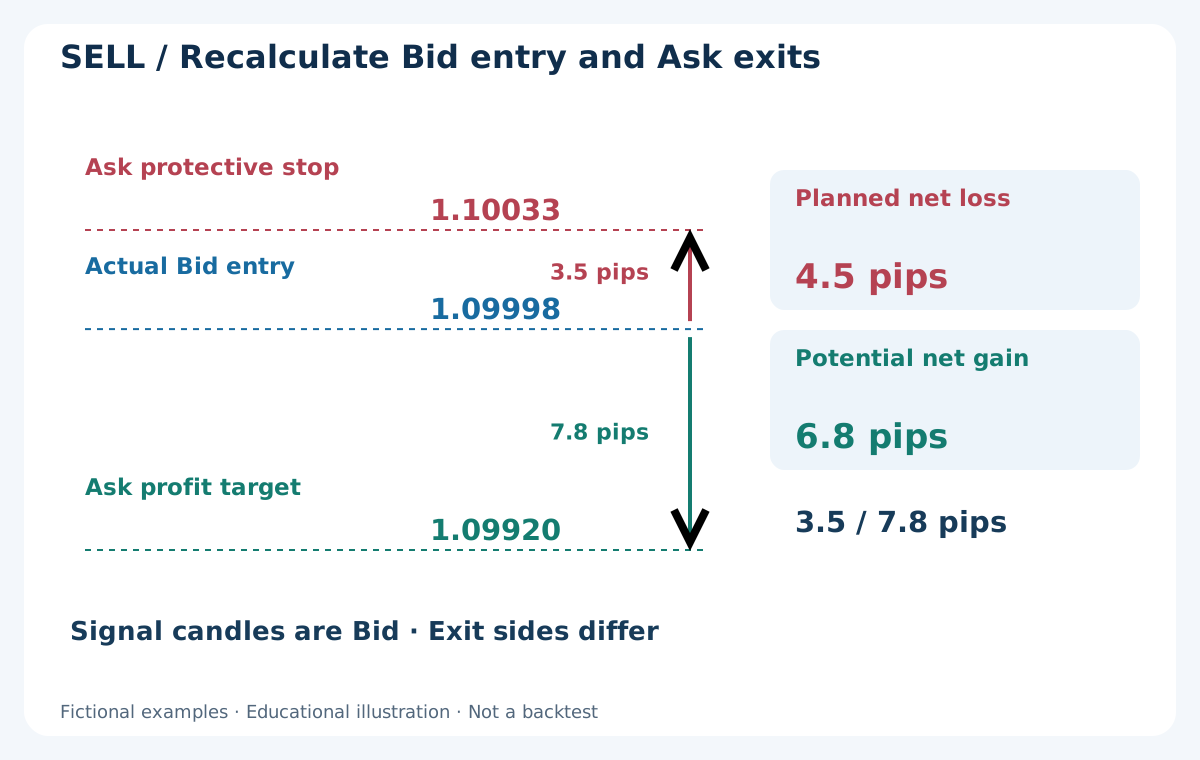
For a separate fictional SELL, let E be 1.10015, giving band 1.10013–1.10017. Assume A.high 1.10012, P.low 1.10010, P.high 1.10030 and P.close 1.10015. R opens at 1.10015, closes at 1.10000 and has high 1.10020. These values satisfy the stated SELL tests. At Bid 1.10000 / Ask 1.10008, planned entry is 1.09998; assume the actual SELL fill equals that value. Ask stop is 1.10033 and Ask target 1.09920.
Gross risk is 3.5 pips and potential gross reward 7.8 pips. With 0.6 pip commission and 0.4 pip future exit reserve, planned loss is 4.5 pips and potential net gain 6.8 pips. The difference from BUY is not an error to hide: the signal reference is Bid, but protective SELL exits are Ask. Recompute margin and volume for this plan rather than copying the BUY lot or its cash outcomes.
12. The holding clock starts at the actual fill
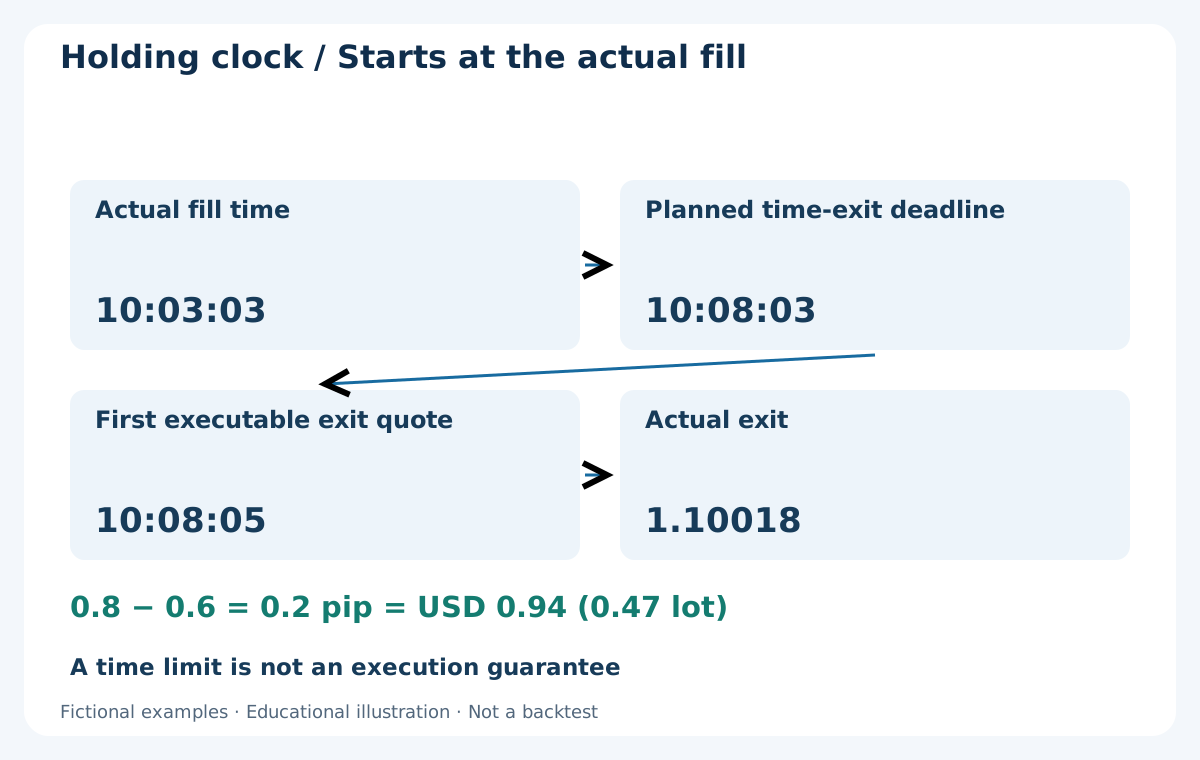
Keep the original stop and target; this version has no trailing stop, break-even move or partial close. Request a time exit on the first executable quote at or after five minutes from the actual fill, unless the position has already closed. If a protective exit has triggered, reconcile that state before attempting a time close. Keep event order where quote updates and confirmations share a timestamp.
With the hypothetical fill at 10:03:03, the planned deadline is 10:08:03. If no quote is available until 10:08:05, the example cannot pretend it closed at the earlier time. Suppose the first quote has Bid 1.10020 and the actual BUY exit is 1.10018. The actual price gain is 0.8 pip; after 0.6 pip commission, net is 0.2 pip, or USD 0.94 at 0.47 lot. Do not deduct the unused planning reserve again from that realised ledger.
Five minutes is therefore a requested holding limit, not a guarantee during disconnection, a gap or an uncertain close. Existing positions need an operational handling rule even after the research entry window ends. A block that begins while a position is open is unavailable for new candidates for its entire duration, even if the position closes midway. This avoids quietly changing the method into immediate re-entry after every exit.
13. Cancellation is part of the strategy, not missing data
Cancel an unfilled block after an invalid first touch, a failed immediate reaction, a missing minute, an expired clock, a failed first-quote gate or a submitted request. No replacement P or second request is permitted in that block. A block without a qualifying A or P simply ends without a candidate. Preserve these different reasons; they describe different weaknesses and should not be merged into a single unexplained “no trade”.
If request status is uncertain, resolve it against the account before another action. A confirmed fill outside the admitted plan is an execution exception: retain available protection and request an orderly exit on the first usable quote under the recorded procedure, without reopening. It still belongs in the performance and cost record. An abort can lose more than its allowance; never erase it because it did not follow the intended price path.
Do not reconstruct a missed setup after restarting midway through a block. If continuous quote observation, the UTC conversion or indicator history is unavailable, label the affected evidence and skip according to the frozen protocol. Adding a news filter, a new session, a trailing rule or a second chance creates a different version that needs its own evaluation. Operational changes must not be introduced quietly after seeing an inconvenient trade.
14. Where the EMA pullback hypothesis can fail
EMA is a smoothed price reference, not a force that makes the market bounce. A narrow band can be touched repeatedly in a sideways market, and a completed trend can reverse immediately after it is observed. The first-pullback rule removes some discretion but cannot establish that the first touch is economically better than later touches. Test that proposition rather than treating the word first as evidence.
Short targets can be dominated by transaction costs, rejection patterns and adverse selection. A candle that appears to close beyond P may still produce an unacceptable executable price. Spread, quote age and latency can deteriorate together. A constant cost subtraction cannot reproduce every change in eligibility or order state; stress the full decision sequence and retain rejected candidates as well as filled trades.
There is no universal best EMA pair, win rate or number of trades that makes this template reliable. A clean illustration only demonstrates internal consistency. Compare failures across independent market episodes, inspect equity drawdown and open risk, and distinguish a coding error from a weak hypothesis. A profitable-looking result after many parameter searches can still be selection noise.
15. Backtest the frozen sequence before interpreting outcomes
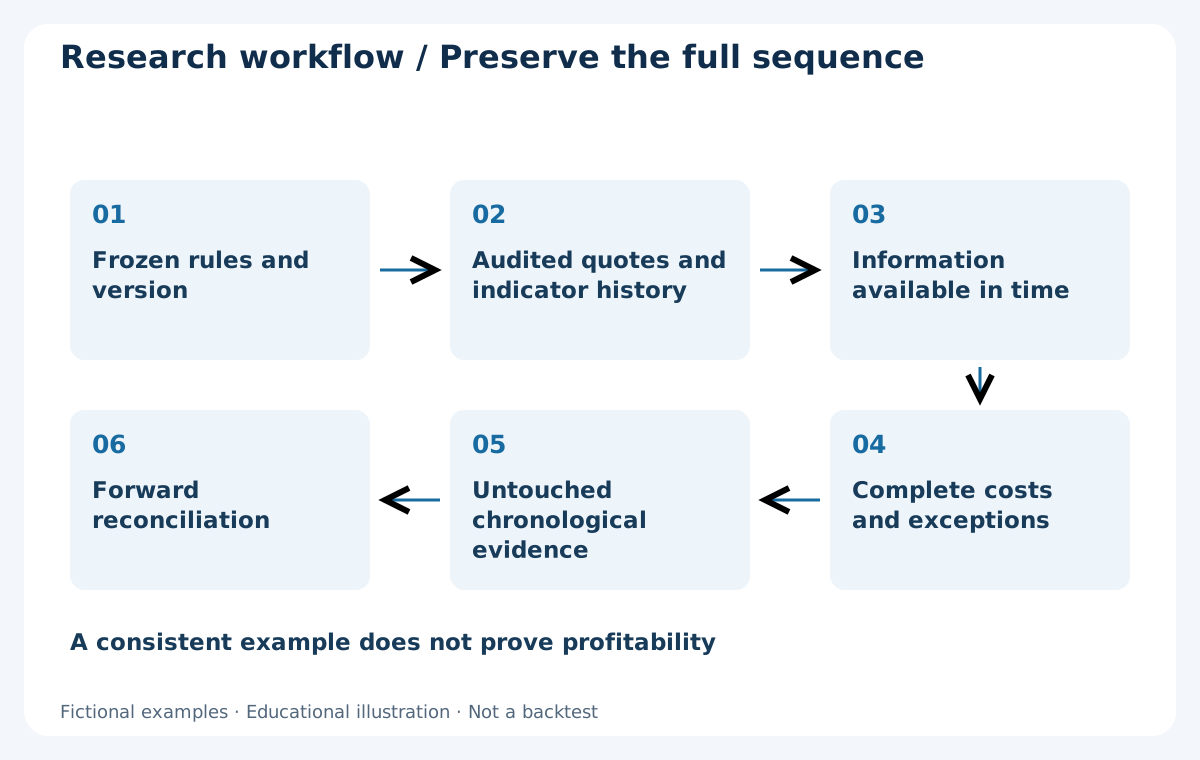
Replay the complete state sequence: eligible M5 block, A, frozen E, first P, immediate R, first quote, planned costs, volume, request, actual fill and exit. Record what was available at each step. Keep a sufficient documented warm-up and check indicator values against the terminal on completed candles. An EMA displayed with a chart shift must not be confused with the buffer index used to retrieve past data.
Standard MT4 Every tick does not certify recorded historical Bid/Ask or realistic latency. A bar-only test cannot resolve every intrabar stop/target order, stale quote or fill exception. Historical quote timestamps alone do not establish local receipt age. If the workflow cannot test a gate, mark that limitation rather than reporting that the gate passed. The MT4 scalping backtest guide provides the data and execution audit.
Separate development, validation, untouched historical testing and forward observation chronologically. Count all parameter and session variants, not just the best line. Report eligible blocks, candidates, rejected candidates, requests, fills, closed outcomes and remaining exposure with their correct denominators. Keep after-charge cash outcomes, drawdown and execution exceptions together; a high modelling percentage is not a probability of future success.
16. A final review before forward observation
A reproducible evidence pack contains the rule version, source data, timezone mapping, indicator setup, complete settings, decision log and original test reports. Link each candidate to the exact A/P/R candles and quote used, including cancellations. Check that the EMA reference did not drift, no future M5 close entered the decision, and the stop and target remained fixed. Keep educational diagrams separate from verified performance history.
Forward observation should first assess rule fidelity and execution differences under the same frozen settings. A demo can verify much of the process without proving identical live liquidity. Preserve disconnections, rejected protection, unusual charges and uncertain orders; do not increase volume merely to collect a more impressive sample. The forward-validation protocol structures observation, reconciliation and review.
The honest outcome may be another controlled test, a conclusion that execution evidence is insufficient, or rejection of the idea. None requires claiming a winning system. This strategy is ready for research only when its information clock, first opportunity, permitted price, post-cost plan and failure states can be followed without discretionary repairs. Commercial EA results require their own original evidence and must not be inferred from these fictional examples.
Frequently asked questions
Does a 1-minute scalping strategy mean every trade lasts one minute?
No. M1 defines the signal candle. This research version requests a time exit five minutes after the actual fill, on the first executable quote available then. A gap, disconnection or uncertain order can make actual holding longer; the stop and target may close the position earlier.
Are EMA20 and EMA50 the best scalping settings?
No optimality is claimed. They are explicit research inputs. Keep completed-candle indexing, applied price and chart shift consistent, and count any alternatives tried. A good-looking setting after a large search is not independent evidence of an edge.
Can a wick at the EMA authorize entry immediately?
No. First the defined A arms the frozen band, then the first valid P touches it, then the immediately following closed R must satisfy the directional confirmation. Entry is assessed only on the first quote after R, with time, spread, freshness, price and cost checks.
Why reject a quote that passes the spread limit?
Spread is only one condition. A later planned entry can reduce reward and increase risk while the target and stop remain fixed. The complete net reward/risk gate must also pass. Do not modify the target or stop to rescue a rejected candidate.
Should spread and the entry reserve be subtracted again from actual-fill profit?
No. Actual entry and exit prices already embed their realised quote-side and execution effects. Include separately booked commission and financing where applicable without double counting. A planning reserve is not an additional charge to deduct from a complete realised ledger.
Can this example be treated as a profitable backtest or an EA recommendation?
No. Prices, indicator snapshots, fills and cash outcomes are fictional. They demonstrate rules and accounting, not profitability. A specific EA requires its own implementation tests, data provenance, original reports and forward evidence under documented execution conditions.
Sources and research notes
The official MetaQuotes references explain the iMA inputs and the Bid/Ask requirements for trade operations. Platform documentation was also checked for bar indexing, symbol restrictions and tester limitations. The strategy rules and all numerical examples are original fictional research specifications; they are not MetaQuotes-endorsed settings, a measured broker result or an executed profitable backtest.
Educational research template. All settings, prices, indicator snapshots, fills and cash outcomes are fictional, not verified results. Forex trading involves risk. A stop, reserve, budget or backtest does not guarantee future performance or a maximum loss.