

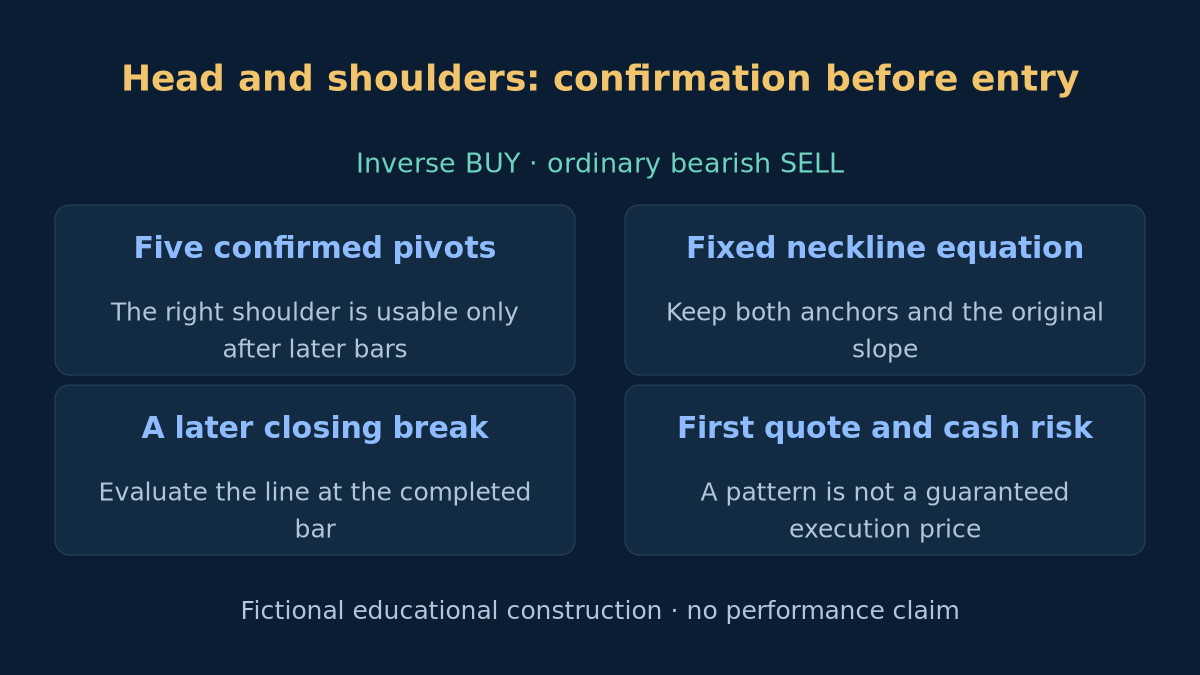
The head-and-shoulders pattern is often easy to identify after a reversal has already happened. A useful research rule must answer a harder question: what was actually known before an order could be sent? This strategy defines the five turning points, the delay needed to confirm them, a neckline that may slope, and a finite opportunity to act. The chart-pattern guide explains the wider reversal and false-breakout context. The settings below are declared research choices, not proven optimal values or a current trading recommendation.
1. Define the reversal hypothesis and data
The ordinary pattern has a left shoulder, a higher head and a right shoulder after a prior rise; its bearish case requires a later neckline break. The inverse pattern turns that structure upside down after a decline and supplies our BUY case. A candidate can fail, remain inside a range or continue the preceding trend. The hypothesis concerns the complete event sequence, not the visual appeal of a final chart, and no positive expectancy is established here.
Use ordinary EURUSD H1 Bid bars from one declared feed and corresponding historical Bid/Ask quotes for execution. Pip size is 0.0001 in this specification. Indices increase forward in time; O, H, L and C denote open, high, low and close. Recognition uses completed bars only. MT4 timeseries shifts run the other way: shift 0 is unfinished and shift 1 is the latest completed bar. Convert indexing explicitly before using the formulas.
Every required bar, from the preceding context through confirmation and the armed window, must have a consecutive hourly timestamp. A gap, including a weekend gap, clears the pivot window and cancels an armed candidate. Resume only when a new sequence has complete context. Missing quotes are unavailable observations; never invent a favourable price. Record feed, server timezone, symbol contract, exclusions and quote availability. The market-structure guide helps distinguish a swing description from a tradable rule.
2. Confirm five pivots without redrawing them
A low pivot at j is strictly below the lows at j−2, j−1, j+1 and j+2; a high pivot is strictly above those four highs. Equality on either side disqualifies that pivot type. The event becomes available only after j+2 closes, even when a chart places the marker back at j. If a bar qualifies as both types, treat it as ambiguous: clear the event window and cancel the candidate. This is our strict detector, not a promise that every platform fractal indicator treats ties identically.
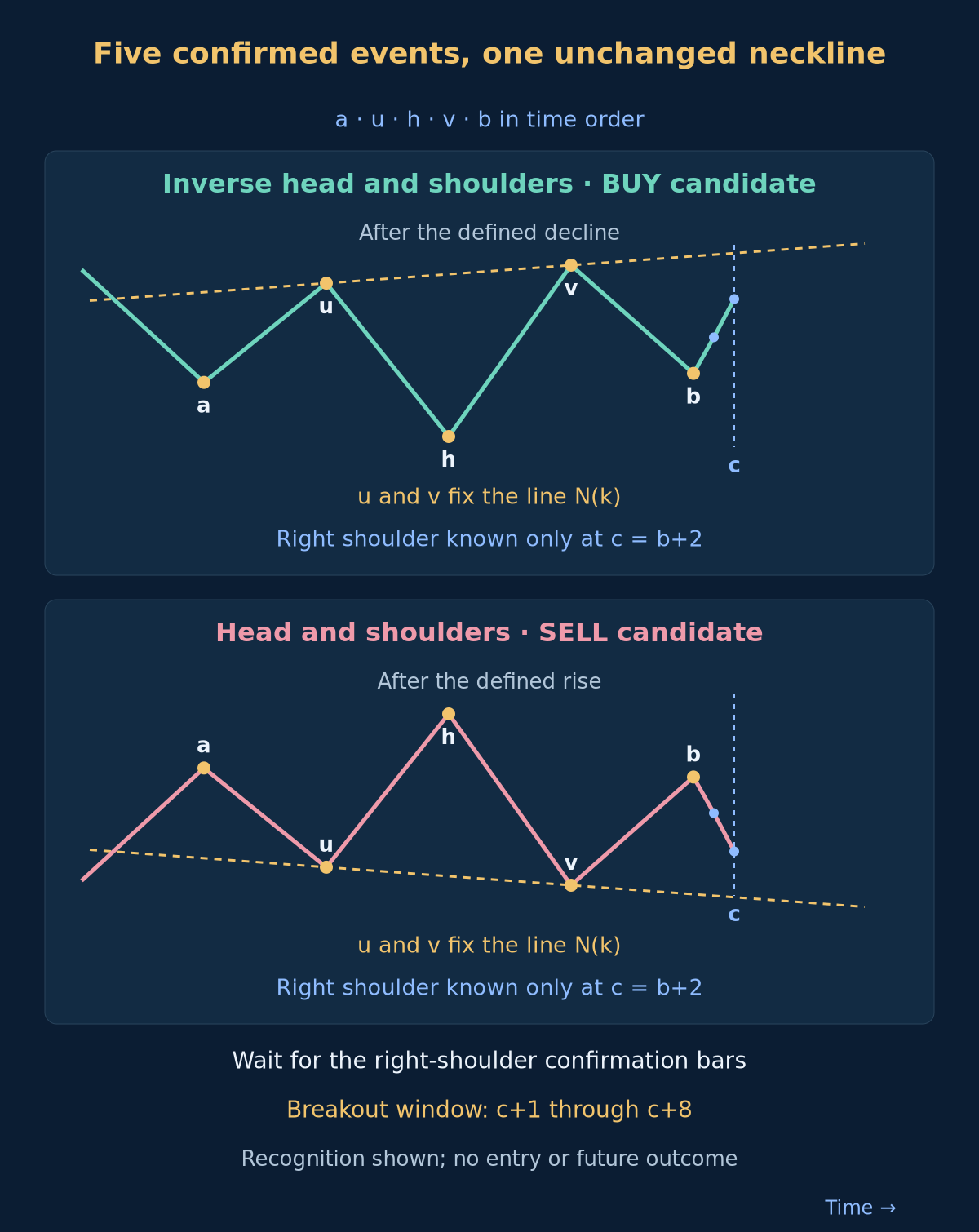
Keep confirmed events in chronological order, including consecutive events of the same type; do not replace them with better-looking extremes. Inspect only the latest five. BUY requires low–high–low–high–low; SELL requires high–low–high–low–high. Label their original bar indices a, u, h, v and b in that order. Shoulders are a and b, the head is h, and neckline anchors are u and v. Any non-alternating sequence fails. Each ordered sequence has a unique identity.
Evaluate a new candidate only while flat. Each newly confirmed pivot first cancels an existing armed candidate, even if that bar also closes beyond the neckline; only then evaluate the latest five events. While a position is open, record events without arming or queuing candidates. After closing, wait for a newly confirmed event. The double-top and double-bottom strategy uses a different three-pivot geometry; do not combine detectors after seeing which one wins.
3. Apply geometric and timing tolerances
Measure spacing by differences in original bar indices. Require b−a from 12 to 48 inclusive and each adjacent leg at least 3. Require the duration ratio (h−a)/(b−h) from 0.5 to 2 inclusive. For BUY, shoulder lows must differ by no more than 4 pips, and each shoulder low must be at least 8 pips above the head low. For SELL, shoulder highs have the same tolerance and must each be at least 8 pips below the head high. Exact symmetry is unnecessary, but a third similar extreme is not accepted as a head.
For BUY set Q[u] = H[u] and Q[v] = H[v]; for SELL use L[u] and L[v]. Define N(k) by the line through those two anchors. Their absolute price difference must be no more than 6 pips. Pattern height D is N(h)−L[h] for BUY or H[h]−N(h) for SELL; require D at least 16 pips. Each BUY shoulder must be at least 6 pips below N(a) or N(b), respectively; each SELL shoulder at least 6 pips above its corresponding line value. Before a, require C[a−8]−C[a−1] at least D for BUY, or the reverse difference for SELL. This endpoint filter does not prove a smooth trend.
4. Fix the line, the stop and an expiry
At c = b+2, freeze u, v, their prices and the resulting neckline equation. Its value N(k) changes with k if the slope is nonzero; fixing the equation does not make the line horizontal. Interpolate at h and extrapolate at the shoulders and later bars using the same forward indices. BUY stop S is L[b] minus 2 pips; SELL stop S is H[b] plus 2 pips. The stop belongs beyond the right shoulder and never follows the sloping neckline. A stop beyond the head would be a different specification.
Reject an already completed break: from v+1 through c inclusive, no BUY Bid close may be strictly above N(k) plus 2 pips, and no SELL Bid close strictly below N(k) minus 2 pips. Also reject if a BUY Bid low or SELL Ask high touched S from b+1 through c. If all checks pass, arm after c closes for bars c+1 through c+8 inclusive; c itself cannot signal. Expire after c+8 if no qualifying break occurs. A gap, ambiguous event, new pivot or stop touch cancels sooner. These are rejections, not omitted losing trades.
5. Inverse pattern: the BUY closing break
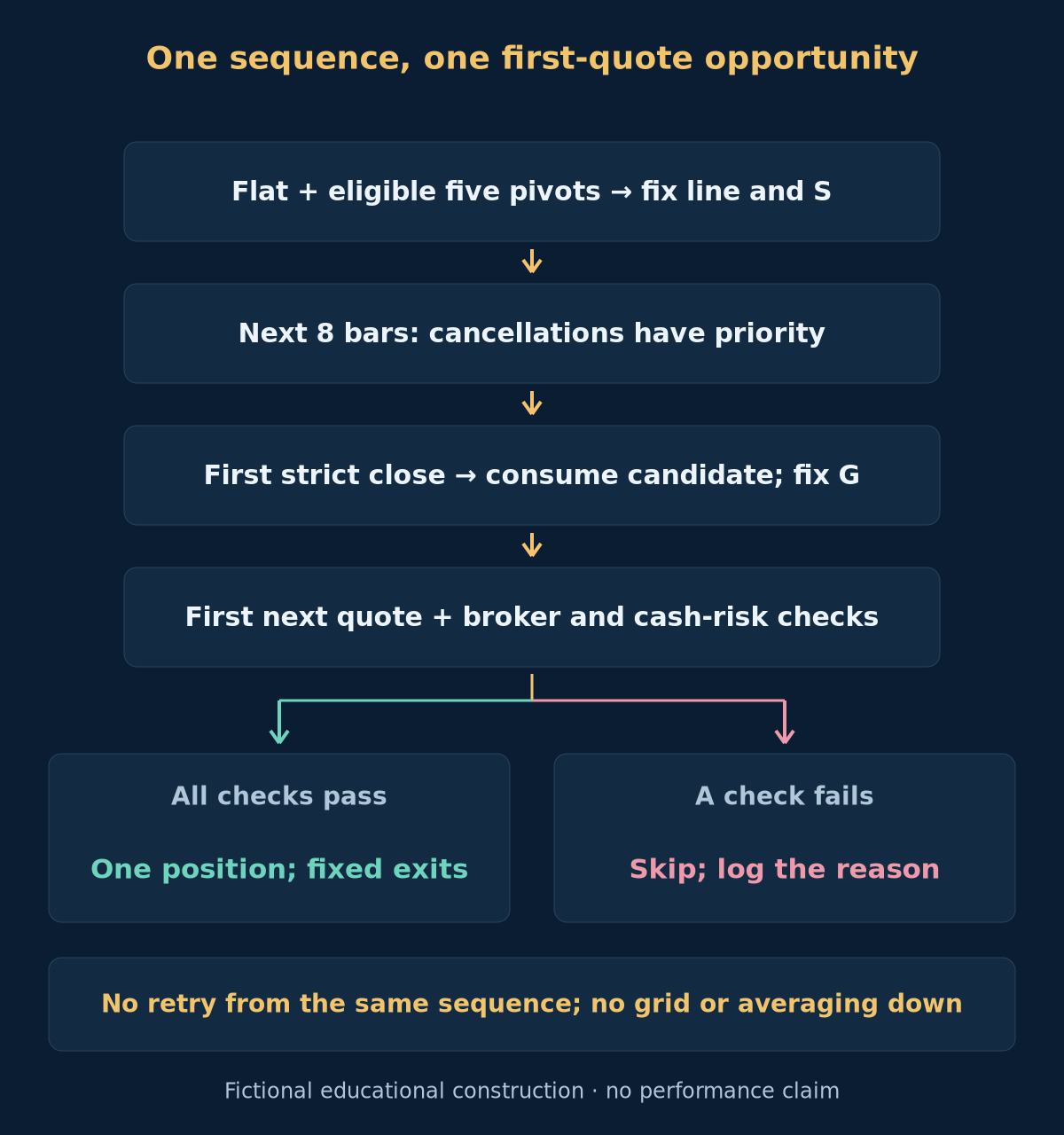
For each completed bar t in the armed window, first cancel if its Bid low is at or below S, or a newly confirmed pivot or data gap has cancelled the sequence. Otherwise the first Bid close strictly above N(t) plus 2 pips signals BUY. A wick above the line or a close exactly on the gate is insufficient. Consume the candidate immediately and freeze G = N(t) plus 2 pips for this signal. The next-quote check uses G, not the neckline extrapolated to the next bar.
Inspect only the first Bid/Ask quote after the signal close. It must arrive within 60 seconds; live Bid must remain strictly above G, spread must be no more than 1.5 pips, and Ask minus the signal Bid close must be no more than 5 pips. A lower Ask is acceptable if all checks still pass. A late, missing, expensive or invalid quote means skip and record why. Do not wait for a better quote, another close or a later return to the neckline from the same sequence.
6. Ordinary pattern: the bearish SELL mirror
For SELL, first cancel when a completed bar’s Ask high is at or above S, or when another cancellation event occurs. The first Bid close strictly below N(t) minus 2 pips supplies the signal and fixes G = N(t) minus 2 pips. At the first subsequent quote within 60 seconds, Bid must remain strictly below G; spread must be no more than 1.5 pips, and the signal close minus Bid no more than 5 pips. A higher Bid can pass while still below G. A failed first quote consumes the opportunity.
SELL opens at Bid and closes at Ask; BUY opens at Ask and closes at Bid. A Bid-only history cannot establish the SELL Ask-stop checks or all actual exits. Do not create a favourable SELL result by copying Bid prices to the wrong side. This strategy requires no return to retest the broken neckline, no entry at the right shoulder and no volume-based confirmation. Those would be separate hypotheses with separate clocks, prices and tests.
7. Check feasibility before and after the fill
At the available entry quote, require a positive distance to S between 8 and 60 pips inclusive. Check price-tick alignment, minimum and maximum volume, lot step, margin, trading permissions, commissions and broker stop restrictions. Unknown or failed constraints mean skip; do not move S to fit the broker. A reported zero minimum stop distance does not guarantee every stop request will be accepted. An entry signal and an order request are not evidence of an actual fill.
Size using that quote and the stated costs. Record the actual fill E, keep S unchanged and recheck the distance and cash budget using E. If the fill breaches the limits, or protection cannot be established, request an immediate close at an available quote and retain the trade, costs and reason in the results. Do not reclassify a filled failure as a skip. Delays, rejected orders and emergency closes are part of execution risk, even when the pattern itself was recognised correctly.
8. Use fixed exits and size in the account currency
For BUY, price risk is E−S and target T is E plus twice that distance. For SELL, risk is S−E and T is E minus twice that distance. This target uses entry-to-stop risk, not the classical head-to-neckline projection. BUY exits use Bid; SELL exits use Ask. Keep S and T fixed, with no trailing or break-even adjustment. If neither is reached, request an exit after 12 completed H1 bars, counting the entry-containing bar as the first, at the first subsequent real quote.
Use an illustrative budget of 0.5% of current equity and at most one open position for this rule set. Divide the cash budget by estimated loss per lot, including price distance, round-trip commission and the total adverse-slippage allowance. Round down to the permitted lot step; below minimum volume means skip. An allowance is not a maximum-loss guarantee. Gaps and execution failures can exceed it. Assess combined exposure with other systems separately using the risk-management guide.
Pips, platform points and minimum ticks are different units. Use the actual contract and account currency for pip or tick money values, converting distance and tick size into matching price units. A value given in points must be converted before combining it with a price distance. USD 10 per pip is not universal. Correct Ask/Bid entries and exits already include spread; do not add the same spread twice. Include swaps when applicable. The pip guide and position-sizing guide cover these conversions.
9. Worked inverse BUY with a rising neckline
The fictional pivots are a = 20, u = 26, h = 32, v = 38 and b = 44. Each leg spans 6 indices, b−a is 24 and the duration ratio is 1. Shoulder lows are 1.09880 and 1.09900; the head low is 1.09760. Neckline highs are 1.10100 at u and 1.10140 at v. Thus the anchor difference is 4 pips, N(h) is 1.10120 and D is 36 pips. The shoulders are 20 and 26 pips below their own line values. C[a−8] = 1.10600 and C[a−1] = 1.10100 provide a 50-pip preceding decline.
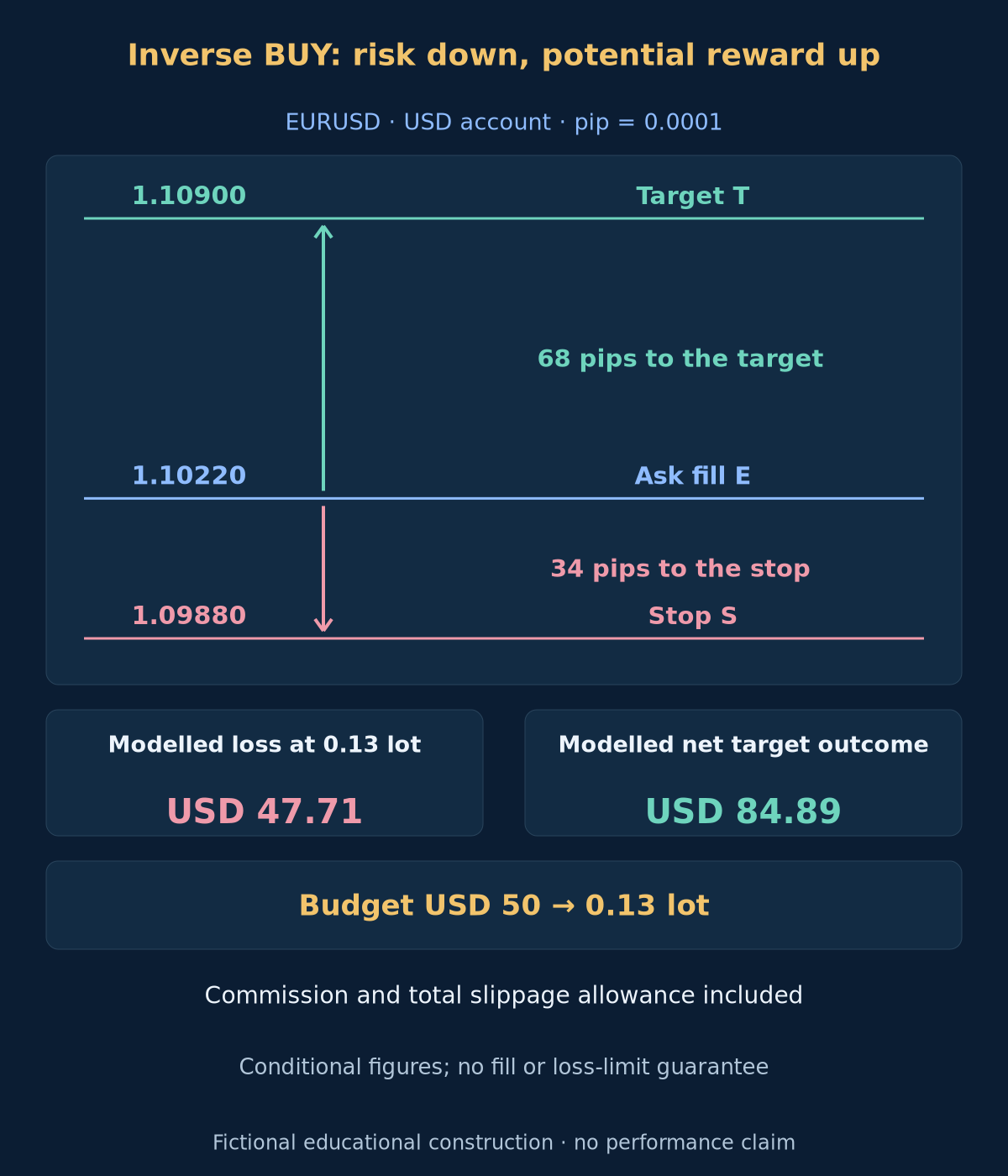
Assume all strict pivot, data and rejection checks pass. The right shoulder becomes known at c = 46, and the first eligible signal bar is t = 47. Here N(47) = 1.10170, so G = 1.10190. A Bid low of 1.10060 remains above S = 1.09880, and a completed Bid close of 1.10200 breaks strictly above G. The first quote arrives 2 seconds later at Bid 1.10210 and Ask 1.10220: spread is 1 pip and adverse chase is 2 pips. Assume accepted protection and an actual fill E = 1.10220.
The fixed stop is 34 pips below E; T = 1.10900 is 68 pips above it. In a USD 10000 account, the 0.5% budget is USD 50. Assume USD 10 per pip per 1 lot, USD 7 round-trip commission per lot and a total adverse-slippage allowance of 2 pips per alternative outcome. Modelled loss per lot is USD 367. Rounding down to a 0.01 lot step gives 0.13 lot and modelled loss USD 47.71. Rounding upward would exceed the budget.
| Calculation | Declared value | Meaning |
|---|---|---|
| Signal gate G | 1.10190 | Frozen at the qualifying signal bar |
| Fixed stop S | 1.09880 | Right-shoulder low minus buffer |
| Price target T | 1.10900 | Twice actual entry-to-stop distance |
| Cash budget | USD 50 | Equity multiplied by the risk fraction |
| Modelled loss per lot | USD 367 | Price distance plus commission and allowance |
| Rounded volume | 0.13 lot | Round down; never round risk upward |
| Modelled loss | USD 47.71 | Conditional allowance, not a loss cap |
| Modelled net target outcome | USD 84.89 | Conditional result, not a forecast |
At T, gross price gain is USD 88.40. Deduct USD 0.91 commission and USD 2.60 slippage allowance for a modelled net target outcome of USD 84.89. The allowance is used once in each alternative outcome, not twice inside one trade. The price-distance ratio is 2, while the net cash ratio is lower. This example assumes no swap and no further fill deviation. Neither the target nor the stop is a guaranteed execution price, and the calculations are not a return forecast.
10. Test the sequence and retain every rejection
Replay bars and quotes in time order. Store each original pivot time and its later confirmation time, sequence identity, neckline anchors and equation, S, expiry, signal bar, frozen G, first quote, order request, actual fill, volume, costs and exit. A screenshot of the final shape cannot prove that the right shoulder was available at entry. The optional equations below summarise the definitions; they are not a complete EA or an executable order-management system.
Record why each sequence failed: alternation, spacing, duration balance, shoulder tolerance, head prominence, anchor difference, height, preceding move, an early break, stop touch, new pivot, expiry, quote quality or broker constraints. Use historical Bid/Ask quotes for SELL invalidation and stop/target ordering. If both exits occur within an OHLC bar and ordering is unknown, mark it ambiguous and report a separate conservative stop-first sensitivity result. Never select the favourable ordering.
Freeze the specification before using untouched periods. Report every tested variant, candidate, cancellation, failed quote, emergency close and completed trade, together with net expectancy, drawdown, turnover and sample uncertainty. Test nearby tolerances, flat and sloping lines, and different feeds without selecting only winning results. The backtesting guide and execution-cost guide explain related limitations. There is no performance study or demonstrated advantage in this article.
Common errors include using b before b+2 closes, silently flattening the neckline, substituting a later anchor, comparing the next quote with N(t+1) instead of frozen G, ignoring cancellation priority, entering at a historical close and retrying a failed first quote. A long gap can postpone a time exit; use the next real quote and record the delay. News, gaps, wide spreads and correlated positions can dominate a small nominal budget. A recognisable pattern or a target twice the stop does not establish profitability.
Optional: exact neckline, gate and sizing equations
low_pivot(j) = L[j] < min(L[j-2], L[j-1], L[j+1], L[j+2])
high_pivot(j) = H[j] > max(H[j-2], H[j-1], H[j+1], H[j+2])
pivot_known_at(j) = close_time[j+2]
N(k) = Q[u] + (Q[v]-Q[u])*(k-u)/(v-u)
c = b + 2; eligible_break_bars = [c+1, c+8]
buy_break(t) = C_Bid[t] > N(t) + 2*pip; G = N(t) + 2*pip
sell_break(t) = C_Bid[t] < N(t) - 2*pip; G = N(t) - 2*pip
buy_stop = L[b] - 2*pip; sell_stop = H[b] + 2*pip
buy_target = E + 2*(E-S); sell_target = E - 2*(S-E)
cash_budget = equity * 0.005
loss_per_lot = stop_pips * pip_value_per_lot + commission_per_lot + slippage_pips * pip_value_per_lot
lots = floor((cash_budget / loss_per_lot) / lot_step) * lot_step
11. Questions about head and shoulders
Must both shoulders and the neckline be perfectly level?
No. This specification allows limited shoulder differences and a limited anchor-price difference. It fixes a line through the two neckline anchors and evaluates that same equation at the appropriate index. A visually pleasing pattern that fails any declared tolerance is rejected; it is not manually adjusted to fit.
Can I enter when the right shoulder first appears?
That is a different hypothesis. Here the right shoulder needs its later confirmation bars, followed by a later qualifying closing break. A break before confirmation rejects the sequence. Moving a marker backward on a chart does not move the information’s availability backward in time.
Does the inverse pattern change execution or retry rules?
It changes the geometry and trade direction. The inverse case opens BUY at Ask and uses Bid for its exits; the ordinary bearish case opens SELL at Bid and uses Ask for exits. Both consume the candidate at the first qualifying close and allow only the first subsequent quote, without a second attempt from that sequence.
Why does the target differ from a classical measured move?
The classical projection uses head-to-neckline height, while this declared rule uses actual entry-to-stop distance. They are different exit hypotheses. Neither projection guarantees price will reach it. Test the full chosen method, including costs, time exits and failed patterns, before drawing performance conclusions.
12. Primary sources and declared scope
Primary references: IG Academy on head and shoulders, neckline breaks and the inverse pattern; MetaQuotes on timeseries indexing, symbol, tick and volume properties, and market-order prices and stop restrictions. Checked 2026-10-19. The strict detector, numerical tolerances, clocks, right-shoulder stop, entry policy, risk-based target and examples are our educational construction. The sources do not prescribe these settings or validate profitability.
Forex and leveraged trading involve substantial risk. This article is educational and is not investment advice. Confirmation, stops and cost allowances do not guarantee fills, limited losses or profit. All prices, diagrams and numerical outcomes here are fictional conditional examples.