

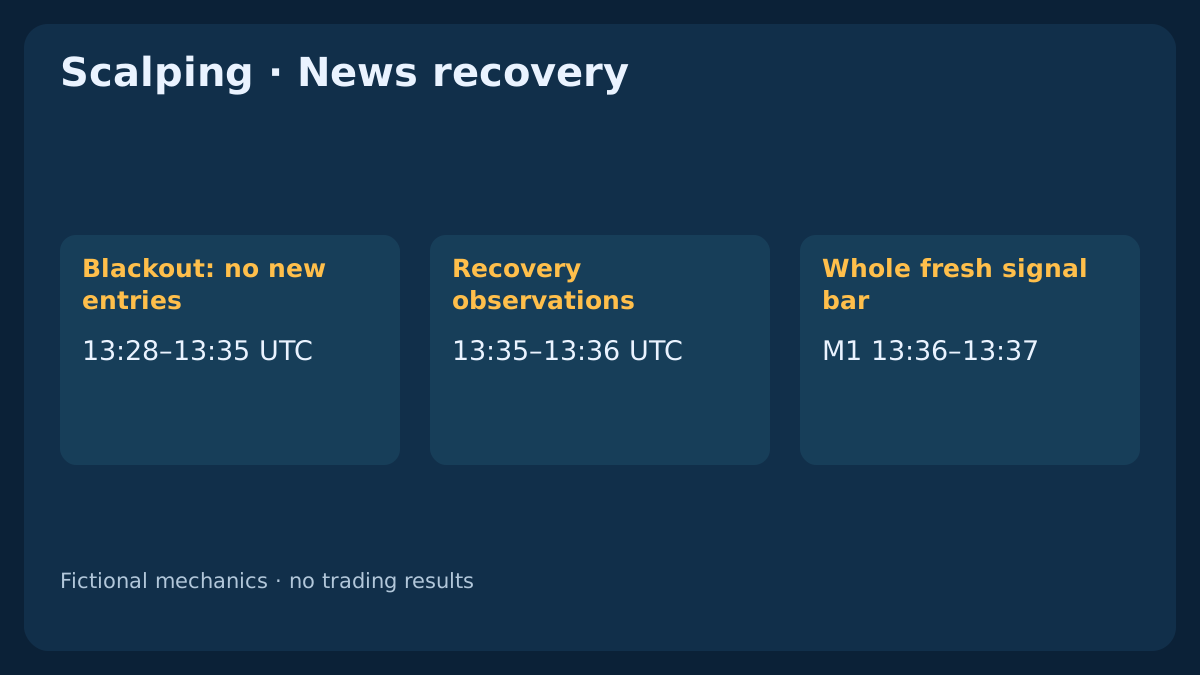
The end of a news pause does not restore the market that existed before it. A small target can be consumed by a wider Ask, and a queued signal can describe an opportunity that has already disappeared. This guide follows the path from a scheduled blackout to quote recovery and a new candidate.
1. The practical question is when to reconsider a new scalp
A scheduled release can change prices and the terms available for trading them. Volatility describes movement; liquidity concerns the ability to transact at available prices and sizes. A large candle is not evidence that a short-target trade can be executed cheaply. A narrow displayed spread does not establish available size or a future fill either.
This guide adds a specific recovery protocol to the economic-calendar and EA-filter guides. It does not interpret a forecast surprise as a BUY or SELL signal. The example separates the time restriction, observed quote quality, a new strategy setup and the final cost/risk decision. None of those checks supplies a profitable strategy by itself.
For a finite entry model, see the M5 MACD and ATR momentum scalping strategy: the first turn is consumed even when confirmation or execution fails.
2. See how the same Bid can hide a more expensive BUY
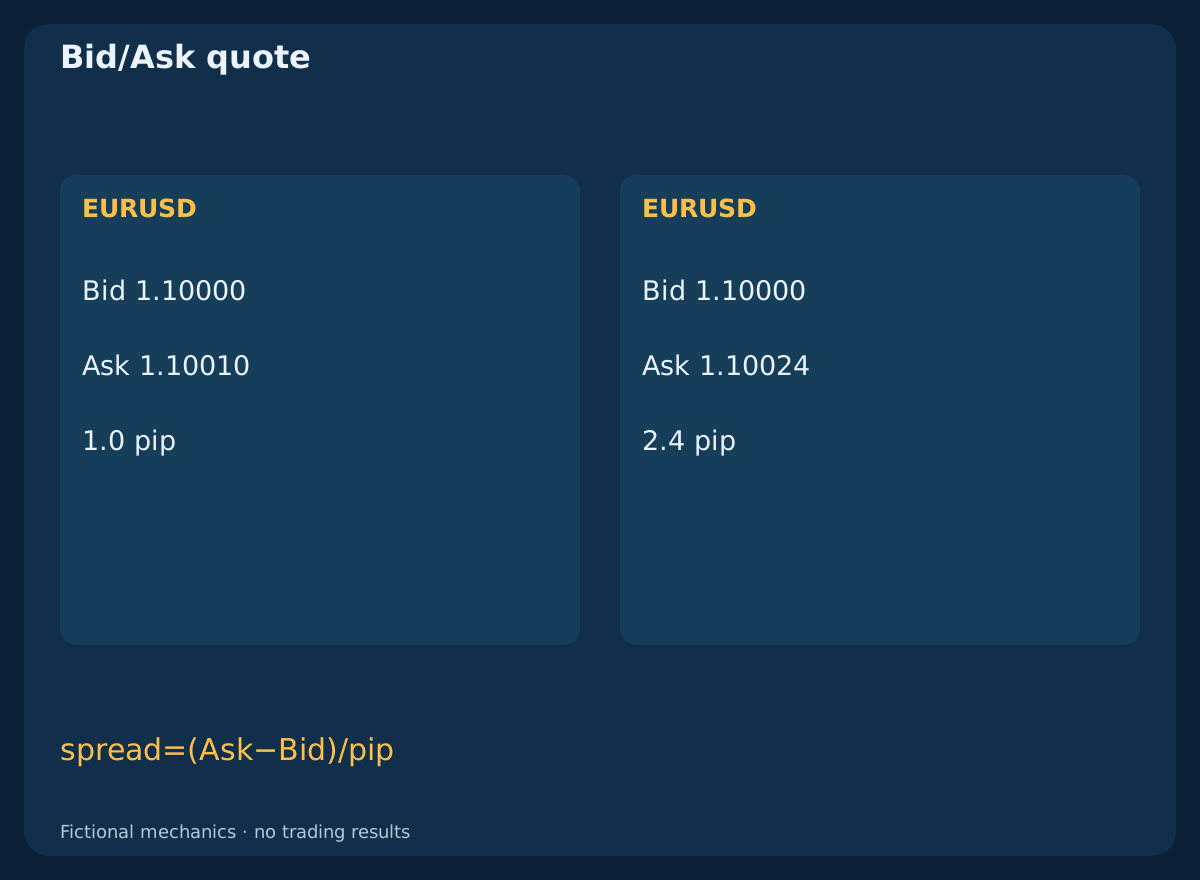
Assume EURUSD, pip=0.0001 and point=tick=0.00001. With Bid=1.10000, an Ask of 1.10010 gives a spread of 1.0 pip; an Ask of 1.10024 gives 2.4 pips. The chart's Bid can be unchanged while the BUY entry becomes more expensive.
Measure spread=(Ask-Bid)/pip on the intended symbol and account. BUY entry uses Ask; SELL entry uses Bid, with the corresponding opposite-side exit. Quote freshness, commissions, adverse execution and size constraints still require separate checks. A spread cap is a filter on an observation, not a guaranteed maximum trading cost.
3. Freeze event coverage and convert the full date
Choose relevant events for both currencies and the combined account exposure, including separate announcement stages. Confirm the original publisher, exact date, displayed zone and latest schedule. BLS calendars, for example, state Eastern Time. An 08:30 America/New_York clock example maps to 13:30 UTC on 2026-01-15, but 12:30 UTC on 2026-07-15. These are conversions, not claims that a release occurred on those dates.
Map UTC to the broker's verified offset for that date; do not copy the calendar hour into an EA input. Record when a calendar version became available. An unknown time, missing coverage or unresolved delay holds dependent new entries. A calendar cannot exclude unexpected news, and an expected-impact label is not a measured probability of a large price move.
4. Merge blackouts before looking for recovery
For the fictional UTC date 2026-01-15, event A is scheduled at 13:30 and event B at 13:32; both were known at 13:20. Choose a pre-buffer of 2 min and post-buffer of 3 min. Their half-open intervals are [13:28,13:33) and [13:30,13:35), giving the union [13:28,13:35).
The start is included and the end excluded. At 13:33, B still blocks; at 13:35, the scheduled union ends only if the schedule remains verified and unchanged. The state then becomes recovery observation, not entry permission. These buffers are teaching choices, not recommended news settings or evidence that prices settle within three minutes. Later stages, delays or new restrictions can extend the hold.
Download fictional news-event windows (CSV)
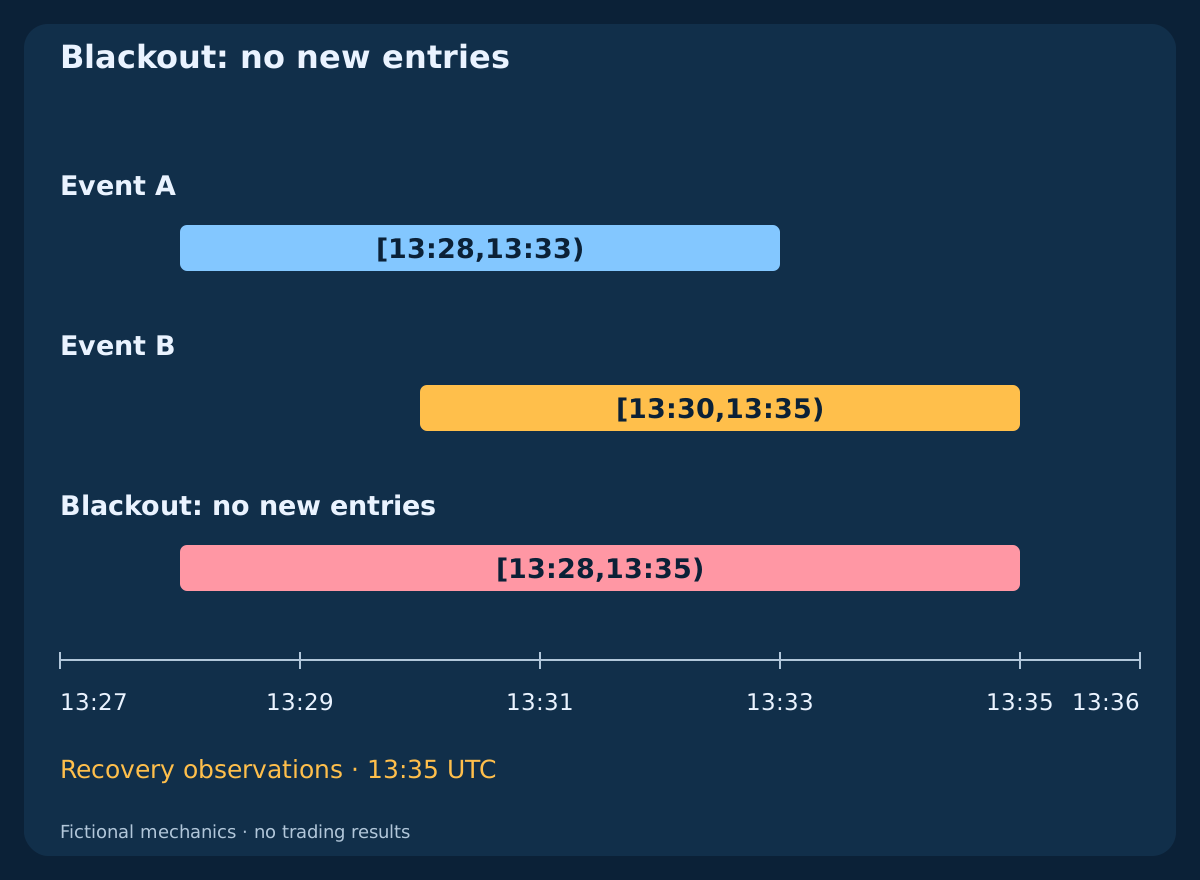
| Event | Start | End |
|---|---|---|
| Event A | 13:28 | 13:33 |
| Event B | 13:30 | 13:35 |
| Blackout: no new entries | 13:28 | 13:35 |
5. Separate new entries from pending orders and existing exposure
Before a blackout, apply a declared pending-order policy with enough operational time to check the response. A cancellation request is not confirmed cancellation, and a broker-held order can fill while the terminal waits. Reconcile the accepted order/position state; a position discovered late remains real exposure. The execution guide explains the cancellation and timeout distinctions.
Management of existing exposure follows its own predeclared rules, valid data and permissions. An entry pause must not silently turn off protection, monitoring or a required risk exit. The MT4 AutoTrading switch can also prohibit requests needed by automated management; it is not a dedicated new-entry gate. A stop or an intended pre-event close cannot guarantee a price or a maximum realised loss.
6. Check the symbol's data rather than a moving terminal clock
Track the intended symbol's valid Bid/Ask and its local receipt age with a checked elapsed-time method. Recent receipt does not prove that upstream prices are current or executable. Keep connection, feed validity, calendar status, clock mapping and broker-order reconciliation as separate required inputs. A tick on another pair does not refresh the traded pair.
MQL4 TimeCurrent() in OnTick() refers to the handled tick; outside it, the value can reflect another Market Watch symbol. It is not an independent advancing clock or a millisecond freshness proof. The example assumes a verified receipt-age measurement; MT4 timestamps alone do not supply that measurement. After restart or clock uncertainty, rebuild verified state before admitting new candidates.
7. Specify a modest observation test with explicit limits
After the verified blackout ends, require 3 consecutive scheduled checks, 10 s apart, with spread<=1.2 pips and own-symbol receipt age age<=500 ms. Bid/Ask must be valid and the other required data and order-state checks resolved. A known failure resets the count; a missing check or gap >10 s also resets it. Threshold equality passes this observation test only.
These are invented test settings. Three sampled observations do not prove continuous stability between checks, market depth or safe execution. Evaluate observed failures between checkpoints too, and recheck all gates at the actual decision/request. An unobserved spike can still occur. Treat recovery as an operational eligibility test, not a forecast or a universal recipe for trading after news.
8. Follow the recovery path without skipping failed observations
At 13:35:00, spread 2.4 fails. At 13:35:10, spread 1.0 and age 100 ms give count 1. At 13:35:20, spread 1.4 resets it. At 13:35:30, spread 1.0 looks narrow but age 800 ms fails, so the count remains zero.
The checks at 13:35:40, 13:35:50 and 13:36:00 have spreads 1.0,1.1,1.0 with age 100 ms. Counts become 1,2,3; quote recovery is ready at 13:36:00. Assume no additional observed failures between the recorded checks. The CSV retains every scheduled observation and subsequent signal check. No order or fill occurs merely because the count reaches three.
Download fictional recovery and signal log (CSV)
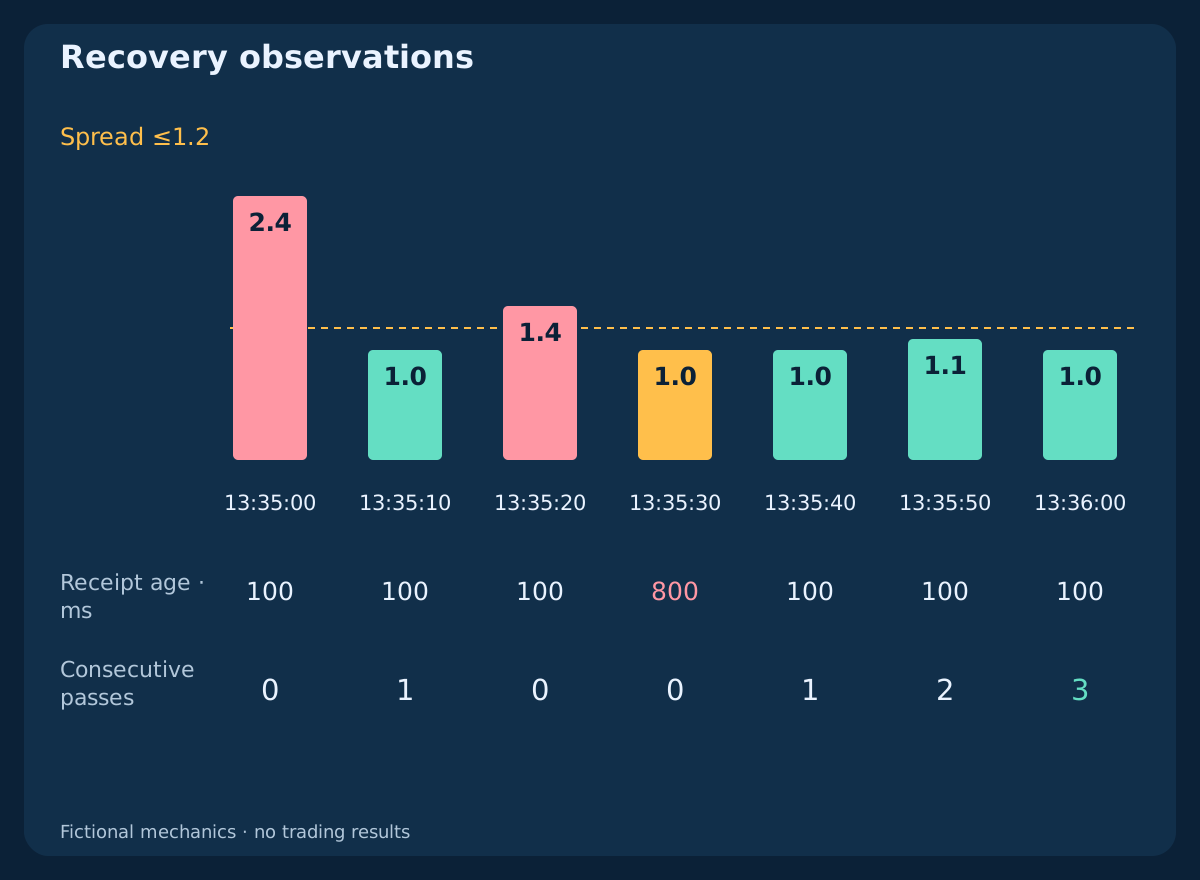
| Time UTC | Spread, pips | Age, ms | Count | State |
|---|---|---|---|---|
| 13:35:00 | 2.4 | 100 | 0 | Recovery observations |
| 13:35:10 | 1.0 | 100 | 1 | Recovery observations |
| 13:35:20 | 1.4 | 100 | 0 | Recovery observations |
| 13:35:30 | 1.0 | 800 | 0 | Recovery observations |
| 13:35:40 | 1.0 | 100 | 1 | Recovery observations |
| 13:35:50 | 1.1 | 100 | 2 | Recovery observations |
| 13:36:00 | 1.0 | 100 | 3 | Recovery ready |
9. Reset readiness when evidence changes
Once ready, any observed required-input failure holds new entries and removes readiness. A spread breach, stale receipt, missed scheduled check, calendar change, disconnect or unresolved order state must not leave a remembered green flag available for a later request. Resume the observation count from zero when the required context is valid again; entering a new blackout takes priority.
For example, a gap of 20 s exceeds the declared 10 s maximum even if the two endpoint quotes look good. Do not invent the missing middle observation. After an interruption, cancel any queued research intent and reconcile exposure before recovery starts again. Keep fault handling and management separate from the entry gate.
10. Require the whole signal bar to begin after readiness
For this example's closed-bar M1 candidate rule, the signal bar must open at or after the latest readiness time and close while readiness remains valid. The bar [13:35,13:36) is excluded even though it closes exactly when recovery becomes ready: it began earlier. Any intent formed before readiness is retired rather than held in a queue.
The new bar [13:36,13:37) can be considered at its 13:37 close, provided all required checks still pass. Assume a separate, previously defined setup is present; this guide does not invent that setup from the news move. A new signal is not a late entry into the original spike. M5 or another model needs its own complete-bar and timing rule.
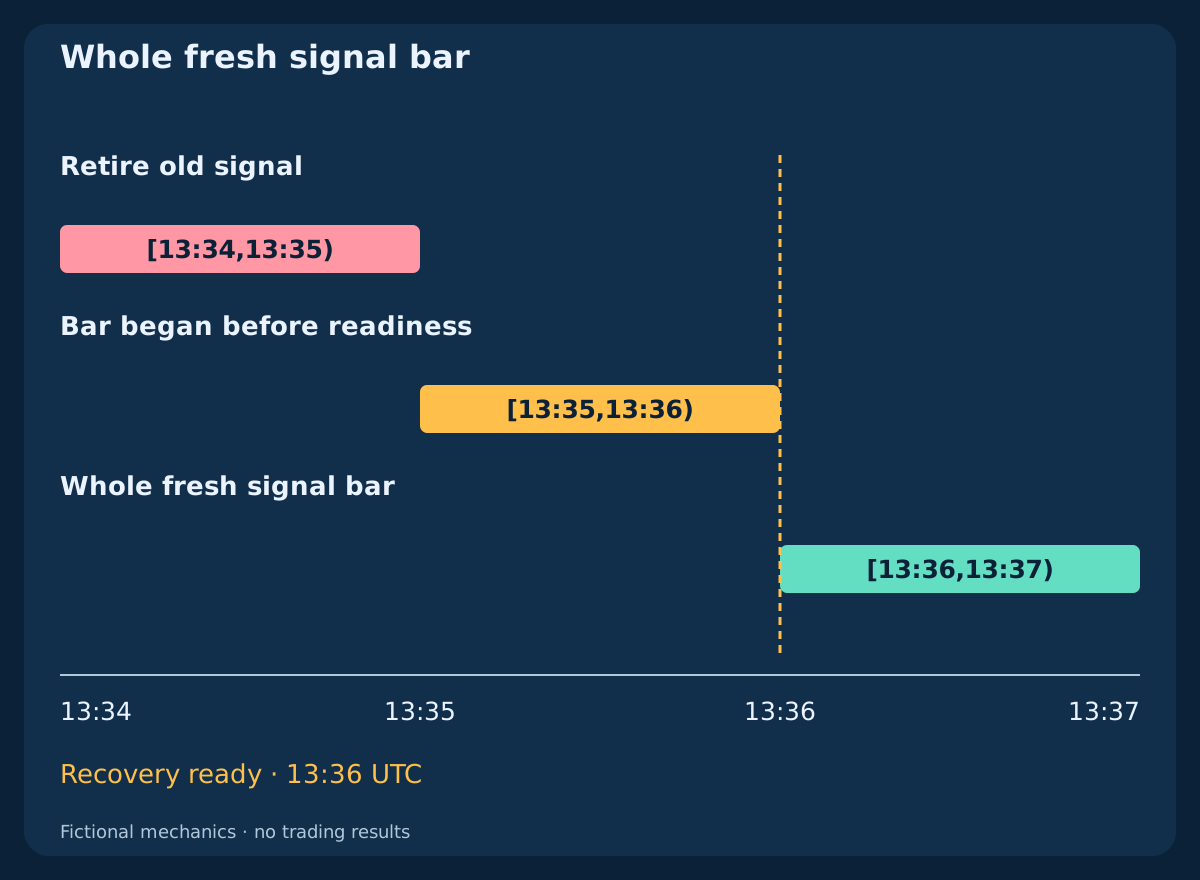
| Result | Bar open UTC | Bar close UTC | State |
|---|---|---|---|
| Retire old signal | 13:34 | 13:35 | Fail |
| Bar began before readiness | 13:35 | 13:36 | Fail |
| Whole fresh signal bar | 13:36 | 13:37 | Candidate eligible |
11. Recalculate complete costs before approving the candidate
Use a USD account, contract 100000 EUR per standard lot and pip value 10 USD/pip/lot. Fix BUY Bid levels S=1.09950 and T=1.10110 against reference Bid=1.10000: gross distances are 5/11 pips. Assume round-trip commission 0.7 pip, adverse entry allowance 0.3 pip and exit allowance 0.2 pip. Before requesting, total planned friction is C=spread+1.2, so L=5+C, W=11-C and R_net=W/L. Fees are assumed linear per lot.
At spread 1.0, L/W are 7.2/8.8 pips and ratio 1.2222. Equity 10000 USD and a chosen 0.25%=25 USD budget give lots=floor((25/(L*10))/0.01)*0.01: 0.34 lots, planned risk 24.48 USD and net target 29.92 USD. The assumed lot grid is 0.01; margin, minimum volume, stop distances and aggregate exposure must also permit the order. Otherwise reject it without moving the levels.
Download fictional scalping cost gates (CSV)
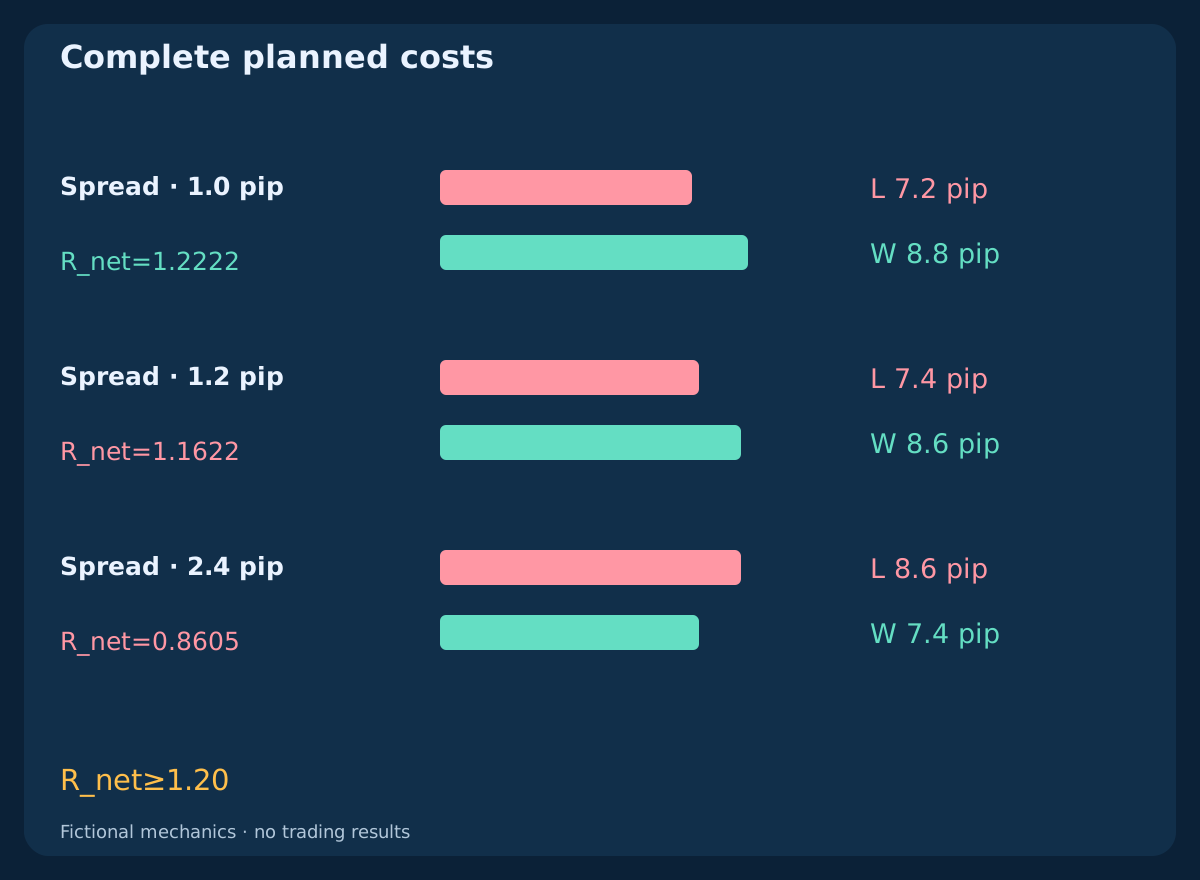
| Spread, pips | Planned loss, pips | Net target, pips | Net ratio | Lots | Risk USD | Target USD | Result |
|---|---|---|---|---|---|---|---|
| 1.0 | 7.2 | 8.8 | 1.2222 | 0.34 | 24.48 | 29.92 | Pass |
| 1.2 | 7.4 | 8.6 | 1.1622 | 0.33 | 24.42 | 28.38 | Fail |
| 2.4 | 8.6 | 7.4 | 0.8605 | 0.29 | 24.94 | 21.46 | Fail |
12. A passing spread cap can still fail the reward/risk gate
Declare a research gate of R_net>=1.20. At spread 1.2 pips, the observation cap passes, but L=7.4, W=8.6 and R_net=1.1622 fail this separate gate. At 2.4 pips, both the spread condition and the ratio fail. A smaller lot reduces planned cash exposure; it does not repair the reward/risk ratio.
All allowances are assumptions, not execution caps. With a known fill F, use the actual Ask entry and Bid exits and add only commission and remaining exit costs: C_remaining=0.9 pip here. Do not charge the already represented spread or entry slippage again. A worse actual fill can breach the planned budget; manage real exposure under the declared procedure rather than retrospectively shrinking historical volume.
13. Treat the request as a new, finite decision
At the fictional 13:37:00 signal close, require a current qualifying quote and permit at most one initial request within 1 s. The illustrated decision at 13:37:00.300 uses a quote received at 13:37:00.200, age 100 ms. Recheck the blackout, readiness, setup validity, price, costs, permissions and exposure immediately before requesting. The CSV marks checks passed, not a fill.
If a required check fails, retire that candidate under the declared rule; do not wait for a prettier quote and reuse it indefinitely. A rejection, requote or uncertain outcome follows the separate execution policy. In particular, an unanswered request is not permission to resend, and a newly discovered position must be protected. Market and limit variants need their own timing and fill assumptions.
14. Preserve the information actually available at each instant
Keep the calendar version, original schedule and source/receipt times, relevant currencies, merged intervals, rule version, dated clock mapping, observations, gaps, reset reasons and readiness transitions. Log signal-bar boundaries, candidate identity and every later request/order state. Retain rejected candidates and missing observations as well as passes.
A revised calendar downloaded later cannot silently replace the snapshot used earlier. Bar OHLC cannot reveal the historical spread path, quote receipt age or an unobserved intermediate failure. Tick data without the relevant clocks and Bid/Ask fields also leave gaps. The event CSV and recovery CSV illustrate logic; the cost CSV calculates assumptions. None supplies live liquidity or trading outcomes.
15. Test the protocol separately from a claimed trading benefit
First replay fixed boundary and failure cases: overlapping blackouts, exact end time, a delayed stage, spread exactly at the cap, stale quotes, a missing checkpoint, restart and readiness invalidation. Include a bar that closes at readiness but started before it, a fresh full bar, and a passing spread with a failing cost ratio. Verify management and pending-order handling while new entries are held.
Then evaluate the complete strategy on common candidate origins with and without the declared filter, realistic costs and separate later observations. Rejected winners count in that comparison too. Do not tune dozens of buffers or recovery thresholds on the same news days and report only the winner. Correct state transitions establish operational consistency, not future profit or protection from unexpected announcements.
16. Use a short sequence before reconsidering entry
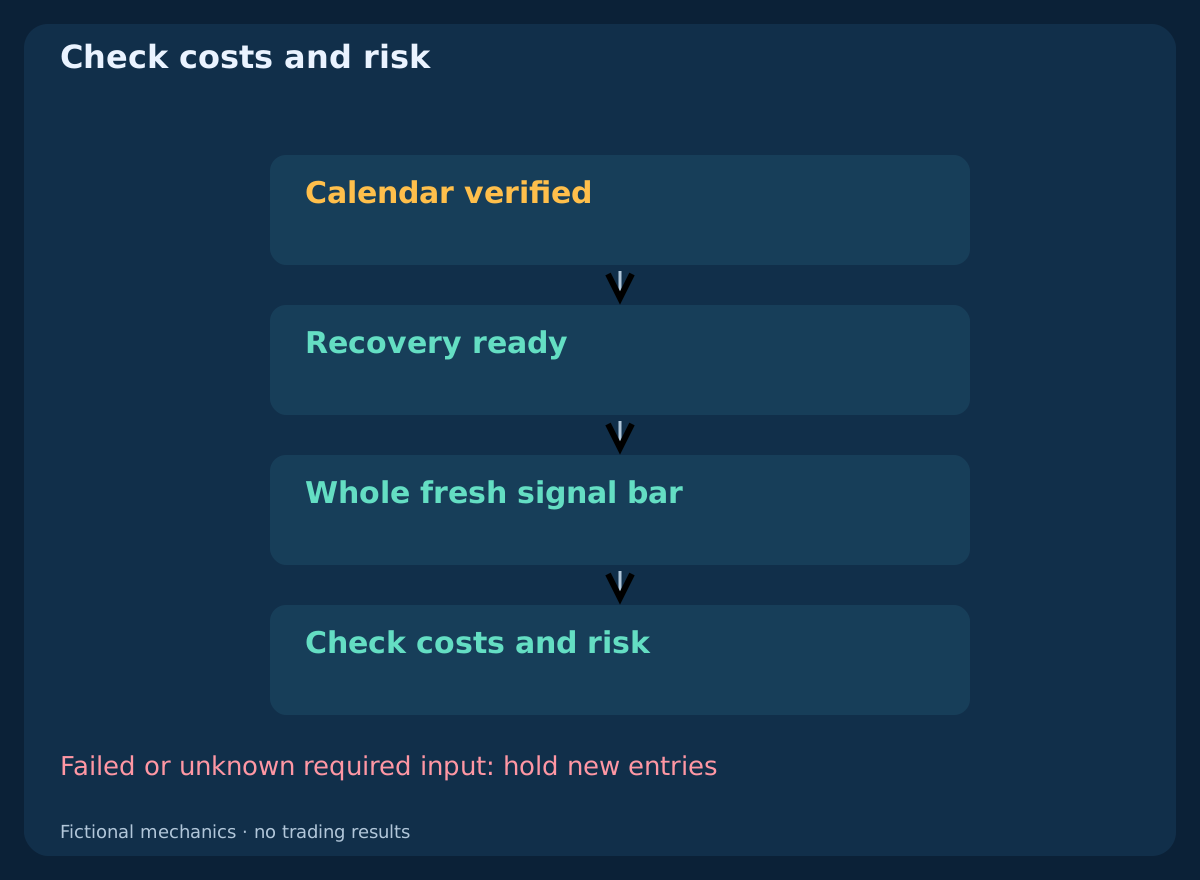
Confirm the current event coverage and dated clock, wait out the whole merged blackout, observe recovery under the declared sampling/failure rule, and require a complete fresh setup. Then recalculate net costs and cash risk and reconcile the actual request/order state. Any unresolved required input holds new entries while the defined management path continues.
The result is permission to evaluate a candidate, not an instruction to trade the news. Use the earlier calendar, session/filter, execution and stop/target guides for their separate responsibilities. Keep a versioned record that another reader can replay. The six diagrams and three fictional CSVs explain that process without claiming that a fixed waiting period makes scalping safe.
Frequently asked questions
Can I resume scalping as soon as the news blackout ends?
The scheduled time restriction may have ended, but quotes, data, pending orders and risk still need checks. In this example recovery observations begin at that point; a complete fresh setup is required afterwards.
Do three narrow-spread observations prove normal liquidity?
No. They satisfy only the declared sampling test. They do not show continuous stability, executable size or future fills; an unobserved spike or later deterioration remains possible.
Can a signal from before the release be used after the pause?
Not under this example's rule. Old intents are retired. The entire new signal bar must begin at or after the latest readiness time and close while the required state remains valid.
Why can a spread inside the cap still be rejected?
The cap checks one price difference. Commission, execution allowances, stop/target distances and the net reward/risk gate can still fail. Lowering volume does not improve that ratio.
Does stopping new entries mean switching off AutoTrading?
Those are different controls. AutoTrading can also prohibit automated management requests. Pending orders and existing exposure need separately verified handling; an entry pause must not silently bypass management.
Does this guide recommend a universal news waiting time?
No. The buffers, observation spacing and thresholds are invented teaching inputs. They do not establish a profitable strategy, guarantee execution or remove unscheduled-news and account risk.
Sources and research notes
Official calendars establish scheduled publication information; MetaQuotes documents platform time functions. All event labels, quote paths, thresholds and trade calculations below are original fictional teaching cases. No actual news-day execution or performance is asserted.
- BLS release calendar: verify dates and Eastern Time
- Federal Reserve: FOMC calendar and separate release stages
- MQL4: TimeCurrent and its quote-time scope
Educational content. Events, quotes, thresholds and calculations are fictional. Forex trading involves risk; waiting windows, spread caps, stops and execution allowances cannot guarantee a fill, profit or a maximum actual loss.