

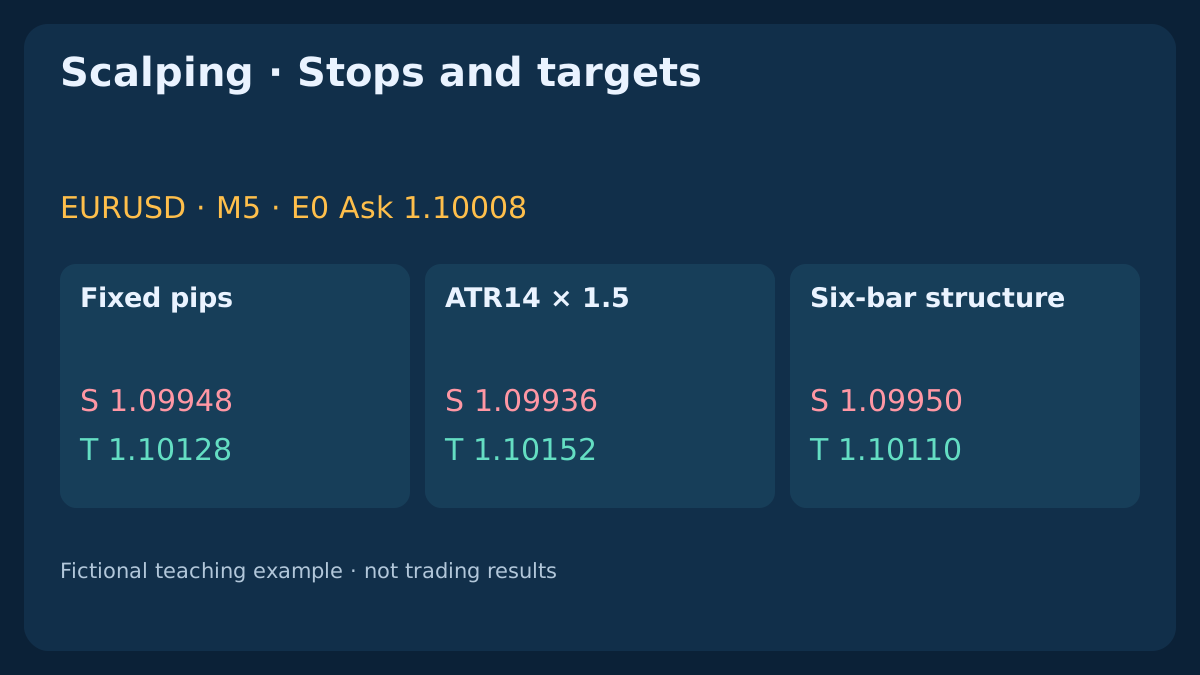
A scalping stop needs a price, a reason and an affordable position size. A target also needs enough room after costs. This guide compares three ways to build exits on the same fictional EURUSD entry, then shows why the choice cannot be settled by a neat reward-to-risk label.
1. Compare exit construction, not a complete entry strategy
A fixed stop sets a distance; an ATR stop scales distance to past movement; a structure stop sits beyond a previously defined price boundary. None supplies an entry edge by itself. A tight stop can reduce the distance of one loss while increasing how often the model exits; a wider stop changes holding time, exposure and position size.
This guide holds the reference entry constant to isolate those differences. It does not recommend a universal pip distance or ATR multiple. First define the trading idea, then test exits on a common calendar of eligible entries, including losing and rejected cases. The worked prices and ordered quote path are invented, not evidence of market success.
To distinguish a signal from a request and a confirmed fill, see scalping execution: market and limit orders, slippage and requotes.
2. Start with the executable side and the correct unit
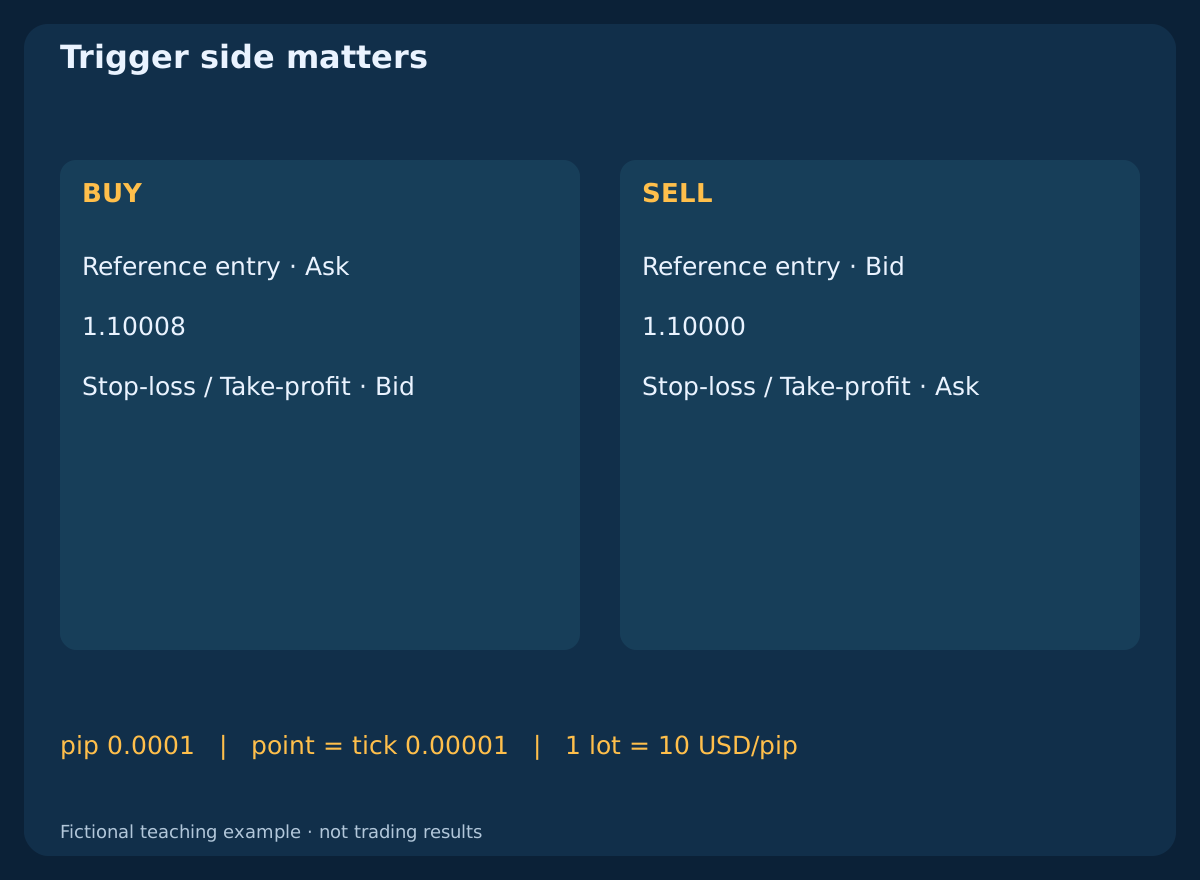
The example assumes EURUSD, a USD account, contract 100000 EUR per standard lot, pip=0.0001 and point=tick=0.00001. Thus one lot has 10 USD/pip here. A pip is ten points in this example; that relationship is not a rule for every symbol, and the quoted currency is not always the account currency.
A BUY opens at Ask and closes at Bid. A SELL opens at Bid and closes at Ask. The reference quote is Bid/Ask=1.10000/1.10008, a spread of 0.8 pip. A Bid candle alone cannot establish whether a SELL stop was triggered. Preserve actual historical Ask data rather than manufacture it from a convenient fixed spread when evaluating real trades.
3. Freeze one reference origin before comparing alternatives
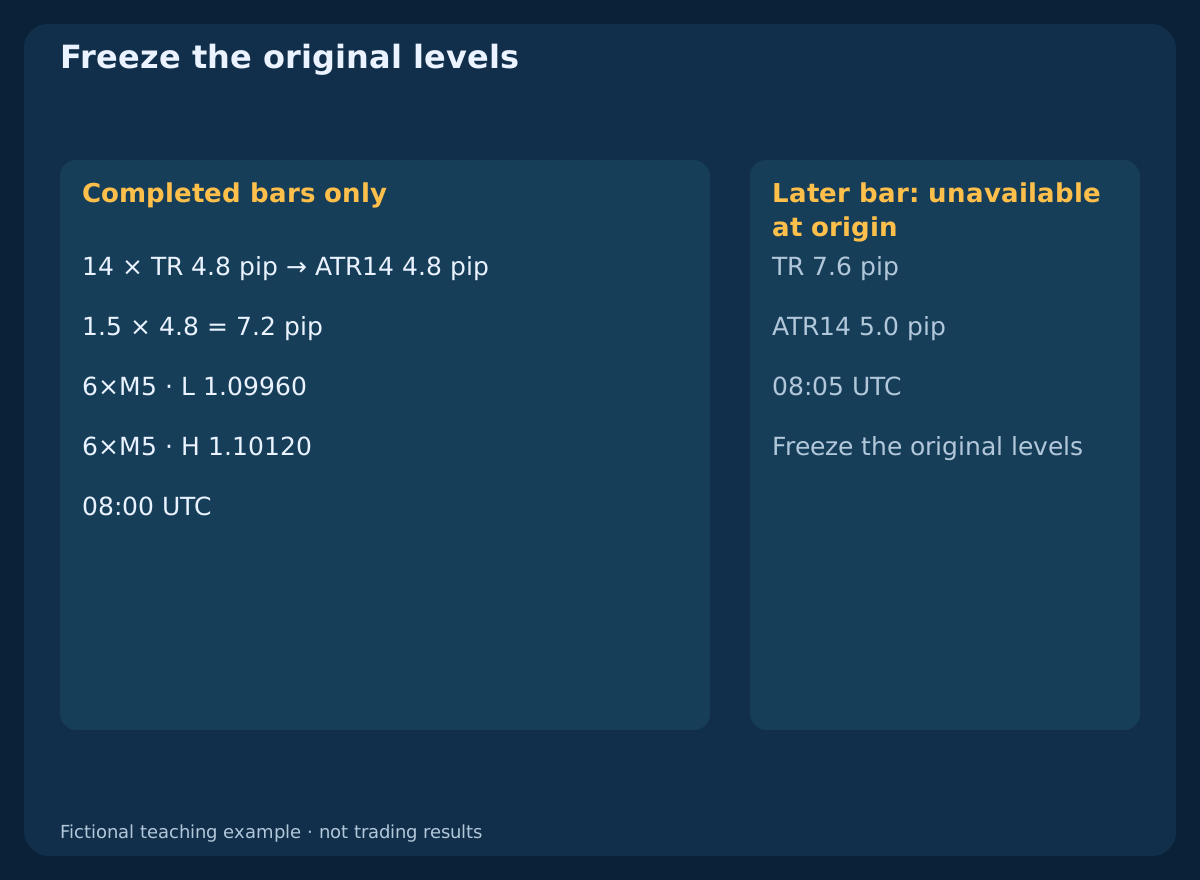
Assume the last M5 bar completes at 08:00 UTC and the reference BUY price is E0=1.10008. This is a fictional planning quote, not proof that an order filled at the bar boundary. The input CSV contains fourteen completed bars through that origin and one explicitly later bar. Each of the first fourteen true ranges is 4.8 pips.
Use the final six completed bars to freeze low=1.09960 and high=1.10120. Do not replace these edges with future extremes. Convert a broker timestamp with the actual offset for the relevant date; UTC is the example clock. The downloadable files preserve all OHLC values, a previous close, the arithmetic and an ordered Bid/Ask path so the comparison can be reconstructed.
Download fictional ATR and structure inputs (CSV)
Download exit comparison and cost calculations (CSV)
| Parameter | Declared assumption |
|---|---|
| EURUSD · Bid / Ask | 1.10000 / 1.10008 |
| Point / tick | pip=0.0001 · point=tick=0.00001 |
| Round-trip commission | 0.7 pip |
| Total execution allowance | 0.3 pip |
| Cash budget | 10000 USD × 0.25% = 25 USD |
| Common horizon | 08:15 UTC |
4. A fixed-pip stop is simple but does not adapt
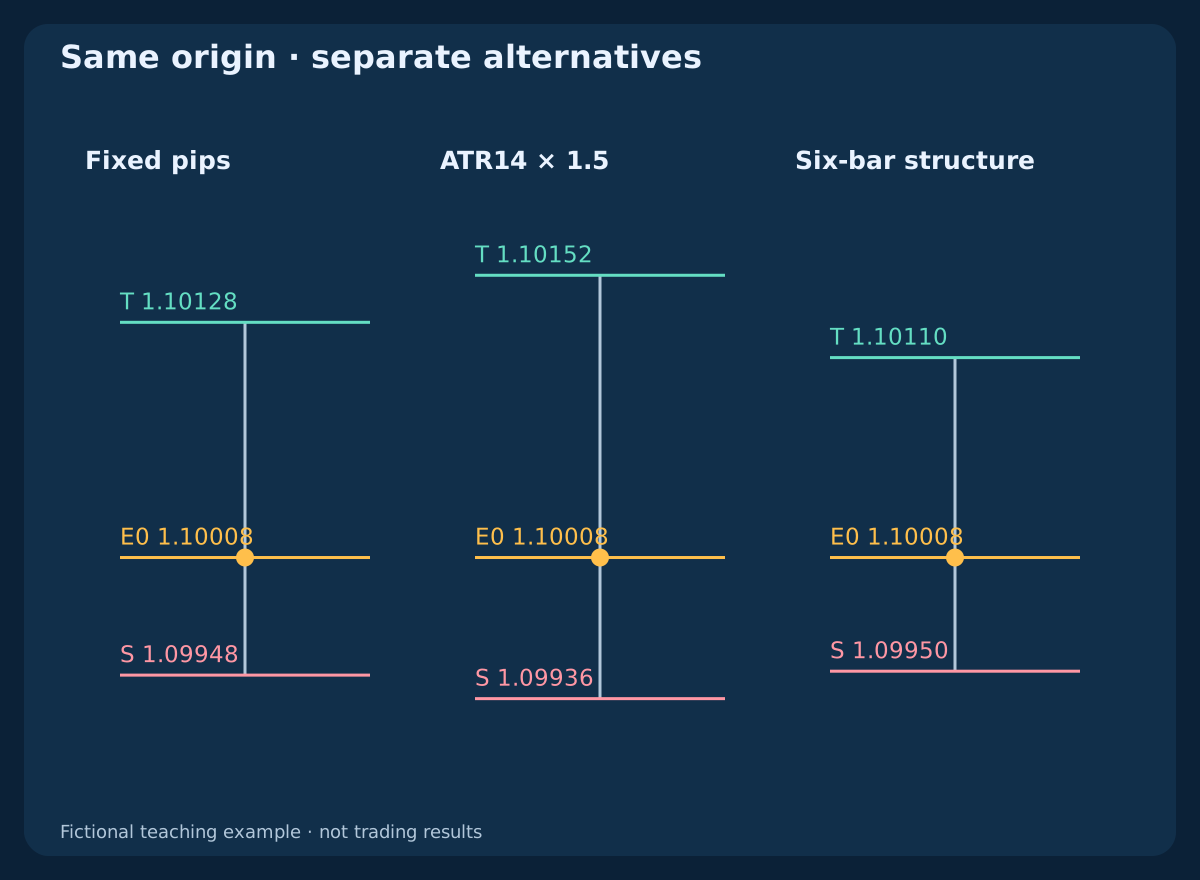
The fixed candidate uses D=6.0 pips below E0 and a target at twice that raw distance: S_bid=1.09948 and T_bid=1.10128. These are Bid-side BUY exits anchored to the reference Ask. They remain the same prices during the quote stress test. Defining six pips below Bid instead would be another, wider entry-to-stop rule.
A constant distance is easy to audit and compare across samples, but its meaning changes with volatility and liquidity. Six pips may cut inside a relevant boundary in one episode and sit unnecessarily far away in another. Choose a small, declared set of distances before testing; repeatedly selecting the one that fits each finished chart creates an outcome-dependent rule.
5. An ATR stop needs a method, a seed and a closed bar
True range is TR=max(H-L,abs(H-C_prev),abs(L-C_prev)). This teaching model seeds ATR with the mean of the first fourteen TR values, then uses the declared Wilder recurrence ATR_next=(13*ATR_prev+TR_next)/14. Platform smoothing and initialization must be checked separately; this specification is not a claim that every indicator named ATR has identical values.
At the origin, ATR14=0.00048=4.8 pips. The candidate uses 1.5*ATR=7.2 pips, so S_bid=1.09936 and the raw two-distance target is T_bid=1.10152. The later bar has TR of 7.6 pips and would raise the declared ATR to 5.0 pips; it cannot change the frozen initial exits. In MT4, read the intended completed-bar buffer after the new bar is recognized, not a still-changing current-bar value.
6. A structure stop needs an objective boundary
The structure candidate uses the frozen six-bar low minus 1.0 pip: S_bid=1.09950. Its target is the frozen six-bar high minus the same buffer: T_bid=1.10110. Entry-to-stop distance is 5.8 pips and raw reward 10.2 pips. This is a finite lookback rule, not a discretionary swing chosen after seeing the result.
A boundary can express where the original price idea fails, but it does not guarantee support or resistance will hold. If the nearest justified target leaves too little net reward, skip that candidate. Extending the target beyond the boundary merely to print a larger ratio changes the model. Fractals or pivots needing future bars must not be treated as already confirmed at the origin.
7. Subtract costs from reward and add them to planned loss
Assume round-trip commission equivalent to 0.7 pip and a total adverse-execution reserve of 0.3 pip across entry and exit. Set C=1.0 pip. The reserve is a planning allowance, not a cap on slippage. For BUY, use L=(Ask-S_bid)/pip+C, W=(T_bid-Ask)/pip-C and R_net=W/L.
The spread is already represented by Ask entry and Bid exit prices; adding it again double-counts it. The fixed candidate gives L=7.0, W=11.0 and R_net=1.5714. ATR gives 8.2/13.4/1.6341; structure gives 6.8/9.2/1.3529. A raw two-distance target is therefore not a net ratio of two. Actual commission schedules, minimum charges and account-currency conversion can require a cash calculation instead of one constant pip allowance.
| Method | Stop Bid | Target Bid | Planned loss, pips | Net target, pips | Net ratio |
|---|---|---|---|---|---|
| Fixed pips | 1.09948 | 1.10128 | 7.0 | 11.0 | 1.5714 |
| ATR14 × 1.5 | 1.09936 | 1.10152 | 8.2 | 13.4 | 1.6341 |
| Six-bar structure | 1.09950 | 1.10110 | 6.8 | 9.2 | 1.3529 |
8. Use the same cash budget, then round volume down
With equity 10000 USD and research budget 0.25%=25 USD, assume minimum lot and lot step both 0.01. For pip value V=10 USD per lot, calculate lots=floor_step(25/(L*V)). The fixed candidate permits 0.35 lots and planned risk 24.50 USD; ATR permits 0.30 lots / 24.60 USD; structure permits 0.36 lots / 24.48 USD.
Keeping volume fixed would give different monetary risks and confuse the comparison. If the permitted minimum volume exceeds the budget, reject the trade rather than round up or pull the stop closer. Also check margin and total exposure across simultaneous positions. A planned risk budget, even with a reserve, does not bound losses through gaps, failed protection or worse execution.
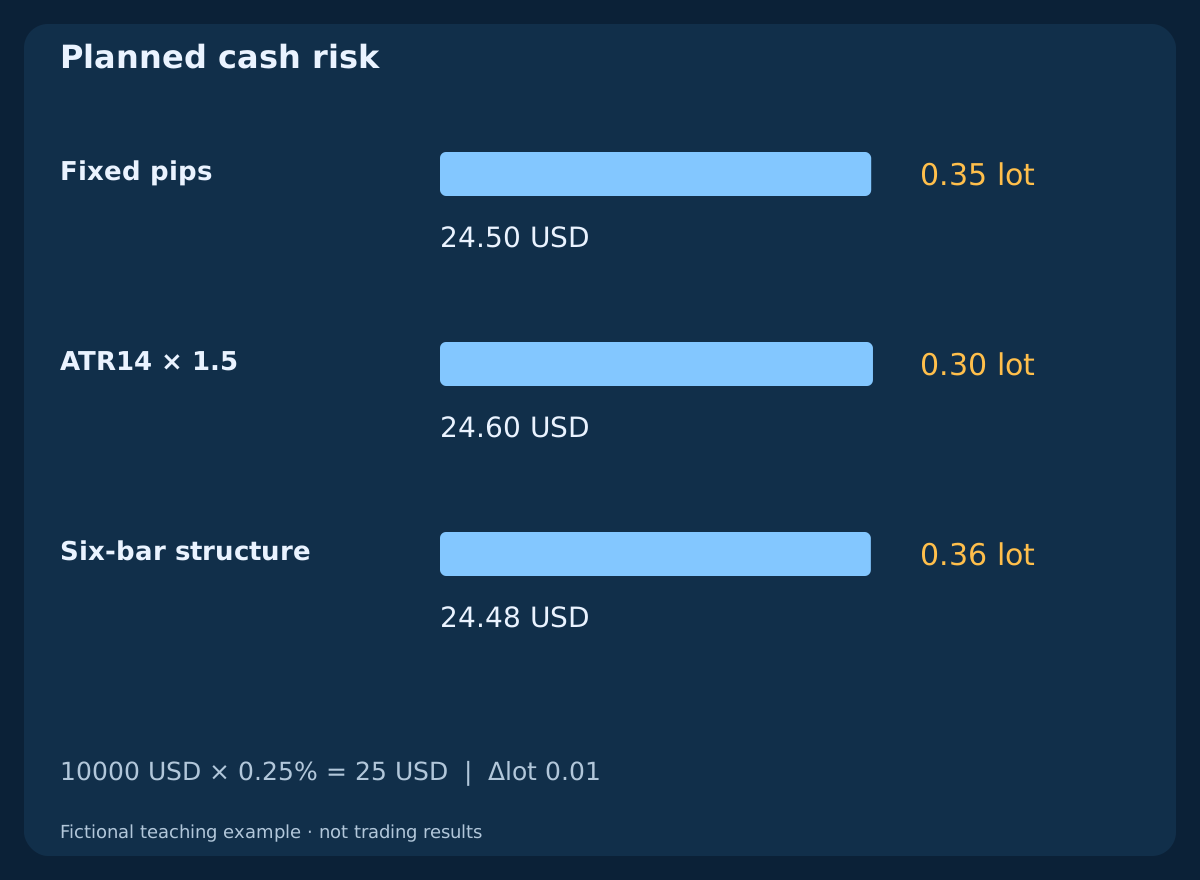
| Method | Lots | Risk USD | Target USD |
|---|---|---|---|
| Fixed pips | 0.35 | 24.50 | 38.50 |
| ATR14 × 1.5 | 0.30 | 24.60 | 40.20 |
| Six-bar structure | 0.36 | 24.48 | 33.12 |
9. Respect the tick grid and the broker’s current restrictions
Here every level already lies on the assumed tick grid. More generally, round a BUY stop down and a SELL stop up to preserve an outside boundary; conservatively round BUY targets down and SELL targets up. Recalculate distance, costs, volume and eligibility after rounding. Decimal display precision alone does not establish that a price is a tradable tick.
Check current stop distances, freeze restrictions, lot bounds and margin before any request. In MQL4, MODE_TICKSIZE is expressed in points, whereas MODE_TICKVALUE is in deposit currency. A zero MODE_STOPLEVEL can still coexist with dynamic restrictions and an invalid-stops rejection. Do not silently widen a rejected stop after entry or send an unprotected replacement without a separately specified and tested policy.
10. A wider spread can invalidate an unchanged target
Now hold Bid and all three exit pairs fixed, but compare Ask=1.10016: spread becomes 1.6 pips. The declared research gate is R_net>=1.20, chosen for this illustration only. It is not a proven profitability threshold. Fixed now gives 7.8/10.2/1.3077; ATR gives 9.0/12.6/1.4000; structure gives 7.6/8.4/1.1053 for L/W/ratio.
The structure candidate fails. Its comparison-only volume of 0.32 lots would keep planned loss at 24.32 USD, but smaller volume cannot repair the failed ratio. Do not re-anchor the fixed or ATR exits in this stress test: the question is the effect of a changed quote on the already frozen plan. A production strategy must separately define quote age, allowed displacement and what happens if a request has an unknown outcome.
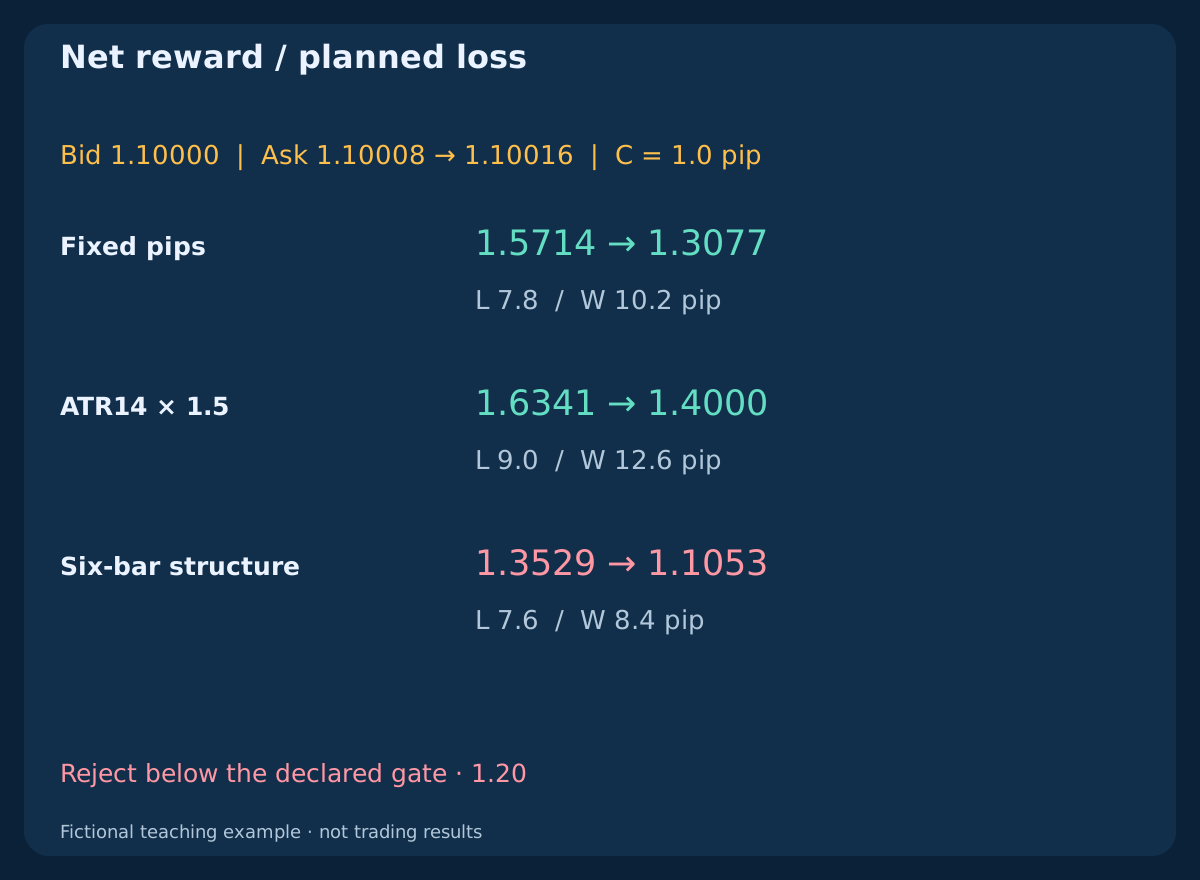
| Method | Planned loss, pips | Net target, pips | Net ratio | Gate |
|---|---|---|---|---|
| Fixed pips | 7.8 | 10.2 | 1.3077 | Passes |
| ATR14 × 1.5 | 9.0 | 12.6 | 1.4000 | Passes |
| Six-bar structure | 7.6 | 8.4 | 1.1053 | Rejected |
11. Mirror SELL on Ask, not on the Bid chart
For SELL, calculate L=(S_ask-Bid)/pip+C and W=(Bid-T_ask)/pip-C. A separate fixed example with Bid entry 1.10000, Ask stop 1.10060 and Ask target 1.09880 gives the same 7.0/11.0 planned pip loss and reward under the cost assumption. SELL structure rules need their own Ask-side boundaries or an explicitly declared conversion policy.
If Bid is 1.10040 while spread expands to 2.0 pips, Ask is 1.10060 and touches that SELL stop. The Bid chart has not touched the stop price. Spread widening can therefore change an exit without a corresponding Bid extreme. A stop trigger is also distinct from the actual fill; execution conditions and gaps can move the realized cash result.
12. Read exit order from a path, not from a finished candle
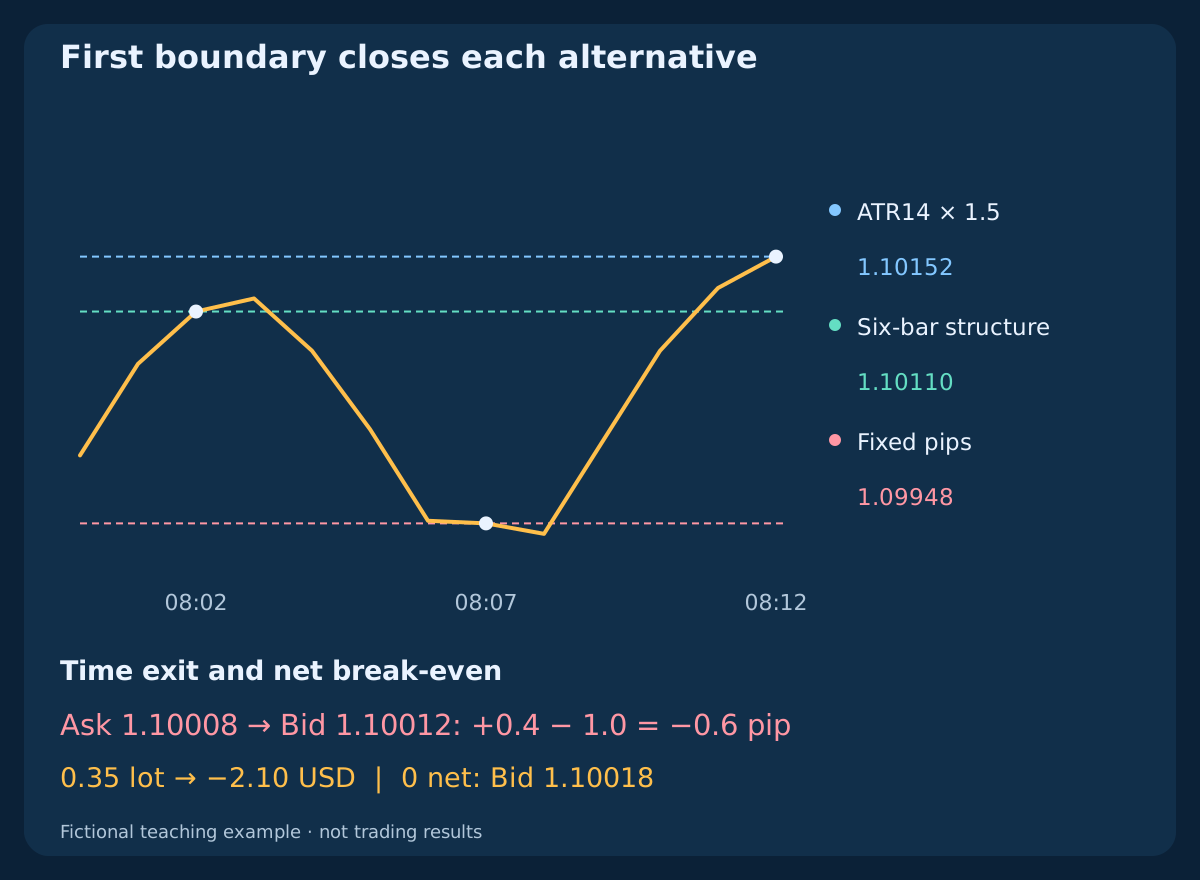
The fictional ordered path reaches the structure target at 08:02 UTC, the fixed stop at 08:07 UTC and the ATR target at 08:12 UTC. In separate alternative positions, each closes at its own first boundary; the structure position cannot later suffer the fixed position’s stop. The file includes every listed Bid/Ask observation and the model’s first-hit flags.
Under level accounting with the stated cost allowance, those alternatives give structure +33.12 USD, fixed -24.50 USD and ATR +40.20 USD. These are constructed conditional outcomes, not actual fills or sample performance. The numbers follow the chosen path; a different path can stop all three. When both boundaries appear within one OHLC bar, their order is unknown without suitable finer data. Never choose the favourable order by default.
Download fictional ordered Bid/Ask path (CSV)
| Alternative | First hit UTC | Exit | Planned net USD |
|---|---|---|---|
| Six-bar structure | 08:02 | Target | +33.12 |
| Fixed pips | 08:07 | Stop | -24.50 |
| ATR14 × 1.5 | 08:12 | Target | +40.20 |
13. Define a time exit and distinguish break-even from entry
A real scalping model also needs a maximum holding time. For this comparison, declare a common horizon of 08:15 UTC; any surviving alternative is evaluated at its first valid executable-side quote at or after that time. Boundary exits take priority on that quote. A missing quote or an unresolved order status must be recorded, not credited as a timely close at an invented price.
In a separate time-exit example, a BUY from 1.10008 closes on Bid 1.10012: raw gain is 0.4 pip, but planned net after C is -0.6 pip. At 0.35 lots, that is -2.10 USD. The planning zero-net Bid is 1.10018. Moving a stop to the entry price does not cover commission and execution costs, and an attempted modification can fail.
14. Keep initial stops and later management as separate rules
The comparison freezes initial stops and targets; it contains no trailing stop, partial close or automatic break-even move. Adding any of these creates another exit policy with its own trigger time, quote side, modification rules and costs. An ATR increase after entry is not permission to enlarge the original loss allowance.
A tighter stop after favourable movement may change future outcomes, but it can also close during ordinary fluctuations. Specify whether a change uses completed bars, which level is valid while a modification is pending and how rejected requests are handled. Reconcile positions after timeouts before another action. Never overwrite the original plan in the research log; keep intended levels, accepted server levels and actual fills separately.
15. Compare candidates on common origins and unseen data
First compare exit methods on the same eligible entry origins, with their own levels, quote checks and cash-based sizing. Retain rejected candidates and all costs. Report both the common-origin view and the accepted-trade view; filtering out weak ratios changes the traded sample. This teaching comparison does not simulate a portfolio: overlapping entries, capital limits and position conflicts need an additional executable policy.
Freeze distances, ATR smoothing and multiples, lookbacks, buffers, horizon and cost gates before an untouched later test. Track net expectancy, drawdown, time in market, cost sensitivity and uncertainty. Maximum adverse and favourable excursion are useful diagnostics only with a declared observation horizon; whole-session future extremes must not decide the stop for the same trade. M1 and M5 use different bars and require separate validation.
16. Choose a testable exit plan, then check feasibility
Before entry, write down the origin, price side, units, stop reason, target rule, tick rounding, net ratio and permitted cash volume. Check broker restrictions, margin, aggregate risk and the exit clock. Reject plans with unavailable inputs, an invalid level, unaffordable minimum volume or insufficient net reward; do not manufacture room by moving a boundary after the fact.
Fixed pips provide a simple reference, ATR supplies a declared volatility scale, and structure ties exits to frozen price locations. Their usefulness depends on entry logic, market conditions and execution. Start with a small, reproducible comparison, then test on suitable unseen data. The related scalping guides cover pair selection and MT4 data; separate strategies supply complete entry and management rules.
Frequently asked questions
What is the best stop-loss in pips for forex scalping?
There is no universal distance. Define the entry idea, price side, volatility or structure reference, costs and cash budget, then compare a small set of frozen rules on suitable unseen data.
Does a 1:2 target give a net reward-to-risk ratio of two?
Not automatically. In the fixed example the raw distances are six and twelve pips, but the cost allowance makes planned loss seven and net reward eleven, giving 1.5714.
Should an ATR stop keep widening after entry?
That is a different management rule. This comparison freezes ATR and the initial levels at the origin. Later volatility cannot retroactively change the original risk plan.
Why can a SELL stop trigger when the chart does not touch it?
SELL closes on Ask. A Bid chart omits the spread above it, so Ask can reach the stop during spread widening even when the Bid high remains below that price.
Does a wider stop mean taking more monetary risk?
It does at the same volume. With a common cash budget, recalculate volume from the complete planned loss and round down. Reject the trade if the minimum lot is too large.
Do the CSV examples establish which stop is more profitable?
No. They reconstruct fictional inputs, comparison arithmetic and an ordered path. Profitability needs a complete strategy, suitable real data, execution assumptions and evaluation on unseen observations.
Sources and research notes
MetaQuotes documents true range, order requirements and symbol properties. The comparison rules, prices, cost reserves and paths below are original fictional teaching assumptions, not broker quotes or a measured trading record.
- MetaTrader 4: Average True Range
- MQL4: OrderSend and stop restrictions
- MQL4: symbol and contract properties
Educational content. Prices, paths, costs and comparison thresholds here are fictional. Forex trading involves risk; stops and planning reserves cannot guarantee fills, profitable results or a maximum actual loss.