

Does a busy breakout trade better than a quiet one? We test a Close beyond the preceding 15 M1 candles, then add a tick-activity filter and VWAP confirmation. The full-rule replay contains 184 trades with a loss of 200.9 pips after the stated costs. Activity improves the sample mean versus the base rule, but no variant shows a profitable edge. Every candidate, rejection and trade remains available.
1. Separate a range breakout from a VWAP reclaim
The trigger is a completed Bid Close above the highest High or below the lowest Low of the preceding 15 M1 candles. It does not require crossing VWAP. A fresh rolling range is calculated for each candle, so consecutive breakouts can be candidates.
A uses the breakout alone. B adds relative tick activity. C also requires the price to be on the trade side of VWAP and VWAP to slope in that direction. Each variant has its own single-position replay; trade lists need not be nested.
2. Keep the familiar source and research clock explicit
HistData Generic ASCII EUR/USD January 2024 contains 2 176 113 Bid/Ask records. Fixed EST is UTC−05:00: add five hours without daylight-saving adjustment. Test all 22 UTC weekdays from 2024-01-02 to 2024-01-31. Each 07:00–17:00 window has all 600 observed M1 intervals.
Volume is zero; N counts every recorded quote, including unchanged records, not lots or market-wide buying pressure. These data already appeared in the guides and V222. This is a retrospective familiar-source experiment, not untouched out-of-sample validation.
3. Freeze a range made only from earlier candles
For a signal starting at t, High15 is the largest Bid High in t−15 minutes through t−1 minute; Low15 is the smallest Bid Low there. Long requires Close > High15; short requires Close < Low15. Equality fails. Never include the signal candle in its own range.
The common candidate universe requires the signal and 20 consecutive complete prior M1 candles, plus continuous anchor coverage. Missing minutes are not filled. Entries start at 07:20 inclusive and end before 17:00 UTC; signal starts run from 07:19 to 16:58.
4. Measure activity and confirm the VWAP direction
B requires current N ≥1.5× the median N of the preceding 20 candles, current excluded. Equality passes. With median2 equal to twice that median, the exact test is 4N ≥3×median2. Extra quotes do not identify institutional orders or guarantee continuation.
C adds a 07:00 UTC VWAP proxy: sum(TP×N)/sum(N), TP=(High+Low+Close)/3, signal included. Long requires Close > VWAP and VWAP > its previous value; short requires both inequalities reversed. Equal slope fails. Use unrounded values. The fixed anchor is a research convention, not a universal local opening.
5. Keep the event funnel separate from executed trades
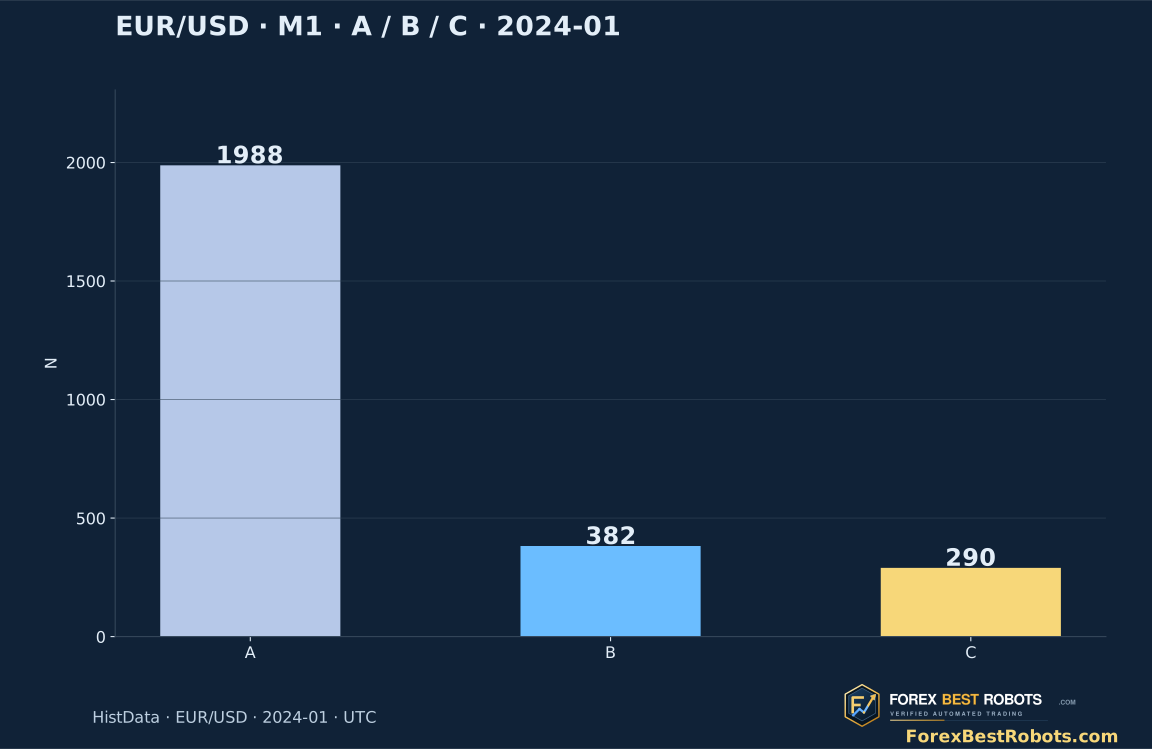
There are 1 988 price-breakout events. Of these, 382 pass activity and 290 also pass VWAP side/slope, before position and quote checks. The executed counts are A 622, B 239 and C 184. The complete log retains 5 964 variant decisions.
C rejects 1 606 events for activity, 92 for VWAP, 104 while occupied and two for first-quote timing; 184 enter. These are exclusive statuses in that checking order. Signals while occupied are not queued. Filters can free a variant to take later events that another variant misses.
6. Inspect the first quote after confirmation
Use the first archive quote at or after the candle end. Delay must be strictly <5 000 milliseconds, timestamp before 17:00 UTC and Ask−Bid ≤1.0 pip. A failed first quote rejects that event permanently; do not wait for a more convenient quote.
Long enters at Ask, short at Bid. Only one position per variant; no re-entry on an exit record. Original order resolves equal timestamps. A recorded quote is a model input, not proof that a real order of a chosen size would fill there.
7. Freeze price thresholds and the exit deadline
Set stop 6 pips and target 9 pips from entry. Starting with the next record, long tests and exits on Bid, short on Ask. The first threshold breach exits at that observed price; stop overshoot is allowed. These are model exits, without broker fill guarantees.
Otherwise exit on the first quote at/after the earlier of entry+20 minutes and 17:00 UTC. Priority on that record: stop, target, then time/session. A gap >60 seconds while open makes a trade unresolved: keep its lockout but exclude its performance. None occur here.
8. Show exactly what the additional cost changes
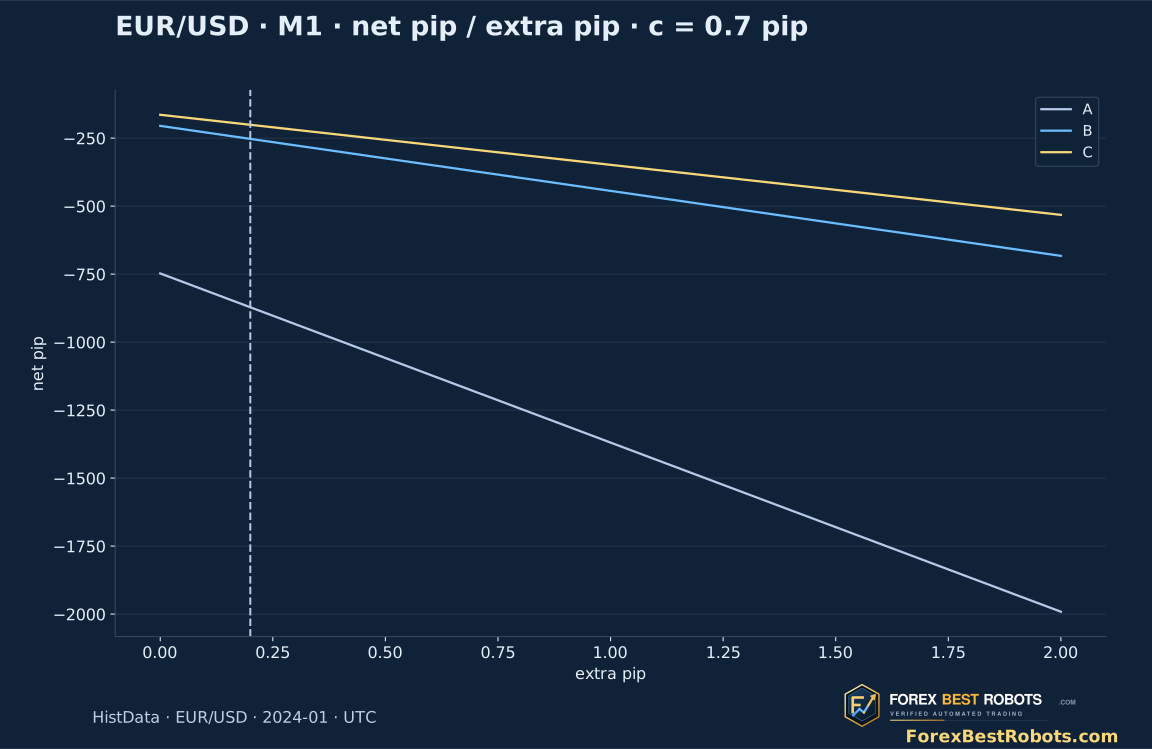
Quote P/L is exit Bid−entry Ask for long, entry Bid−exit Ask for short, in pips. It already includes spread. Subtract illustrative round-trip commission 0.70 pip and an initial extra allowance 0.20 pip, once per resolved trade. These are assumptions, not measured broker charges or slippage.
The extra choice 0 / 0.2 / 0.5 / 1.0 / 2.0 changes accounting only. IDs, entries, exits and eligibility stay fixed. It does not re-simulate latency, rejection or stop fills. Position size, money returns, financing and margin are outside this model.
9. Read the whole-sample loss before selecting examples
At 0.70+0.20 costs, A loses 871.9 pips, B 252.7 and C 200.9. C already has −35.3 quote pips; commission 128.8 and extra 36.8 produce −200.9. Its 76 wins, 107 losses and one flat trade give 41.30% wins, mean −1.0918 pip and profit factor 0.6337.
B improves the sample mean versus A: −1.0573 versus −1.4018 pips. Adding VWAP in C slightly worsens mean and profit factor versus B; smaller total loss also accompanies fewer trades. No variant proves a profitable edge. C’s maximum realized cumulative drawdown is 243.3 pips, starting from zero; this is not intratrade account or percentage drawdown.
| Rule variant | Resolved trades | Total quote P/L · spread included · pips | Total net P/L · pips | Mean net P/L · pips per trade | Net profit factor | Maximum realized cumulative drawdown · pips |
|---|---|---|---|---|---|---|
| A | 622 | -312.10 | -871.90 | -1.4018 | 0.5607 | 915.00 |
| B | 239 | -37.60 | -252.70 | -1.0573 | 0.6394 | 304.20 |
| C | 184 | -35.30 | -200.90 | -1.0918 | 0.6337 | 243.30 |
10. Compare chronological segments under the same rules
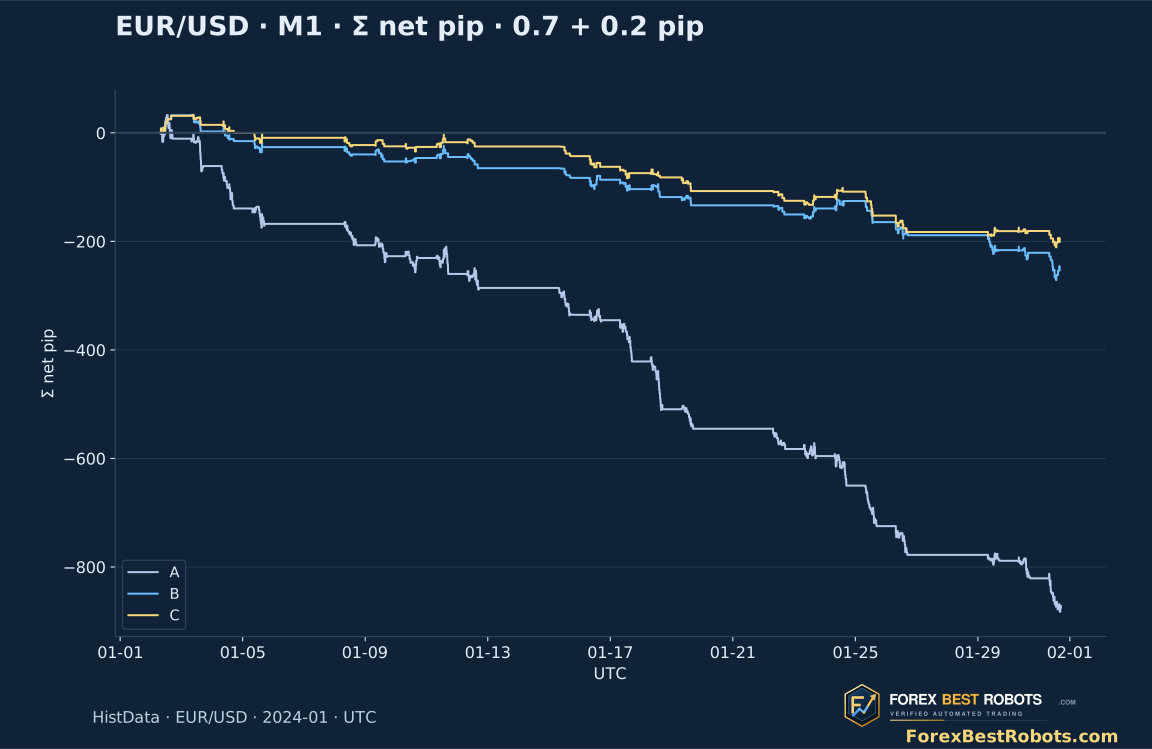
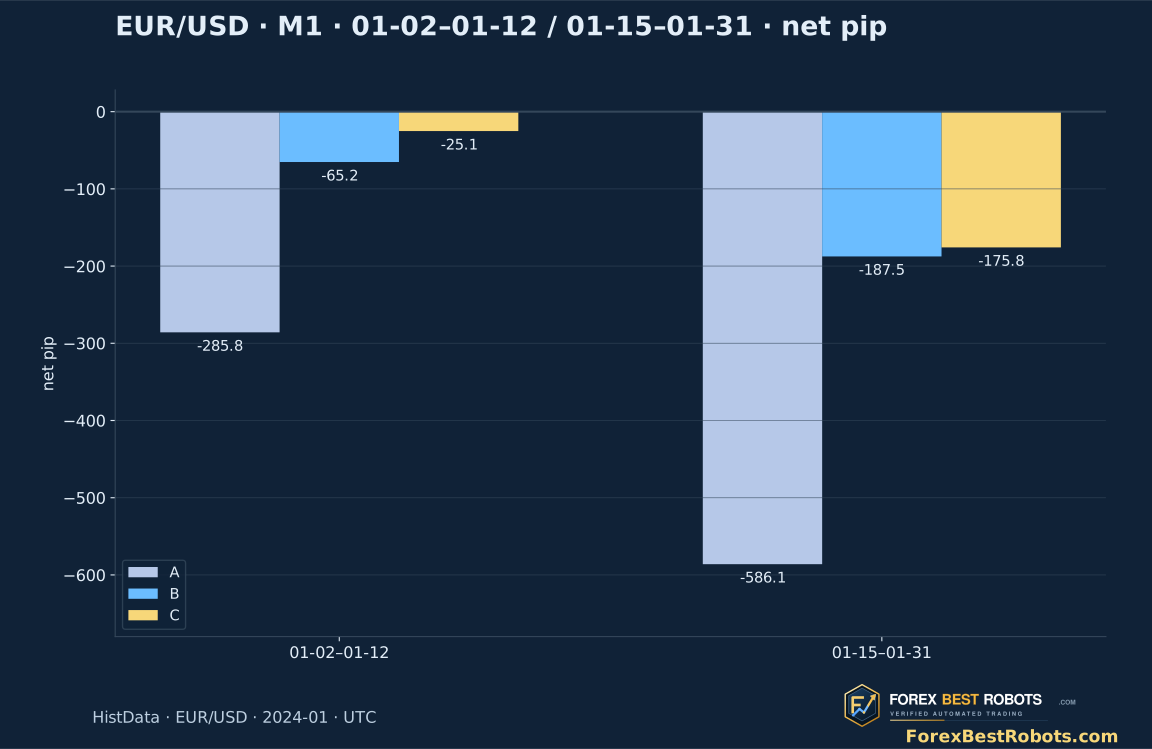
Earlier, 2024-01-02–2024-01-12, has nine sessions; later, 2024-01-15–2024-01-31, thirteen. C makes 71 earlier trades: quote +38.8 pips becomes −25.1 net. Its 113 later trades give −74.1 quote and −175.8 net. Both net segments lose.
The split describes one known month. It is not independent validation. Keep these rules and the negative result when testing other periods, feeds and real execution. The 15/20-bar windows, 1.5 factor and exits were fixed before results, without retuning.
11. Inspect the first full-rule long and short
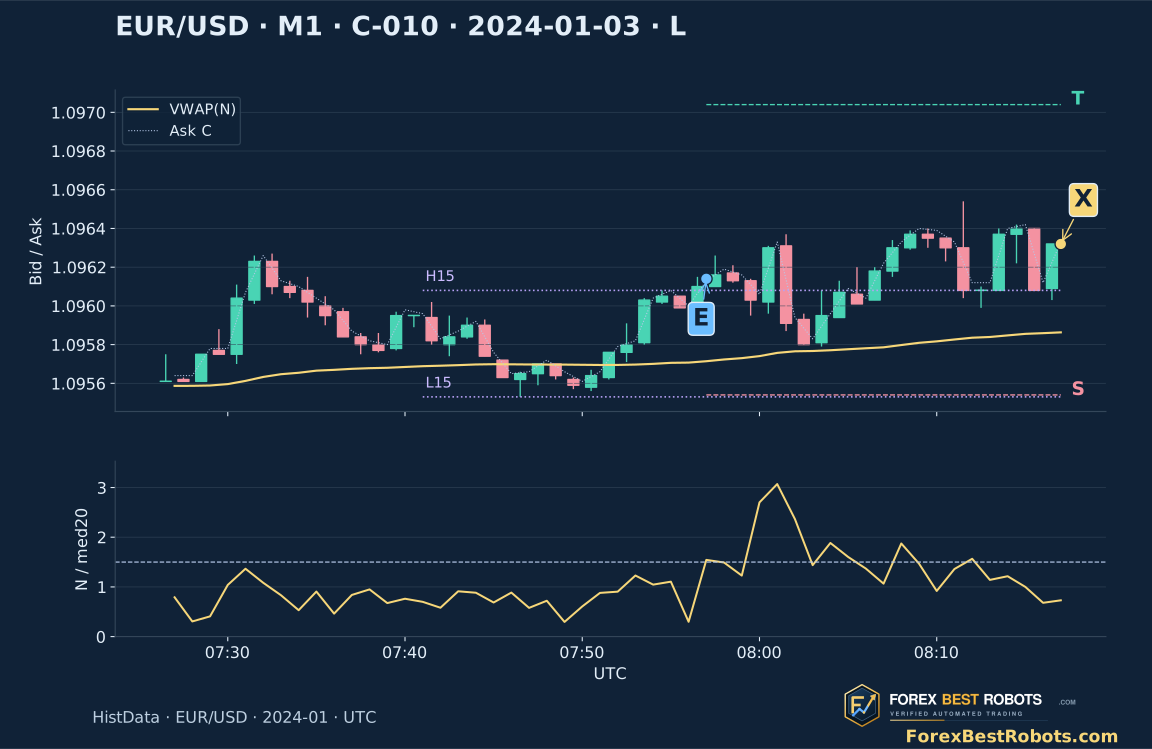
C-010 is the first resolved C long, chosen by direction and time. On 2024-01-03, the 07:56 candle confirms at 07:57 UTC: Close 1.096100 exceeds High15 1.096080; N=88 versus median 57 gives 1.5439×. Entry 07:57:00.042 Ask 1.096140; timed exit 08:17:00.084 Bid 1.096320. Quote +1.80 pips, net +0.90.
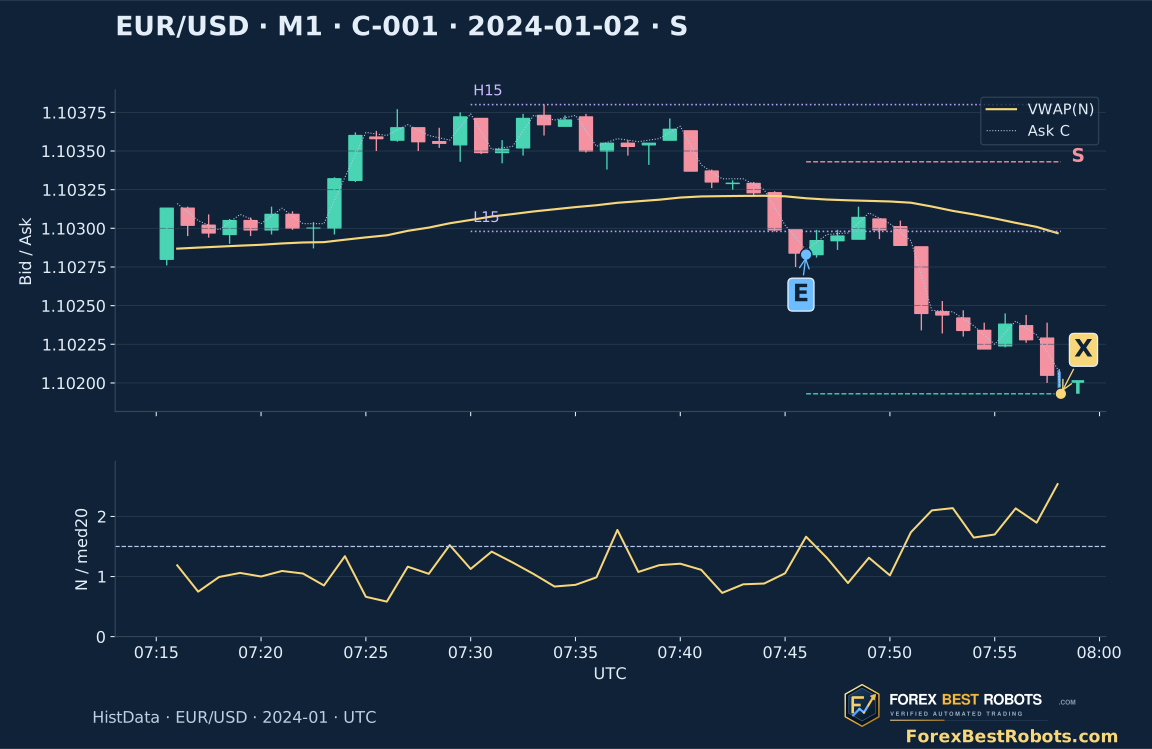
C-001 is the first C short: 2024-01-02 entry 07:46:00.144 Bid 1.102830, target exit 07:58:09.421 Ask 1.101930. Close 1.102840 is below Low15 1.102980; N=128 / median 77 =1.6623×. Quote +9.00, net +8.10. Both examples happen to win; they were not selected by P/L. The first default-cost loss is C-002, available in the full viewer. The final blue candle stops at the exit quote, with no completed indicator shown for it.
12. Inspect the breakout, activity and costs of every trade
Choose a variant, dates and extra round-trip cost. Pick a trade or step through the list. Compare the frozen range, completed signal and execution quotes; the cost choice changes accounting only.
Fixed commission: 0.70 pip per round trip. The selected allowance is extra; recorded spread is already included in quote P/L. Changing this field recalculates accounting only.
Worked examples · switch to C and all dates, keeping your selected allowance
Selected variant and dates · all resolved trades
- Resolved trades
- —
- Unresolved trades · excluded
- —
- Total quote P/L · spread included · pips
- —
- Total illustrative commission · pips
- —
- Total additional allowance · pips
- —
- Total net P/L · pips
- —
- Mean net P/L · pips per trade
- —
- Net winning trades · %
- —
- Net profit factor
- —
- Maximum realized cumulative drawdown · pips
- —
Selected trade · exact quote replay
Cost calculation for this tradeBid candles, dotted Ask Close and gold VWAP are historical observations. H15/L15 freeze the signal’s preceding 15-bar range. E/X are exact model quotes, S/T the stop/target. The lower panel is N divided by the preceding-20 median; its dashed line is 1.5. The blue last candle ends at the exit quote.
On narrow screens, scroll inside the chart or table to read its full width.
- Direction
- —
- Exit reason
- —
- Signal candle · UTC start → confirmation
- —
- Entry quote · UTC
- —
- Exit quote · UTC
- —
- Entry price
- —
- Exit price
- —
- Frozen stop threshold
- —
- Frozen target threshold
- —
- Time/session deadline · UTC
- —
- Holding time · minutes
- —
- First-quote delay · milliseconds
- —
- Entry spread · pips
- —
- Quote P/L · spread included · pips
- —
- Illustrative round-trip commission · pips
- —
- Selected extra round-trip allowance · pips
- —
- Net P/L after both deductions · pips
- —
- Frozen preceding-15 range · Bid Low → High
- —
- Completed signal Bid Close
- —
- Close beyond the broken boundary · pips
- —
- Previous → signal VWAP proxy
- —
- Signal N / median of preceding 20
- —
- N / preceding-20 median · requires ≥1.5
- —
- Activity check · used by B/C
- —
- VWAP side and slope check · used by C
- —
Inspect all trades in this selection
| Trade | Signal candle · UTC start → confirmation | Direction | Entry quote · UTC | Exit quote · UTC | Exit reason | Quote P/L · spread included · pips | Illustrative round-trip commission · pips | Selected extra round-trip allowance · pips | Net P/L after both deductions · pips |
|---|
13. Use a quote replay within its limits
One currency pair, one month and one archive cannot establish robustness. An observed minute does not prove that every quote was captured. Quote records do not reproduce depth, order queues, latency, executable size or broker stop rules. Tick activity can rise during noisy or failing moves.
The narrow finding is that the declared breakout/activity/VWAP rule did not demonstrate a profitable edge after the stated costs. Preserve all 1 045 simulated trades and the rejected events. A readable breakout and a busy candle are hypotheses to test, rather than evidence of guaranteed profit.
Frequently asked questions
Does this M1 breakout rule make a profit in the test?
No. C has 184 trades, −35.3 quote pips and −200.9 net after 0.70+0.20 per round trip. All variants and both chronological segments are negative after default costs.
Which candles form the 15-bar range?
Only the preceding 15 complete Bid M1 candles. Exclude the signal candle. A Close equal to the boundary fails; it must be strictly beyond it.
Does 1.5× activity mean 50% more traded volume?
It means at least 50% more recorded quotes than the median count of the preceding 20 candles, excluding current. It does not measure executed lots or buyers versus sellers.
Why do 290 filter passes produce 184 C trades?
104 pass while a position is open and two fail the first-quote delay. The remaining 184 enter. Rejected events are not retried or queued.
Can stops exceed six pips or costs change fills?
A recorded price jump can exit beyond the six-pip threshold. The cost control only adds accounting deductions; it does not change simulated fills or re-run the strategy.
Why do both worked examples win when the month loses?
They are the first C long and first C short, selected by direction and time, not profit. All losses remain in the viewer and CSV; C-002 is the first default-cost loss.
Data, timing and reproducibility
Downloads retain 1 045 trades, 1 988 candidates, 5 964 decisions, observed M1 inputs, coverage and the frozen protocol. Integer prices use millionths; one EUR/USD pip equals 100 units. The cost script uses standard Python; optional raw-quote replay requires NumPy and the identified original ZIP.
The public kit identifies the original source and SHA-256 rather than redistributing that raw archive. Charts use historical data; each final trade candle is rebuilt only through its exit record. These are quote simulations, without real-account performance claims.
- Every simulated trade and source quote indices (CSV)
- Candidate events, decisions and coverage (ZIP)
- Inputs, fixed protocol and replay methods (ZIP)