

This strategy tests whether an M1 close returning across a quote-weighted VWAP becomes more useful with MFI confirmation and a tick-activity filter. The January 2024 EUR/USD replay is negative: the full rule makes 99 trades and loses 177.4 pips after the stated costs. Fewer trades reduce the total loss, while the mean result and profit factor worsen. The rules, rejected opportunities and individual trades remain visible so that this result can be examined rather than inferred from one attractive chart.
1. Turn a VWAP reclaim into a testable rule
A reclaim here means a completed Bid Close crosses back above the anchored VWAP proxy; a downward cross is the mirrored short condition. It is a price event, without an assumed profitable edge. The VWAP guide explains the anchor, the MFI guide the rolling sums, and the tick-volume guide the event-count weights used in this strategy.
MFI confirmation uses its 50 midpoint and direction of change, rather than requiring a 20/80 return. Tick activity compares the current count with earlier candles. These are distinct tests. Their combined result must still survive execution and costs.
2. Keep one real feed, one clock and a declared sample
The source is HistData Generic ASCII EUR/USD tick quotes for January 2024: 2 176 113 original Bid/Ask records, identified by SHA-256 in the method kit. The source uses fixed EST, UTC−05:00; add five hours without daylight-saving adjustment. We examine all 22 UTC weekdays from 2024-01-02 through 2024-01-31.
The 07:00–17:00 UTC windows contain all 600 observed M1 intervals on each of these 22 days. The source Volume field is zero. N counts recorded quotes, including unchanged records; it does not measure traded lots. Earlier quotes remain available for MFI and the activity comparison. January 8 already appeared in the guides, so this is a retrospective test on a familiar source, not untouched validation.
3. Freeze the 07:00 UTC anchor and calculate completed inputs
For each day, build Bid OHLC and TP=(High+Low+Close)/3. Starting at 07:00 UTC, calculate VWAP proxy = sum(TP×N)/sum(N), including the signal candle. Require every M1 interval since the anchor; do not fill absent minutes. This fixed UTC reference is a research convention, not a claim that it always equals a local market opening.
MFI(14) classifies TP×N by changes in typical price. Equal TP contributes to neither directional sum; both sums zero means unavailable. It requires 15 consecutive complete candles, and two adjacent readings require 16. Prices and threshold tests use unrounded values.
4. State the long and short conditions without hindsight
Long: previous Close ≤ previous VWAP and current Close > current VWAP. The MFI filter additionally requires current MFI > 50 and greater than previous MFI. Short: previous Close ≥ previous VWAP and current Close < current VWAP, with current MFI < 50 and less than its previous value. Both MFI readings must be available when that filter is used.
The activity filter requires current N ≥ the median N of the preceding 20 complete consecutive M1 candles, excluding the current candle. Equality passes. Entry times run from 07:20 inclusive to before 17:00 UTC: the first possible signal starts 07:19, and the last starts 16:58. No parameter is retuned after observing results.
5. Compare three variants and keep every candidate decision
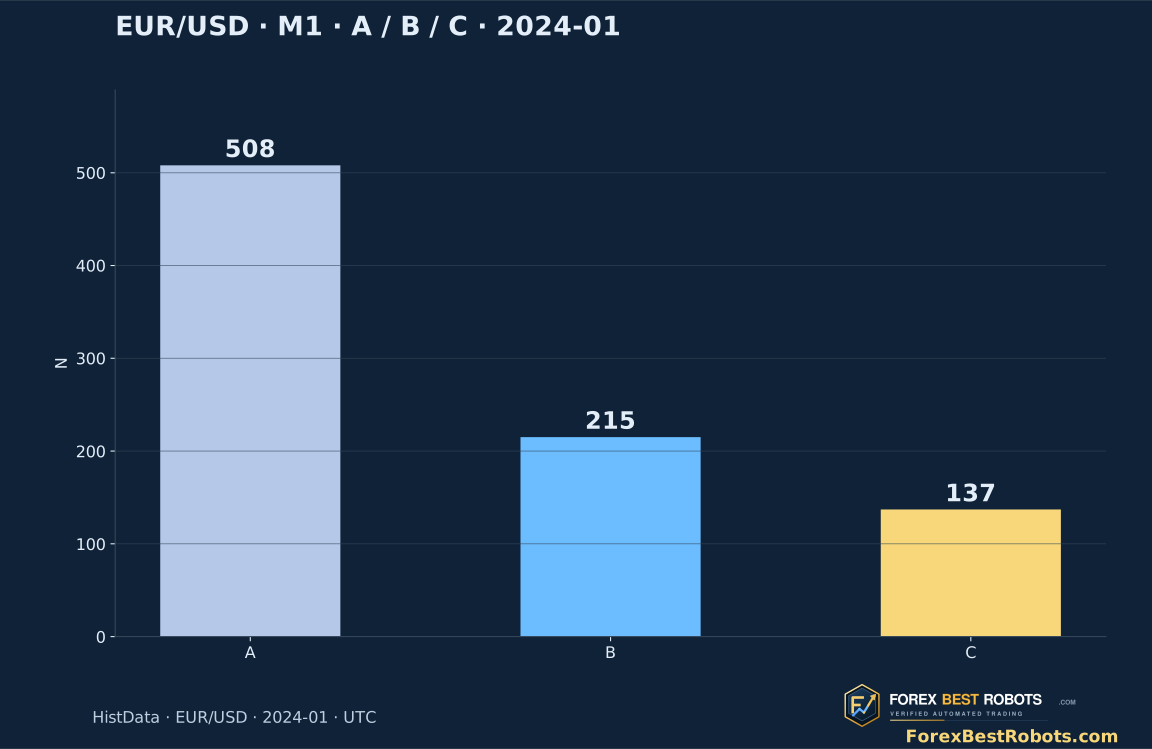
A uses only the price cross; B adds MFI; C adds MFI and activity. The shared event universe has 508 price crosses, of which 215 pass MFI and 137 pass both filters. These counts precede position and first-quote checks. Each variant has its own single-position replay, so accepted trade lists are not simple nested subsets.
A executes 158 trades, B 130 and C 99. For C, 293 candidates fail MFI, 78 fail activity, 35 occur while occupied, two fail the five-second quote rule and one fails the first-quote spread gate. Signals arising while a position is open are not queued for later entry. All 1 524 variant decisions are retained.
6. Confirm the candle, then inspect the first eligible quote
After the signal candle ends, use the first archive quote at or after that time. Its delay must be strictly less than 5 000 milliseconds, its timestamp before 17:00 UTC, and Ask−Bid no more than 1.0 pip. A failed first quote rejects that event permanently; the replay does not wait for a later narrower spread.
A long enters at observed Ask; a short at observed Bid. There is one position per variant and no re-entry on the same quote record as an exit. Quote timestamps and source order settle the historical sequence, but do not prove a real order would have filled at those prices or with the assumed delay.
7. Freeze six-pip and nine-pip thresholds at entry
From the entry quote, freeze a 6-pip stop distance and a 9-pip target distance. Long positions trigger and liquidate on Bid; shorts on Ask. Check from the next source record after entry. The first recorded threshold breach exits at the observed liquidation quote, which can be beyond the stop. These are quote-triggered model exits, not guaranteed broker stop or limit fills.
Otherwise exit on the first quote at or after the earlier of entry plus 20 minutes and 17:00 UTC. On that record the priority is stop, target, then timed/session exit. A quote gap greater than 60 seconds while open makes a trade unresolved: retain its lockout interval but exclude it from performance. There are zero such unresolved trades here; this does not certify complete market coverage.
8. Separate recorded spread from additional round-trip costs
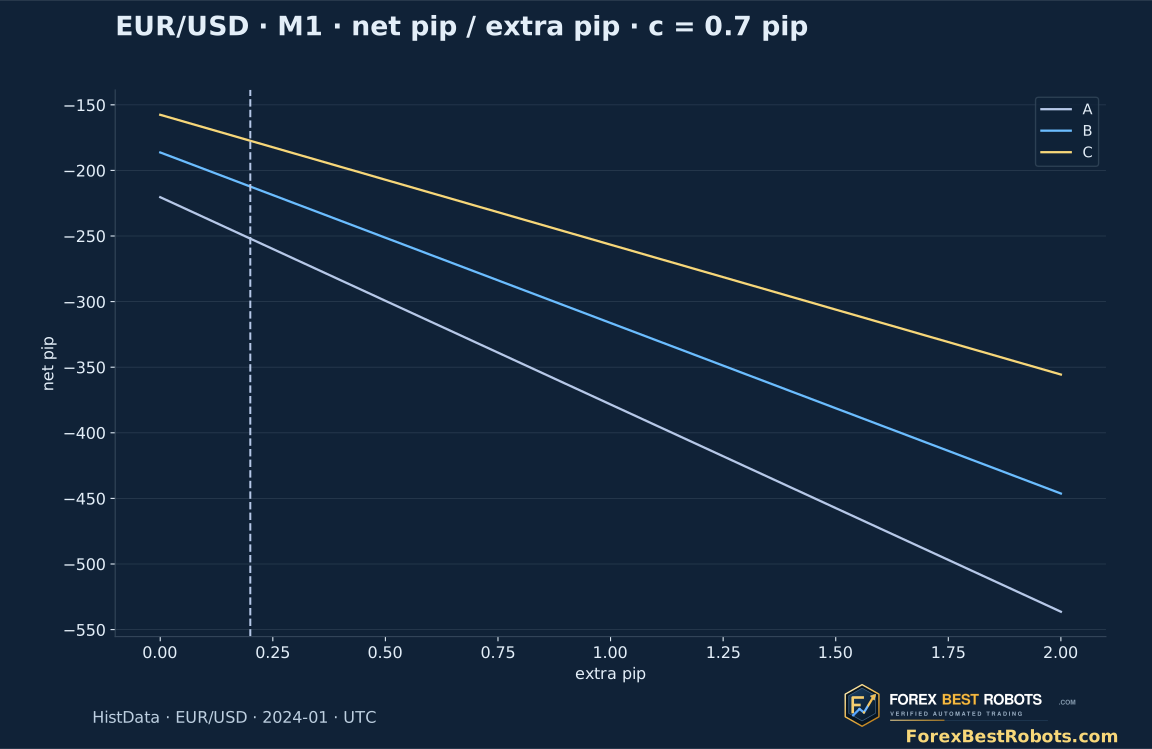
Quote P/L is (exit Bid−entry Ask) for a long, or (entry Bid−exit Ask) for a short, converted to pips. It already includes the recorded Bid/Ask spread. Net P/L subtracts 0.7 pip illustrative round-trip commission plus an additional round-trip allowance, initially 0.2 pip. These are transparent assumptions, not a broker tariff or measured slippage.
The interactive allowance offers 0, 0.2, 0.5, 1.0 or 2.0 pips. It changes each trade’s accounting and the totals, while keeping entries, exits, eligibility and trade IDs fixed. It does not re-simulate latency, rejected orders or stop prices. Position size, cash return, financing and margin constraints are not modelled.
9. Read the negative result before comparing the charts
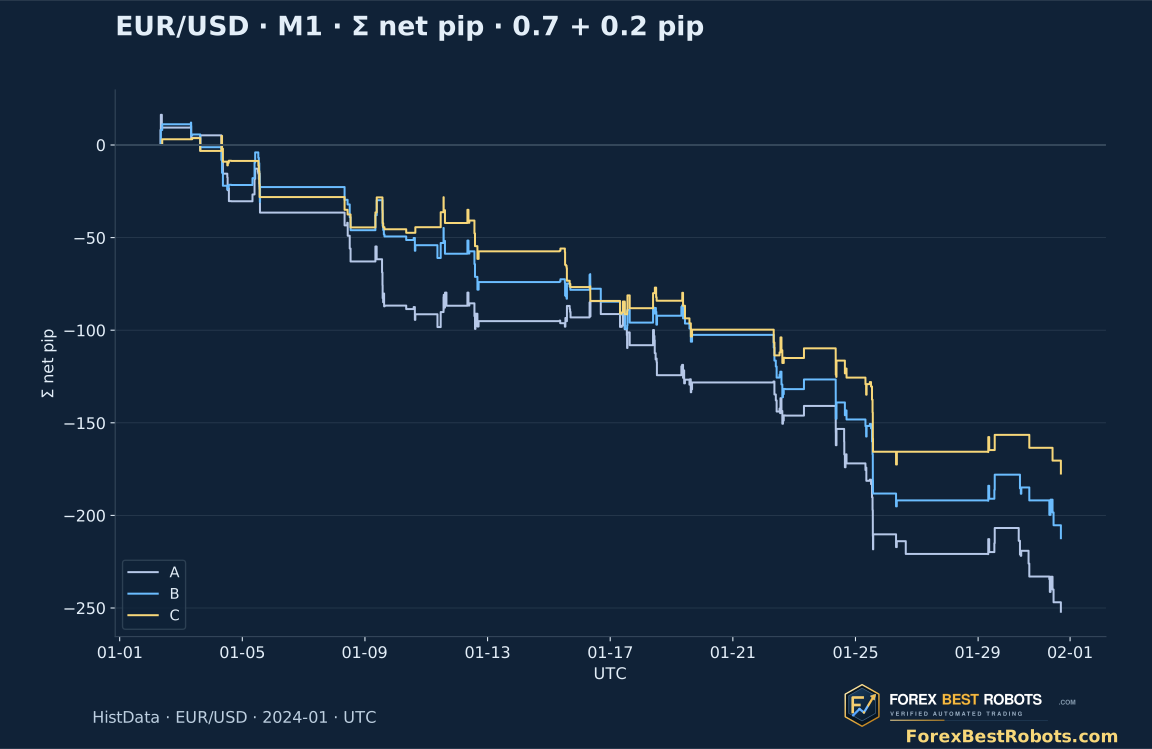
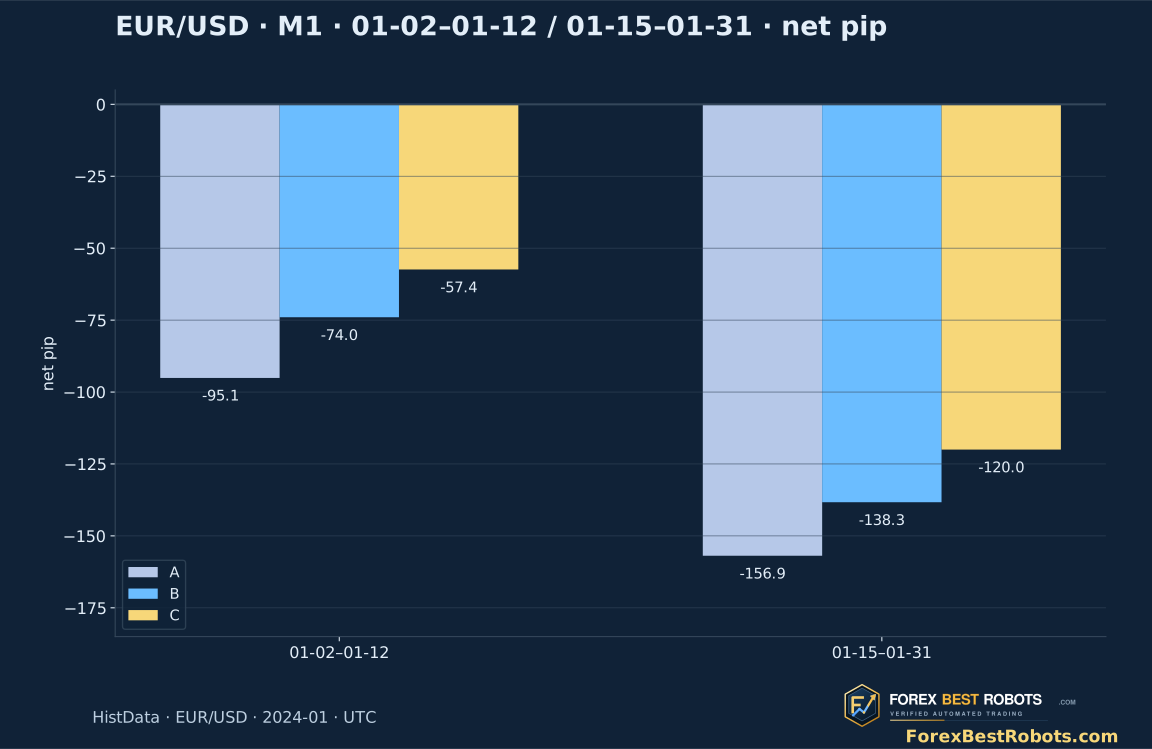
At the default 0.7+0.2 pip additional costs, A loses 252.0 pips, B 212.3 and C 177.4. C’s quote P/L is already −88.3 pips before those additional deductions. Its 35 wins and 64 losses produce a 35.35% win rate, mean −1.7919 pips, profit factor 0.4727 and maximum realized cumulative drawdown of 182.3 pips.
C’s smaller total loss comes with fewer trades. Its mean and profit factor are worse than A’s, so the totals do not establish that the filters improved trade quality. Drawdown uses the closed-trade cumulative pip path including an initial zero; it is not an intratrade account-equity or percentage drawdown. The figure and table use all resolved trades, without hiding losing dates.
| Rule variant | Resolved trades | Total quote P/L · spread included · pips | Total net P/L · pips | Mean net P/L · pips per trade | Net profit factor | Maximum realized cumulative drawdown · pips |
|---|---|---|---|---|---|---|
| A | 158 | -109.80 | -252.00 | -1.5949 | 0.5196 | 268.30 |
| B | 130 | -95.30 | -212.30 | -1.6331 | 0.5100 | 224.40 |
| C | 99 | -88.30 | -177.40 | -1.7919 | 0.4727 | 182.30 |
10. Show both chronological segments without calling them independent validation
The earlier segment is 2024-01-02–2024-01-12, nine session days; the later is 2024-01-15–2024-01-31, thirteen. With default costs, C makes 36 earlier trades for −57.4 pips and 63 later trades for −120.0. Both segments are negative. The same frozen rules and execution conventions apply to each.
This chronological split describes variation within one retrospective month. The later segment is not presented as untouched out-of-sample evidence. A credible next test would preserve these rules, use other periods and feeds, and record real execution differences before drawing a trading conclusion.
11. Inspect the first trade and the first losing trade
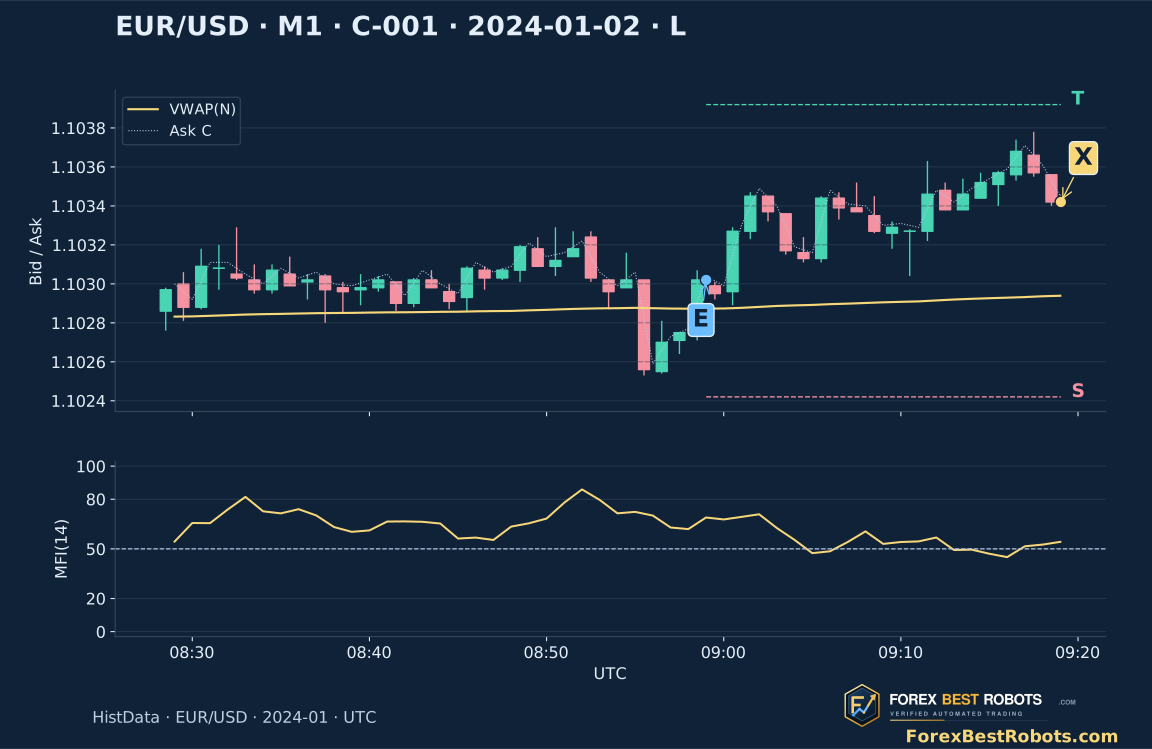
C-001 is the first resolved full-rule trade, a long on 2024-01-02. The 08:58 candle confirms at 08:59 UTC; entry is 08:59:00.505 at Ask 1.103020. The time exit is 09:19:01.963 at Bid 1.103420: quote P/L +4.00 pips, net +3.10 after 0.70+0.20. N=105 passes the earlier median 104; MFI rises from 61.9545 to 68.9697.
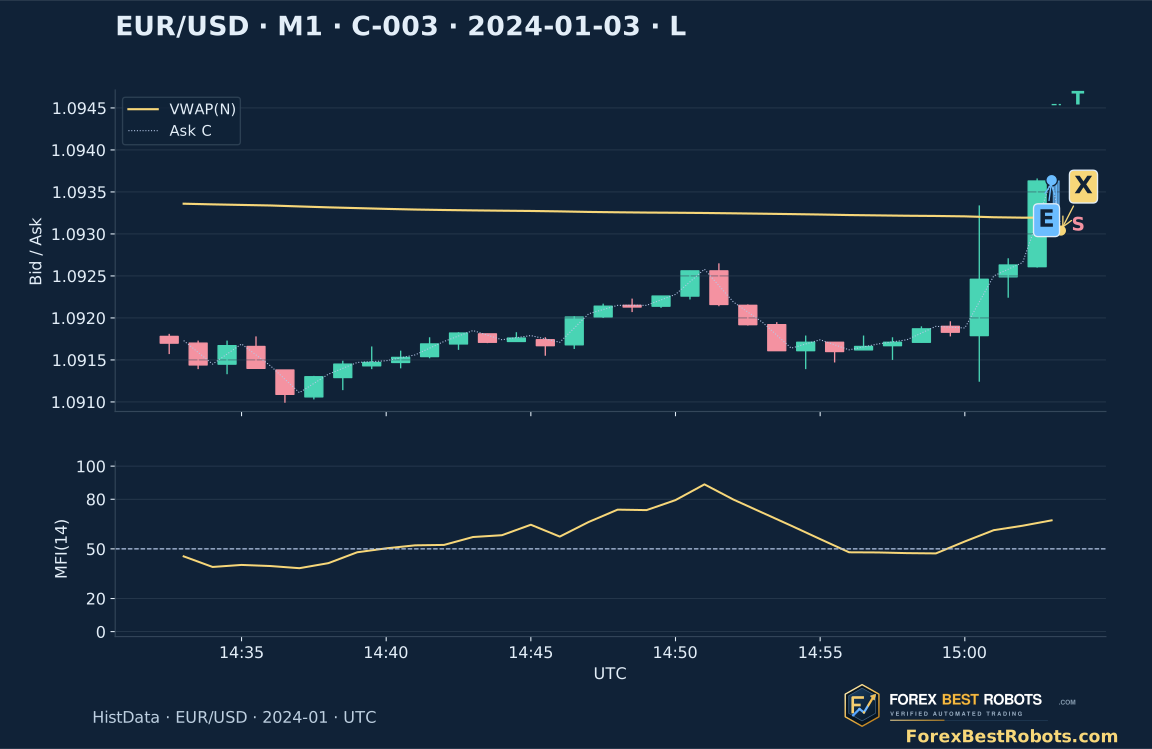
C-003 is the first C trade with a negative result at default costs, explicitly selected by that rule. On 2024-01-03 it enters long at 15:03:00.092, Ask 1.093640, then stops at 15:03:19.241, Bid 1.093040: quote −6.00, net −6.90 pips. E marks the actual model entry, X the exit, S/T the frozen thresholds. The final shaded candle is truncated at the exit quote; its completed indicators are not shown.
12. Inspect every trade and change a clearly defined cost
Choose A/B/C, a date segment and the additional round-trip allowance. Select a trade or move one step at a time. The summary and net results update together; recorded entries and exits stay fixed.
Fixed commission: 0.70 pip per round trip. The selected allowance is extra; recorded spread is already included in quote P/L. Changing this field recalculates accounting only.
Worked examples · switch to C and all dates, keeping your selected allowance
Selected variant and dates · all resolved trades
- Resolved trades
- —
- Unresolved trades · excluded
- —
- Total quote P/L · spread included · pips
- —
- Total illustrative commission · pips
- —
- Total additional allowance · pips
- —
- Total net P/L · pips
- —
- Mean net P/L · pips per trade
- —
- Net winning trades · %
- —
- Net profit factor
- —
- Maximum realized cumulative drawdown · pips
- —
Selected trade · exact quote replay
Cost calculation for this tradeBid candles, dotted Ask Close and gold VWAP show the historical path. E/X mark exact model quotes; S/T are frozen thresholds. The blue final candle stops at the exit quote. MFI values are drawn at completed candle ends only.
On narrow screens, scroll inside the chart or table to read its full width.
- Direction
- —
- Exit reason
- —
- Signal candle · UTC start → confirmation
- —
- Entry quote · UTC
- —
- Exit quote · UTC
- —
- Entry price
- —
- Exit price
- —
- Frozen stop threshold
- —
- Frozen target threshold
- —
- Time/session deadline · UTC
- —
- Holding time · minutes
- —
- First-quote delay · milliseconds
- —
- Entry spread · pips
- —
- Quote P/L · spread included · pips
- —
- Illustrative round-trip commission · pips
- —
- Selected extra round-trip allowance · pips
- —
- Net P/L after both deductions · pips
- —
- Previous → signal VWAP proxy
- —
- Previous → signal MFI(14)
- —
- Signal N / median of preceding 20
- —
- MFI check · used by B/C
- —
- Activity check · used by C
- —
Inspect all trades in this selection
| Trade | Signal candle · UTC start → confirmation | Direction | Entry quote · UTC | Exit quote · UTC | Exit reason | Quote P/L · spread included · pips | Illustrative round-trip commission · pips | Selected extra round-trip allowance · pips | Net P/L after both deductions · pips |
|---|
13. Use this replay as evidence with clear limits
A single currency pair, one January month and one quote archive cannot establish robustness. A minute containing a record does not prove every market update was captured, and quote data do not reproduce depth, order queues, latency or executable size. The one-pip gate and five-second deadline also remove some opportunities, rather than repairing a poor fill afterwards.
The result supports a narrow conclusion: this declared VWAP/MFI/activity rule did not demonstrate a profitable edge under the stated replay and cost assumptions. Preserve the complete event log and the negative result when proposing a later test. The measurement guides and this strategy serve different purposes: a readable indicator event is only the start of a trading hypothesis.
Frequently asked questions
Is the full VWAP and MFI scalping rule profitable in this test?
No. C has 99 trades, quote P/L −88.3 pips and net −177.4 after 0.70+0.20 pip additional deductions per round trip. Both chronological segments are negative. This is evidence about the declared sample and model, not every possible VWAP strategy.
Does MFI confirmation require crossing 20 or 80?
No. This specific strategy requires MFI above 50 and rising for a long, below 50 and falling for a short. The guide’s 20/80 returns are different observations. All tests use completed candles and unrounded values.
Why are 137 filter passes only 99 full-rule trades?
The 137 events pass MFI and activity before execution checks. Of those, 35 occur while occupied, two fail the first-quote timing rule and one fails the spread gate. The remaining 99 enter; rejected events are not retried.
Does the allowance subtract the spread twice?
No. Bid/Ask entry and exit prices already include the recorded spread in quote P/L. The allowance is an additional assumed round-trip deduction beside fixed illustrative commission. Its control changes accounting only.
Can the replay fill a stop beyond six pips?
Yes. The six-pip distance defines the trigger threshold. The model exits at the first observed liquidation quote that breaches it, so a jump can produce a larger loss. Actual broker execution can differ further.
Is the later segment an independent out-of-sample test?
It is a retrospective chronological comparison within one month and source. January 8 data already appeared in the guides. The later segment is not claimed as untouched validation; the negative results and complete logs are retained.
Data, timing and reproducibility
The downloads retain all 387 trades across A/B/C, all 508 candidate events and 1 524 variant decisions, observed M1 Bid/Ask inputs, daily coverage and the frozen protocol. Prices use integer millionths; one EUR/USD pip equals 100 units. The method kit includes a cost replay using Python’s standard library and an optional quote replay requiring NumPy and the identified original archive.
The raw monthly archive is identified by its source page and SHA-256 rather than redistributed. Static figures and the trade viewer use historical observations. The final trade-path candle is recomputed only through the exit quote. Neither charts nor results are screenshots of live fills, and there is no claim of real-account performance.
- Every simulated trade and source quote indices (CSV)
- Candidate events, decisions and coverage (ZIP)
- Inputs, fixed protocol and replay methods (ZIP)