

Smaller histogram bars show a narrowing distance between MACD and its signal. They do not establish that price is about to resume a trend. This original model follows one fresh histogram lobe, freezes a price level before the pullback ends and permits only the first precisely timed recovery.
1. Define a distinct continuation hypothesis
This model tests a first recovery in the same-side MACD-minus-signal histogram while the main series and price context remain directional. It uses a pre-pullback price level and requires confirmation on the recovery bar itself. The existing MACD/ATR scalping model instead selects a turn and waits for a separate next-bar test with ATR exits. Changing only the timeframe would not create this distinction.
Use fictional EURUSD H1 Bid OHLC and an assumed USD account, with 1 pip=0.0001. The settings, spacing, depth bounds and deadlines below are original research choices, not proven optimal values. EMA context and MACD reuse price history; they do not create independent evidence. None of the constructed examples reports an order, measured edge or trading result.
2. Name main, signal and difference before counting bars
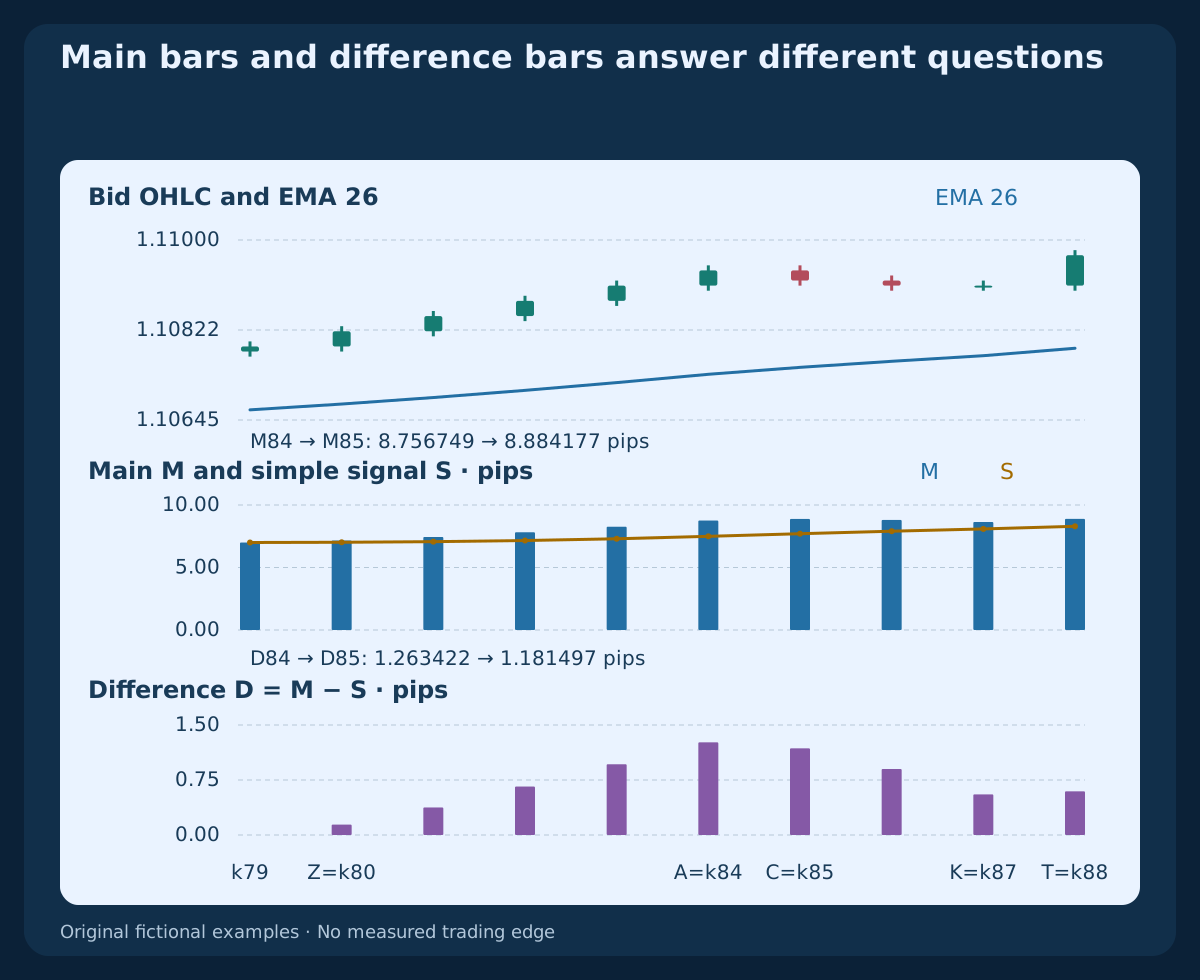
Use M=EMA12(Close)−EMA26(Close), S=SMA9(M) and D=M−S. Traditional MT4 MACD displays M as bars; this strategy contracts D, the separate OsMA difference. An EMA-smoothed signal produces another D series and potentially other events. Our nine-value signal is explicitly simple, not exponential.
Seed each price EMA with the mean of its first n closes, then apply E_n(k)=(2×Close(k)+(n−1)×E_n(k−1))/(n+1). EMA12 starts at k11, EMA26 and M at k25, S and D at k33; the first fully available fresh D crossing could be k34. This declared reference is not guaranteed to match a terminal with different earlier history or seeds.
3. Start only at a fresh difference crossing
BUY origin Z requires D(Z−1)≤0 AND D(Z)>0; SELL requires D(Z−1)≥0 AND D(Z)<0. Both readings must exist. A first available positive value is not a manufactured crossing from zero. The lobe is the uninterrupted run of the current strict D sign; zero ends it.
At Z and every later candidate bar, BUY requires M(t)>0 AND Close(t)>EMA26(t) AND EMA26(t)>EMA26(t−5). SELL reverses all three strict comparisons. A failed origin consumes that lobe even if context improves later. Do not adopt an origin that occurred during an open position or unresolved request.
4. Recognize the peak only when contraction starts
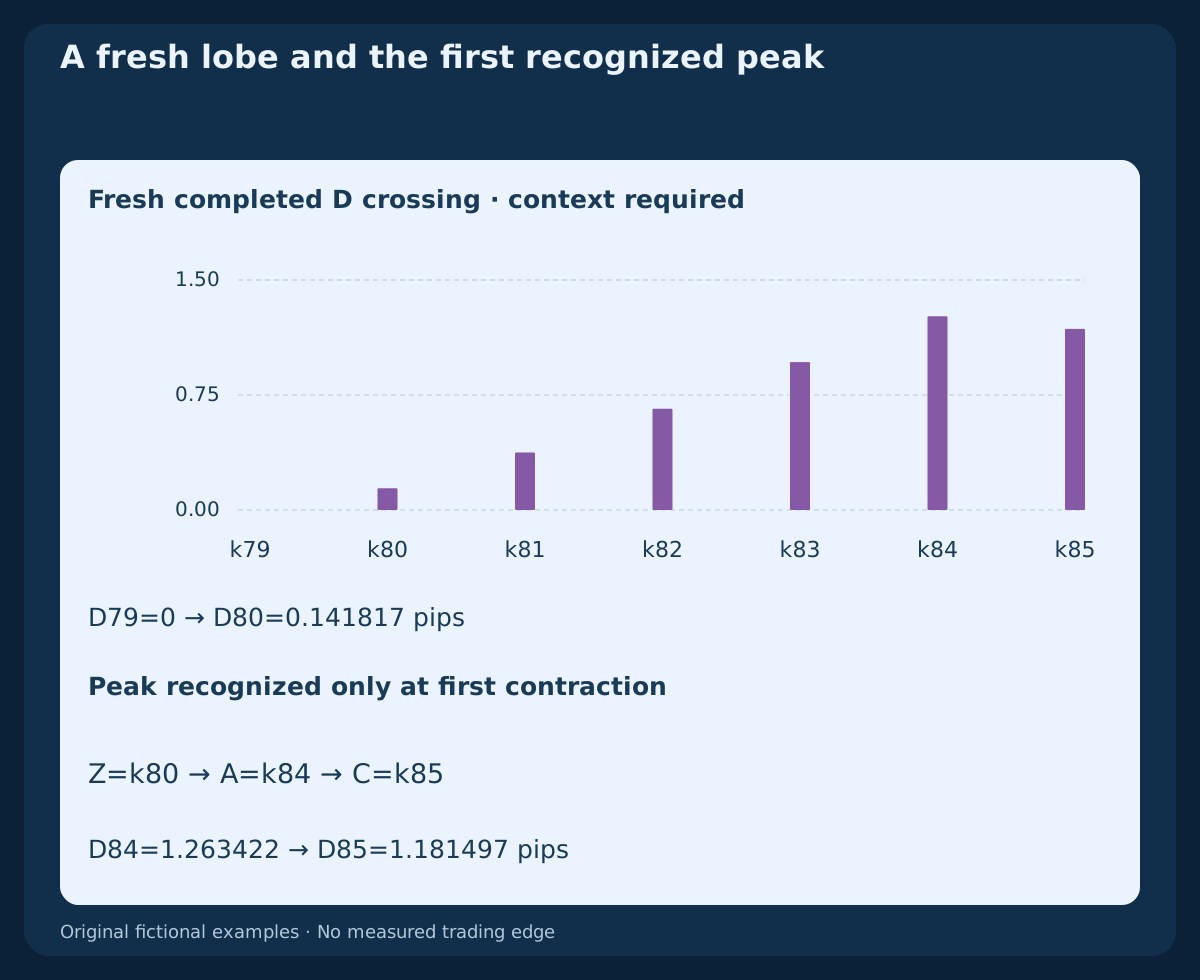
From Z require at least three strictly increasing positive readings of U=abs(D), including Z. The first decrease identifies A=C−1 after C closes and its data arrive; A was not a confirmed peak at its own close. Equality during initial expansion, or a decrease before three readings, rejects the lobe.
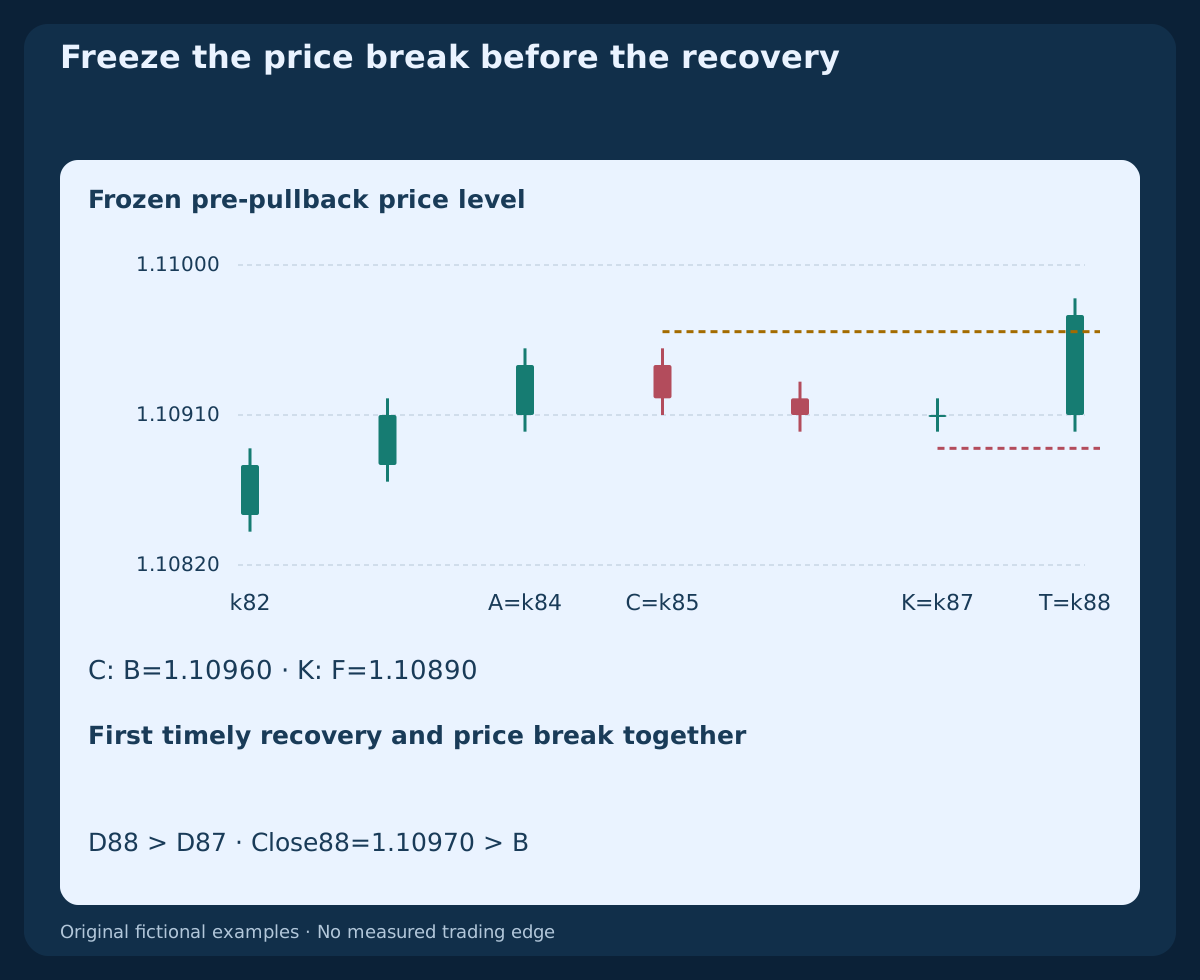
At C freeze BUY level B=max High(A−2…A)+1 pip, or SELL level B=min Low(A−2…A)−1 pip. Both range endpoints are included. This level uses completed pre-pullback bars and cannot move with the correction. A close already beyond B during contraction rejects the opportunity before a later recovery can repair it.
5. Require exactly three strict contraction bars
The contraction bars are C, C+1, C+2, with U(A)>U(C)>U(C+1)>U(C+2)>0. Define K=C+2. A turn before K, an equal reading or a D-sign reset does not qualify. Keep context valid on each closed bar. These are three decreases, not merely three readings containing two decreases.
At K require remaining amplitude 0.25≤U(K)/U(A)≤0.75, with U(A) strictly positive. Equivalently compare U(A)≤4U(K)≤3U(A) without division. This is a declared depth filter, not a probability. The valid construction retains 0.4384475074 of the peak; compare full values rather than rounded chart labels.
6. Use the next bar for the first recovery and price break
The only recovery bar is T=C+3=K+1. Require U(T)>U(K) with the same strict D sign. BUY also needs Close(T−1)≤B AND Close(T)>B; SELL needs Close(T−1)≥B AND Close(T)<B. A wick, equality or an already-outside state is insufficient.
If T continues shrinking or is equal, expire at that close. If the first recovery occurs but its price test fails, consume it immediately. Do not add another bar for price confirmation. Later larger histogram bars or a later price break cannot revive the lobe; a future independent D crossing is required.
7. Freeze the correction protection and cancel first
After the three contractions and depth check at K, BUY freezes F=min Low(C…K)−1 pip; SELL freezes the Bid ceiling V=max High(C…K)+1 pip. No T price belongs to this range. At T cancel BUY if Low(T)≤F, or SELL if High(T)≥V, before testing histogram recovery or price confirmation.
Trend failure, missing required history or an invalid D sign also terminates the active candidate. OHLC cannot order an intrabar structure breach and a later close, so cancellation has priority. A bar used to cancel an active candidate cannot also arm another origin. Restored context alone never resets a consumed lobe.
8. Mirror SELL using magnitude rather than numeric rise
For SELL the main and D are negative and EMA26 slopes down. Contraction means D moves toward zero; re-expansion means it becomes more negative. The common magnitude rule remains U=abs(D). A numerically rising negative D is not the SELL recovery described here.
The separate SELL construction reflects all Bid OHLC around 1.10500, exchanging highs and lows, then recalculates every EMA, M, S and D. BUY and SELL quotes and protection sides remain distinct. A mirrored Bid chart is not an observed Ask history, and opposite charts do not promise equal executable risk.
9. Assess only the first quote after the recovery close
The immediately following H1 bar is E. Its first observed two-sided quote must arrive within 60 seconds of T’s scheduled close boundary, with the required completed data ready. Missing data on that first observation consumes the opportunity; do not search for a later convenient quote. The boundary itself is not proof of data arrival or execution.
Require positive prices, Ask≥Bid, spread ≤2.0 pips, BUY Bid_entry>B or SELL Ask_entry<B. Adverse displacement must satisfy BUY Ask_entry−CloseBid(T)≤2 pips or SELL CloseBid(T)−Bid_entry≤2 pips. After the stop calculation require 6≤R≤25 pips. Equality at the break fails; the other stated bounds are inclusive.
10. Fix quote-side exits before requesting an order
BUY enters at Ask, with SL_Bid=F, R=(Ask_entry−F)/pip and TP_Bid=Ask_entry+2R×pip. SELL enters at Bid, freezes s_entry=Ask_entry−Bid_entry, then uses SL_Ask=V+s_entry, R=(SL_Ask−Bid_entry)/pip and TP_Ask=Bid_entry−2R×pip. The SELL conversion uses entry spread as a declared translation, not a reconstruction of historical Ask highs.
Freeze these absolute prices at the assessed quote before the request; later fill slippage does not move them. No trailing, averaging or partial exit. Exit at the first protection execution, otherwise request a full market exit after twelve H1 bars including E, at boundary Close(E+11). Execution waits for a tradable quote; gaps, closures and changing spread can alter fills and realized losses.
11. Budget costs and round tradable volume down
Use planned budget 0.5% of equity. The independent quote examples assume $10,000 equity, $50 budget, $10 per pip per lot, $7 per lot round-turn commission, 0.01 lot steps and adverse entry/exit allowances totalling 0.4+0.6=1 pip. Financing is assumed zero in these examples, not universally.
Estimated loss per lot is (R+1)×10+7; potential reward after those costs is (2R−1)×10−7. Use floor((50/loss_per_lot)/0.01)×0.01, then check broker volume limits, margin, actual contract value, price grid and stop distances. Reject if the minimum lot exceeds budget. Quoted sides already include spread; do not deduct it twice. Planned risk is not a guaranteed maximum loss.
12. Reproduce the complete BUY clock and plan
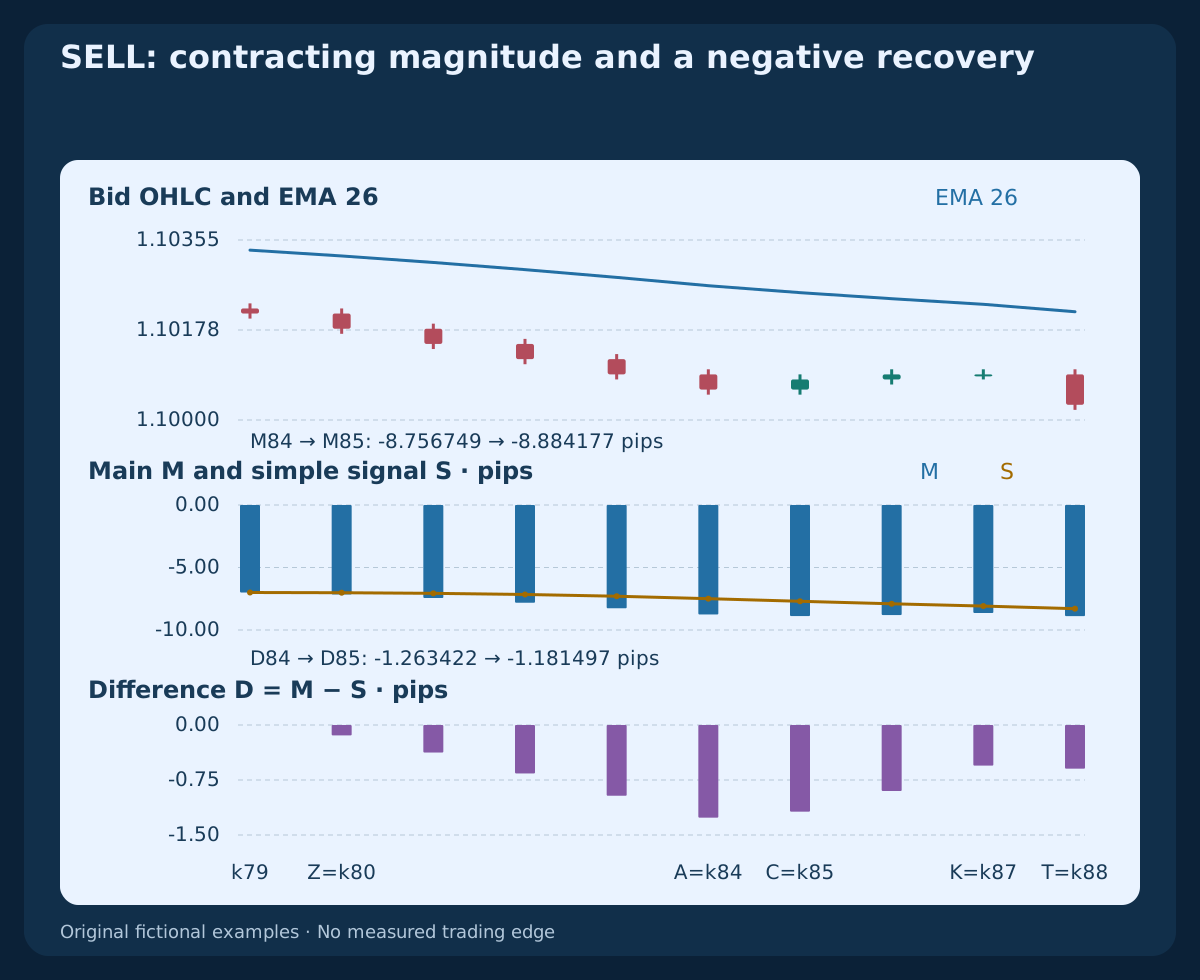
The original bar zero opens at 2026-10-19 11:00 UTC. The fresh origin is Z=k80, peak A=k84, first contraction C=k85, third contraction K=k87 and first recovery T=k88. D at A/K/T is 1.263422 / 0.553944 / 0.595605 pips. At C the main M still rises while D shrinks, demonstrating why the two bar series cannot be substituted.
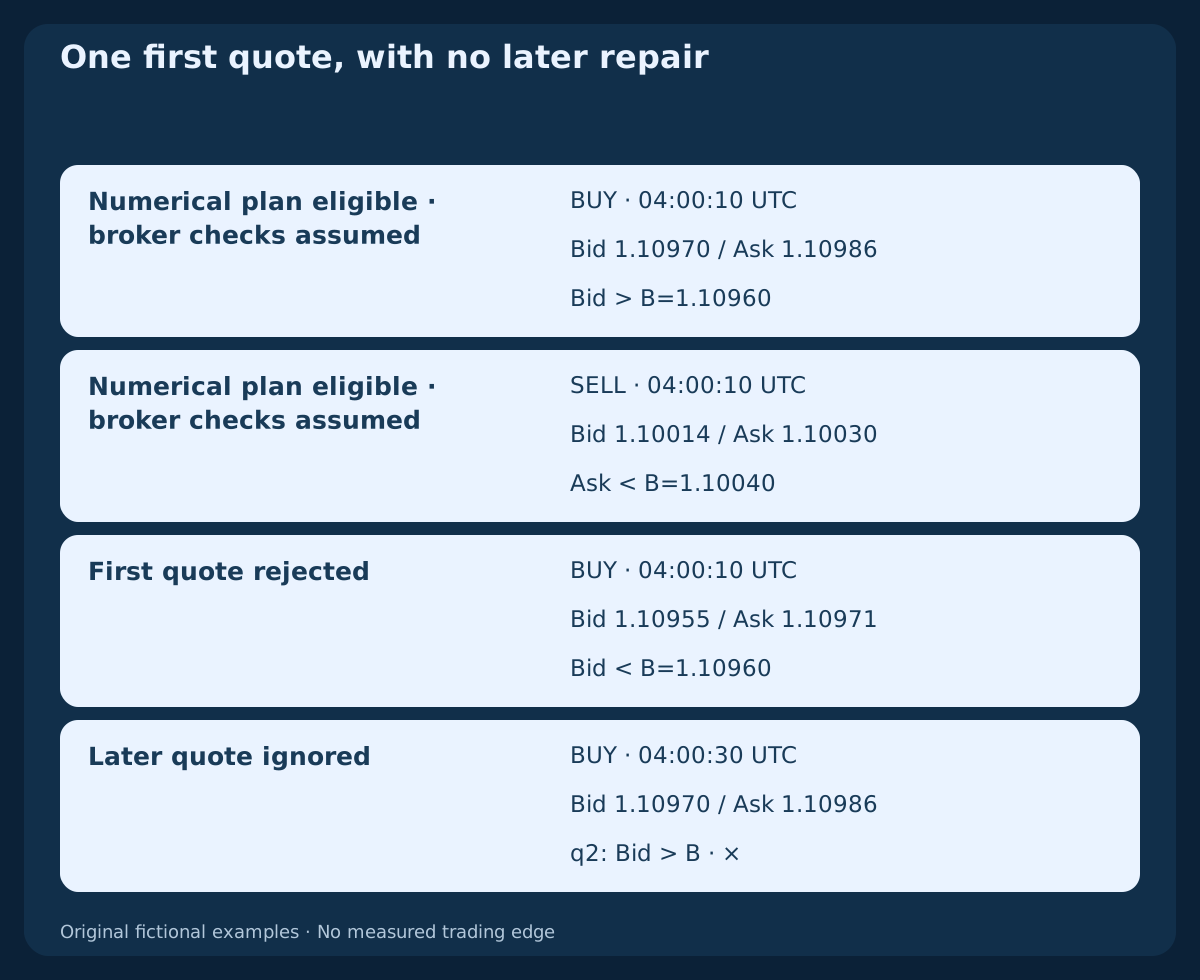
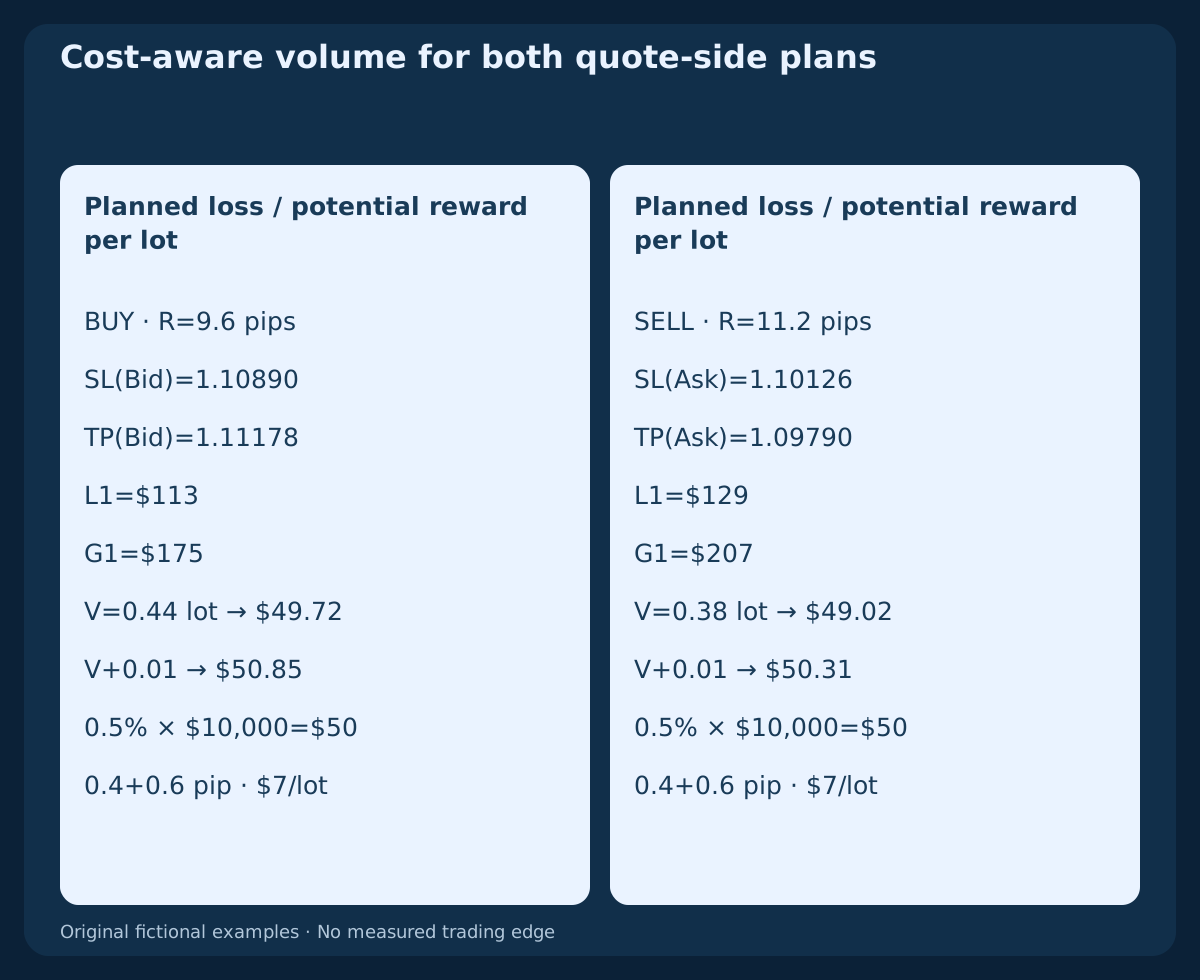
BUY freezes B=1.10960 at C and F=1.10890 at K. T closes at 1.10970, boundary 2026-10-23 04:00 UTC. Assume first data and Bid/Ask at 04:00:10 UTC, 1.10970 / 1.10986. Then R=9.6 pips, target 1.11178, loss/reward per lot $113 / $175. Volume 0.44 lot plans $49.72; the next step plans $50.85. Time exit, if needed, has boundary 2026-10-23 16:00 UTC. No later fill or outcome is asserted.
13. Check the independent SELL quote plan
The mirrored SELL uses B=1.10040, Bid ceiling V=1.10110 and T close 1.10030. Its D readings at A/K/T are −1.263422 / −0.553944 / −0.595605 pips. Magnitude decreases three times and then increases; the recovery is a numeric decrease of D.
Assume first Bid/Ask 1.10014 / 1.10030, spread 1.6 pips. Fixed Ask stop 1.10126 gives R=11.2 pips and Ask target 1.09790. Estimated loss/reward per lot is $129 / $207; 0.38 lot plans $49.02, and the next step $50.31. The scheduled quote and time-exit boundaries match BUY. A gross target at twice R is not net reward of twice planned loss.
14. Keep early, deep, late and failed-first cases
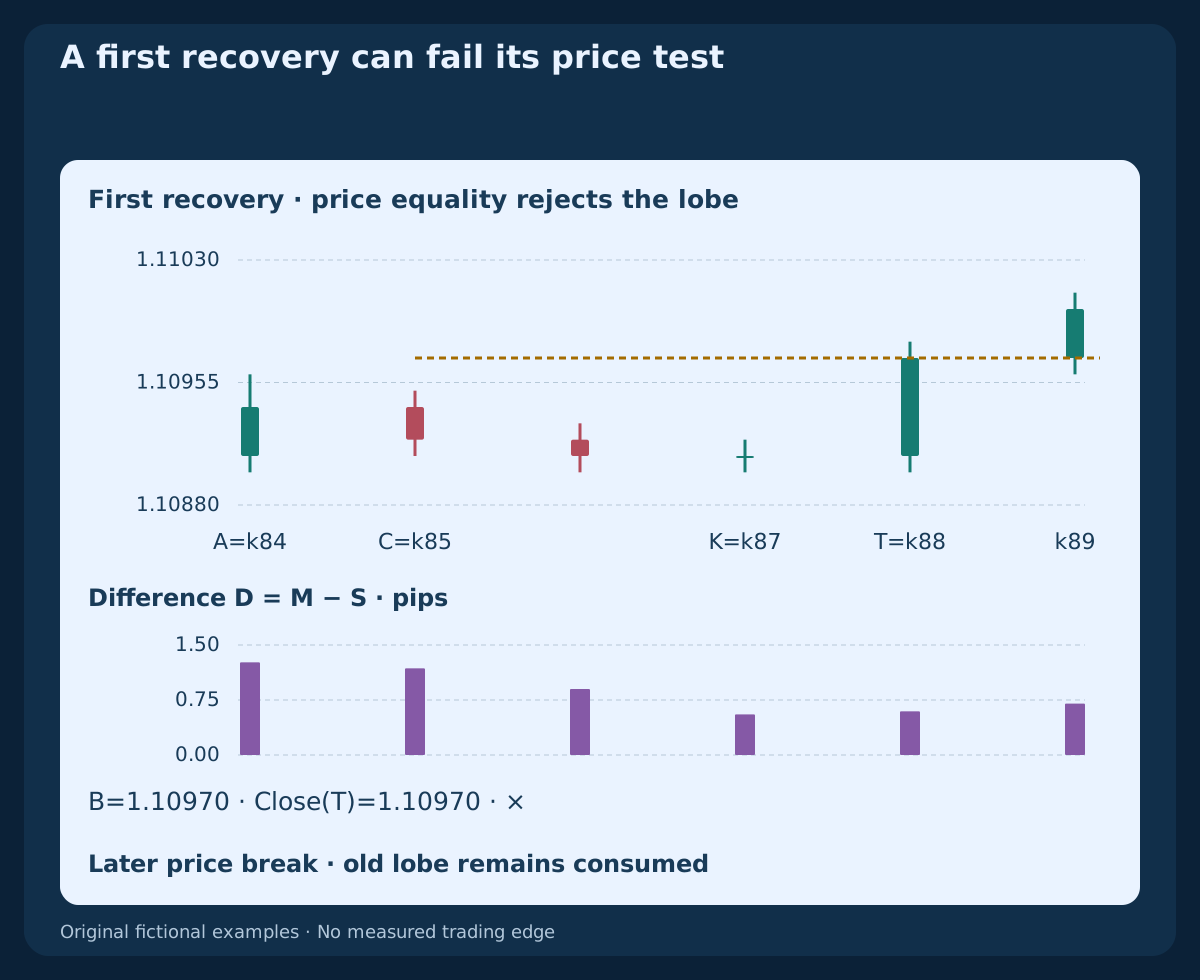
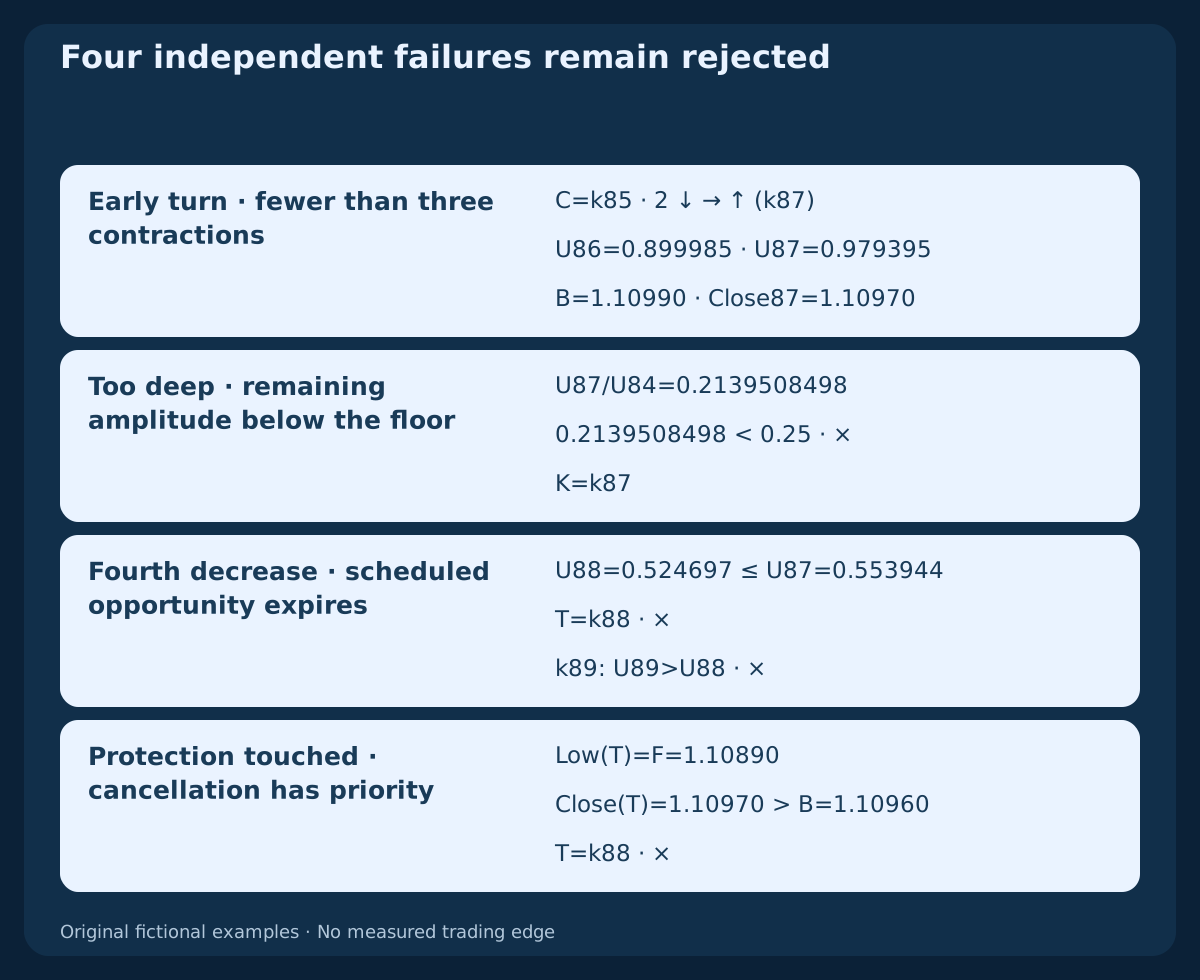
The separate histories reject a recovery after only two contractions, remaining amplitude 0.2139508498 below the depth floor, a fourth shrinking bar at T, and a T-bar protection touch. In the price-equality case the separately frozen level is B=1.10970; T closes exactly there, so the first histogram recovery fails even though a later close clears it.
The first-quote rejection has assumed Bid/Ask 1.10955 / 1.10971 at 04:00:10 UTC. Its Bid is below the BUY level despite acceptable spread and favorable displacement. The later 04:00:30 UTC quote 1.10970 / 1.10986 is ignored. These cases are separate constructions, not alternative fills chosen after seeing which one wins.
15. Download the full history and read closed buffers
The first CSV provides eight fictional OHLC histories, all warm-up data, EMA12/26, main, SMA signal and difference. Anchor and fixed-level fields appear only when those facts become knowable. The second CSV records events and assumed quotes. The table excerpts BUY; its indicator columns are in pips, while CSV indicator values are in price units. Empty warm-up cells mean unavailable, not zero.
A completed MT4 difference can be inspected with iOsMA(NULL,PERIOD_H1,12,26,9,PRICE_CLOSE,1). Alternatively subtract MODE_SIGNAL from MODE_MAIN using matching iMACD inputs and shifts. The prior completed bar is shift two; shift zero is forming. Freeze bar timestamps, since stored shifts change later. Terminal timestamps identify openings, while our displayed UTC timestamps identify close boundaries.
Download eight fictional H1 OHLC histories with EMA, MACD main, SMA signal and difference (CSV)
Download decision events and assumed quote plans (CSV)
| Index | UTC close boundary | Bid close | M (pips) | S (pips) | D (pips) |
|---|---|---|---|---|---|
| 79 | 2026-10-22 19:00:00 UTC | 1.10790 | 7.000000 | 7.000000 | 0.000000 |
| 80 | 2026-10-22 20:00:00 UTC | 1.10820 | 7.159544 | 7.017727 | 0.141817 |
| 84 | 2026-10-23 00:00:00 UTC | 1.10940 | 8.756749 | 7.493327 | 1.263422 |
| 85 | 2026-10-23 01:00:00 UTC | 1.10920 | 8.884177 | 7.702680 | 1.181497 |
| 86 | 2026-10-23 02:00:00 UTC | 1.10910 | 8.802998 | 7.903013 | 0.899985 |
| 87 | 2026-10-23 03:00:00 UTC | 1.10910 | 8.639077 | 8.085132 | 0.553944 |
| 88 | 2026-10-23 04:00:00 UTC | 1.10970 | 8.890830 | 8.295225 | 0.595605 |
16. Reconcile state before researching performance
Allow at most one position per instrument and one initial market request per opportunity, with supported attached protection. Broker rejection, requote, stale data or a failed first quote consumes the lobe. An uncertain response requires ticket/exposure reconciliation before any new risk, not an automatic retry. After a verified exit, wait for a future independent origin; do not adopt a lobe that began while invested.
Test causal prefixes, equality, unavailable predecessors, exact depth limits and scheduled expiry. Bid OHLC cannot recover Ask execution or resolve which of two touched exits came first; retain ambiguity and obtain ticks. Meaningful research requires broker history, realistic costs, rejected cases and out-of-sample testing. The supplied constructions establish reproducible rules and arithmetic, not a win rate or a reason to trade real money.
Frequently asked questions
Which histogram does this strategy use?
It uses MACD main minus its nine-value simple signal. Standard MT4 MACD bars display the main series, so counting their contraction tests another model. An exponential signal also changes the difference values.
Are three smaller readings enough?
No. The model requires three strict decreases from the recognized peak, followed by recovery on the very next bar. The initial lobe also needs at least three increasing readings before contraction starts.
Can price confirm one bar after the histogram turn?
No. The first timely recovery must also pass the frozen price-break test on that same completed bar. A later break cannot repair an equal or failed first price close.
Does a positive MACD main value renew a rejected lobe?
No. Context alone cannot reset it. The difference must leave the old strict sign and a future fresh crossing must qualify independently, with flat and reconciled exposure.
Is the SELL stop an observed historical Ask high?
No. Its fixed Bid correction ceiling is translated by entry spread for this model. Later spread changes can activate the Ask stop at a different Bid level; Bid candles cannot reconstruct Ask execution.
Do the examples demonstrate profitability?
No. They are original fictional OHLC histories and assumed quotes, without executed orders or outcomes. Settings, depth bounds, buffers and deadlines remain unvalidated research choices.
Sources and research notes
Primary sources support main/signal/difference definitions, the MT4 simple signal, other platforms’ EMA signal convention, closed-buffer indexing and executable price sides. The exact lobe, expansion, contraction, depth, timing, price, protection and quote rules plus all constructed data are original hypotheses; sources do not validate their performance.
Educational strategy hypothesis. Eight fictional histories and assumed quotes; no executed orders, broker backtest, measured advantage or guaranteed outcome.