

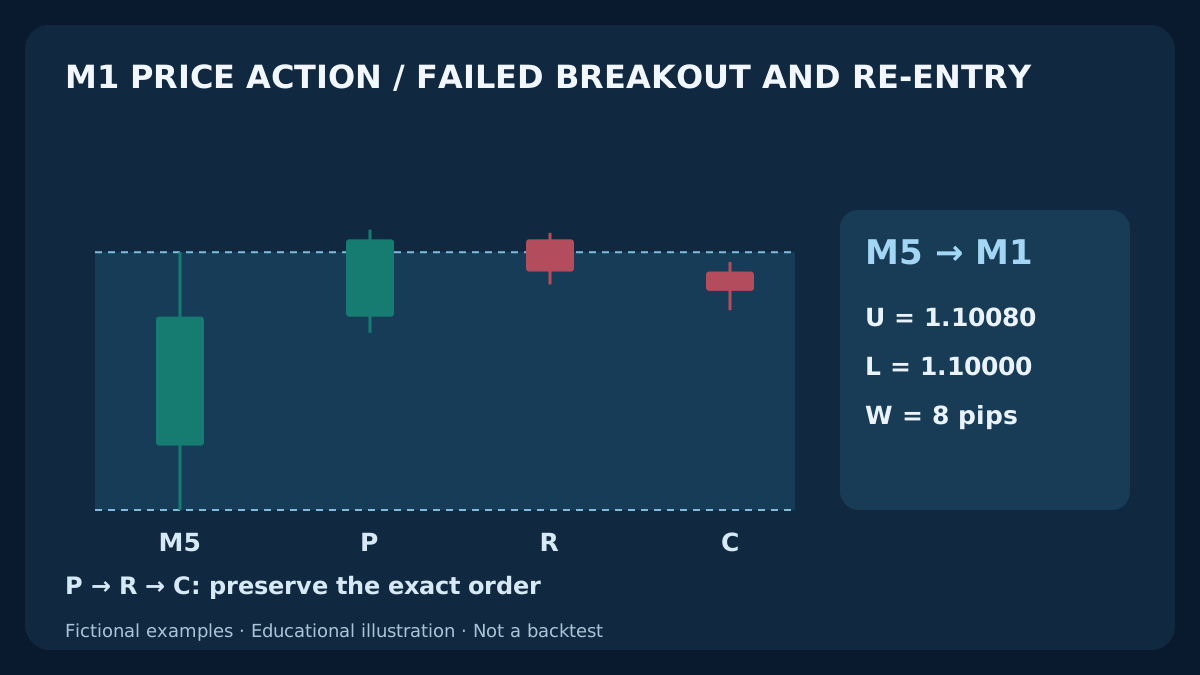
A failed breakout is useful for research only when the original range and the first excursion are known before the return. This template separates three closed M1 candles from the quote at which a trade could actually be requested.
1. What this price action scalping strategy tests
This price action scalping Forex strategy tests whether an initial excursion beyond a known intraday range can fail and offer a short move toward its opposite edge. One completed M5 Bid candle defines the range. Three separate closed M1 candles must then establish the outside excursion P, immediate return R and immediate confirmation C. A long wick, an inside close alone or a visually attractive reversal is insufficient.
This is an original research hypothesis with fixed sample settings, not a proven profitable system. It differs from an Asian-session range setup: its reference is the immediately preceding M5 candle at each slot, with no Asian box or London-opening condition. It also differs from the M5 continuation breakout and the M1 EMA pullback. The scalping guide explains the wider timeframe and cost context.
2. Freeze the instrument, clock and research inputs
Use illustrative EUR/USD with 1 pip = 0.0001 and point/executable price tick = 0.00001. Signals use Bid OHLC. Define an entry window of 09:00–11:00 UTC and ten-minute slots starting at 09:00, 09:10 and so on through 10:50. Map broker candle timestamps to UTC using the historical offset, including daylight-saving changes. These hours are a test definition, not a claim about the best session.
Require range width 5–10 pips inclusive, initial excursion of at least 0.3 pip and a fixed stop buffer of 0.3 pip. Monitor only the first three M1 candles for P. The maximum spread is 0.8 pip, documented quote age 2 seconds, request window strictly less than 10 seconds after C closes and directional entry chase 0–1.5 pips inclusive. Use entry reserve 0.2 pip, round-trip commission 0.6 pip, future adverse exit reserve 0.4 pip and minimum planned net reward/risk 1.1. These inputs require validation for the actual contract; see the pairs and cost-filters guide.
| Setting | Illustrative value | Interpretation |
|---|---|---|
| Reference | 1 completed M5; W = 5–10 pips | Freeze U/L/W at slot start |
| Sequence | First 3 M1 for P; immediate R and C | No same-candle or late replacement |
| Entry | 0.8 pip / 2 seconds / <10 seconds / 0–1.5 pips | Spread / quote age / request window / chase |
| Fixed exits | 0.3-pip buffer; opposite range edge | SELL on Ask; BUY on Bid |
| Costs | 0.2 / 0.6 / 0.4 pip; net ratio ≥ 1.1 | Entry reserve / commission / future exit reserve |
| Exposure | 1 position; 1 candidate/request per slot | Time exit 3 minutes after actual fill |
3. Use only the immediately preceding completed M5 candle
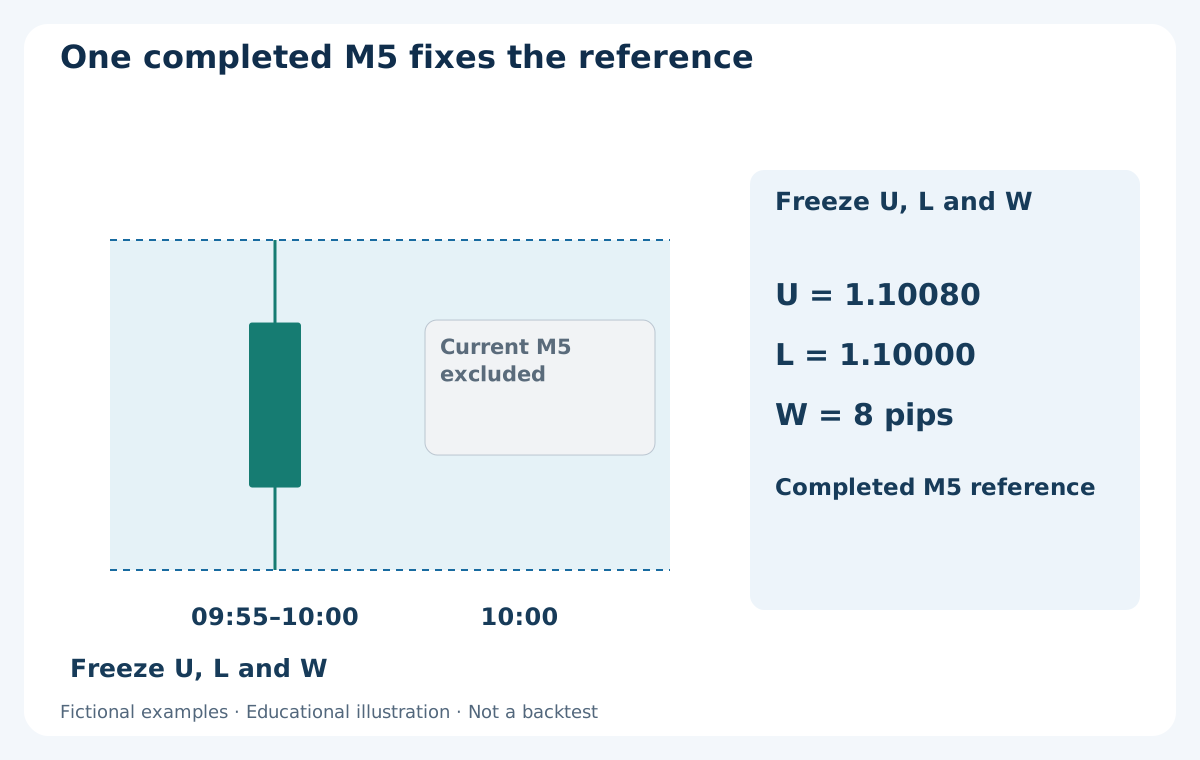
For a slot starting at T, take exactly the M5 candle covering T minus five minutes through T. Freeze U = High, L = Low and W = U − L. Do not include the current forming M5 candle or replace the reference after observing a failure. At T = 10:00, the 09:55–10:00 candle has Open/High/Low/Close = 1.10020 / 1.10080 / 1.10000 / 1.10060. Thus U = 1.10080, L = 1.10000 and W = 8 pips, within the width band.
Activate only when flat at the slot start and continuously observing from that point. The first observed valid paired quote after T must arrive before T + 5 seconds and satisfy the 2-second freshness rule. A missing or invalid reference candle, inconsistent OHLC, a timestamp gap or a mid-slot restart cancels the slot. A slot starting with a position open is skipped in full, even if that position closes soon afterward. Activation cannot be reconstructed from a later chart.
4. The first excursion P consumes the opportunity
Inspect only the completed M1 candles opening at T, T + 1 minute and T + 2 minutes. The first candle with High > U or Low < L is P and consumes the slot's opportunity. Equality at an edge is only a touch. If the same candle crosses both edges, cancel before choosing a direction. If none of these three candles crosses an edge, no setup exists; the fourth candle cannot start one.
For an upper excursion and prospective SELL, require P.High ≥ U + 0.3 pip and P.Close > U. For a lower excursion and prospective BUY, require P.Low ≤ L − 0.3 pip and P.Close < L. Equality passes the excursion-distance threshold but fails an outside-close requirement. A weak first excursion or a candle that returns inside before its own close cancels the slot. Do not ignore it in favour of a later, cleaner reversal. P itself cannot also serve as R.
5. Require a separate immediate return R and confirmation C
R must be the immediately next M1 candle, with its opening time exactly one minute after P's. Its close must be strictly inside L < R.Close < U. For SELL, require R.Close < R.Open, R.High ≤ P.High and R.Low > L. For BUY, require R.Close > R.Open, R.Low ≥ P.Low and R.High < U. This rejects a new excursion extreme or an opposite-edge touch. A missing immediate R or a return only one candle later cancels the slot; do not rename the later candle R.
C must immediately follow R. Its entire range must be strictly inside (L, U). For SELL it must be bearish and close strictly below R.Low; for BUY it must be bullish and close strictly above R.High. Equality fails these strict conditions. No additional candle may replace a failed C. All candle decisions use completed data that was actually available; a confirmation drawn later on a chart is not evidence of an executable entry.
6. Separate the close, first quote and request deadline
Evaluate only the first observed current-symbol paired Bid/Ask quote after C completes. It must be positive, on legal ticks, with Ask ≥ Bid, spread ≤ 0.8 pip and documented age ≤ 2 seconds. Bid must remain strictly inside the range and below R.Low for SELL or above R.High for BUY. The relevant stop and target must not already have been reached on the executable exit side. Local receipt time and server time are different clocks; do not subtract unrelated clocks to claim freshness.
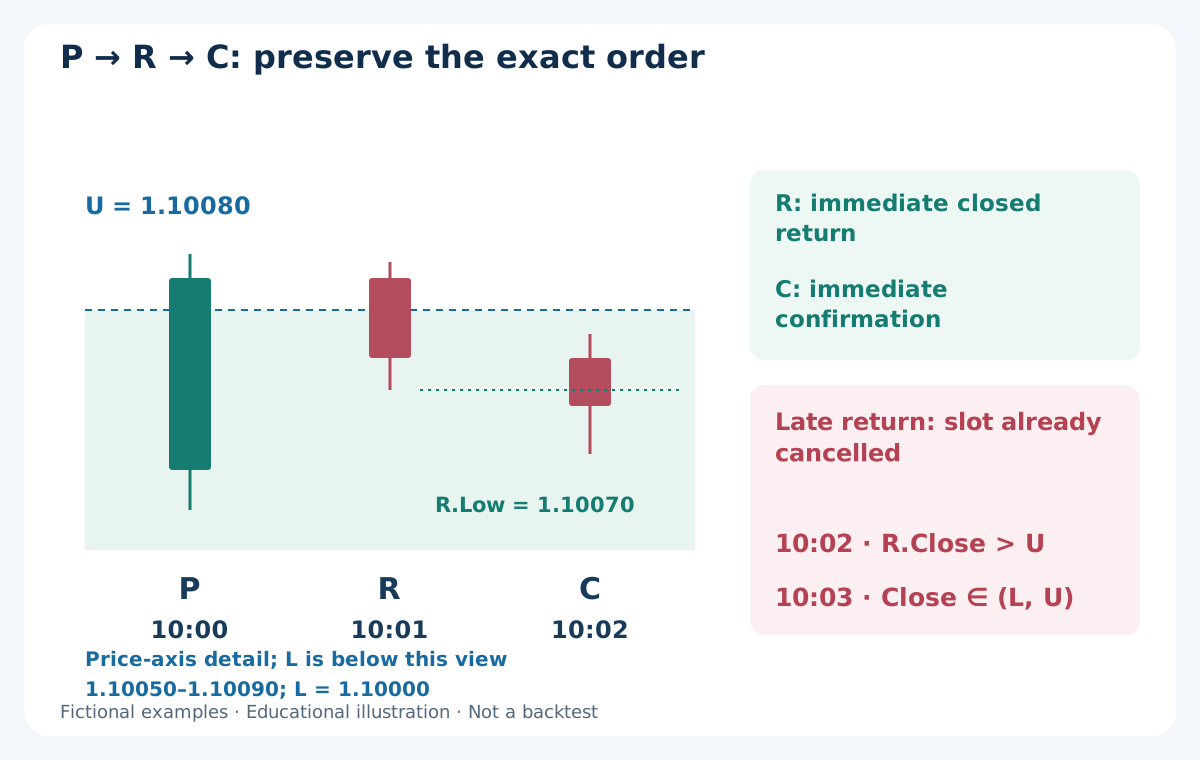
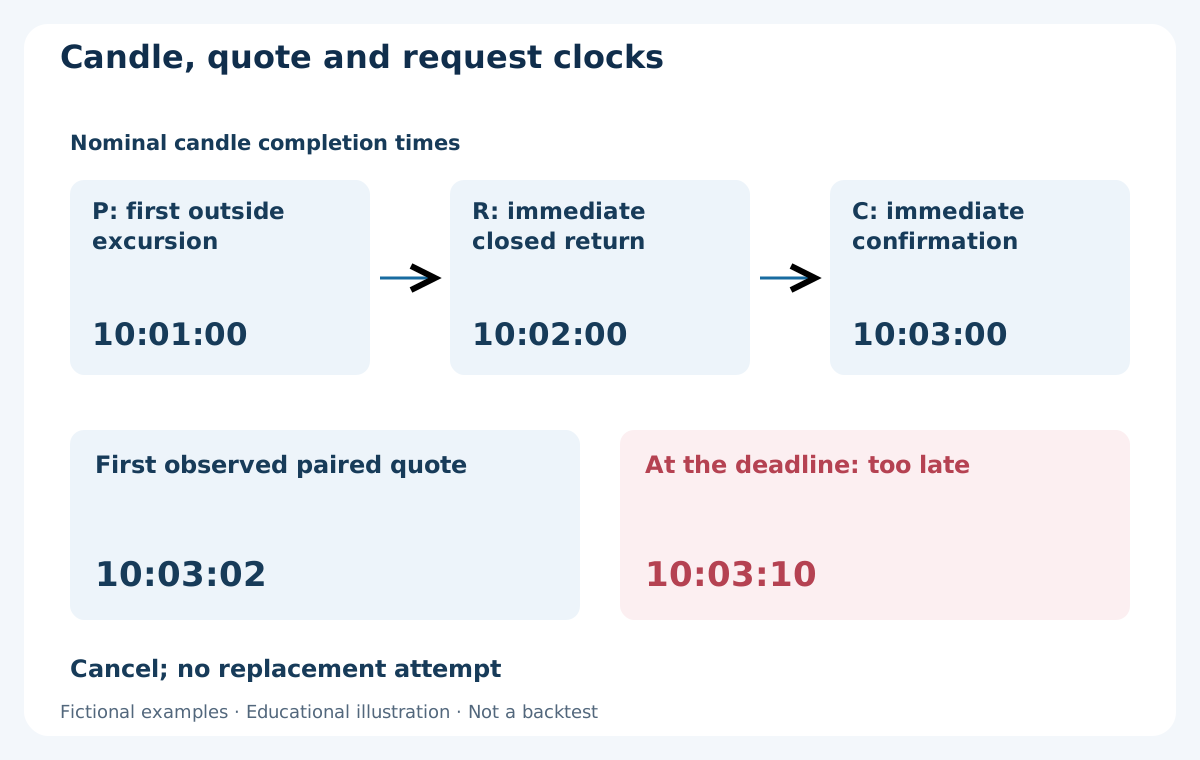
For P opening at 10:00, R at 10:01 and C at 10:02, their nominal closes are 10:01, 10:02 and 10:03. A first quote at 10:03:02 can qualify, but the request must be sent strictly before 10:03:10, before the slot ends and inside the entry window. Equality at a deadline is too late. Failure at the first quote cancels the candidate; do not wait for an improved quote. Any intervening invalidation before submission also cancels it. Send at most one request per slot, with no retry or reversal; reconcile uncertain status as explained in the slippage and latency guide.
7. Freeze protection and calculate the executable plan
For SELL set Ask stop = P.High + 0.3 pip and Ask target = L. For BUY set Bid stop = P.Low − 0.3 pip and Bid target = U. Planned entry E* is Bid − 0.2 pip for SELL or Ask + 0.2 pip for BUY. Directional chase is C.Close − E* for SELL or E* − C.Close for BUY; require 0–1.5 pips inclusive. Check legal tick normalization, level sides, broker stop distances, volume and margin. If the exact levels are prohibited, reject rather than widening protection or moving the target. This version requires supported protection with the entry request; it does not authorize silently entering unprotected.
Calculate gross stop and target distances from E*. Add commission and future exit reserve, together 1.0 pip, to planned loss; subtract them from potential gain. Both must be positive and potential net gain / planned net loss ≥ 1.1 before sizing. The entry reserve is a planning allowance, not a guaranteed fill cap. A fill worse than E* or outside the admitted geometry, ratio or cash budget is an execution exception: retain available protection, reconcile status and request an orderly exit on the first usable quote without reopening. Record its actual costs and result.
8. Worked SELL: P outside, R inside, C confirms
Retain U = 1.10080 and L = 1.10000. The 10:00–10:01 P candle has Open/High/Low/Close = 1.10060 / 1.10087 / 1.10055 / 1.10084. Its high is 0.7 pip above U and its close is outside. R at 10:01 has 1.10084 / 1.10086 / 1.10070 / 1.10074: bearish, inside close, no new high or opposite touch. C at 10:02 has 1.10074 / 1.10077 / 1.10062 / 1.10068: fully inside, bearish and closing below R.Low = 1.10070.
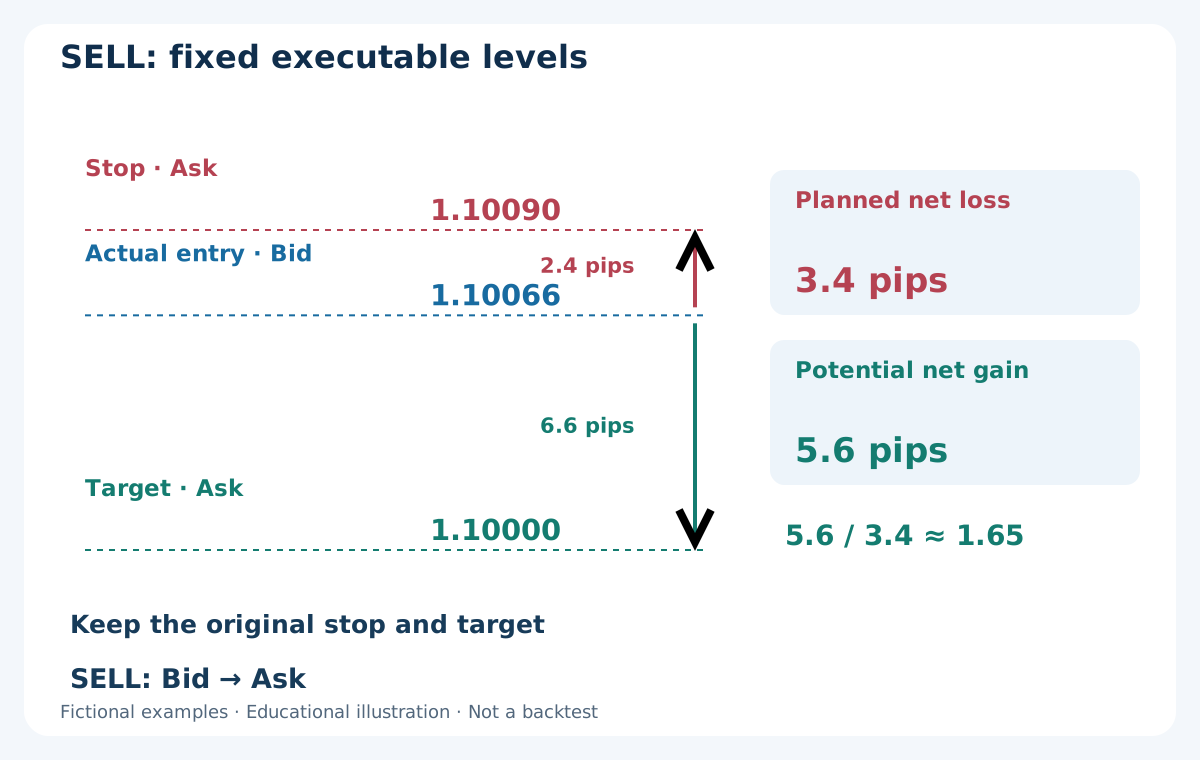
Assume all timing and account checks pass. The first quote at 10:03:02 is Bid 1.10068 / Ask 1.10074, spread 0.6 pip. E* = 1.10066, a 0.2-pip chase below C.Close. Assume actual SELL fill at that price at 10:03:03. Ask stop is 1.10090 and Ask target 1.10000. Gross risk is 2.4 pips and potential gross reward 6.6 pips. Planned net loss = 2.4 + 0.6 + 0.4 = 3.4 pips; potential net gain = 6.6 − 0.6 − 0.4 = 5.6 pips. The ratio 5.6 / 3.4 ≈ 1.65 passes 1.1.
Spread and assumed entry deviation are already embedded in the distance from the Bid fill to Ask exits; do not deduct either again. These prices illustrate arithmetic, not measured execution. A broker's minimum stop distance can reject this small plan. The trading-cost guide explains why the future reserve is not an actual ledger entry or a maximum loss guarantee.
9. Reject a poorer first quote or a late return
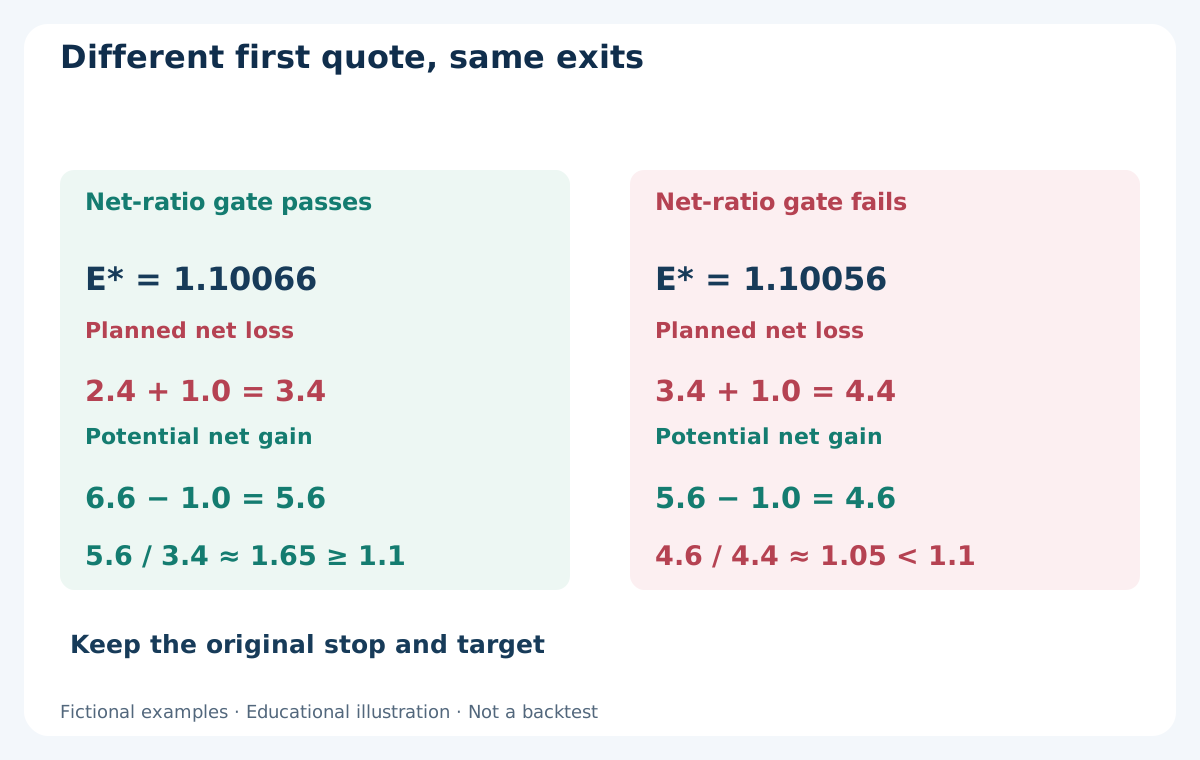
As an alternative first quote for the same SELL pattern, use Bid 1.10058 / Ask 1.10064. Spread remains 0.6 pip and E* = 1.10056. Chase is 1.2 pips, so the distance gate passes. With unchanged stop and target, gross risk becomes 3.4 pips and gross reward 5.6 pips. Planned net loss is 4.4 pips and potential net gain 4.6 pips. The ratio 4.6 / 4.4 ≈ 1.05 fails 1.1: cancel. These are alternative first-quote scenarios, not two attempts. Do not move either exit to rescue the ratio.
Timing can independently reject the shape. If the immediate R closes outside at 10:02 and the next candle returns inside at 10:03, that return is too late. The slot already failed at R; adding a later confirmation cannot restore it. Record late return separately from a cost rejection. An attractive screenshot does not override the exact candle sequence.
10. Size down from the complete planned loss
Assume a EUR 100000 standard contract, USD account and USD 10 per pip per lot. For the SELL, planned loss of 3.4 pips is USD 34 per lot. An illustrative USD 25 budget gives 25 / 34 ≈ 0.73529 lot. At a 0.01 lot step round down to 0.73 lot: planned loss is USD 24.82 and conservative target amount is 0.73 × 5.6 × 10 = USD 40.88. These are hypothetical calculations, not expected profits or a recommended position size.
Verify the actual pip value, account-currency conversion, commission schedule, minimum volume and free margin. Skip if the rounded size is below the minimum; never round up to force eligibility. A budget cannot cap losses during gaps, failed exits or operational errors. The position-sizing guide covers the contract-specific checks.
11. BUY needs its own Bid and Ask calculation
For a separate lower excursion, keep the same range. P has Open/High/Low/Close = 1.10020 / 1.10025 / 1.09993 / 1.09996. R has 1.09996 / 1.10010 / 1.09994 / 1.10006. C has 1.10006 / 1.10018 / 1.10003 / 1.10012. P clears the lower edge and closes outside; R returns bullish without a new low or opposite touch; C is fully inside and closes above R.High = 1.10010.
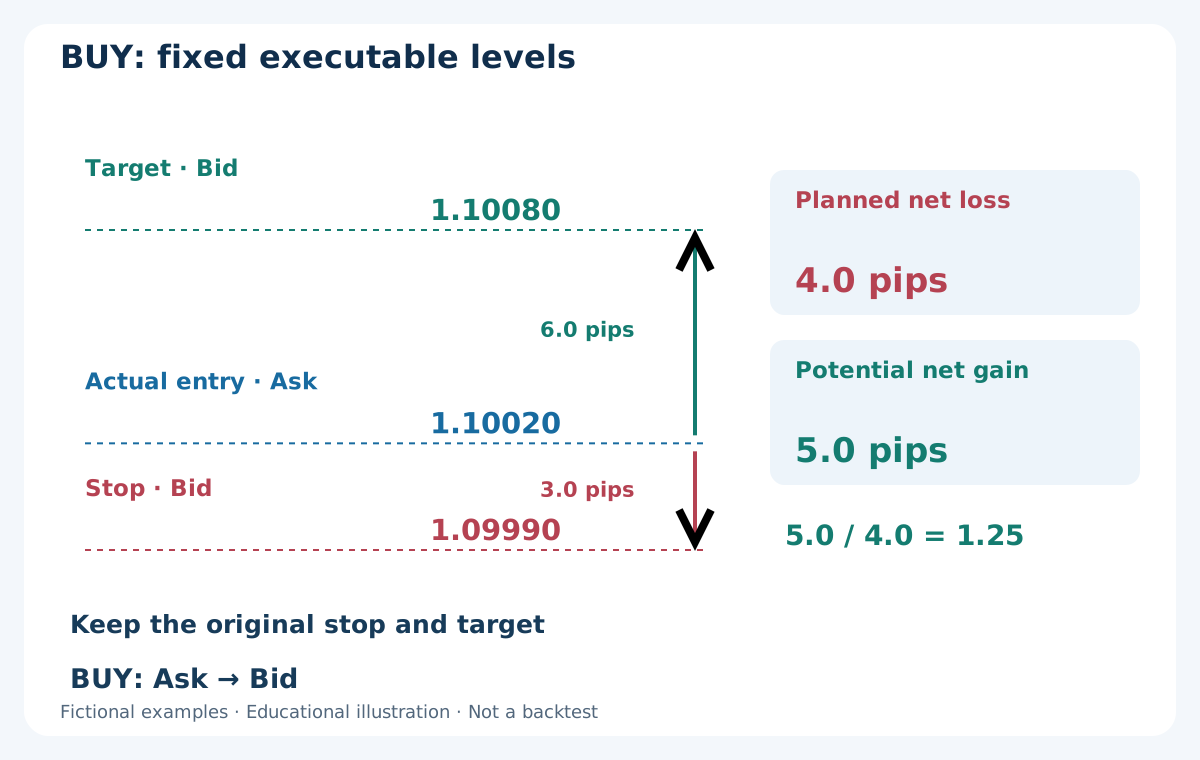
At first quote Bid 1.10012 / Ask 1.10018, spread is 0.6 pip and E* = 1.10020. Chase above C.Close is 0.8 pip. Assume all other gates pass and the BUY fills at E*. Bid stop is 1.09990 and Bid target 1.10080. Gross risk is 3.0 pips and gross reward 6.0 pips; planned net loss is 4.0 and potential net gain 5.0 pips. The ratio is 1.25, passing 1.1. For the same USD 25 budget, 25 / 40 = 0.625 rounds down to 0.62 lot: planned loss USD 24.80 and conservative target USD 31.00.
Signals use Bid candles in both directions. BUY opens on Ask and exits on Bid; SELL opens on Bid and exits on Ask. A Bid low at L does not prove that a SELL target could close on Ask. Do not copy the SELL volume or cash amounts into BUY. Paired quotes and actual event order are needed to establish executable exits.
12. Start the three-minute exit clock at the actual fill
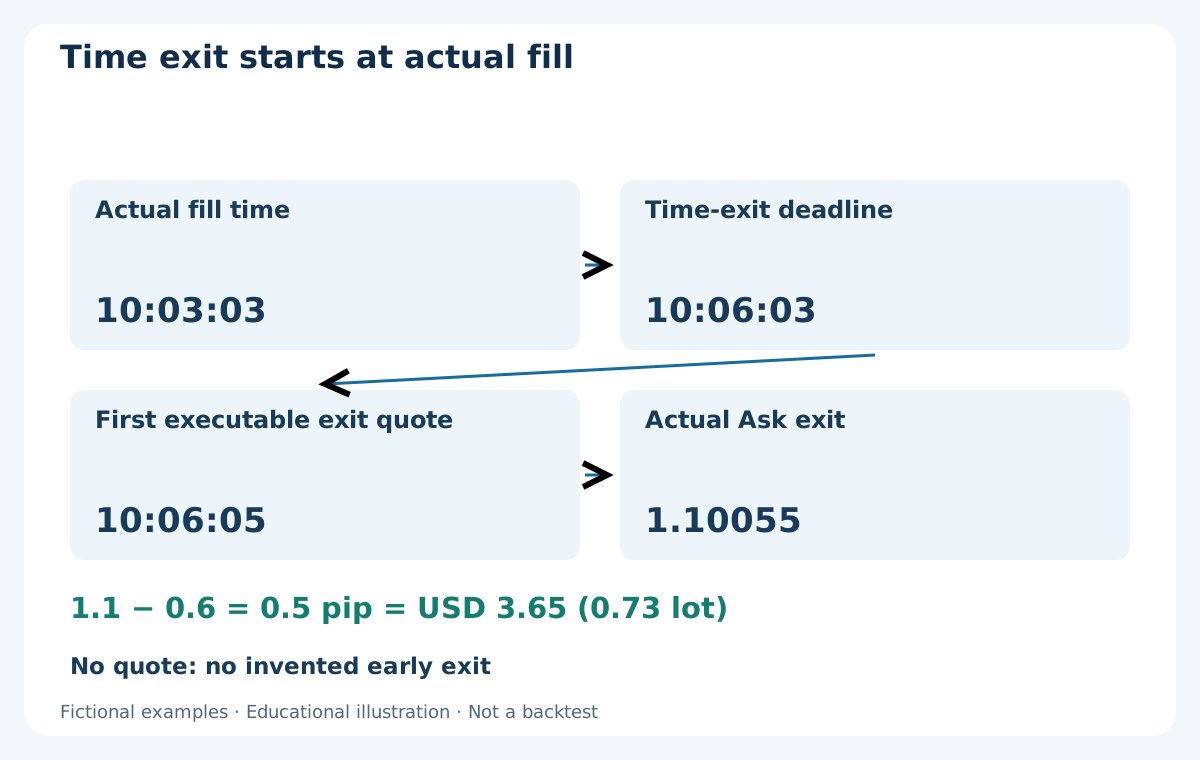
Keep the original stop and target, with no trailing, break-even move, partial close, grid or averaging. Unless already closed, request a time exit on the first executable quote at or after three minutes from actual fill. Reconcile any protective exit or uncertain order state before sending another action. Equal timestamps still require a known event order. Existing positions remain managed after the entry window ends.
The SELL fill at 10:03:03 gives deadline 10:06:03. Suppose no quote is available until 10:06:05, when Bid is 1.10047 and Ask 1.10053. Assume an actual Ask exit at 1.10055 after adverse deviation. Fill-to-fill gain is (1.10066 − 1.10055) / 0.0001 = 1.1 pips. After 0.6-pip commission, realised net gain is 0.5 pip, or USD 3.65 at 0.73 lot. Do not invent an earlier exit at the deadline or deduct an unused reserve again. Three minutes is a requested holding limit, not an execution guarantee.
13. Keep cancellations and execution exceptions visible
Use distinct log reasons for ineligible range, missed activation, no excursion, two-sided P, weak P, failed or late R, failed C, bad first quote, excessive chase, cost rejection, deadline expiry and rejected request. Each slot has at most one candidate and one request. No retry, reversal, replacement reference or restart may rescue it. No setup and cancelled candidates belong in the record, not only filled trades.
A timeout is not proof of rejection. Reconcile the account before another action and retain the original event trail. A confirmed fill outside the approved plan follows the exception exit procedure, with actual result, fees and remaining exposure reported. Protection and reserves can fail or be exceeded. Excluding these events would change both the risk picture and the strategy being tested.
14. Where this failed-breakout hypothesis can fail
A return inside a range does not prove a liquidity trap or reveal other traders' intent. A persistent trend can resume after C and reach the stop. Random oscillation can also produce a persuasive three-candle reversal. Fixed definitions reduce hindsight without establishing an economic advantage. The width, excursion threshold and opposite-edge target may all be poor choices.
Very small stop distances are sensitive to spread, slippage, minimum broker distances and delayed data. A fixed deduction cannot reproduce a quote that would have cancelled entry. Adding a session filter, changing R, tolerating a new extreme or allowing a second attempt creates a new version. Preserve all trials and failed hypotheses; do not present a selected historical winner as evidence of robustness.
15. Replay the complete information and execution sequence
Test slot eligibility, exact prior M5, timely activation, frozen U/L/W, first excursion P, immediate R, immediate C, first paired quote, all gates, rounded size, request, actual fill and every exit. Include no setups and cancellations in the relevant denominators. Test equality at edges, excursion and width thresholds, R's extreme, strict C conditions and exclusive deadlines. Missing data must not be silently replaced by a later candle or quote.
Standard MT4 Every tick does not certify recorded historical paired Bid/Ask, actual receipt age or realistic latency. M1 bars cannot resolve which exit occurred first if both levels appear inside one bar. Where data cannot assess a gate or event order, label that part untestable. The MT4 scalping-backtest guide explains the distinction between modelled ticks and execution evidence.
Separate development, validation, untouched historical testing and forward observation chronologically. Report slots, candidates, cancellations, requests, fills, closed outcomes, open exposure, commissions, drawdown and execution exceptions. Stress costs and timing through the eligibility logic rather than adjusting only final profit. No profitable backtest is supplied here; a consistent diagram cannot establish an edge.
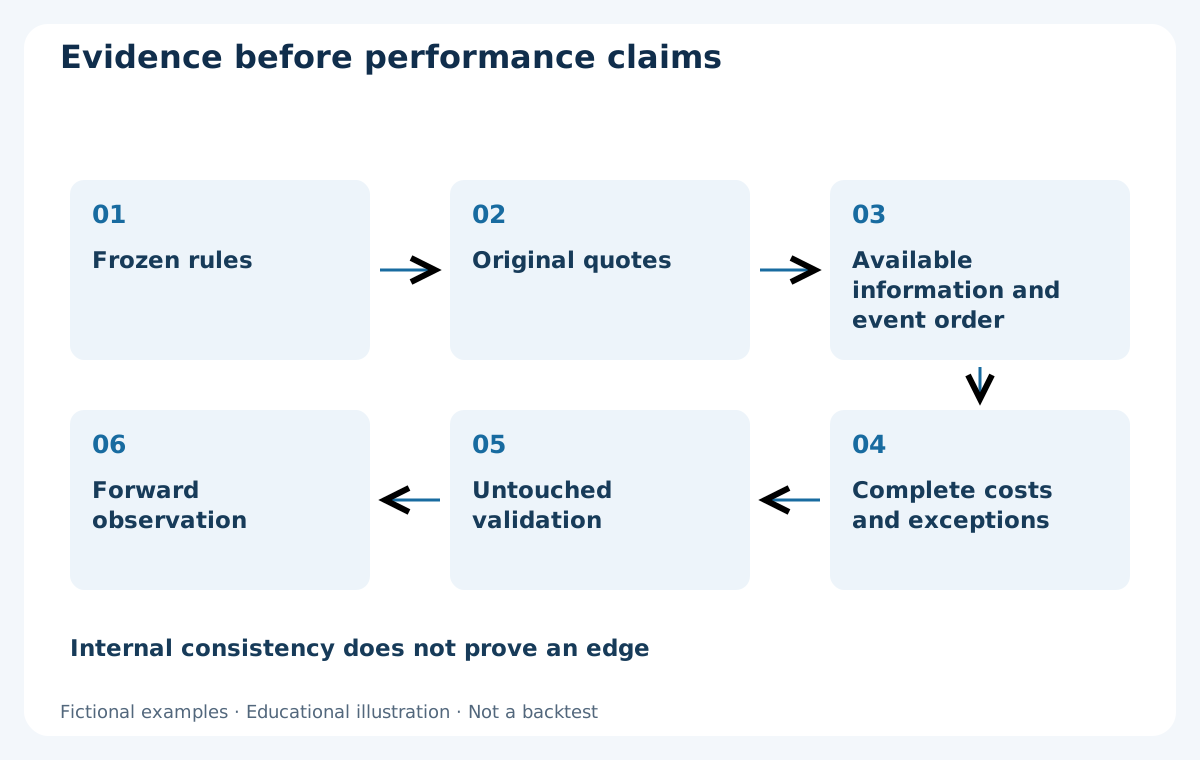
16. Audit evidence before forward observation or EA claims
Keep the exact rule version, UTC mapping, original quotes, parameter file, slot log and unaltered test reports. Every candidate should reference its prior M5 candle, P/R/C timestamps and first observed quote. Verify that the range never changed, no late R replaced the immediate one and no future information entered a decision. Educational diagrams must remain separate from monitored trading results.
The forward-validation protocol provides an observation and reconciliation framework. Demo observation can check rule fidelity without establishing identical live liquidity. Insufficient evidence, another controlled experiment or rejection of the hypothesis are valid outcomes. Commercial Expert Advisors need separate documented evidence; this fictional template does not establish that any listed EA implements or profits from these rules.
Frequently asked questions
Is a wick outside the range enough?
No. P must be the first excursion, reach the minimum distance and close outside. A separate immediate R must return inside, followed by a qualifying immediate C. A same-candle return cancels this version.
Can a later candle replace a failed return?
No. R is the immediately next M1 candle after P. A late return or a failed C consumes the opportunity. At most one candidate and one request are allowed per slot.
Why use a completed M5 reference?
Its boundaries are available at the slot start. Using the forming M5 high or low would alter the reference after observing the reversal. The range remains fixed throughout the opportunity.
Does a good candle pattern guarantee an entry?
No. The first paired quote, deadlines, protection, chase, costs, size and margin must all pass. A cost rejection cannot be repaired by moving the original exits.
Is the three-minute exit guaranteed?
No. Its clock starts at actual fill, and the request waits for an executable quote at or after the deadline. Reconcile earlier exits and uncertain status; retain delays and actual costs in the record.
Has this strategy demonstrated profitability?
No. The rules and prices are a fictional research specification. Testing with adequate quotes, untouched data and forward observation is needed; it may reject the hypothesis. Listed EAs require independent evidence.
Sources and research notes
MetaQuotes documents market-order quote sides, price normalization and broker stop restrictions. Those mechanics support the execution explanations; they do not validate this original strategy or its thresholds. Every price, quote, fill and cash outcome is fictional. No profitable backtest, broker execution measurement or independent performance validation was performed for this article.
Educational research template. All settings, prices, fills and cash outcomes are fictional, not verified results. Forex trading involves risk. A stop, reserve, budget or backtest does not guarantee future performance or a maximum loss.