

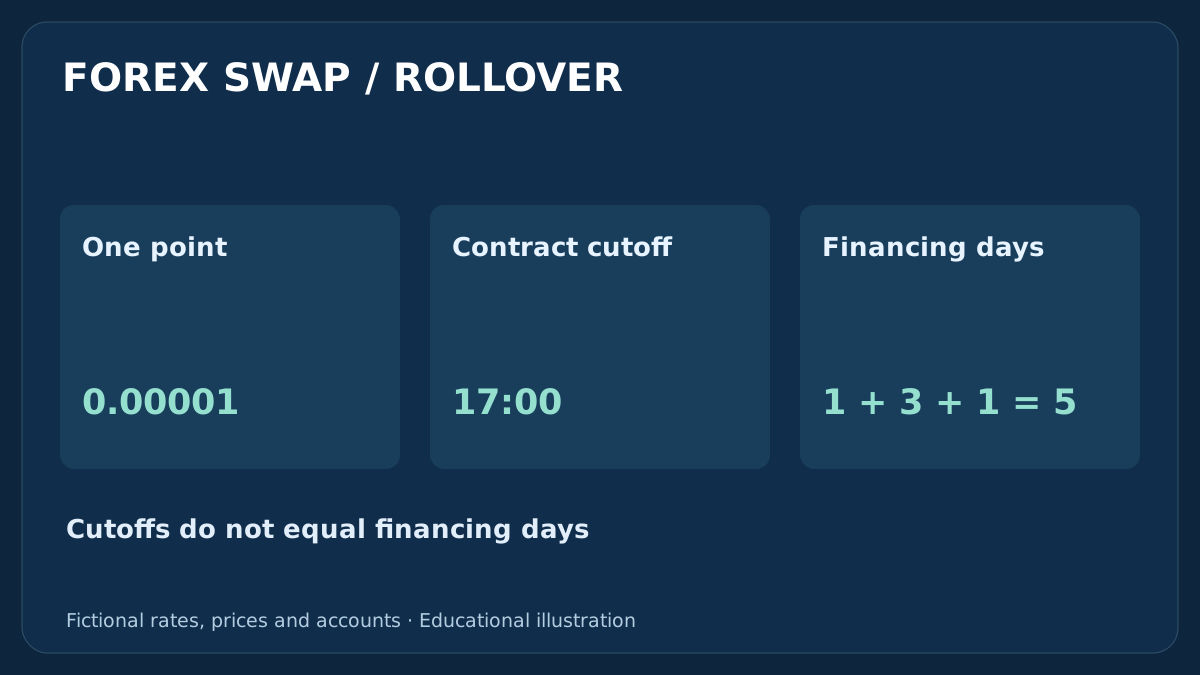
A Forex position can gain from price and still lose part of that gain to financing. Before holding it through a rollover, identify the rate, its unit, the financing calendar and the account entry it will create. This guide follows those steps with fictional numbers and keeps planning allowances separate from booked costs.
1. What Forex swap and rollover mean
In retail Forex, swap commonly names the financing debit or credit attached to carrying a position through the broker's rollover cutoff. Rollover concerns carrying the exposure into the next financing period; it is not necessarily a new trading signal or a fresh ticket visible to the customer. This guide addresses retail position financing, not the specification of an institutional swap derivative.
The amount can differ between BUY and SELL, instruments, accounts and dates. A simple comparison of central-bank interest rates cannot establish the customer charge after the broker's terms and adjustments. Begin with the actual contract rather than a list of supposedly best positive-swap pairs. The H4/D1 swing-trading guide explains the broader holding plan into which this cost fits.
For reproducible D1 and H4 decisions, use the daily-candle and broker-clock protocol to define boundaries, short Sunday bars and completed information.
2. Read the contract before reading the number
Record the exact MT4 symbol and suffix, account type, contract size, volume, account currency, long and short rates, calculation unit, cutoff and financing-day schedule. Include any applicable administration or conversion charge. A rate shown for one legal entity or account is not automatically available on another. Save when a quoted rate was observed and whether it was indicative or final.
MT4 exposes MODE_SWAPLONG and MODE_SWAPSHORT, but MODE_SWAPTYPE determines how their values must be interpreted: 0 means points, 1 the symbol's base currency, 2 interest and 3 the margin currency. These are different calculation modes, not four equivalent ways to paste a number into one formula. Confirm the broker's implementation, rate basis and settlement currency using the symbol-specification checklist.
| MT4 mode | Quoted unit | Required interpretation |
|---|---|---|
| 0 | Points | Convert with the symbol point and contract value |
| 1 | Symbol base currency | Use the specified base-currency basis and conversion |
| 2 | Interest | Check reference amount, rate and day-count basis |
| 3 | Margin currency | Use the specified margin currency, not a guessed account currency |
3. A cutoff is not midnight or a minimum holding time
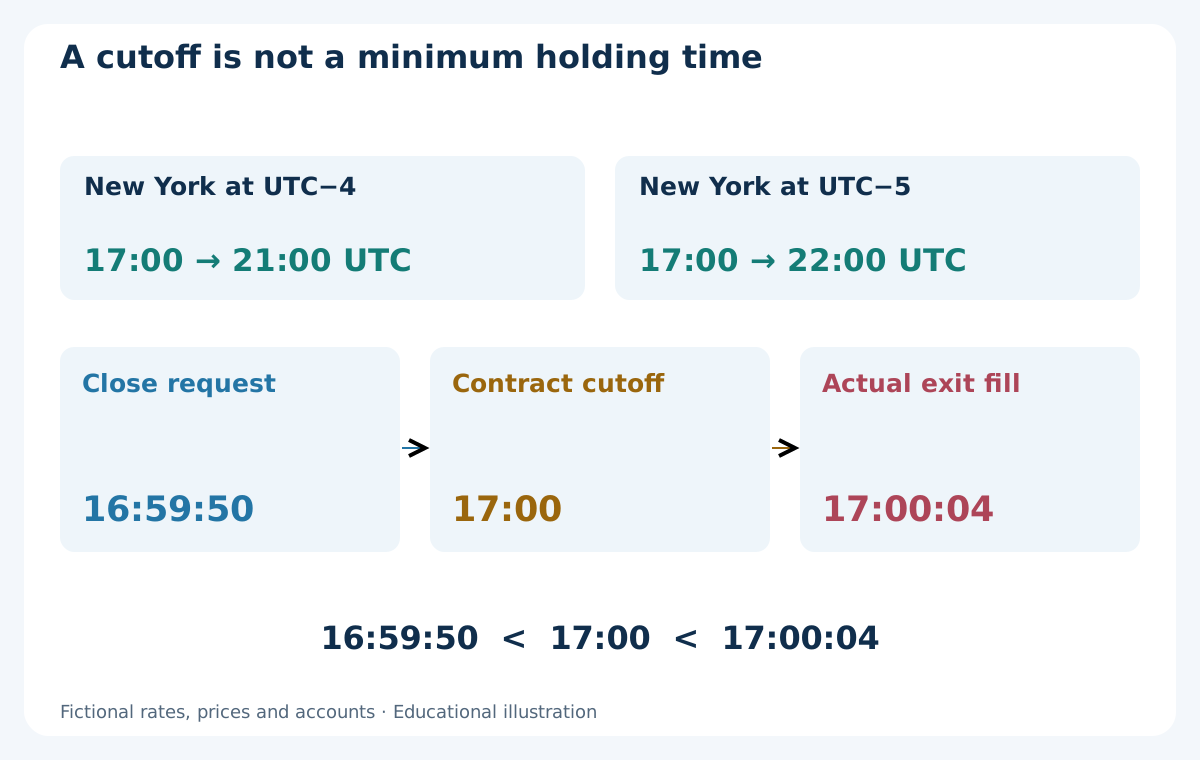
For illustration, suppose a contract applies a cutoff at 17:00 New York time. When New York is UTC−4, that maps to 21:00 UTC; when it is UTC−5, it maps to 22:00 UTC. These are conditional clock conversions, not a universal broker schedule. A D1 candle boundary, server midnight and the financing cutoff can be separate events.
Under that fictional policy, a position actually opened at 16:59 and closed at 17:01 New York time crosses the cutoff despite its brief duration. A close request sent at 16:59:50 but filled at 17:00:04 has not established a pre-cutoff exit. Determine eligibility from the actual account event and contract rule, not the intended request time. The session and time-zone guide helps record historical offsets without treating local time as fixed UTC.
4. Why a triple charge is not universally a Wednesday rule
Weekend and holiday settlement can make one rollover account for several financing days. Many Forex contracts follow settlement patterns that commonly place a three-day adjustment on Wednesday, but that is not an instruction to hard-code every instrument that way. For example, OANDA's cited schedule describes a Thursday three-day adjustment for USD/CAD because of its different settlement cycle.
Use the schedule for the actual instrument, account and date, including holiday changes. Do not charge the same weekend again merely because the position remains visible on Saturday and Sunday if it was already included in the applicable multiplier. Conversely, an absent weekend ledger entry does not prove free financing. Neither the number of D1 bars nor the number of statements tells you the correct multiplier by itself.
5. Separate points, pips and the value of a lot
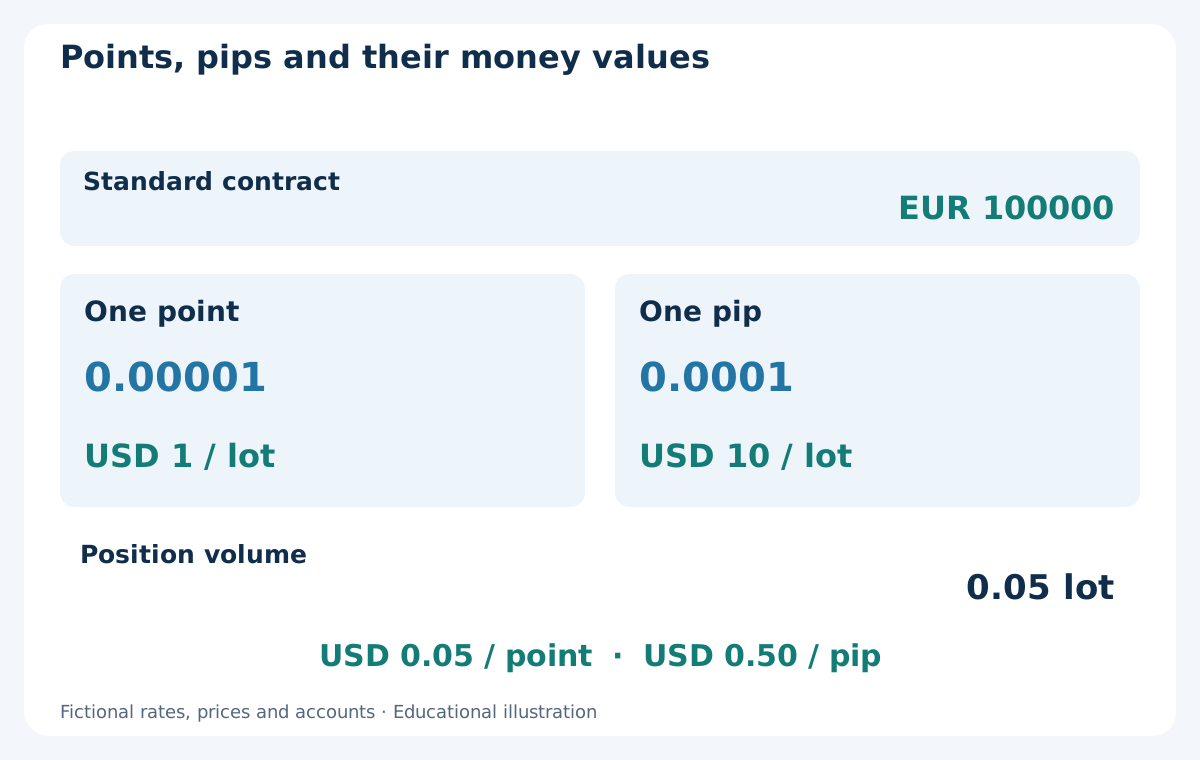
The main example uses EUR/USD with a EUR 100000 standard contract, a USD account, point and executable tick of 0.00001, and 1 pip = 0.0001. One point per lot is therefore USD 1; one pip per lot is USD 10. At 0.05 lot, the values become USD 0.05 per point and USD 0.50 per pip. This conversion follows the stated contract, not the number of decimal places alone.
A displayed swap of −8.0 points is −0.8 pip on that contract, not −8.0 pips. Confusing the two overstates this charge tenfold. Another symbol, tick size, contract or account currency needs a new calculation. When using a tick value, verify its currency and the relationship between tick size and point before scaling. Do not substitute spread points or minimum price movement for a financing unit without checking the mode.
6. Calculate long and short as separate alternatives
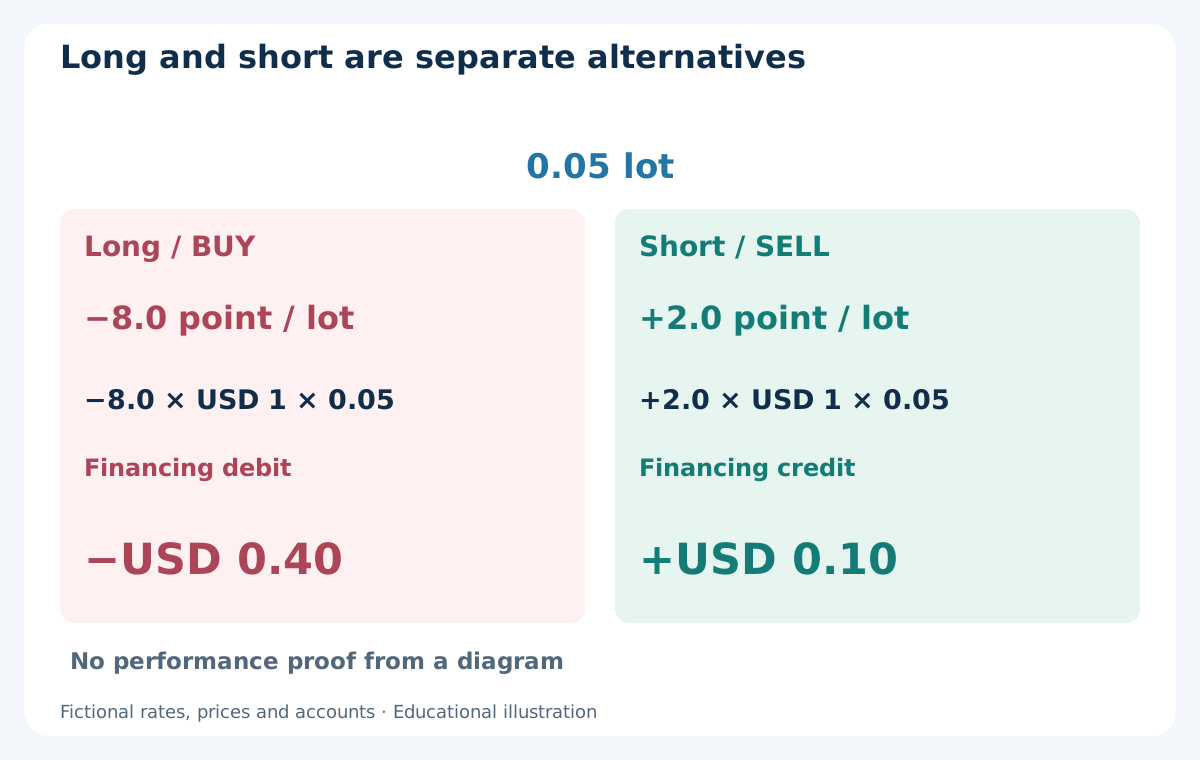
Assume the fictional contract quotes a daily long swap of −8.0 points per lot and a daily short swap of +2.0 points per lot, before any multi-day multiplier. At 0.05 lot, the long debit is −8.0 × USD 1 × 0.05 = −USD 0.40 per financing day; the short credit is +2.0 × USD 1 × 0.05 = +USD 0.10. The signs tell you which way the account entry moves.
These are alternative directions, not instructions to open both. A positive rate on one side does not establish a profitable hedge or eliminate adverse price exposure, and both sides can have negative rates under other terms. If a published quote already includes a multi-day adjustment, do not multiply it again. The trading-cost guide places financing alongside spread and commission without treating them as interchangeable fees.
7. Count financing days with an explicit calendar
Suppose the example position crosses three fictional cutoffs: Tuesday with multiplier 1, Wednesday with 3 and Thursday with 1. Hold both quoted daily rates constant for this calculation only. The multiplier sum is 1 + 3 + 1 = 5 financing days. The long entries are −USD 0.40, −USD 1.20 and −USD 0.40, totalling −USD 2.00; the separate short alternative totals +USD 0.50.
Three rollover events therefore represent five financing days here, not three equal daily charges. This calendar is not a promise about next week's schedule, a holiday week or another instrument. If the rate changes, calculate each event using its own applicable rate and multiplier, then sum the signed amounts. Preserve rounding and booking conventions so a later statement difference can be explained rather than hidden.
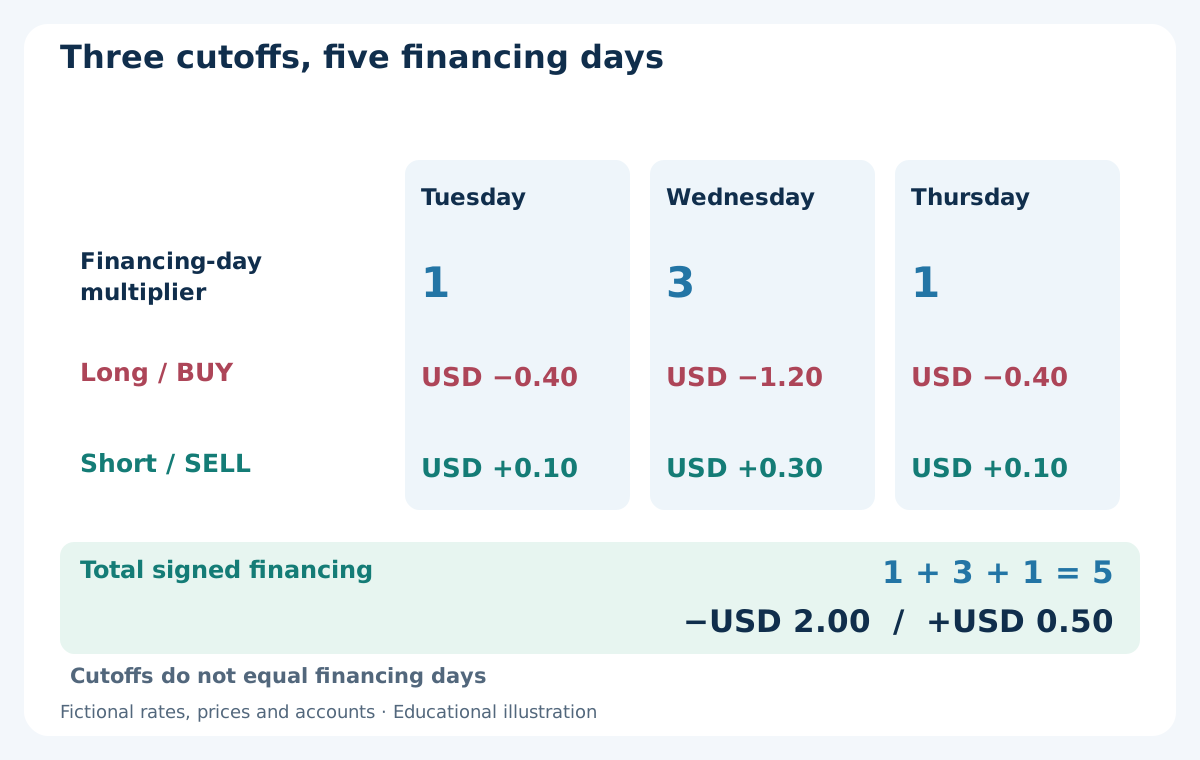
| Fictional cutoff | Multiplier | Long entry, USD | Separate short entry, USD |
|---|---|---|---|
| Tuesday | 1 | −0.40 | +0.10 |
| Wednesday | 3 | −1.20 | +0.30 |
| Thursday | 1 | −0.40 | +0.10 |
| Total | 5 | −2.00 | +0.50 |
8. An annual rate needs its own basis and day count
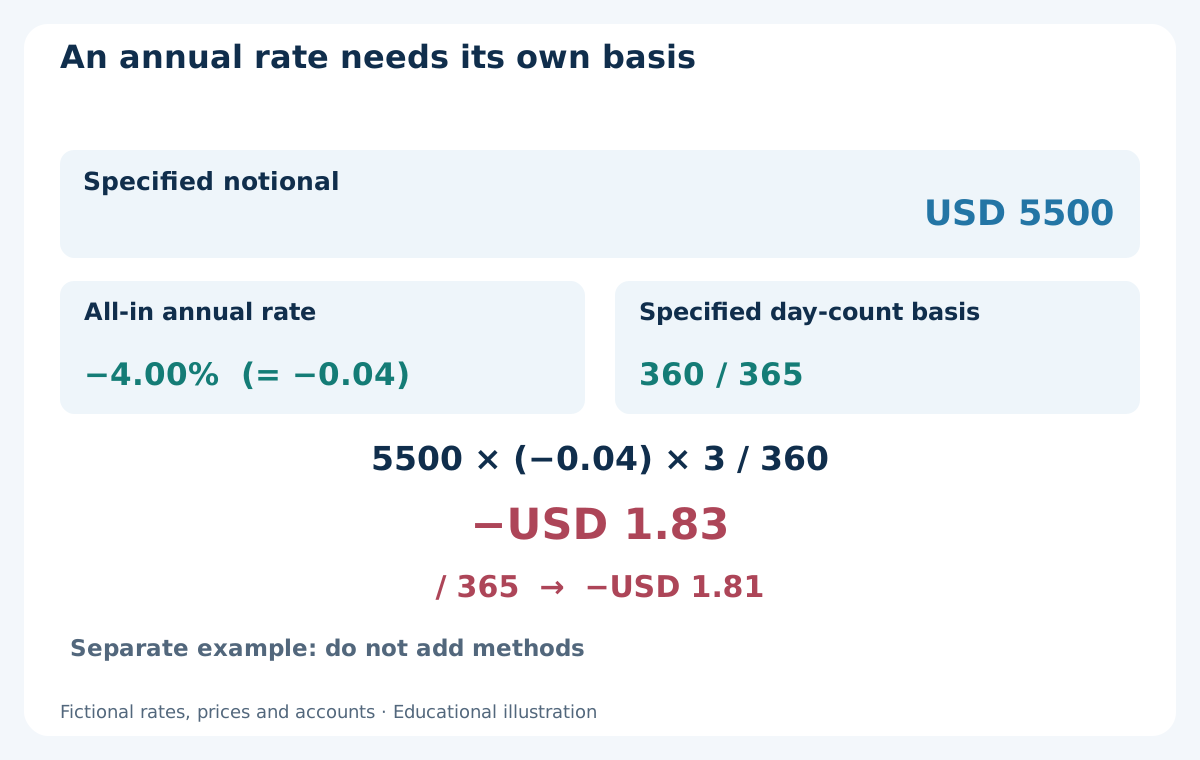
Consider a separate fictional contract that explicitly uses a USD 5500 notional basis, an all-in annual funding rate of −4.00% and a 360-day denominator. For a three-day adjustment, the charge is 5500 × (−0.04) × 3 / 360 = −USD 1.83 after rounding to cents. If that separate contract instead specified 365, the same inputs would round to −USD 1.81. Neither denominator is universal.
This is an alternative method, not another debit to add to the points calendar. The contract must define its reference amount, rate, day count and conversion. Notional exposure also differs from margin: in a simplified USD 5500 exposure, 1:100 leverage implies USD 55 margin, while 1:50 implies USD 110. Replacing the funding basis with either margin figure is unjustified unless the actual contract specifies it. Changing leverage alone does not change this example's exposure.
9. Convert into the account currency once
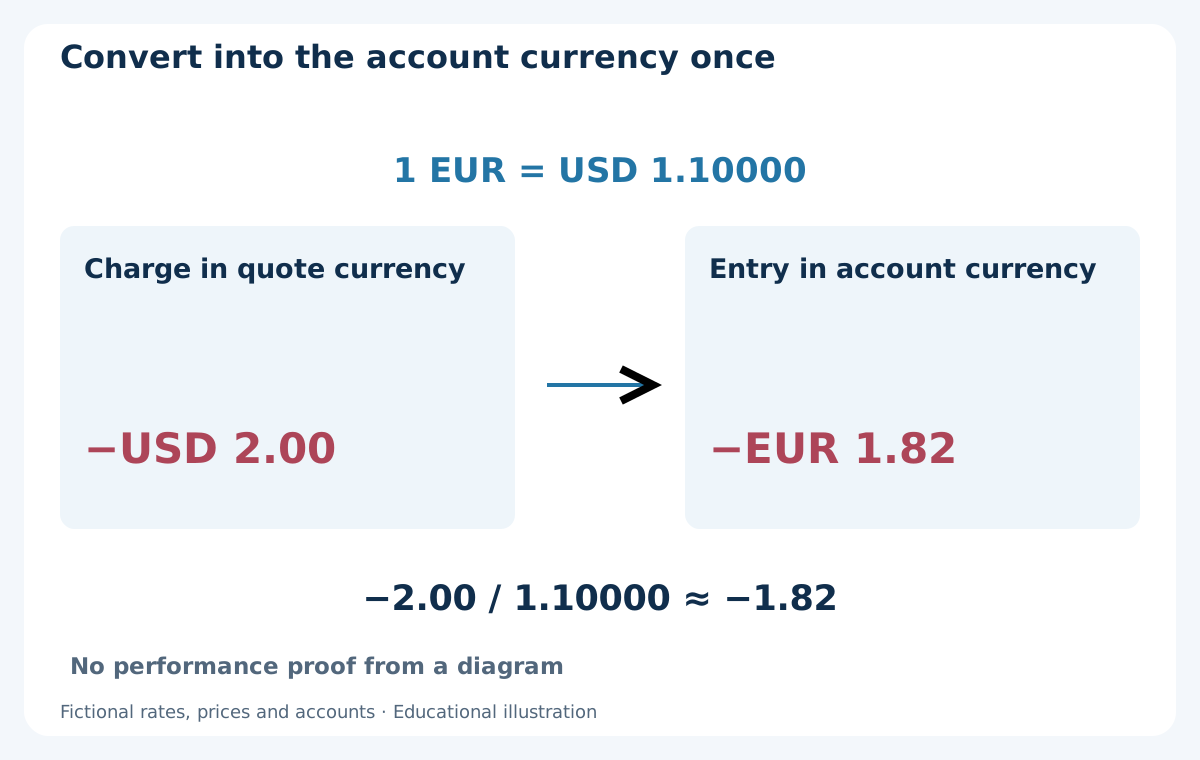
The main points calendar produced a USD 2.00 debit. In a separate conversion illustration, assume an EUR account and an exact conversion of 1 EUR = USD 1.10000, with no conversion fee. The debit becomes −2.00 / 1.10000 ≈ −EUR 1.82. Multiply or divide according to the quotation direction; do not label a USD charge as EUR simply because the account is denominated in EUR.
Actual conversion can use the broker's applicable side, timing and fee, so this fixed teaching rate is not a general settlement rule. The funding currency may also be the base or margin currency under another calculation mode. Reconcile the amount the statement actually books, including separate conversion entries where applicable. Do not convert an already account-currency amount a second time, or use today's exchange rate to rewrite a historical cost.
10. Reconcile price profit, swap and commission
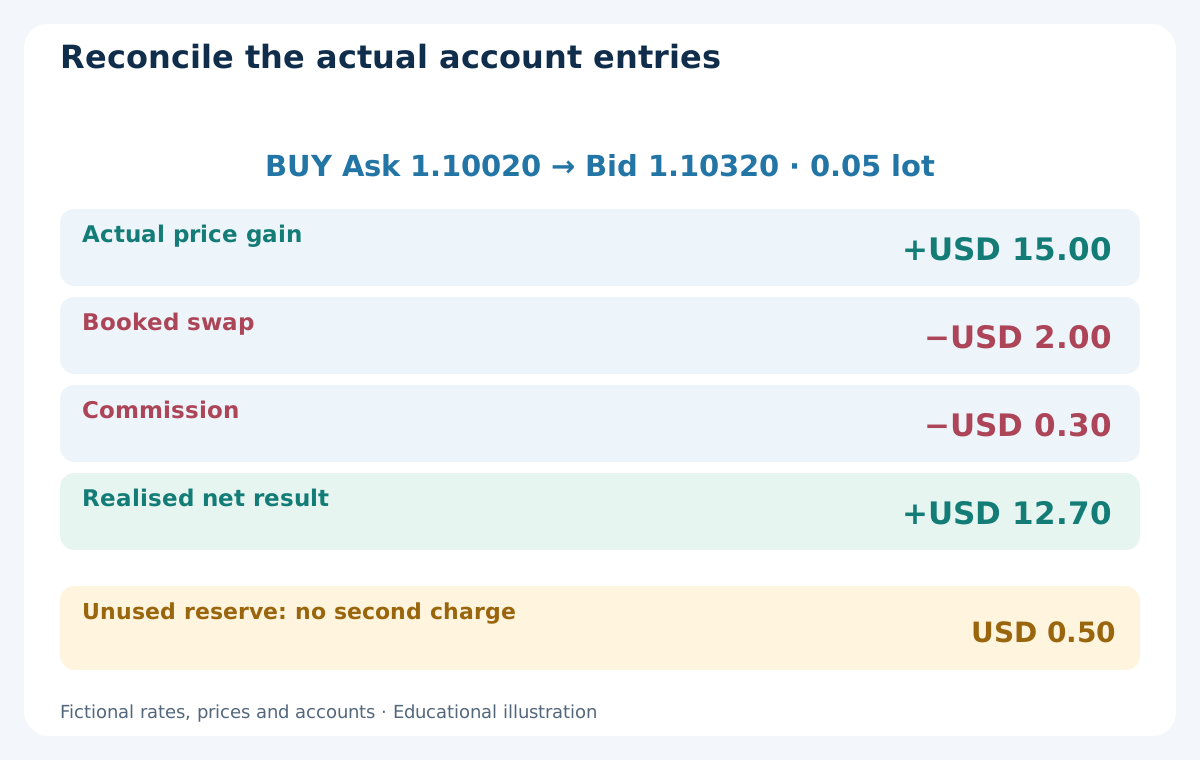
Return to the USD account and the points calendar. Suppose a BUY actually enters at Ask 1.10020 with 0.05 lot and exits at Bid 1.10320. Its fill-to-fill price gain is 30 pips, or USD 15.00. With actual booked swap of −USD 2.00 and round-trip commission of −USD 0.30, the realised result is 15.00 − 2.00 − 0.30 = USD 12.70. These new cost assumptions differ from the introductory guide's example.
In MT4, OrderProfit excludes swap and commission; reconcile the selected order's signed OrderProfit, OrderSwap and OrderCommission values with the statement. A current cumulative swap field must not be added again to the daily entries that already make it up. The spread is already reflected in executable fills, and an unused 1.0-pip exit reserve of USD 0.50 is not another booked expense. The trade-reconciliation guide addresses separate adjustments and uncertain account events.
| Booked item | Illustrative USD amount | Treatment |
|---|---|---|
| Fill-to-fill price gain | +15.00 | Actual executable prices |
| Swap | −2.00 | Actual net debit from the points calendar |
| Round-trip commission | −0.30 | Actual charge |
| Realised net result | +12.70 | 15.00 − 2.00 − 0.30 |
| Unused exit reserve | 0.00 extra charge | USD 0.50 was a planning allowance |
11. Include the holding allowance before rounding volume
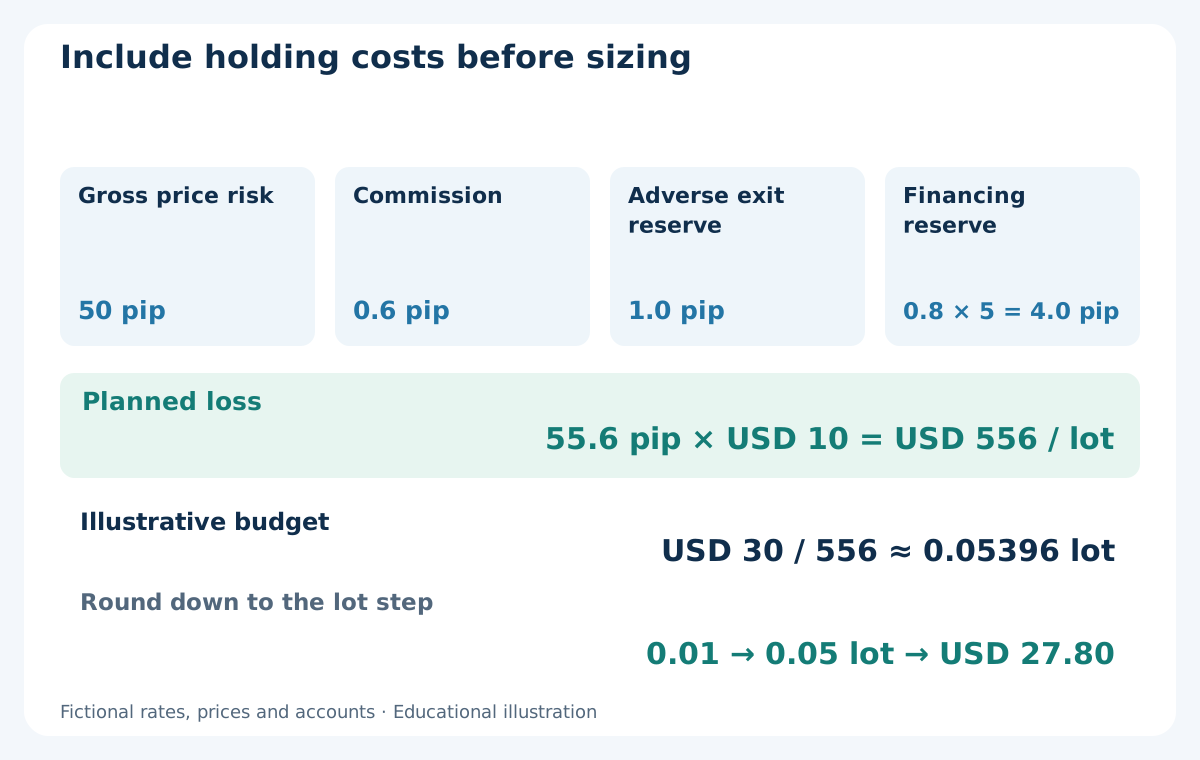
In this points example, five financing days at 0.8 pip of debit per day require a 4.0-pip holding allowance. Combine a hypothetical 50-pip price stop, 0.6-pip round-trip commission and 1.0-pip adverse exit reserve: 50 + 0.6 + 1.0 + 4.0 = 55.6 pips of planned loss. At USD 10 per pip per lot, that is USD 556 per lot, assuming the specified hold and rates.
An illustrative USD 30 budget gives 30 / 556 ≈ 0.05396 lot. With a 0.01 lot step, round down to 0.05 lot, for USD 27.80 planned loss. Skip if the minimum size or margin makes the plan impossible. Rates, delayed exits and gaps can exceed this allowance; it is not a guaranteed loss cap. Use the position-sizing guide to verify units and limits rather than forcing a trade by rounding up.
12. A positive swap does not guarantee a positive trade
Take a separate short scenario with the calendar's +USD 0.50 booked credit. A SELL entered at Bid 1.10000 and exited at Ask 1.10200 loses 20 pips, or USD 10.00 at 0.05 lot. With USD 0.30 commission, the net result is −10.00 + 0.50 − 0.30 = −USD 9.80. A real credit belongs in the ledger even when it is much smaller than the price loss.
Do not increase volume merely to collect more financing or presume that long and short positions cancel all costs. Closing and reopening around a cutoff introduces actual fills, spread, possible commission and uncertain execution; it cannot be treated as a free funding bypass. A failed close also leaves exposure and possible financing in place. Compare complete, executable alternatives instead of looking only at the attractive sign of a rate.
13. Stress changing rates and calendars
For a simple stress of the same five financing days, change the long daily assumption from −8.0 to −12.0 points per lot. At 0.05 lot the total debit rises from USD 2.00 to USD 3.00. That additional USD 1.00 can alter a trade's eligibility even if its chart signal is unchanged. This is a sensitivity calculation, not a forecast or a new current broker quote.
Historical testing must also allow rates to change between cutoffs and multipliers to shift with holidays. Save snapshots and applicable account terms; a current symbol property is not an archive of past charges. Account labels such as swap-free do not establish the entire cost of holding: inspect the applicable fee schedule and conditions. Any alternative administration charge must be accounted for under its own terms, not invented or silently assumed to be zero.
14. Keep rollover market risk separate from the financing entry
The funding adjustment is only one event around the rollover window. Thin quotes, a wider spread, news, gaps, platform outages and margin pressure can also affect the position. A swap estimate does not describe those execution risks. Likewise, broker-side financing is not disabled by disconnecting MT4, while an EA's terminal-dependent close still requires its operating process.
Record any stop, close or margin event using its actual fill and status. Ordinary stops need not fill exactly at their level through a gap, and a planned pre-cutoff exit is not complete until it succeeds. Review open equity and shared exposures, not only closed balance or a neat daily funding total. The account risk-management guide provides the broader budget framework.
15. Test financing along the complete holding path
Retain the historical rate source, unit, contract, time-zone mapping, cutoff eligibility, multiplier, conversion and booking convention for each position. Combine them with original entry and exit quotes, commissions, spread conditions and failed requests. If a historical financing input is unavailable, label the assumption and stress it; do not present a zero-cost placeholder as measured broker history.
Apply funding changes through entry eligibility, sizing, management and equity over time, not only as a deduction from final profit. Keep development, untouched later testing and forward observation in time order. Demo can check calculation and reconciliation without establishing identical live charges or execution. The MT4 backtesting guide explains why a report's settings and data limit its conclusions.
16. Use a holding-cost checklist before trusting the result
Before evaluating an overnight position, identify the instrument and account, long or short rate, calculation mode, financing currency, effective cutoff, historical offset, multiplier and conversion rule. Calculate the planned hold in money, then retain the actual entries by unique account event. Separate a one-day rate from an already adjusted charge, and a cumulative field from its component postings.
The objective is an explainable net result and a testable cost assumption, not a claim that a positive swap or slower strategy must work. A pricing change can invalidate an old plan; obtaining more evidence or rejecting it are valid outcomes. Commercial EAs require their own documented behaviour and results. These fictional examples do not prove that any robot listed on this site implements the calculations or earns the illustrated amounts.
Frequently asked questions
What is swap in Forex, and how is it related to rollover?
Swap commonly refers to the financing debit or credit for carrying a retail position through the broker's cutoff. Rollover is the carry into the next financing period. The actual account terms define the unit, timing and amount; it is not necessarily a new visible trade.
Does a swap quote of 8 points mean 8 pips?
Not on the stated five-decimal EUR/USD contract. One pip is ten points there, so 8 points equal 0.8 pip. Confirm the calculation mode, contract, volume and currency before converting a displayed swap value into money.
Is triple swap always charged on Wednesday?
No. Instrument settlement, holidays, account terms and the broker's schedule determine the multiplier. Wednesday is common in some Forex contracts, while the cited OANDA schedule gives USD/CAD a Thursday adjustment. Use the applicable historical calendar.
Can a position held for only a few minutes incur financing?
Yes, if it qualifies at the actual cutoff under the contract. In the fictional example, an entry at 16:59 and exit at 17:01 cross 17:00 New York time. A close request before the cutoff is not proof that the exit filled before it.
How should MT4 profit be reconciled with swap and commission?
Use the selected order's signed price profit, swap and commission, then reconcile any separate statement adjustments. In the example, USD 15.00 − 2.00 − 0.30 = USD 12.70. Do not add a cumulative swap field to its daily components or book an unused reserve again.
Does a positive swap guarantee a profitable trade?
No. The separate short example receives USD 0.50 financing but loses USD 10.00 on price and pays USD 0.30 commission, leaving a net loss of USD 9.80. The credit does not cap adverse price moves, execution costs or future rate changes.
Sources and educational notes
OANDA documents financing cutoffs, changing long/short rates and settlement-day multipliers. MetaQuotes documents MT4 swap calculation modes; its order-profit and swap references were also checked for reconciliation. All prices, rates, calendars, conversions and outcomes in this guide are fictional teaching assumptions, not current broker terms or measured performance. The annual-rate example is a separate hypothetical contract, not OANDA pricing or an additional charge on the points example.
Educational content. Rates, calendars, prices, volumes and results in the examples are fictional. Forex trading involves risk. Financing credits, stops and planning allowances do not guarantee an exit, a maximum loss or future performance.