

A failed fair value gap does not automatically become a successful trade in the opposite direction. This original M15 baseline first records the original zone’s closing failure, then evaluates its first later touch from the other side. That first touch must reach the original midpoint and close back beyond the outer buffer. A shallow first touch is consumed, even if a later return looks better. Fictional candles and a dependent SELL mirror make the rules reproducible; no historical profitability is supplied.
1. Define a role-reversal hypothesis without inferring hidden orders
An inverse FVG here means an original three-candle interval whose initial directional hypothesis has failed at a later completed close. The unchanged prices may then be studied from the opposite side. This is not evidence of institutional orders, a mandatory price return or a profitable reversal. The existing FVG strategy trades an original-direction return; the Breaker strategy starts with a failed source-candle block. This detector instead starts with outer-wick non-overlap and tests a separate first-touch midpoint condition.
Use one ordinary EURUSD Bid feed, UTC-aligned M15 bars and pip=0.0001; point=tick=0.00001; contract=EUR100,000/lot; account=USD, verifying actual specifications. No original-direction position is opened. No H1 pivot, sweep, D1 trend or stacked-FVG filter selects the trade. The midpoint is a geometric reference; there is no resting midpoint order or assumed midpoint fill.
2. Recognise and freeze the original three-candle interval
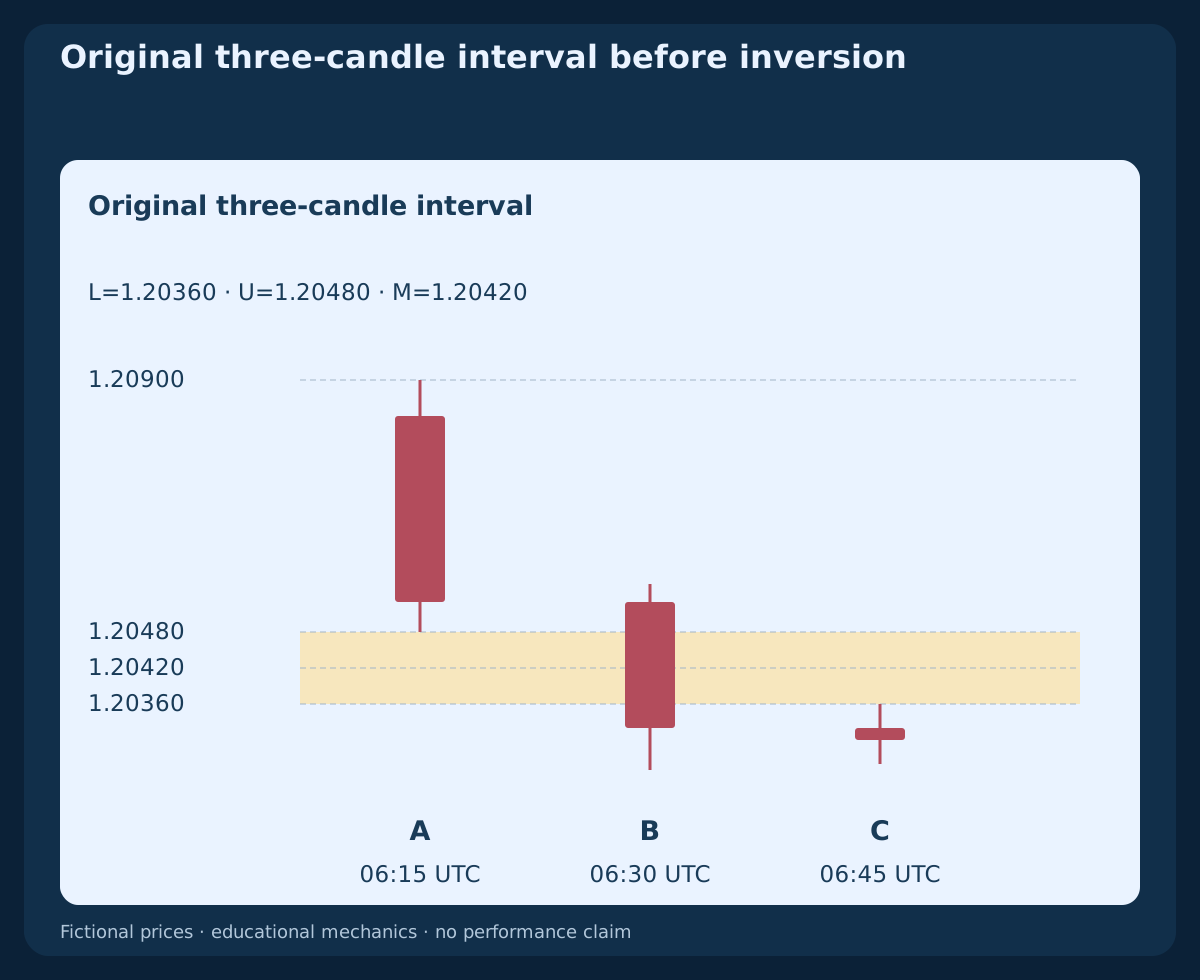
For consecutive completed source bars A, B and C, an original bearish FVG needs High(C)<Low(A); L=High(C); U=Low(A); its possible inverse direction is BUY. An original bullish FVG needs Low(C)>High(A); L=High(A); U=Low(C); its possible inverse direction is SELL. Equality creates no zone. Require 6≤(U−L)/pip≤20; M=(L+U)/2. Require range(B)>0; abs(Close(B)−Open(B))≥12 pip; abs(body(B))/range(B)≥0.60, with B’s body in the original FVG direction.
For an original bearish zone require Close(C)<L−1 pip; bullish requires Close(C)>U+1 pip. Require BUY: High(A)>U; SELL: Low(A)<L before arming. Freeze all levels at C’s close. BUY’s later protection and target are SL_Bid=L−2 pip; TP_Bid=High(A); SELL uses the mirrored first-source extreme. The fixture has L=1.20360; U=1.20480; M=1.20420; width=12 pip; SL_Bid=1.20340; TP_Bid=1.20900. A’s high is a declared prior-price target, not a price magnet; never move it to improve a ratio.
3. Use one scheduled triple and consume its daily slot
On each Monday–Friday UTC date, inspect only the three consecutive M15 intervals 06:00–06:45 UTC. C becomes known at 06:45 UTC. The first post-C observation of the own symbol must have the complete three-bar history available and satisfy C_close≤t_ready<C_close+30 seconds. A missing interval, unreliable UTC mapping or failed first readiness check disables the date. Do not substitute a later triple or an older attractive zone.
Persist the UTC date and the original FVG identity—symbol, direction and C’s scheduled close—before further eligibility checks. A rejection still consumes the day. Require no EURUSD position or pending EURUSD order anywhere in the account; unresolved old exposure also blocks the new date. Ignore other overlapping or newly appearing FVGs during this sequence. Do not merge zones, shrink the original interval after a return or invert the same record a second time.
4. Select the first raw closing failure before testing its buffer
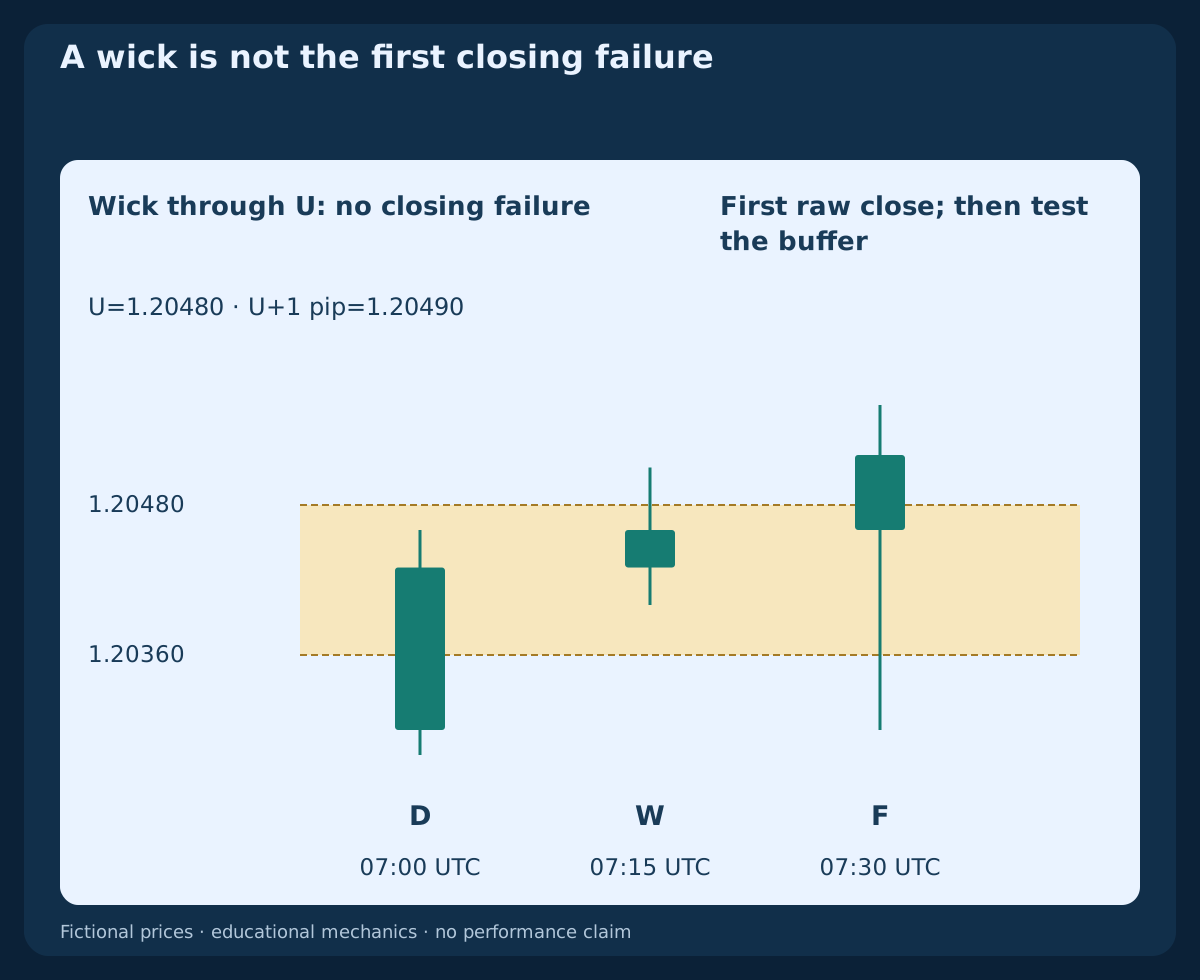
The only failure closes are 07:00,07:15,07:30,07:45 UTC. For an original bearish zone, F is the first completed close with Close(F)>U. This first raw failure must also be bullish and satisfy U+1 pip<Close(F)≤U+6 pip; Close(F)>Open(F). A close only half a pip beyond U fails eligibility immediately; a later larger close cannot replace it. Equality at U is not a raw failure; equality at U+1 pip fails the buffer and at U+6 pip passes the cap.
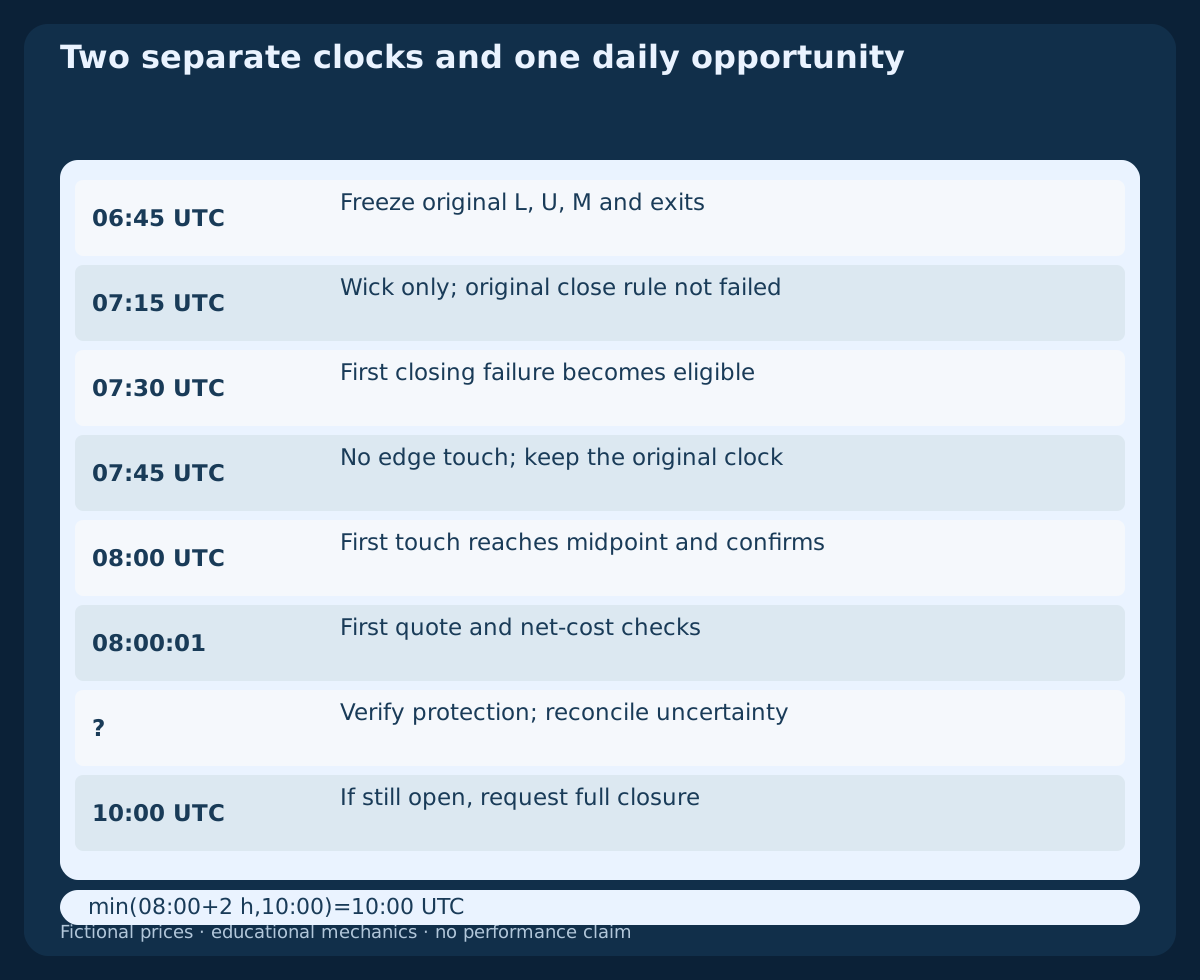
From C’s close through submission, a BUY target reach Bid≥TP_Bid cancels, including completed extrema and already observed forming quotes. Missing required intervals cancel; no failure by the fourth close expires. In the fixture W wicks above U but closes inside at 07:15 UTC; High(W)=1.20510; Close(W)=1.20460. F is the first closing failure at 07:30 UTC; Close(F)=1.20520. F creates the inversion candidate but cannot be its own later retest or an immediate entry.
5. Start a separate three-bar retest clock after F
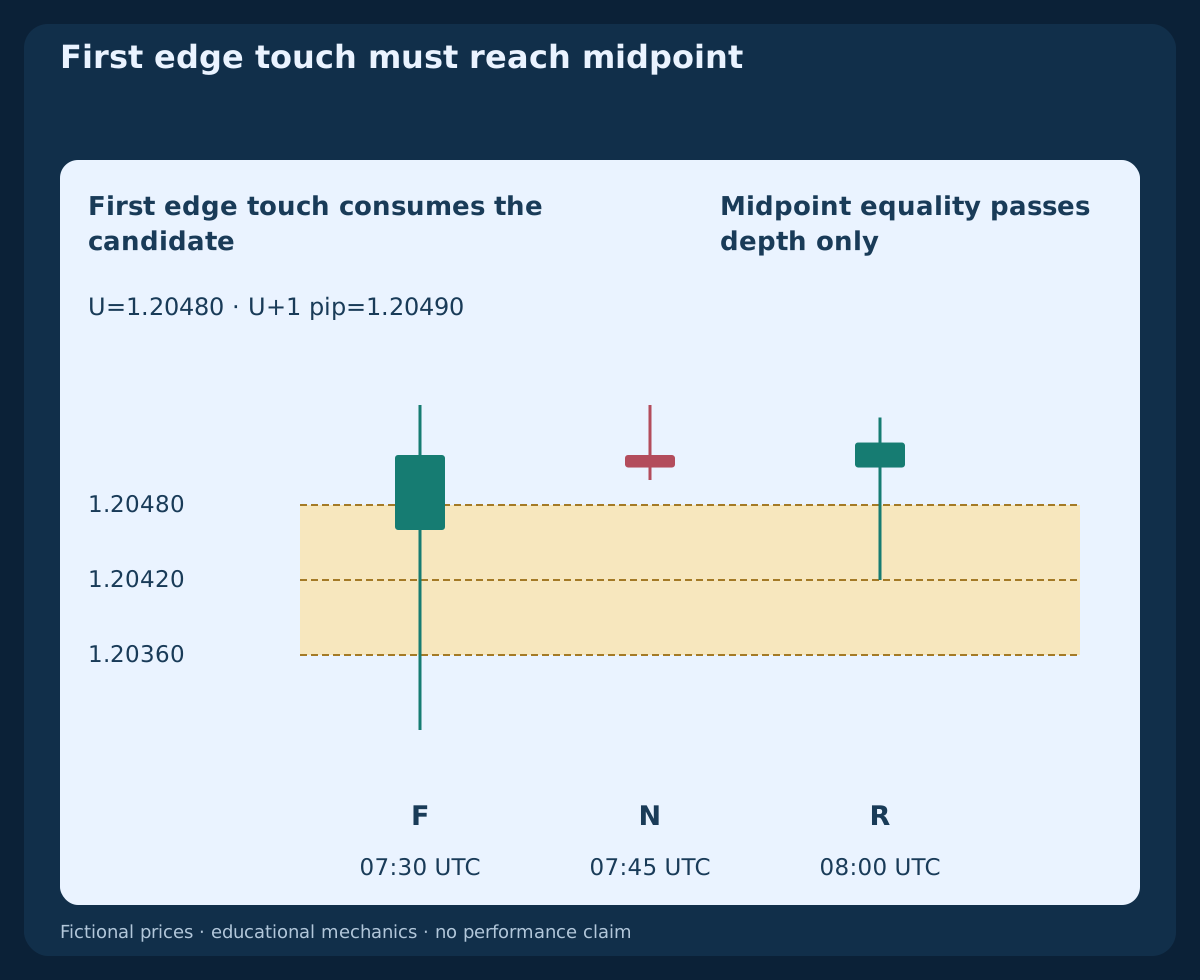
Inspect exactly the next three consecutive M15 bars after F. For BUY, the first bar with Low≤U is the first touch, including an opening inside or across the zone. The edge equality counts and consumes the opportunity, even if midpoint depth or later closing conditions fail. The example N has Low(N)=1.20500>U, so it is not a touch. A failure at the last allowed close has its final permitted retest close at 08:30 UTC; the third close is included.
From F’s close through submission, cancel BUY on any observed Bid≤L, in addition to the target veto. Use subsequent completed-bar lows and forming quotes; equality cancels before any attractive close. This far-edge rule starts after F closes, so F’s formation low may be below L. It is a Bid-side hypothesis veto, not proof that an order existed or a stop executed. A timestamp gap, wrong-side opening or failed first touch ends this date rather than starting another retest clock.
6. Require the first touch to reach midpoint and close back outside
For BUY the first-touch bar R must satisfy Open(R)>U; L<Low(R)≤M; Close(R)>Open(R) and U+1 pip<Close(R)≤U+6 pip. Midpoint equality passes; equality at L or the closing buffer fails. This is a range-depth proxy from Bid OHLC, not proof of continuous ticks through M or a midpoint fill. There is no limit order. A first upper-half touch that never reaches M is rejected even if its close looks excellent.
The fictional R closes at 08:00 UTC; Open=1.20510; High=1.20550; Low=1.20420; Close=1.20530. It reaches M exactly, stays above L, and closes bullish five pips above U. Confirmation belongs to R’s completed close, never to the intrabar low. Do not wait for a second confirmation candle after a failed R. Keep the original L, U, M, stop and A-derived target unchanged.
7. Mirror SELL while retaining Ask-side protection
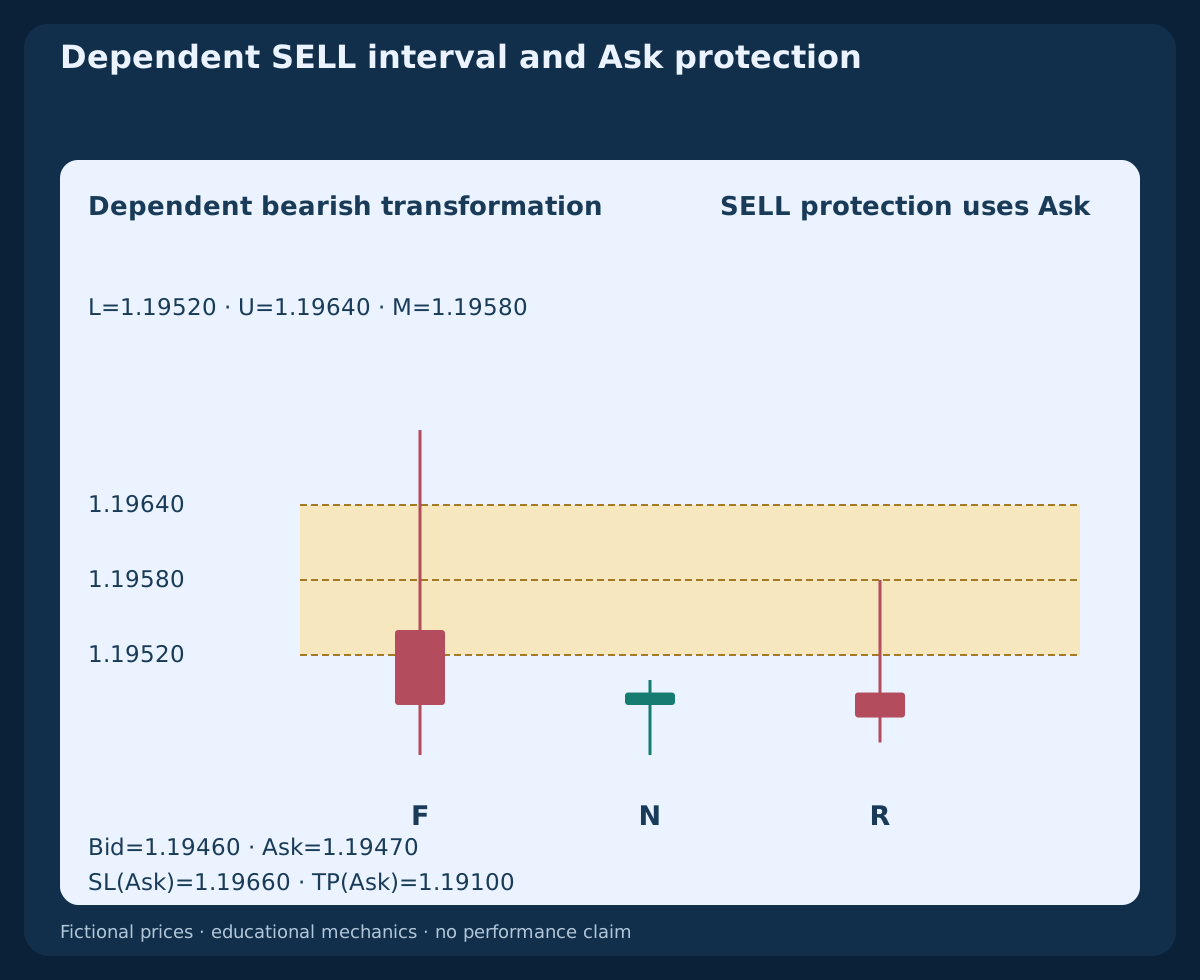
An original bullish FVG has inverse direction SELL. The first raw failure is Close(F)<L, requiring L−6 pip≤Close(F)<L−1 pip; Close(F)<Open(F). After that close, the first High≥L consumes the touch. Require Open(R)<L; M≤High(R)<U; Close(R)<Open(R); L−6 pip≤Close(R)<L−1 pip. Retest clocks, equality choices and candidate priority are mirrored, not chosen after outcomes.
Freeze SL_Ask=U+2 pip; TP_Ask=Low(A); after C cancel on Bid at or below the target, and after F also on Bid at or above U. These are hypothesis vetoes, not Ask execution evidence. SELL opens at Bid and exits on Ask. The dependent transformation p′=2.40000−p swaps Bid highs/lows and gives L=1.19520; U=1.19640; M=1.19580; SL_Ask=1.19660; TP_Ask=1.19100. Swap Bid/Ask separately for paired quotes; no mirror reconstructs actual historical Ask extrema.
8. Inspect only the first quote after complete R data arrive
Use the first own-symbol paired quote after complete R data become available, strictly after its scheduled close. Require R_close<t_quote≤t_submit<R_close+30 seconds and 0≤t_submit−t_quote≤2 seconds on verified clocks. Missing that first quote or an unverified ordering rejects the date. Require tradable positive Bid below Ask, spread≤1.5 pip; abs(Bid−Close(R))≤1 pip, and all post-F and target vetoes still clear. A later quote cannot repair failure.
BUY uses the quoted Ask and SELL the quoted Bid. The original first quote is 08:00:01 UTC; Bid=1.20530; Ask=1.20540. Check symbol permissions, tick alignment, minimum stop distances, volume limits, margin and available account risk. A zero reported minimum stop level does not guarantee acceptance. The baseline permits only a market request with both fixed protections attached and supported at opening; if the venue requires an unprotected opening followed by modification, skip.
9. Include both execution allowances before calculating the ratio
For this USD example assume pip_value=$10/pip/lot; commission=$7/lot round trip; entry_allowance=0.5 pip; exit_allowance=0.5 pip; financing_reserve=$0. Verify the actual tariff and holding charges; replace these declared inputs before testing. Let dSL and dTP be positive executable-side distances from the current entry quote to the fixed stop and target, in pips. Set Loss1=(dSL+1.0)×10+7; Reward1=(dTP−1.0)×10−7 and require positive estimates with Reward1/Loss1≥1.50, using full precision.
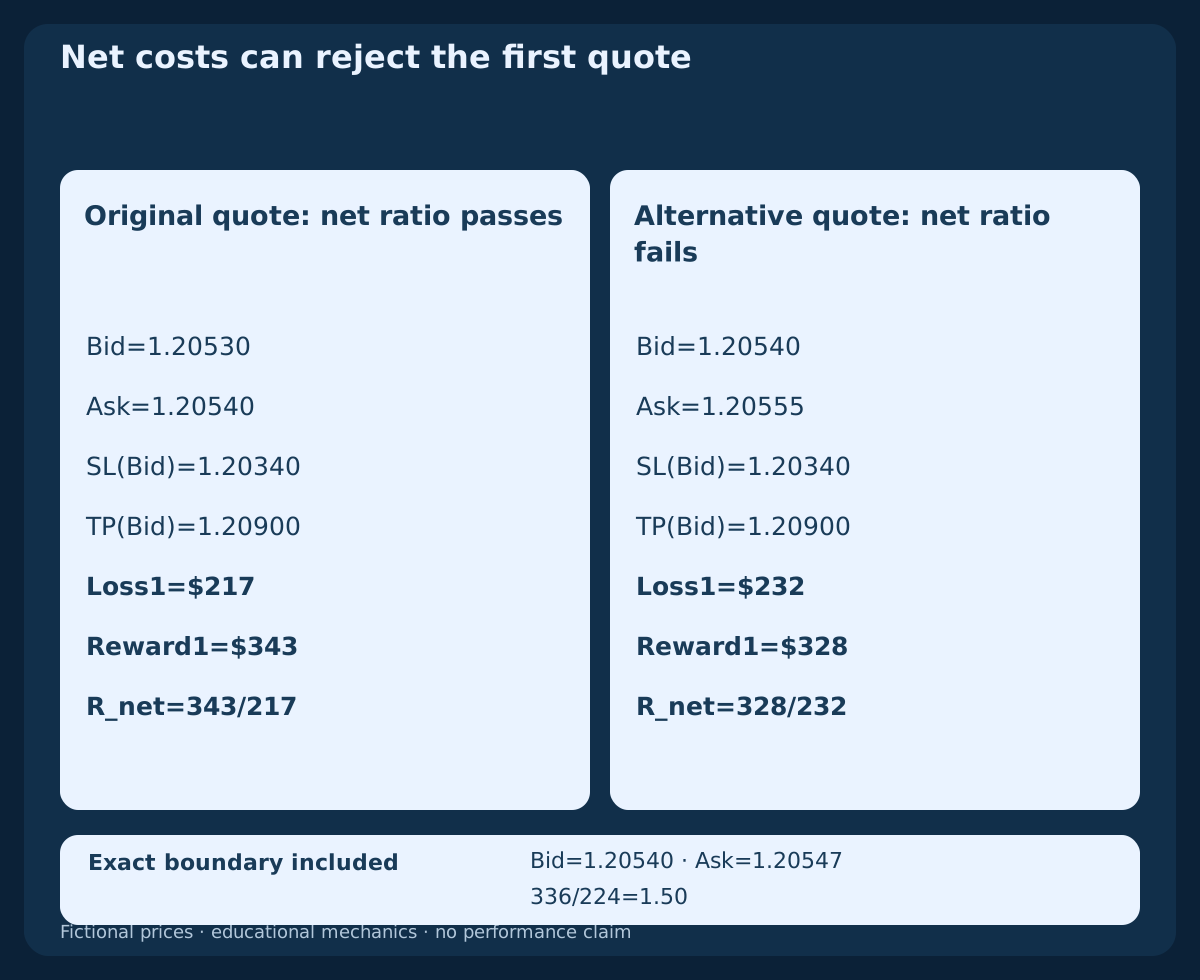
The accepted BUY quote gives dSL=20 pip; dTP=36 pip; Loss1=$217; Reward1=$343; R_net=343/217≈1.58065. Entry Ask to exit Bid already includes the spread effect; never add it again. The allowances are planning assumptions, not a cap on adverse execution. A nice gross ratio, a narrow quoted spread or a confirmed inverse-zone retest cannot override a failed net ratio.
10. Round down account risk and reject a worse quote
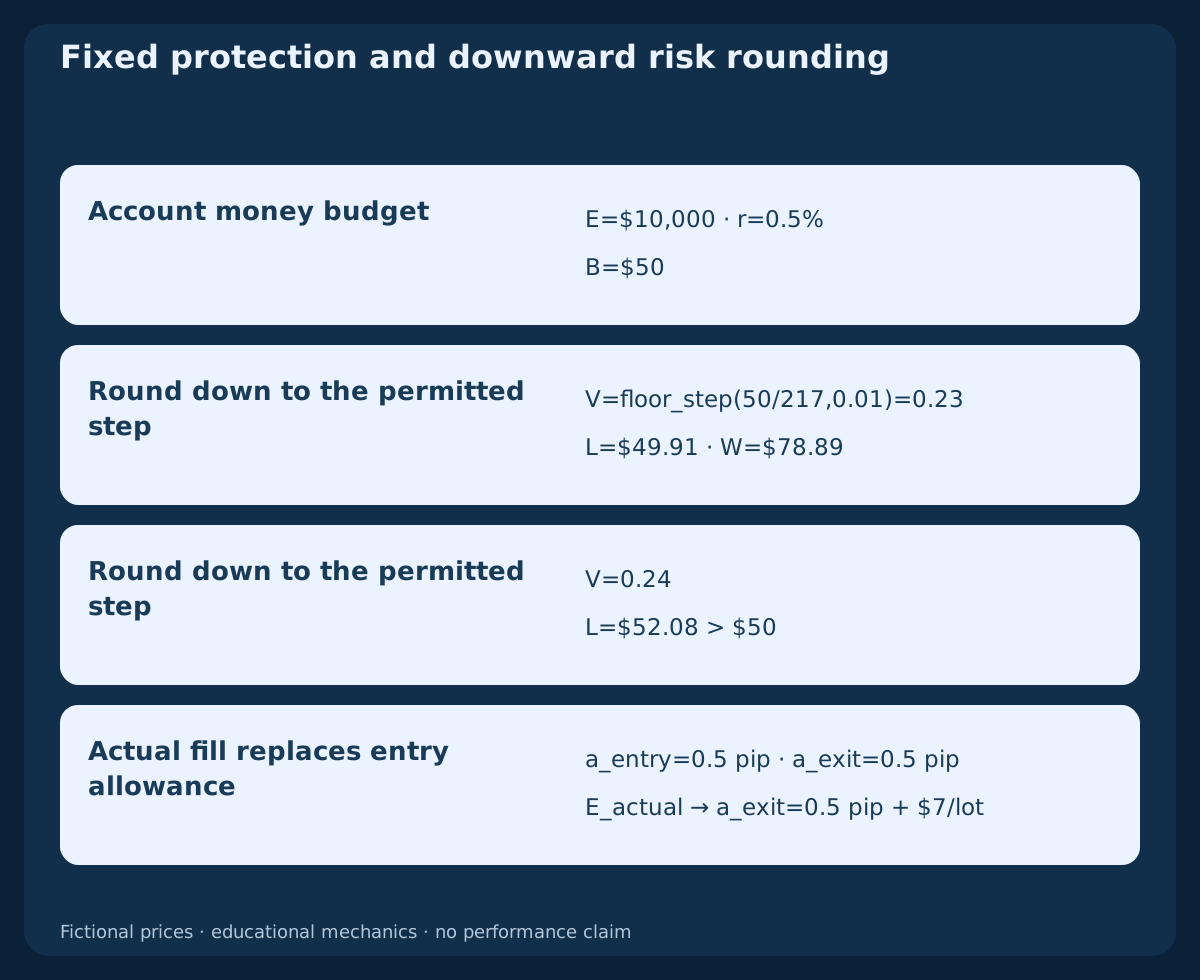
Use Budget=min(0.005×equity,max(0,0.01×equity−existingPlannedLoss)). Unknown existing account risk blocks entry; no EURUSD position or pending EURUSD order may exist. With equity=$10,000; existingPlannedLoss=$0; Budget=$50; min=step=0.01 lot, round down V=floor_step(Budget/Loss1,0.01)=0.23 lot. Planned loss is 0.23×217=$49.91 and planned target reward 0.23×343=$78.89. The next step 0.24×217=$52.08 exceeds budget. Below-minimum volume means skip.
As an alternative first quote, Bid=1.20540; Ask=1.20555 passes spread and Bid-drift caps but gives Loss1=$232; Reward1=$328; 328/232≈1.41379<1.50. Reject the day without moving the stop or target. With the original prices and costs, Bid=1.20540; Ask=1.20547 gives exactly 336/224=1.50; the next tick Ask=1.20548 fails. These are alternative arithmetic cases, not later quotes the model may select.
11. Send once and reconcile the actual result
Persist the UTC-date candidate identity, all frozen levels and the consumed request slot before sending one protected entry request. A definitive rejection still consumes the day. An uncertain response is neither proof of failure nor permission to resend: block new exposure, inspect broker orders, deals and account state, and resolve that same request first. A restart restores the state and deadlines; it cannot create another attempt.
After a confirmed fill, verify both protections and actual size. Recompute loss and reward from the actual fill using only the remaining exit_allowance=0.5 pip; commission=$7/lot; financing_reserve=$0; the actual fill replaces the entry allowance, so do not count it twice. If adverse entry movement exceeds 0.5 pip, recomputed risk exceeds the saved budget, the net ratio falls below 1.50, or protection is absent or invalid, request full closure at the first tradable quote. Retain accepted protection until closure is confirmed. Log the abort and all costs; an uncertain close also requires reconciliation.
12. Keep fixed protection and a non-extending exit deadline
Retain the original SL/TP without trailing, break-even moves, partial exits, averaging or automatic reversal. A confirmed earlier protective fill takes priority. Otherwise request full closure at the first tradable quote at or after deadline=min(R_close+2 hours,10:00 UTC) on the setup date: Bid for BUY, Ask for SELL. The fixture gives 08:00→10:00 UTC; a late valid retest gives 08:30→10:00 UTC, not an extension to ten-thirty. Neither fill time nor an outage moves these clocks. Pre-entry zone vetoes are not additional post-fill structural exits.
The scheduled deadline does not move during an outage. When quotes return, reconcile first and close any remaining model position as soon as execution is possible. If required monitoring or clock mapping becomes unreliable earlier, retain protection and request closure when possible. Standard protection, time exits, allowances and a planned account budget cannot guarantee a maximum realised loss.
13. Reproduce the original eight bars and their dependent mirror
The table and first CSV contain eight fictional M15 Bid bars A, B, C, D, W, F, N and R, with full UTC dates and interval boundaries. The CSV also supplies their deterministic eight-bar SELL transformation: sixteen rows, not sixteen independent observations. The second CSV contains the accepted quote, one rejected alternative and the dependent mirrored quote. No future exit path, historical market sample or broker execution report is supplied.
Assume the BUY is filled exactly at quoted Ask=1.20540; V=0.23 lot only to illustrate accounting. A stop filled exactly at Bid=1.20340 produces a price loss of $46.00, plus $1.61 commission: $47.61 before additional slippage or charges. An exact target at Bid=1.20900 instead gives $82.80−$1.61=$81.19. These are mutually exclusive hypothetical outcomes, not the allowance-adjusted planning estimates or actual results. No future exit path is supplied.
Download the eight fictional M15 bars and dependent SELL mirror (CSV)
Download the three paired-quote arithmetic cases (CSV)
| Bar | Timeframe | Open UTC | Close UTC | Open | High | Low | Close |
|---|---|---|---|---|---|---|---|
| A | M15 | 2026-10-22 06:00 | 2026-10-22 06:15 | 1.20840 | 1.20900 | 1.20480 | 1.20530 |
| B | M15 | 2026-10-22 06:15 | 2026-10-22 06:30 | 1.20530 | 1.20560 | 1.20250 | 1.20320 |
| C | M15 | 2026-10-22 06:30 | 2026-10-22 06:45 | 1.20320 | 1.20360 | 1.20260 | 1.20300 |
| D | M15 | 2026-10-22 06:45 | 2026-10-22 07:00 | 1.20300 | 1.20460 | 1.20280 | 1.20430 |
| W | M15 | 2026-10-22 07:00 | 2026-10-22 07:15 | 1.20430 | 1.20510 | 1.20400 | 1.20460 |
| F | M15 | 2026-10-22 07:15 | 2026-10-22 07:30 | 1.20460 | 1.20560 | 1.20300 | 1.20520 |
| N | M15 | 2026-10-22 07:30 | 2026-10-22 07:45 | 1.20520 | 1.20560 | 1.20500 | 1.20510 |
| R | M15 | 2026-10-22 07:45 | 2026-10-22 08:00 | 1.20510 | 1.20550 | 1.20420 | 1.20530 |
14. Retain the first failed gate instead of choosing a later winner
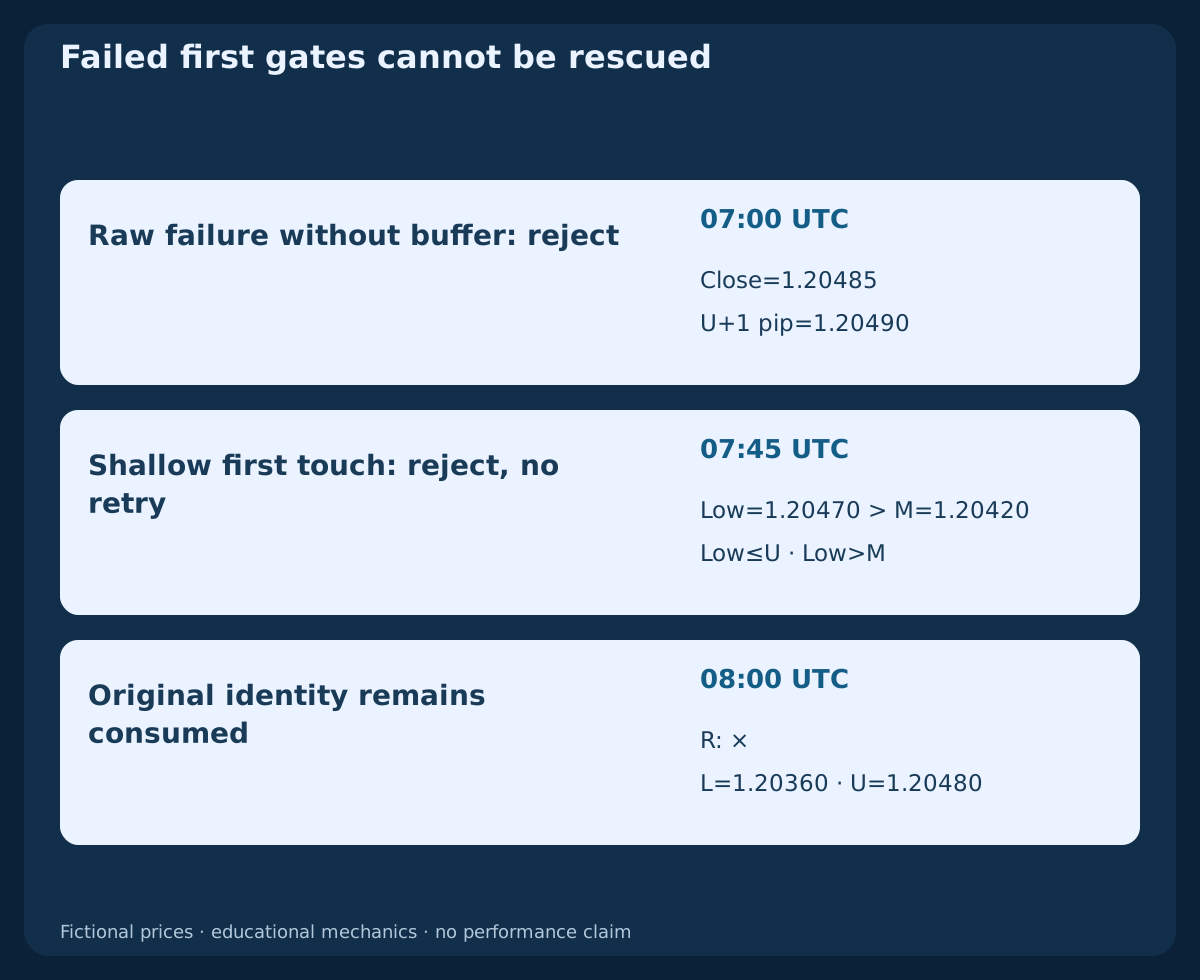
In a separate alternative, let the first raw failure close be 07:00 UTC; Close=1.20485. It has failed the original bearish close rule, but not passed the inverse entry buffer U+1 pip=1.20490. Reject the date; the later stronger F cannot become a new first failure. A failed original hypothesis and an eligible inverse strategy are separate records.
In another alternative, the first post-F touch is N at 07:45 UTC; Low=1.20470, with otherwise valid opening and bullish close. It touches the zone but remains above M=1.20420, so it fails midpoint depth and consumes the candidate. A later attractive 08:00 UTC midpoint test cannot replace N. Neither alternative is inserted into the original CSV as an additional event or another entry attempt.
15. Replay observation availability and preserve the full denominator
Record source identities, original direction, L/U/M, C’s availability and daily consumption before the first failure clock. Log wick-only observations, the first raw closing failure, buffer eligibility, post-F vetoes, the first edge touch even if shallow, midpoint depth and R’s actual readiness. Then record the first quote, receipt/submission times, frozen exits, volume and request outcome. The initial failed FVG remains failed even if an inverse candidate later works; do not count dependent stages as independent market evidence.
A historical implementation must establish which bars were complete at each decision. MT4 shift 0 is forming and bar labels are opening times; a nearest-bar lookup across a gap is not a missing-data repair. Reconstruct verified UTC intervals and use relevant historical Bid/Ask quotes to order intrabar events. OHLC alone cannot resolve a stop and target appearing in one bar. Mark ambiguity and run a separately labelled conservative sensitivity rather than selecting the favourable path.
16. Evaluate this frozen inversion model before adding context filters
Before studying outcomes, fix the scheduled triple, strict outer wicks, width, middle-body filter, original C close, four failure closes, first-raw-close priority, buffer and cap, three later retest bars, first-edge-touch priority, midpoint depth, quote clocks, fixed exits and costs. Compare variants on common dates and reserve later chronological data. Count nonformations, missing observations, rejected or expired inversions, missed first quotes and aborts alongside fills. Changing the first touch to the first midpoint touch changes the sample.
Verify an implementation in forward demo, including gaps, rejected protection, restart recovery and uncertain replies. Report net expectancy, drawdown, losing streaks, non-entry counts and execution failures before considering practical use. The charts and exact arithmetic make this baseline reproducible; no backtest, win rate, measured expectancy or live recommendation is supplied. An added FVG, trend or news filter is a new version requiring a new untouched evaluation.
Frequently asked questions
When can the original three-candle FVG first be known?
Only at C’s completed close, 06:45 UTC in the fixture, with the required data available. Earlier rectangle placement is not earlier knowledge.
Can a wick or a later stronger close replace the first failure?
No. A wick alone is not the chosen closing failure. The first strict close through the far edge is selected, then its buffer is tested; failure cannot be repaired by a later close.
Can a shallow first touch wait for a deeper midpoint return?
No. The first edge touch consumes the opportunity. Missing midpoint depth rejects the date, even if a later retest would look valid.
Does midpoint equality prove an entry at midpoint?
No. It passes a declared OHLC depth condition. This model has no resting midpoint order and only considers a later market request after R closes.
Is the planned $49.91 loss guaranteed?
No. It includes declared reserves and linear fees. Gaps, protection failure, slippage or delayed closure can exceed the budget.
Does the SELL mirror prove protective executions?
No. It is a dependent price transformation. Actual SELL stops and exits need relevant Ask evidence and broker records.
Official references and research scope
The practitioner reference supplies common FVG/IFVG terminology. This complete M15 detector, calendar, first-failure and first-touch policies, thresholds, fictional bars and exits are declared original research choices. Official references verify quote-side and order mechanics; none establishes this model’s profitability.
- MetaTrader 4: order types, Bid/Ask and protective triggers
- MetaQuotes MQL4: market requests and broker constraints
- TTrades: close-through terminology for inversion FVGs
Educational strategy specification. Fictional bars, dependent mirror and hypothetical accounting; no ready-to-run EA, historical backtest or measured profitability.