

A divergence drawn on a past turning point can look easier to trade than it was. Here a pivot becomes known only after two complete right-hand candles. We test regular MFI divergence, then add VWAP side and confirmation activity. Full-rule C makes 52 simulated trades and loses 97.5 pips after the stated costs. Neither filter improves the sample mean or profit factor. Every pivot-pair decision, rejected signal and trade remains available.
1. Distinguish a visible pivot from an available signal
Regular bullish divergence means a newer price Low is lower while its MFI(14) is higher than at the previous Low. Bearish divergence means a higher price High and lower MFI. This protocol does not use hidden divergence, 20/80 crossings or a fitted trendline.
A tests the confirmed divergence. B also requires the confirmation Close on the trade side of VWAP. C adds quote activity at confirmation. Each variant runs one independent position, so accepted trade lists need not be nested.
2. Keep the known source and research clock explicit
HistData Generic ASCII EUR/USD January 2024 contains 2 176 113 Bid/Ask records. Fixed EST is UTC−05:00: add five hours without daylight-saving adjustment. All 22 UTC weekdays from 2024-01-02 to 2024-01-31 have 600 observed M1 intervals in each 07:00–17:00 session.
N counts all quote records, including unchanged ones. Source Volume is zero; this is not executed size or market-wide money flow. The same archive already appeared in the guides, V222 and V223. This is a retrospective known-source experiment, not untouched out-of-sample validation.
3. Wait for two complete candles to the right of a strict pivot
A Low pivot must be strictly lower than the Lows of its two left and two right neighboring candles; a High must be strictly higher than all four neighboring Highs. Equal neighbors fail. All five observed M1 candles must be consecutive. P1/P2 times identify candle starts, not the exact tick that made the extreme.
For a pivot candle beginning at 15:00, the right candles end at 15:02 and 15:03. Its signal becomes known at 15:03, three minutes after the pivot start. Compare only the immediately preceding same-type confirmed pivot, 5–30 minutes apart inclusive. Failed spacing or unavailable MFI still updates the pivot chain; never skip to a more favorable older pivot.
4. Calculate pivot MFI and test filters at confirmation
Use TP=(High+Low+Close)/3 and TP×N. Compare each TP with the previous completed TP: higher contributes positive flow, lower negative, equal is neutral. Sum 14 classifications ending at each pivot, requiring 15 consecutive candles. MFI=100×positive/(positive+negative); both sums zero are unavailable. Compare unrounded ratios, with strict price and MFI inequalities.
B compares confirmation Bid Close with sum(TP×N)/sum(N) anchored at 07:00 UTC, including the completed confirmation candle. Long requires Close > VWAP; short Close < VWAP; equality fails and no slope test is used. C requires confirmation N ≥ the median of the preceding 20 complete candles, current excluded: 2N ≥median2, where median2 is twice that median. Equality passes. Pivot activity does not replace confirmation activity.
5. Separate eligible divergences from executed positions
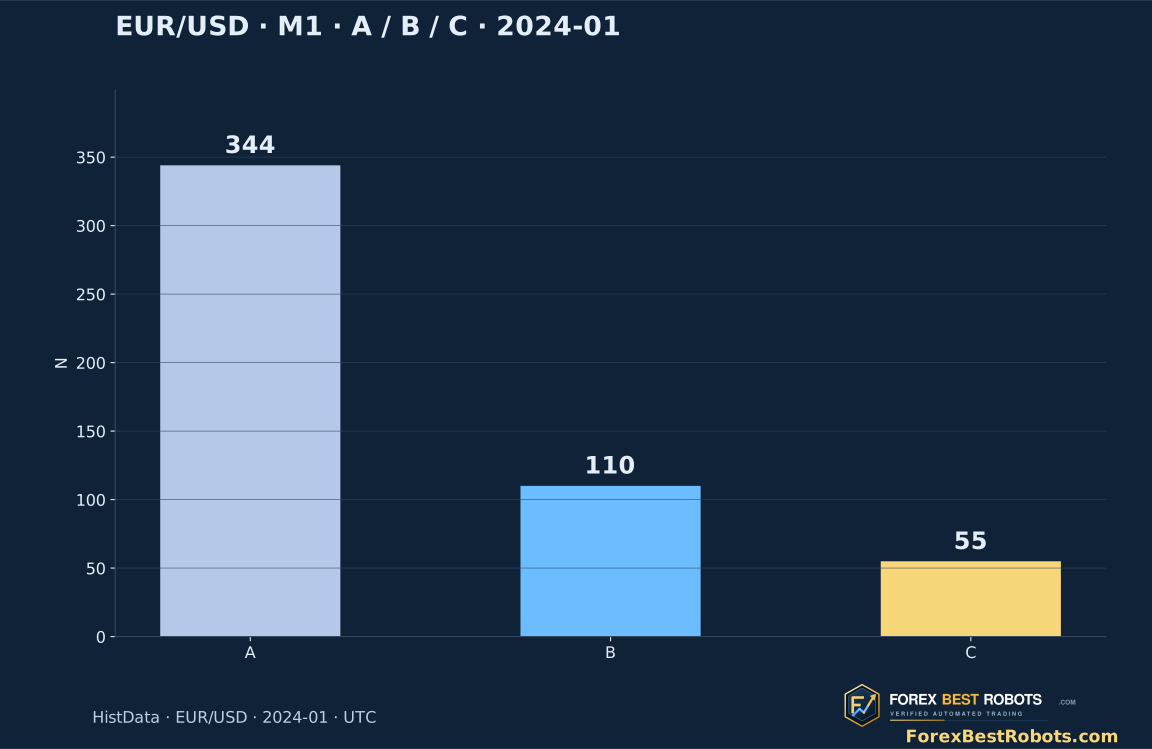
The full archive contains 6 613 confirmed pivot records with pair decisions. Within the common set of research events, 344 regular divergences qualify; 110 also pass VWAP side and 55 pass both filters before position and quote checks. A/B/C execute 259/95/52 trades; the log retains all 1 032 variant decisions.
C rejects 234 candidates for VWAP side, 55 for activity, two while a position is open and one for first-quote delay; 52 enter. These statuses are exclusive in that order. The shared eligibility checks require the confirmation and preceding 20 consecutive M1 candles, continuous anchor coverage and both pivot MFI values. Signal candle starts run 07:19–16:58; entries 07:20 inclusive to before 17:00 UTC.
6. Check the first quote after confirmation before entering
Use the first archive quote at or after the confirmation candle end. Delay must be strictly <5 000 milliseconds, the timestamp before 17:00 UTC and Ask−Bid ≤1.0 pip. An unsuitable first quote rejects the event permanently; do not wait for a better quote. Long enters at Ask, short at Bid.
Do not enter at P2 or when only one right candle is complete. Each variant allows one position, without queued signals or re-entry on an exit record. Source order resolves equal timestamps; simultaneous Low/High candidates process Low first. Historical quotes do not prove executable size, latency or actual broker fills.
7. Keep fixed exits and quote sides explicit
Set stop 6 pips and target 9 pips from entry. Starting with the next record, long tests and exits on Bid, short on Ask. The first threshold breach exits at its observed quote, including overshoot; prices are not clipped to a more favorable threshold.
Otherwise use the first quote at/after the earlier of entry+20 minutes and 17:00 UTC. Priority is stop, target, then time/session. A gap >60 seconds while open leaves the outcome unresolved: preserve lockout and exclude performance. No such trades occur here. These conventions model exits rather than guarantee broker execution.
8. Read the cost formula before changing the allowance
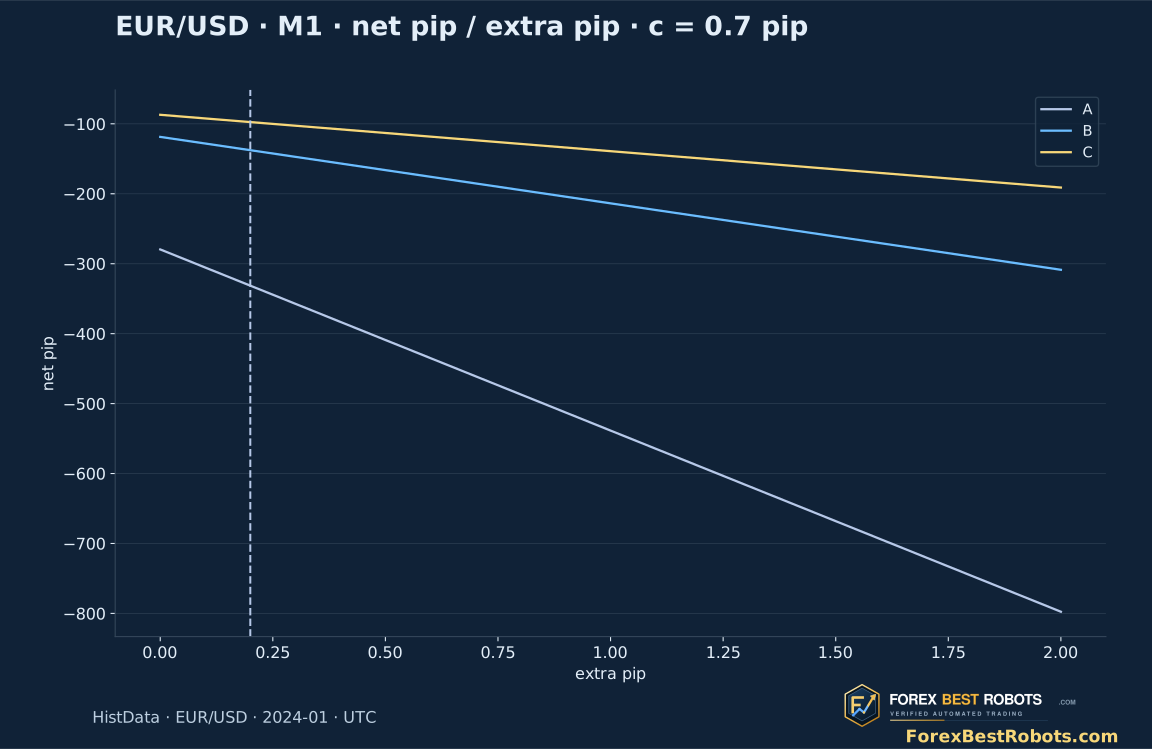
Quote P/L is exit Bid−entry Ask for long or entry Bid−exit Ask for short, expressed in pips. Spread is already included. Deduct illustrative round-trip commission 0.70 pip and default extra allowance 0.20 pip once per resolved trade. Neither is a measured broker charge or measured slippage.
The choice 0 / 0.2 / 0.5 / 1.0 / 2.0 pip changes accounting only. It does not change pivot confirmation, trade IDs, eligibility, entry/exit times or prices. Cash returns, position size, leverage, financing and margin are outside this model.
9. Compare means as well as smaller total losses
After 0.70+0.20 per round trip, A loses 331.4 pips, B 137.7 and C 97.5. C has −50.7 quote pips; commission 36.4 and extra 10.4 give −97.5 net. Its 15 wins, 36 losses and one flat trade produce 28.85% wins, mean −1.8750 pip and profit factor 0.4341.
VWAP worsens the sample mean from A’s −1.2795 to B’s −1.4495 pips; activity worsens it further to C’s −1.8750. Profit factor also falls from 0.5999 to 0.5214 to 0.4341. Smaller total loss accompanies fewer trades, not better evidence of an edge. C’s maximum realized cumulative drawdown is 118.5 pips from initial zero, not intratrade account or percentage drawdown.
| Rule variant | Resolved trades | Total quote P/L · spread included · pips | Total net P/L · pips | Mean net P/L · pips per trade | Net profit factor | Maximum realized cumulative drawdown · pips |
|---|---|---|---|---|---|---|
| A | 259 | -98.30 | -331.40 | -1.2795 | 0.5999 | 401.00 |
| B | 95 | -52.20 | -137.70 | -1.4495 | 0.5214 | 159.80 |
| C | 52 | -50.70 | -97.50 | -1.8750 | 0.4341 | 118.50 |
10. Keep both chronological segments and the negative result
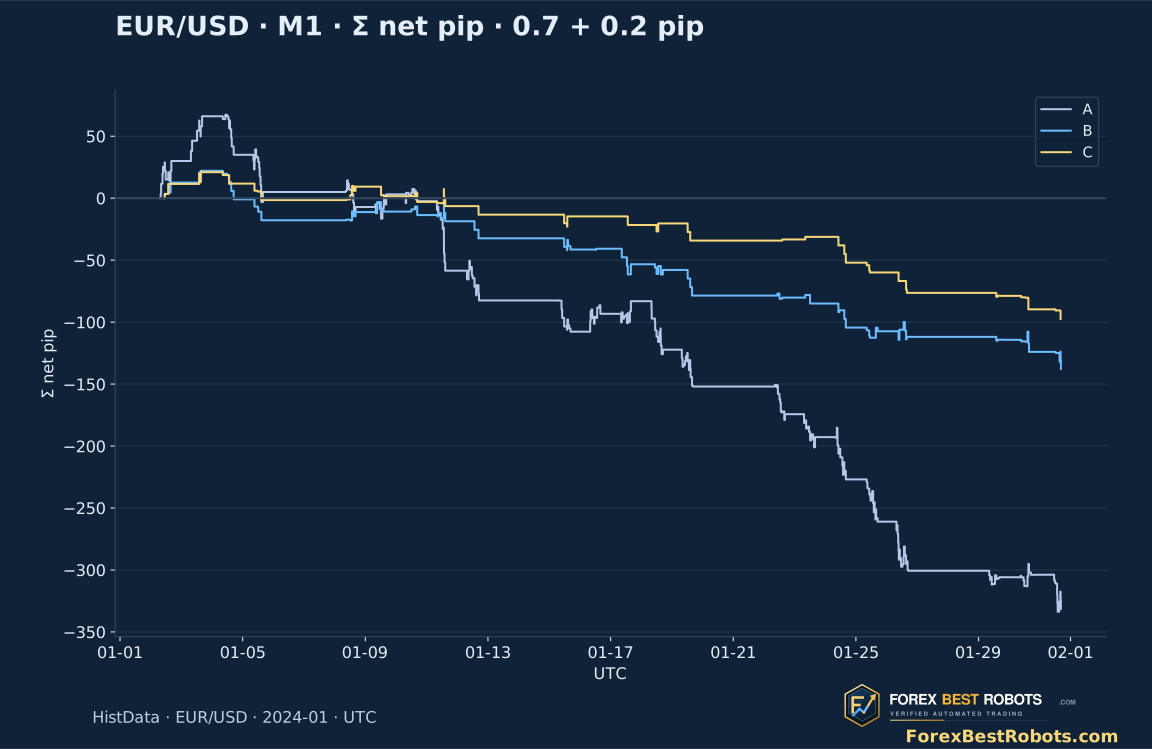
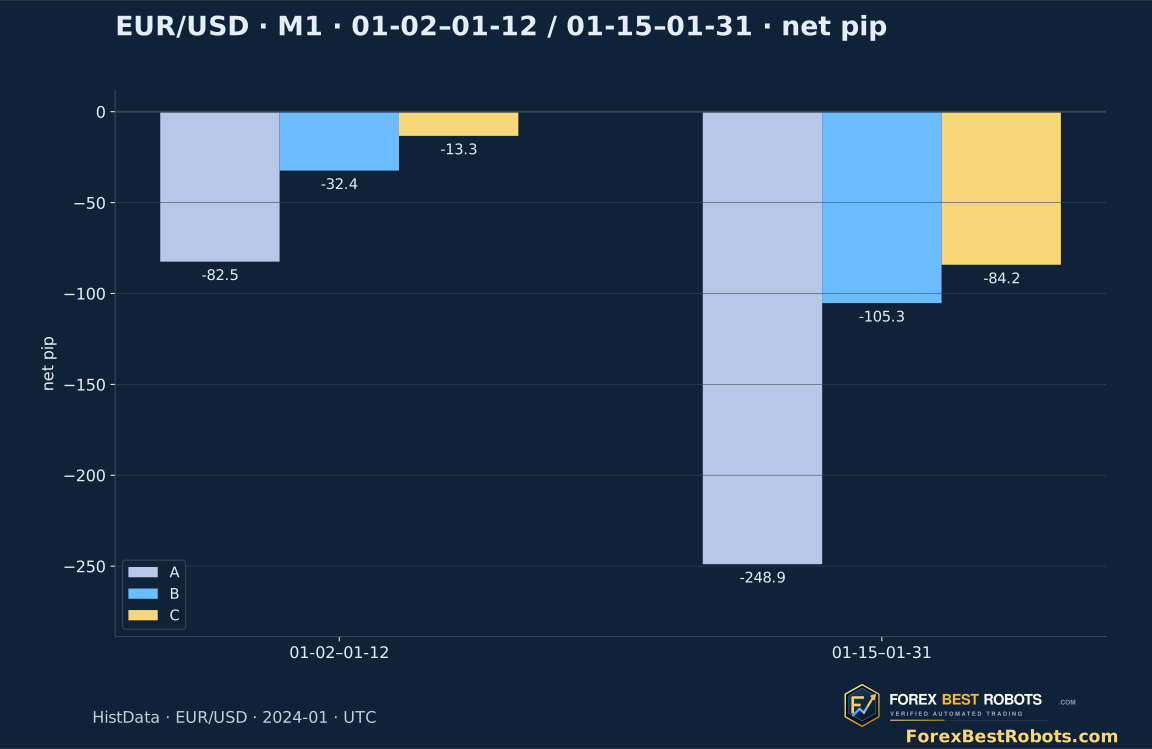
Earlier, 2024-01-02–2024-01-12, has nine sessions; later, 2024-01-15–2024-01-31, thirteen. C makes 25 earlier trades: +9.2 quote pips becomes −13.3 net. Its 27 later trades give −59.9 quote and −84.2 net. Both net segments lose; all A/B segment results are also negative after default costs.
The known-month split describes instability; it is not independent validation. The two-left/two-right pivot, immediate pair, 5–30-minute spacing and fixed exits were declared before results. Preserve these rules when checking other months and feeds, without tuning this month into a success story.
11. Inspect the first full-rule long and short, including the loss
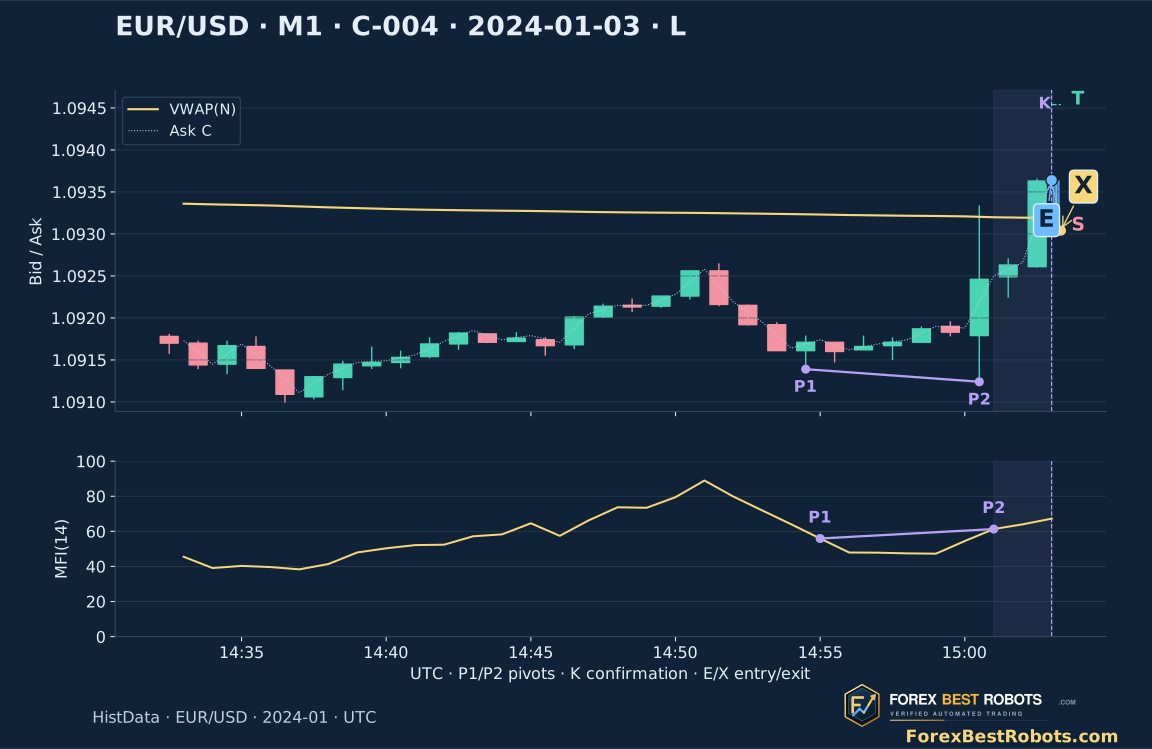
The first resolved C long is C-004 on 2024-01-03. P1 14:54 Low 1.091390 → P2 15:00 Low 1.091240, while MFI rises 55.9316→61.3164. Confirmation is 15:03 UTC, not 15:00: Close 1.093630 > VWAP 1.0931945; N=406 / median 148 =2.7432×. Entry 15:03:00.092 Ask 1.093640; stop exit 15:03:19.241 Bid 1.093040. Quote −6.00, net −6.90 pips.
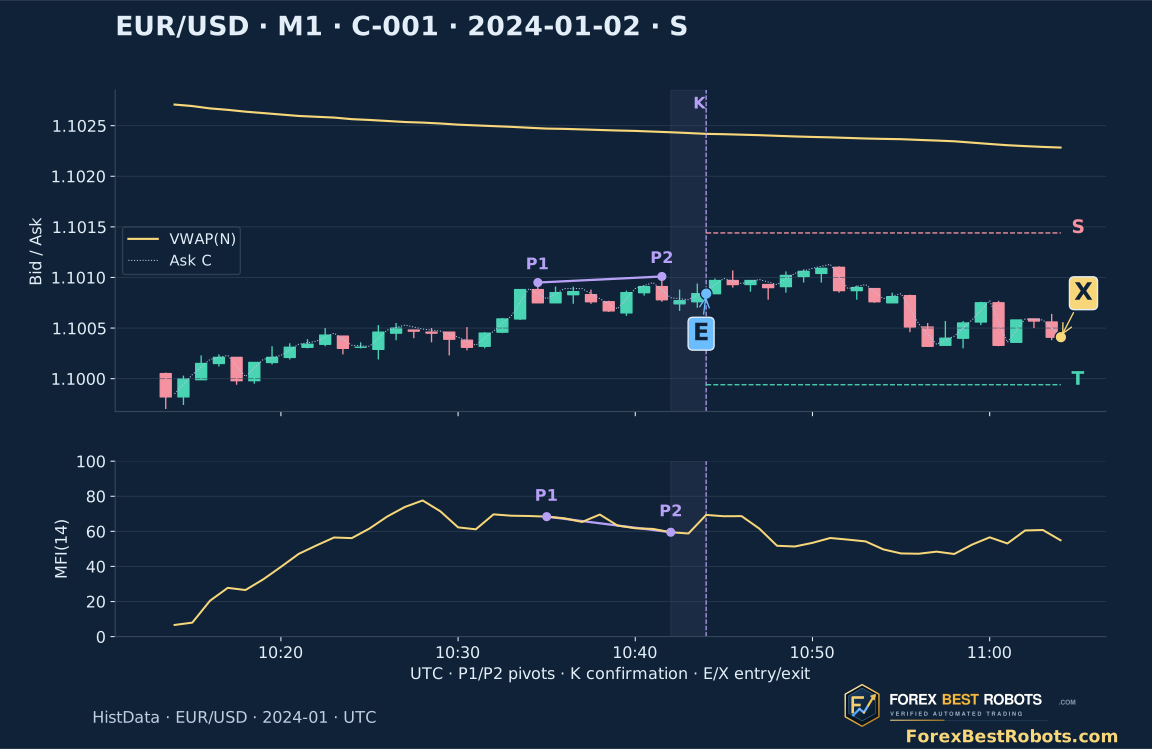
The first C short is C-001 on 2024-01-02. P1 10:34 High 1.100950 → P2 10:41 High 1.101010, while MFI falls 68.3867→59.4966. The signal is known at 10:44 UTC; N=118 / median 84 =1.4048× and Close 1.100840 < VWAP 1.1024190. Entry 10:44:00.237 Bid 1.100840; timed exit 11:04:01.164 Ask 1.100410. Quote +4.30, net +3.40. Selection uses direction and time, not profit. The final blue candle ends at X, without completed indicators for the rest of its minute.
12. Inspect confirmed pivots, MFI and the cost of every trade
Choose a variant, dates and extra round-trip cost. Select a trade or step through the list. Compare the two pivot candles, when the signal became known and the recorded entry and exit quotes. The cost choice changes accounting only.
Fixed commission: 0.70 pip per round trip. The selected allowance is extra; recorded spread is already included in quote P/L. Changing this field recalculates accounting only.
Worked examples · switch to C and all dates, keeping your selected allowance
Selected variant and dates · all resolved trades
- Resolved trades
- —
- Unresolved trades · excluded
- —
- Total quote P/L · spread included · pips
- —
- Total illustrative commission · pips
- —
- Total additional allowance · pips
- —
- Total net P/L · pips
- —
- Mean net P/L · pips per trade
- —
- Net winning trades · %
- —
- Net profit factor
- —
- Maximum realized cumulative drawdown · pips
- —
Selected trade · exact quote replay
Cost calculation for this tradeBid candles, dotted Ask Close and gold VWAP use historical quotes. P1/P2 identify the earlier/newer pivot candles; the lower panel shows their completed MFI values. Purple shading covers the two right candles; K is the confirmation time. E/X are exact model quotes, S/T the stop/target. The blue last candle ends at X; its indicators are unavailable.
On narrow screens, scroll inside the chart or table to read its full width.
- Direction
- —
- Exit reason
- —
- Confirmation candle · UTC start → signal known
- —
- Entry quote · UTC
- —
- Exit quote · UTC
- —
- Entry price
- —
- Exit price
- —
- Frozen stop threshold
- —
- Frozen target threshold
- —
- Time/session deadline · UTC
- —
- Holding time · minutes
- —
- First-quote delay · milliseconds
- —
- Entry spread · pips
- —
- Quote P/L · spread included · pips
- —
- Illustrative round-trip commission · pips
- —
- Selected extra round-trip allowance · pips
- —
- Net P/L after both deductions · pips
- —
- Pivot candle starts · P1 → P2 · UTC
- —
- Bid pivot prices · P1 → P2
- —
- Completed pivot MFI(14) · P1 → P2
- —
- Pivot separation · minutes
- —
- Signal known after two right candles · UTC
- —
- Confirmation Bid Close / anchored VWAP
- —
- Confirmation N / preceding-20 median
- —
- Confirmation activity ratio · requires ≥1
- —
- Confirmation activity check · used by C
- —
- Confirmation VWAP side check · used by B/C
- —
Inspect all trades in this selection
| Trade | Confirmation candle · UTC start → signal known | Direction | Entry quote · UTC | Exit quote · UTC | Exit reason | Quote P/L · spread included · pips | Illustrative round-trip commission · pips | Selected extra round-trip allowance · pips | Net P/L after both deductions · pips |
|---|
13. Use divergence as a testable hypothesis
A lower price Low with higher MFI can coexist with continuing losses. Delayed pivot confirmation can arrive after much of a rebound, as the first long shows. Quote-count weights, the fixed 07:00 anchor and the chosen pivot spacing are research conventions, not universal market structure.
One pair, month and archive cannot establish robustness. An observed minute does not prove complete quote capture, and quotes do not reproduce depth, queues or actual stop execution. Preserve all 406 simulated trades and failed pair decisions. The narrow finding is that the declared divergence/VWAP/activity rule did not demonstrate a profitable edge after the stated costs.
Frequently asked questions
Was this confirmed MFI divergence strategy profitable?
No. C has 52 trades, −50.7 quote pips and −97.5 net after 0.70+0.20 per round trip. All variants and both chronological segments are net negative; both added filters worsen mean and profit factor.
When is a five-candle pivot actually known?
Only at the end of its second complete right candle. A pivot starting at 15:00 becomes known at 15:03. Its price/MFI annotations identify the past pivot candle; they are not permission to enter at 15:00.
Can I choose any earlier pivot that makes a good divergence?
This protocol uses only the immediately previous same-type confirmed pivot, 5–30 minutes apart inclusive. Failed spacing, price or MFI comparisons do not allow skipping to an older favorable pivot.
Does MFI here measure real money flow or require 20/80?
It uses Bid HLC3 weighted by all recorded quote counts, not executed lots or market-wide money. Equal TP is neutral and zero total flow unavailable. This divergence rule has no 20/80 threshold. C tests activity on the confirmation candle, not the pivot.
Why do 55 combined passes produce only 52 C trades?
Two arrive while a position is open and one fails the first-quote delay. The first quote must be under five seconds and spread at most one pip; rejected events are not retried or queued.
Can the cost selector change the examples or stop fills?
It changes accounting only. C-004 is the first C long and loses 6.90 pips at default costs; C-001 is the first C short and gains 3.40. Entries/exits remain fixed. A price gap can exit beyond the nominal stop.
Data, timing and reproducibility
Downloads retain all 406 trades, 344 candidates, 1 032 variant decisions, 6 613 confirmed-pivot records with pair decisions, observed M1 inputs, coverage and the frozen protocol. Prices are integer millionths; one EUR/USD pip equals 100 units. The cost script uses standard Python; the optional raw replay needs NumPy and the identified original ZIP.
The public kit identifies the original source and SHA-256 without redistributing its raw archive. Seven CSV files are reproduced by the raw-quote replay. Final trade candles are rebuilt only through the exit record. These are historical quote simulations, without real-account performance claims.
- Every simulated trade and source quote indices (CSV)
- Candidate events, decisions and coverage (ZIP)
- Inputs, fixed protocol and replay methods (ZIP)