

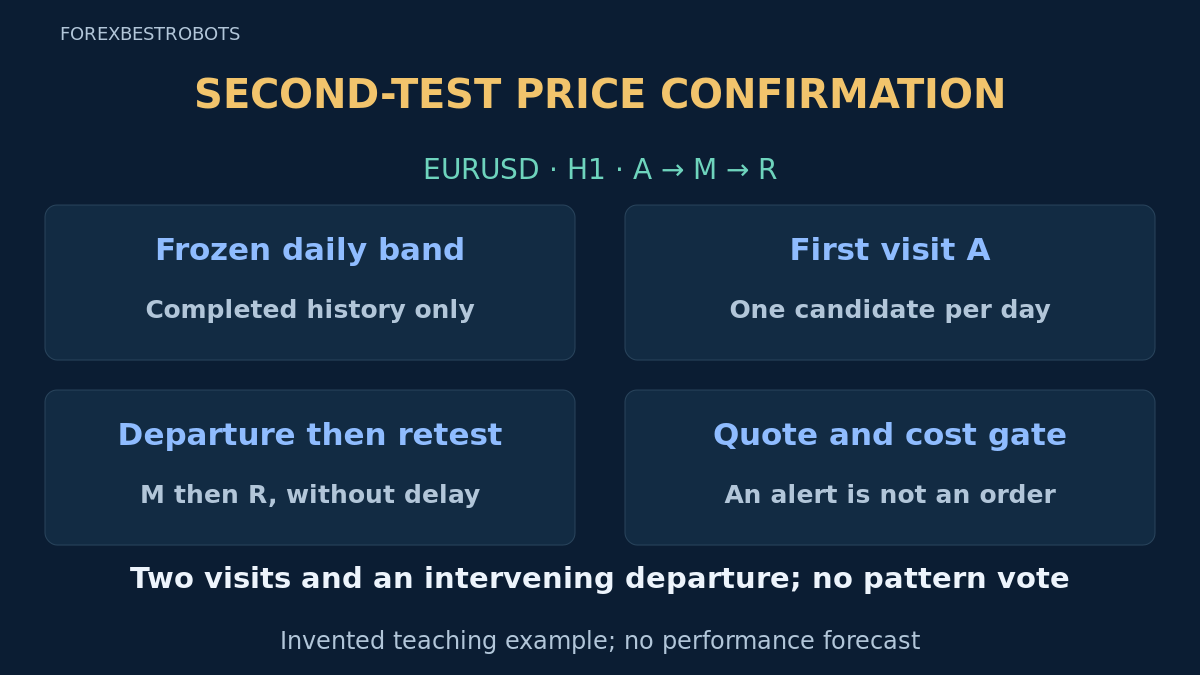
A level may hold once and fail on its next visit. This strategy asks a narrower question: after the first rejection and a completed departure, does an immediate retest stop short of the first extreme and close beyond that departure? The sequence makes the hypothesis reproducible; it does not establish that buyers or sellers will keep control.
This is an authored research baseline, not a proven profitable system. Unlike a pin-bar pattern, it needs no wick/body ratio. Unlike a breakout/retest, it needs no outside close. The general support/resistance strategy supplies background, while Strategy 1 tests a different trend-and-RSI hypothesis.
1. Fix the market and one candidate per day
Use EURUSD H1 Bid candles, pip 0.0001 and illustrative tick 0.00001; verify actual symbol specifications. Use the broker's D1 calendar, not local midnight. Require 24 consecutive completed H1 intervals ending exactly at the new D1 opening D. Missing history, a weekend gap or inconsistent calendar mapping disables that entire day. No oscillator, higher-timeframe trend, session or news filter is added.
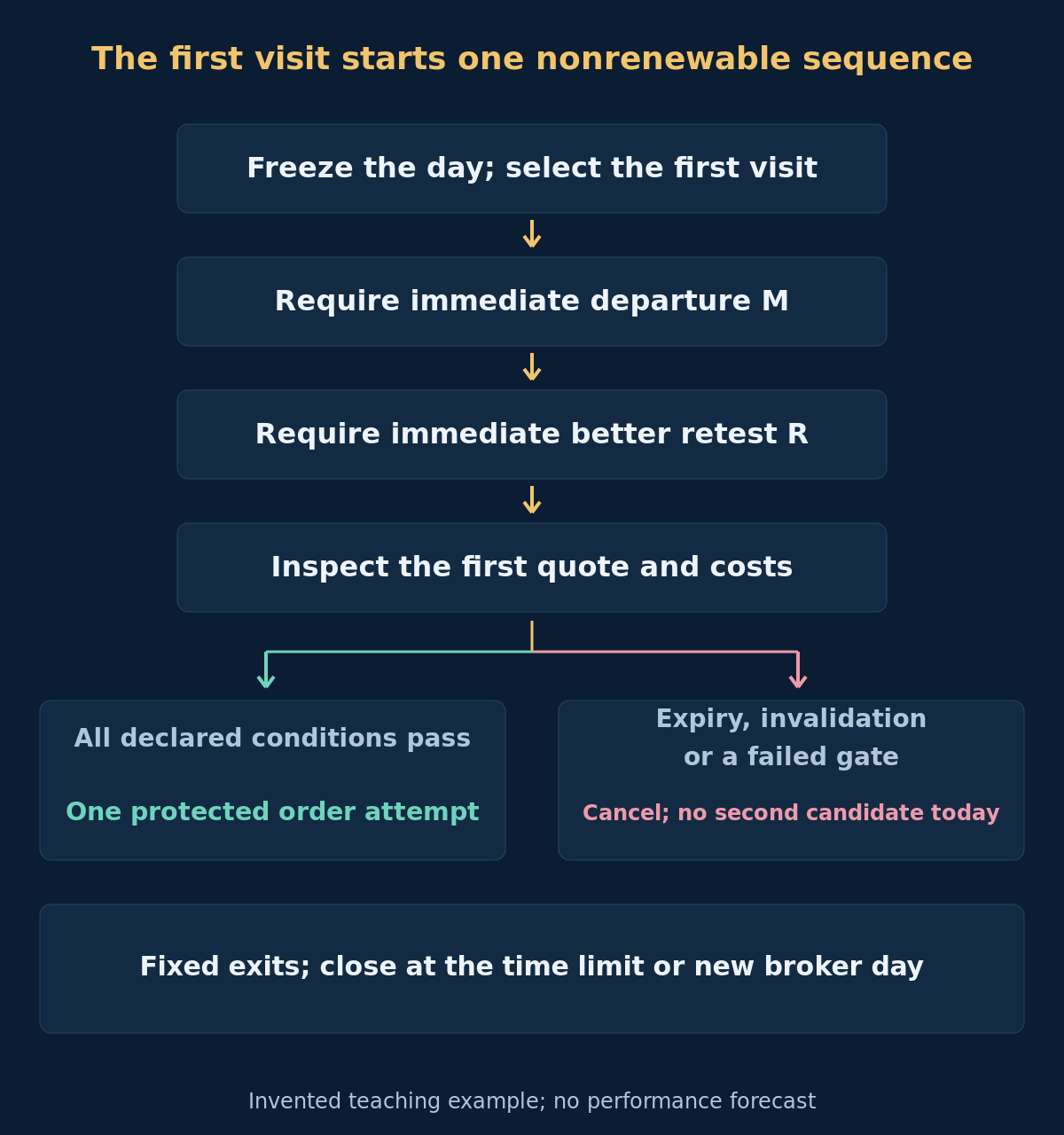
At the first own-symbol quote establishing the new D1 bar, freeze the reference described below. Remain flat and require no EURUSD position or pending order anywhere in the account at A and submission. A is the first current-day H1 candle whose low reaches the support band's upper edge or whose high reaches the resistance band's lower edge. That first visit consumes the day's sole candidate even if it fails. Never select a nicer later visit; do not carry an unfinished sequence into another broker day.
2. Freeze levels and bands before the first visit
From those 24 completed H1 candles take L = min(Low), U = max(High) and W = U − L. Require W from 40 to 120 pips inclusive and the last reference close within [L + 0.25 × W, U − 0.25 × W], including endpoints. The support band is [L − 0.00020, L + 0.00020]; resistance is [U − 0.00020, U + 0.00020]. Freeze both for that day; later highs and lows cannot redraw them.
A single candle reaching both bands rejects the day; so does an excursion beyond the outer edge of the visited band. Equality at an outer edge is allowed for a visit, but not beyond it. For a BUY sequence, any A, M or R high reaching the opposing near edge U − 0.00020 rejects it. SELL mirrors this at L + 0.00020. Check these vetoes before any confirmation condition.
3. Define the first support visit A
For BUY, A's low must lie inside the support band, while its open and close must both be strictly above L + 0.00020. No bullish body or pin-bar shape is required at A. All first-visit and opposing-edge checks must pass. A is still not an order: the next two specific candles must complete the sequence.
At A's close freeze Bid stop S = Low(A) − 0.00020 and Bid target Tp = U − 0.00020, both rounded down to valid ticks. The stop depends on the first test, not the later better low. The target is the opposing near edge, not a projected price move. Never tighten S or move Tp to improve the eventual cost ratio.
4. Require departure M, then the immediate second test R
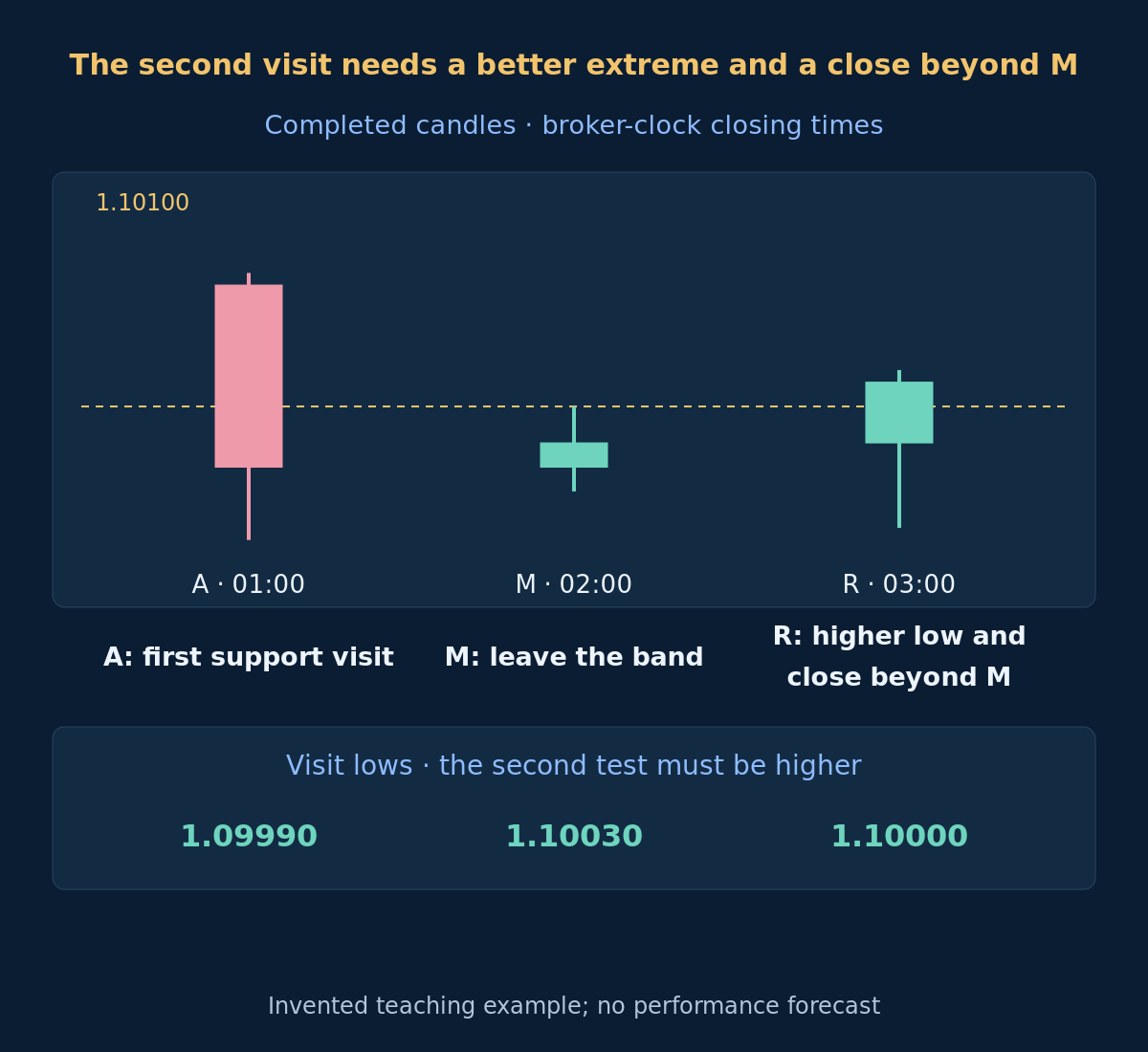
M is exactly the next consecutive completed H1 candle after A. Require Low(M) > L + 0.00020 and High(M) < Tp. R is exactly the next one after M. Its low must be inside the support band and strictly above Low(A); require a bullish R and Close(R) > High(M), with High(R) < Tp. Equality at the better-low or close gate fails. There are no extra waiting candles.
On M and R first cancel on Bid low at or below S or Bid high at or above Tp, then apply the sequence conditions. A missing interval, wrong visit geometry, a failed immediate candle or a new broker day consumes the candidate permanently. R must close within the same D1 bar as A. No later close may rescue it. Confirmation uses completed R; no retrospective fill at its close is allowed.
5. Mirror SELL and convert the exit side explicitly
For SELL, A's high lies in the resistance band; its open and close are strictly below U − 0.00020. Freeze Bid ceiling V = High(A) + 0.00020 and projected Bid target P = L + 0.00020. The immediately next M needs High(M) < U − 0.00020 and Low(M) > P. The immediately next R must have its high in the resistance band, strictly below High(A), a bearish body, Close(R) < Low(M) and Low(R) > P.
On M and R, Bid high at or above V or Bid low at or below P vetoes first. SELL enters at Bid and exits on Ask: set Ask SL = V + 0.00020 and Ask TP = P + 0.00020, rounded up to valid ticks. The 2-pip conversion is an authored allowance, not observed Ask history or a spread forecast. Use actual relevant Bid/Ask quotes to test execution. The one-candidate rule covers both directions together.
6. Inspect the first quote; allow one protected attempt
Inspect and submit on the first own-symbol quote received after R closes, no later than 15 seconds after that close, with receipt age at most 2 seconds at submission on verified clocks. Require tradable Bid below Ask, spread at most 2 pips and abs(Bid − Close(R)) ≤ 0.00020. Any observed post-R touch of the frozen Bid invalidation or projected target before submission cancels. Missing or inconsistent evidence blocks entry; do not wait for a better quote. The quote must still belong to the same broker day.
Check fixed price ordering, tick size, broker distances, permissions, margin and combined exposure. Establish valid SL/TP with the initial order or do not open. One submission consumes A, including rejection or an uncertain response; reconcile broker state before any further action. After a confirmed fill, recompute costs and the loss estimate with that actual entry. A failed limit or absent protection requests closure, records costs and blocks another attempt for A.
7. Follow the invented BUY sequence
An invented 24-bar reference fixes L at 1.10000 and U at 1.10400: W is 40 pips. Its last close 1.10200 is in the middle half. Support is [1.09980, 1.10020] and resistance [1.10380, 1.10420]. The table shows the first 3 current-day H1 candles, labeled by broker-clock closing time. The optional recipe below reproduces the reference.
| Candle · close time | Bid open | Bid high | Bid low | Bid close |
|---|---|---|---|---|
| A · 01:00 | 1.10200 | 1.10210 | 1.09990 | 1.10050 |
| M · 02:00 | 1.10050 | 1.10100 | 1.10030 | 1.10070 |
| R · 03:00 | 1.10070 | 1.10130 | 1.10000 | 1.10120 |
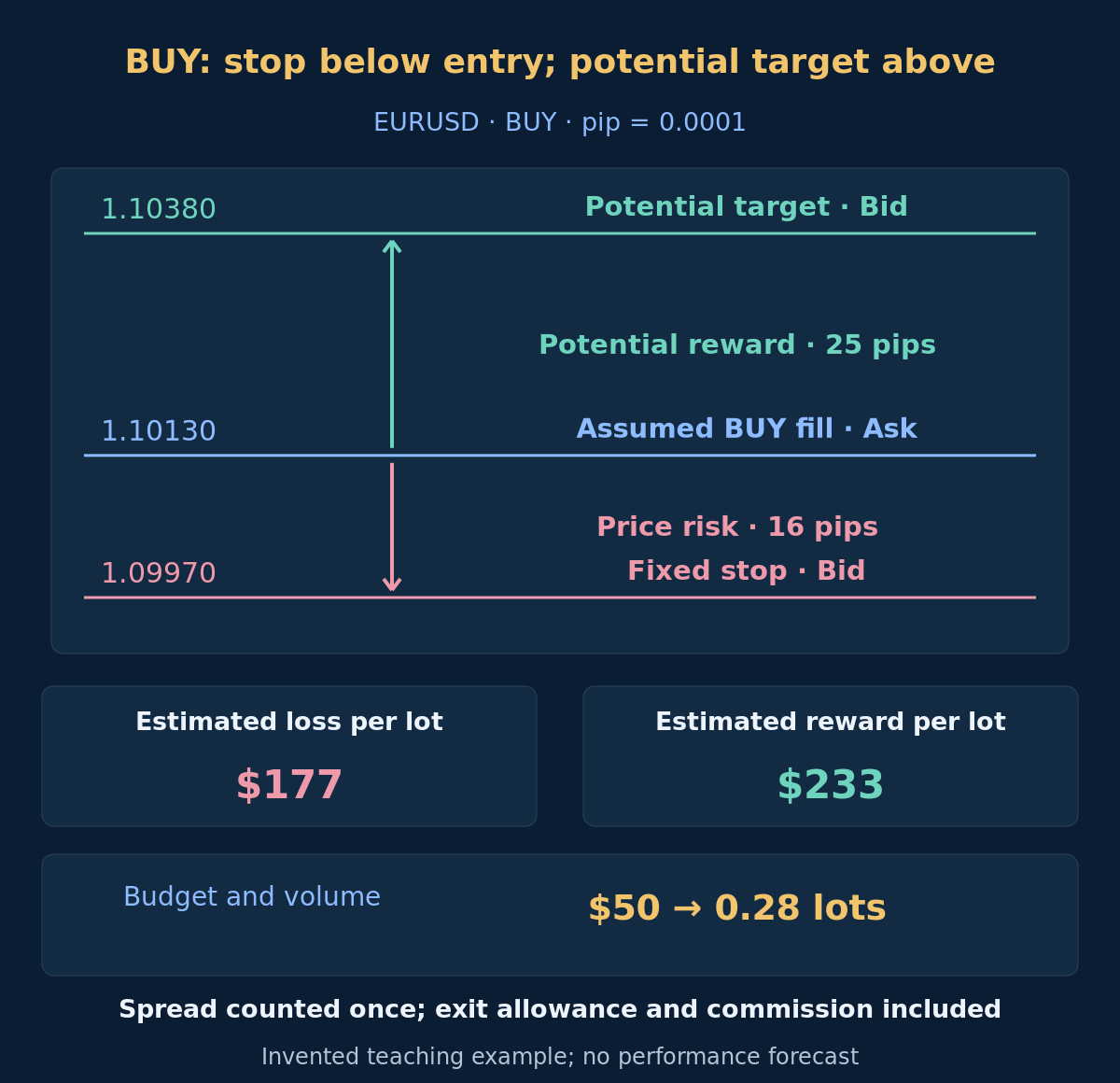
A qualifies with low 1.09990; M's low 1.10030 leaves support. R's low 1.10000 is strictly better than A's and its close 1.10120 exceeds M's high 1.10100. Assume all other gates pass and the first quote at 03:00:01 is Bid 1.10120 / Ask 1.10130, with a BUY fill at Ask. S is 1.09970 and Tp 1.10380: price risk 16 pips and potential reward 25 pips. No later trade outcome is supplied.
8. Include costs before sizing the position
Limit planned entry loss to 0.5% of current equity and total planned open/pending account loss to 1.0%. In USD, use Budget = min(0.005 × equity, max(0, 0.01 × equity − existingPlannedLoss)). Unknown existing risk blocks entry. Invented equity $10,000 with no existing risk gives budget $50. Assume pip value $10 per lot, round-turn commission $7 per lot, adverse exit allowance 1 pip and financing reserve $0. With positive executable distances dSL and dTP in pips, define Loss1 = (dSL + 1) × 10 + 7 and Reward1 = (dTP − 1) × 10 − 7. Require positive estimates and unrounded Reward1 / Loss1 ≥ 1.25. These are planning inputs, not recommended risk or a guaranteed loss cap. Verify actual fees and conversion; see trading costs.
Here Loss1 is $177 and Reward1 is $233, a ratio about 1.32. With minimum and step 0.01 lot, round down to 0.28 lots: estimated loss $49.56 and reward $65.24. The next step, 0.29, estimates $51.33 loss and exceeds budget. If the first quote were Bid 1.10140 / Ask 1.10150, spread and displacement still pass, but Loss1 is $197 and Reward1 $213: ratio about 1.08 fails. Skip it, and skip whenever the minimum lot exceeds the budget. Spread is already inside executable distances; never add it twice. After an actual fill, its price difference is inside the recomputed distances; the 1-pip reserve is for the remaining exit. Follow the account-risk rules.
Optional: reconstruct the frozen range and cost arithmetic
For each reference candle use tuples (Open, High, Low, Close). Repeat this 4-candle block exactly 6 times over 24 consecutive H1 intervals ending at D: [(1.10200,1.10400,1.10150,1.10300), (1.10300,1.10350,1.10000,1.10100), (1.10100,1.10300,1.10050,1.10250), (1.10250,1.10300,1.10100,1.10200)]. The final close joins A's open. This is synthetic OHLC, not historical execution. English decimal notation is retained.
BUY arithmetic: (1.10130 − 1.09970) / 0.0001 = 16; (1.10380 − 1.10130) / 0.0001 = 25; (16 + 1) × 10 + 7 = 177; (25 − 1) × 10 − 7 = 233; floor((50 / 177) / 0.01) × 0.01 = 0.28; 0.28 × 177 = 49.56; 0.28 × 233 = 65.24. These are alternative estimated outcomes, not realized results.
9. Keep fixed exits and respect the day boundary
Keep the initial SL/TP; no trailing, break-even move, partial exit, averaging, automatic reversal or extra candle-close exit is included. Earlier actual protective fills take priority. Otherwise request full closure at the earlier of 8 elapsed hours after R's closing timestamp and the next broker D1 opening, using the first tradable quote: Bid for BUY, Ask for SELL. Under the unchanged example clock the time limit is 11:00.
Use the declared broker calendar and observed D1 timestamps to recognize a new day; do not substitute the computer's date. A quote outage does not renew a candidate or extend a deadline, though a fill may be delayed. Unreliable required data or clock mapping means retain accepted protection and request closure when possible. Reconcile an uncertain close before another order. Requests are not fills; gaps and costs can exceed planned loss.
10. Test both visits without selecting hindsight winners
Replay the broker day, frozen reference, first boundary visit, exact M and R, first quote, order responses and exits in timestamp order. MT4 shift 0 is forming; verify actual openings and completed availability rather than adding a daily label to unfinished data. Keep days rejected for gaps, width, first-visit failures, cost or broker constraints. If OHLC cannot resolve stop/target order, use finer data or retain an unresolved outcome under a declared convention. See backtesting practice.
Compare with a separately logged first-visit system using matched dates, costs and risk; evaluate whether the second visit adds anything after delay and lost opportunities. Record all band-width and time-limit variants. Reserve later chronological evaluation and forward demo checks. Trends can run through both visits, ranges can disappear and apparent better lows can fail. No backtest, win rate or expectancy is supplied.
- The broker day, 24 completed intervals and frozen range pass.
- A is the first visit across both bands; one candidate is consumed.
- M departs immediately; R retests immediately with a strictly better extreme.
- R closes past M; invalidation and opposing-edge vetoes take priority.
- The first quote, fixed protection, costs, volume and aggregate risk pass.
- All failures, requests, protective exits and time/day exits are logged.
11. Questions about the second test
Does a higher second low prove support will hold?
No. It describes the completed sequence, not hidden demand or a future outcome. The hypothesis needs comparison against a matched first-visit baseline after all costs and rejected days.
Can a later retest replace a failed R?
No. M must follow A immediately and R must follow M immediately. The day's first visit consumes its sole candidate, even if the sequence fails. A new broker day needs a newly frozen valid reference.
Why can the candle pattern pass while the order is rejected?
The observed pattern and executable trade are separate. A worse first quote, higher costs, invalid protection or excessive account risk can reject an otherwise valid signal.
Does the target mean the example earned a profit?
No. It is a fixed potential exit. The chart ends at confirmation; no later execution or result is supplied. Losses, missed fills and time exits remain possible.
12. References and scope
Primary platform references: iTime and bar timestamps, TimeCurrent and quote-clock scope and OrderSend price sides and order constraints. Sources checked on 2026-10-19. They support platform mechanics, not the authored bands, sequence, risk limits or profitability. This is a strategy specification, not a certified EA.
Forex and leveraged trading involve substantial risk. This material is educational, not investment advice. All example prices and money figures are invented. Past or simulated results do not guarantee future performance.