

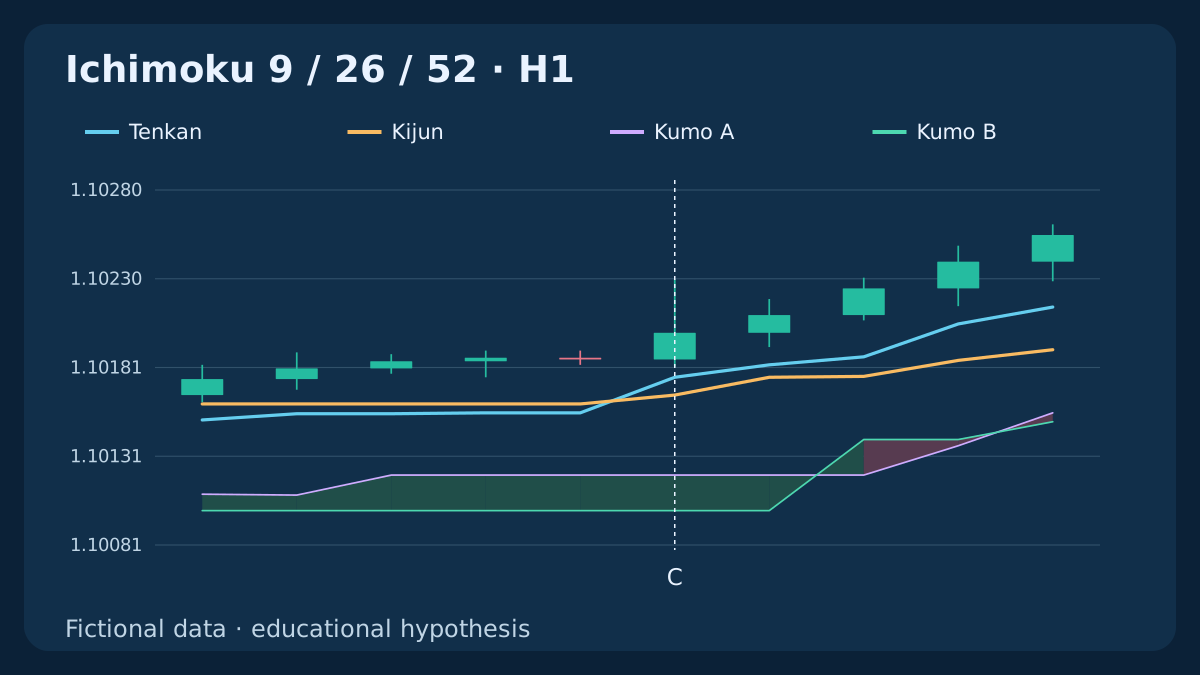
A price close above the cloud does not prove that the Tenkan/Kijun cross occurred above it. This strategy separates three questions: which cloud belongs to the signal candle, whether both lines actually crossed outside that cloud, and whether the first executable quote still supports the planned risk. Every chart comes from the downloadable fictional OHLC data.
1. A different hypothesis from a cloud-breakout pullback
The research hypothesis is that a new Tenkan/Kijun transition, while price is already on one side of Kumo, may precede a continuation large enough to pay trading costs. This is a proposal to test, not evidence of an advantage. The existing Ichimoku strategy instead begins with a cloud breakout and waits for a pullback; this version does neither.
The entry object is the completed cross C itself. Require flat exposure, no pending or unknown request and continuous observation of the close; do not replay a missed C after a restart. There is no later retest or confirmation candle. Three prior price closes, two outside-cloud line observations and every numerical threshold below are explicit research choices. Histories establish indicator events; separate execution cases assume a flat account at the selected C.
2. Calculate midpoints and align the cloud by its display index
Use chronological EUR/USD H1 Bid OHLC and 1 pip = 0.0001; point = tick = 0.00001. With inclusive completed windows, T[i] = (HH9[i] + LL9[i]) / 2 and K[i] = (HH26[i] + LL26[i]) / 2. These are range midpoints, not averages of closing prices. Define the unshifted sources A_raw[i] = (T[i] + K[i]) / 2; B_raw[i] = (HH52[i] + LL52[i]) / 2.
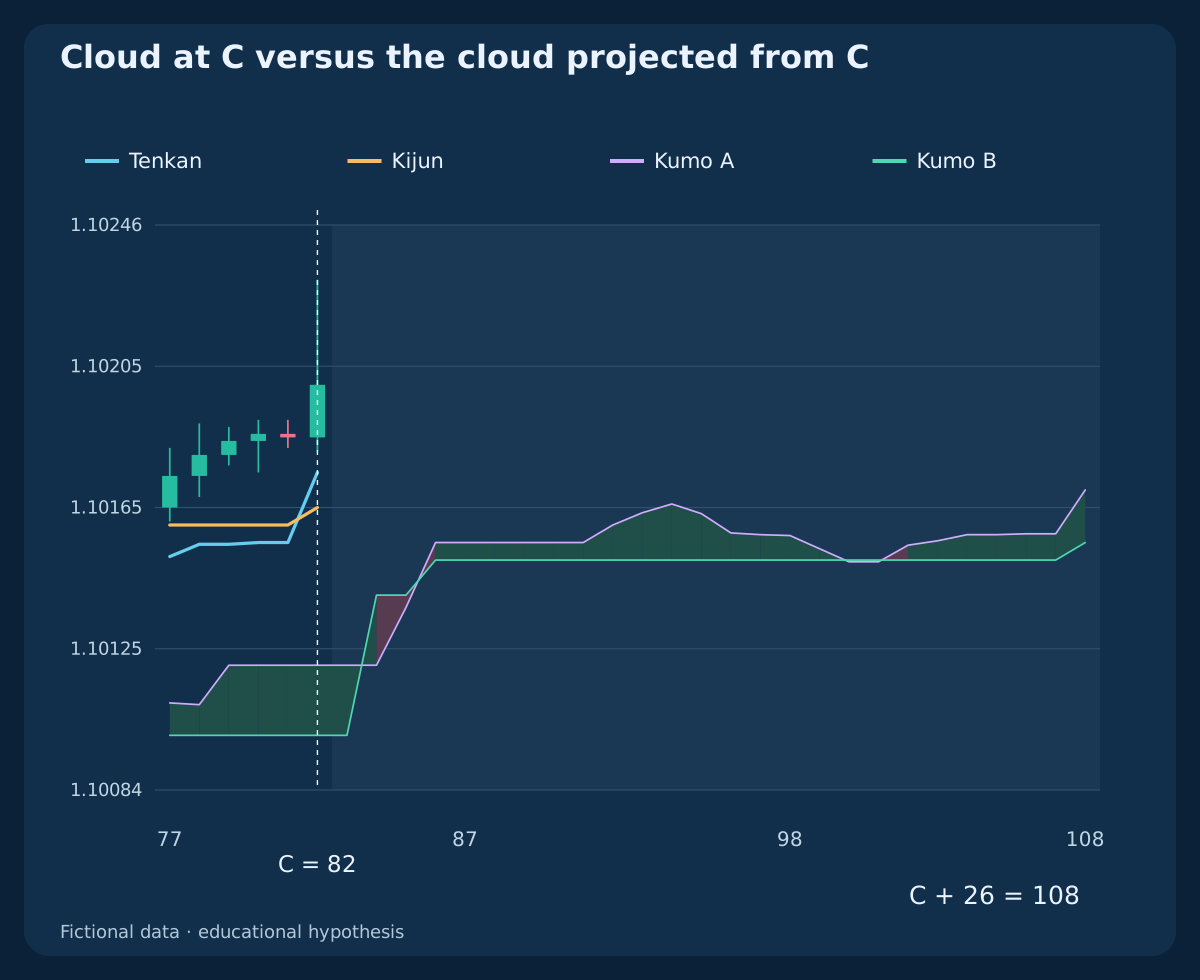
The cloud at candle i is A_display[i] = A_raw[i−26]; B_display[i] = B_raw[i−26]. Its top is the larger displayed value; its bottom the smaller. Values newly computed at C are drawn at C + 26, not substituted at C. For all three preceding cloud comparisons, the earliest fully supported candidate is C = 80: 81 consecutive H1 candles from index 0. Unknown inputs or gaps invalidate this strict reference; a market closure is not an invented candle.
3. Require established price context and an outside-cloud line pair
For BUY, the three immediately preceding closes satisfy Close[j] > Top[j], j = C−3 … C−1. For SELL, require Close[j] < Bottom[j], j = C−3 … C−1. Each Top or Bottom belongs to its own displayed candle. Do not compare every historical close with today’s cloud or with a single frozen cloud price.
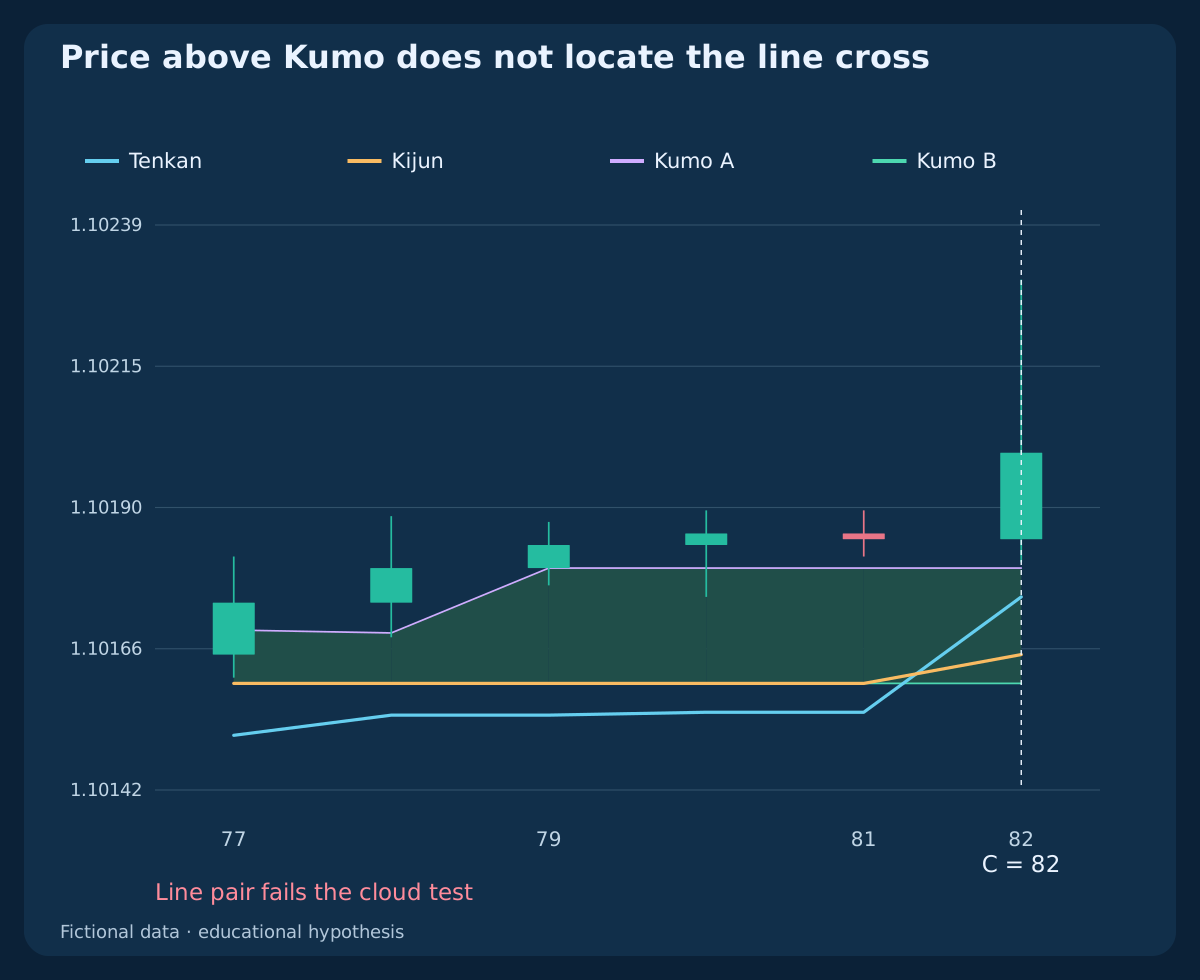
BUY also requires min(T[j], K[j]) > Top[j], j ∈ {C−1, C}; SELL requires max(T[j], K[j]) < Bottom[j], j ∈ {C−1, C}. Strict equality to a cloud edge fails. Checking both endpoints keeps both line segments outside the linearly drawn cloud between them; a close above Kumo alone is insufficient. This is a closed-observation rule, not an inferred intrabar timestamp.
4. Recognize one fresh cross on the completed signal candle
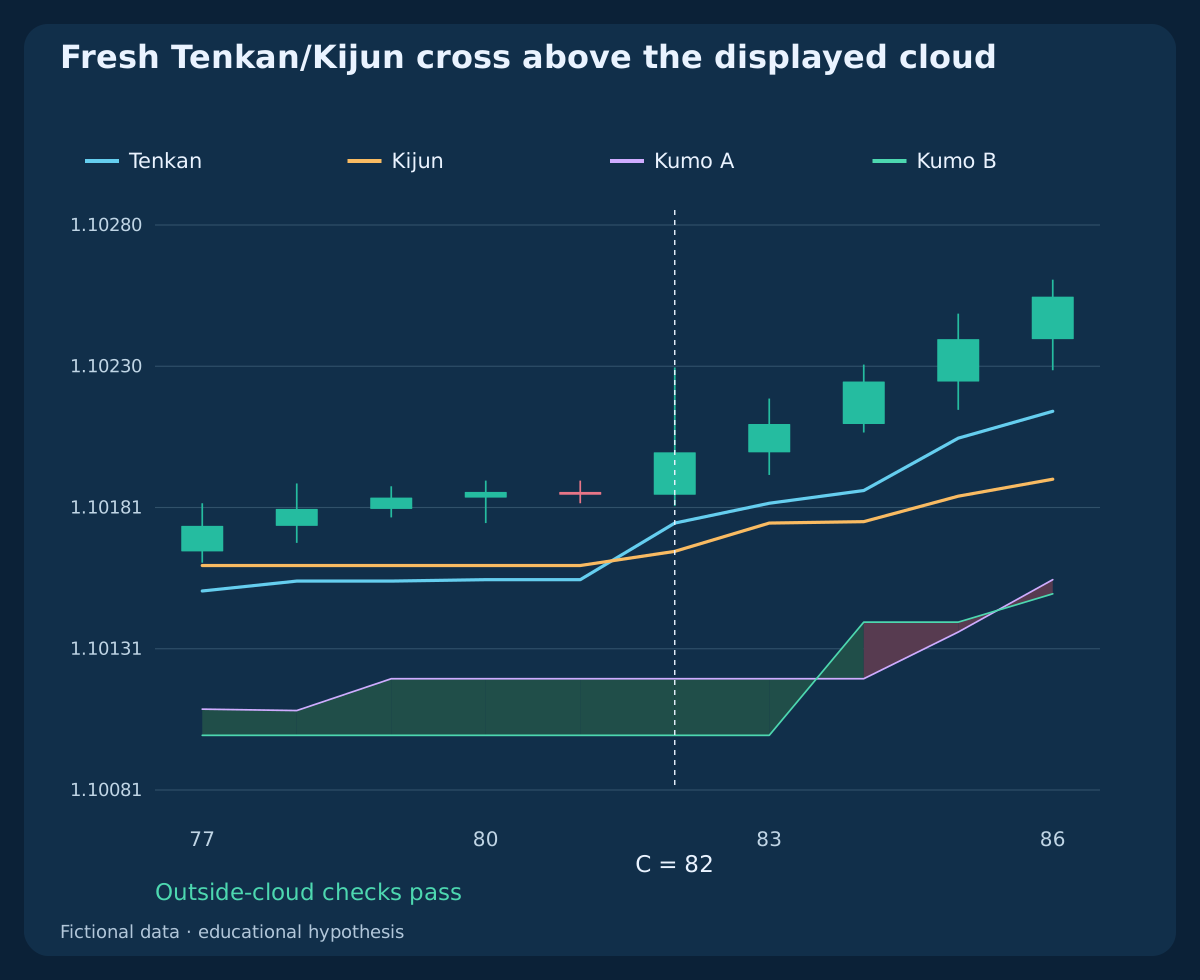
BUY requires T[C−1] ≤ K[C−1] ∧ T[C] > K[C], Close[C] > T[C] and Close[C] > Open[C]. SELL reverses the inequalities: T[C−1] ≥ K[C−1] ∧ T[C] < K[C], Close[C] < T[C] and Close[C] < Open[C]. These conditions supplement all context checks. Current line equality is not a crossing; an intrabar event that disappears before close is unavailable.
At the selected C = 82, the BUY has T[C−1] = 1.10155; K[C−1] = 1.10160 and T[C] = 1.10175; K[C] = 1.10165. The cloud at C spans 1.10100 … 1.10120. In the separate inside-cloud history, the same fresh cross and three price closes pass, but Kumo spans 1.10160 … 1.10180; the line-pair test fails. A later attractive candle cannot rescue that C.
5. Freeze protection from the displayed cloud at C
BUY uses SL = Bottom[C] − 1 pip; R0 = Close[C] − SL; TP = Close[C] + 2 × R0. SELL uses SL = Top[C] + 1 pip; R0 = SL − Close[C]; TP = Close[C] − 2 × R0. R0 must be positive. The complete signal candle must stay strictly beyond the numerical stop boundary: Low[C] > SL for BUY or High[C] < SL for SELL.
These fixed prices use the cloud displayed at C, not the new cloud projected to C+26. BUY protection is triggered on Bid; SELL protection on Ask even though the source OHLC is Bid. Freeze SL and TP after C. Later cloud movement does not authorize widening protection or moving the target. Reject unsupported tick prices, protection or account rules before requesting entry.
6. Use one first-quote decision and an exclusive deadline
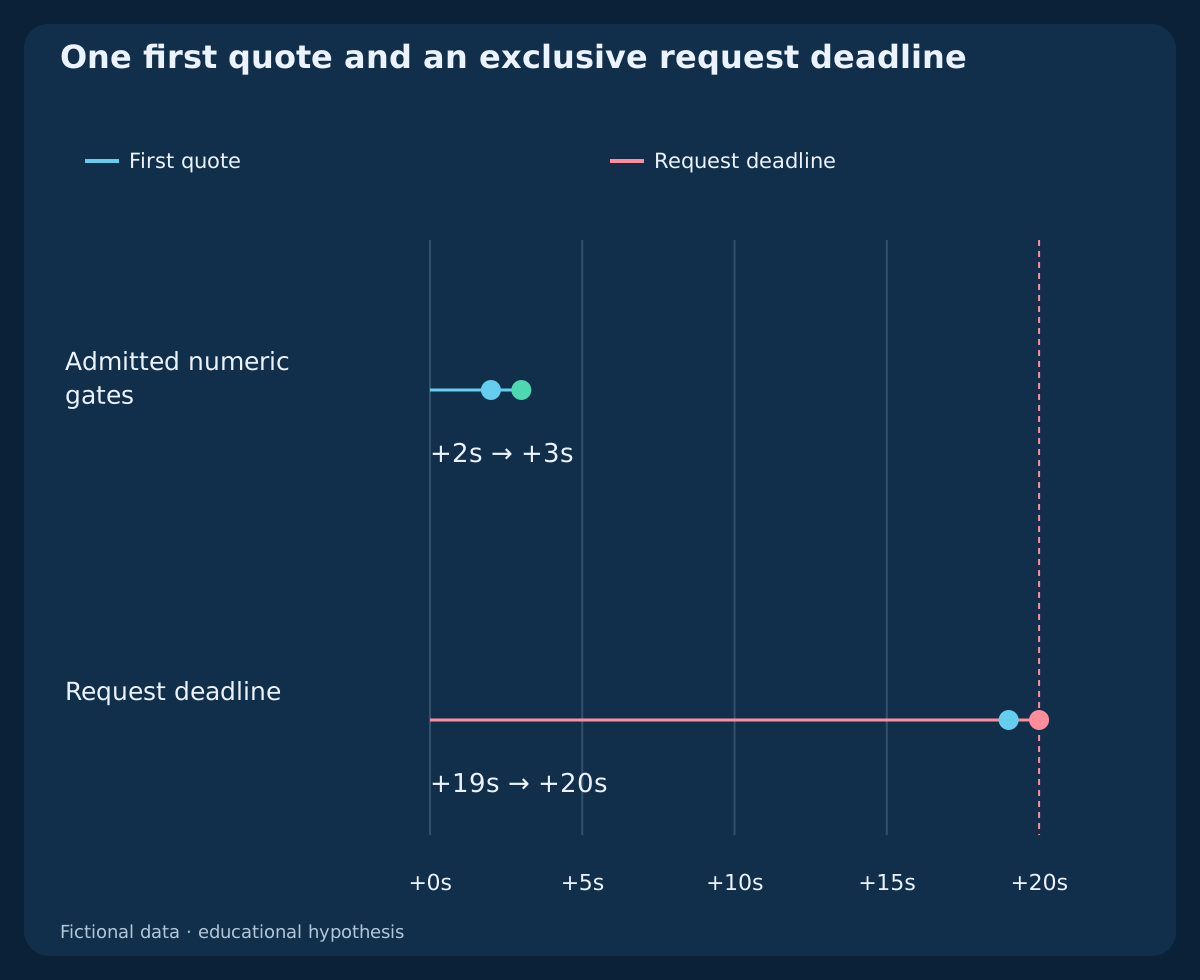
Entry is allowed during 08:00 ≤ t_UTC < 16:00. Evaluate only the first observed current-symbol valid positive paired Bid/Ask after C becomes available. Its documented age at transmission must be between 0 and 2 seconds inclusive, and the request must occur strictly before C’s nominal close plus 20 seconds. A first observation that lacks valid evidence consumes the candidate.
The worked C covers 10:00–11:00 UTC. The first quote is at 11:00:02, a hypothetical request at 11:00:03 and fill at 11:00:04. A request at 11:00:20 UTC is too late. Check the deadline again before sending; a timely observation does not authorize a late request. Match clock domains before measuring quote age. The worked quote stays unchanged until the request; otherwise cancel instead of rebuilding the plan.
7. Apply quote, distance and net-ratio gates before sizing
Require spread at most 1.2 pips. Current BUY Bid must remain above both frozen Tenkan/Kijun values; current SELL Ask below both. Relevant exit-side quotes must still lie strictly between SL and TP. Define a planning entry E* = Ask + 0.2 pip for BUY or E* = Bid − 0.2 pip for SELL. Directional distance from C.close to E* must be between 0 and 2 pips inclusive.
The entry reserve is a planning allowance, not the market-order request price. From E*, calculate positive gross stop and target distances. Add commission, future exit reserve and any financing reserve to the loss; subtract them from reward. Call these planned amounts L_net and G_net; require G_net / L_net ≥ 1.5. Here those costs are 0.6, 0.4 and 0 pips. Unknown applicable costs, contract rules or margin mean rejection.
8. Worked BUY: cloud geometry and the first quote
C is the 10:00–11:00 UTC candle. Its Bid close is 1.10200; the displayed cloud bottom and top are 1.10100 / 1.10120. Therefore SL = 1.10090; R0 = 11 pips; TP = 1.10420. Assume the first quote is Bid 1.10200 / Ask 1.10208, unchanged until transmission, with documented freshness, legal protection and sufficient margin.
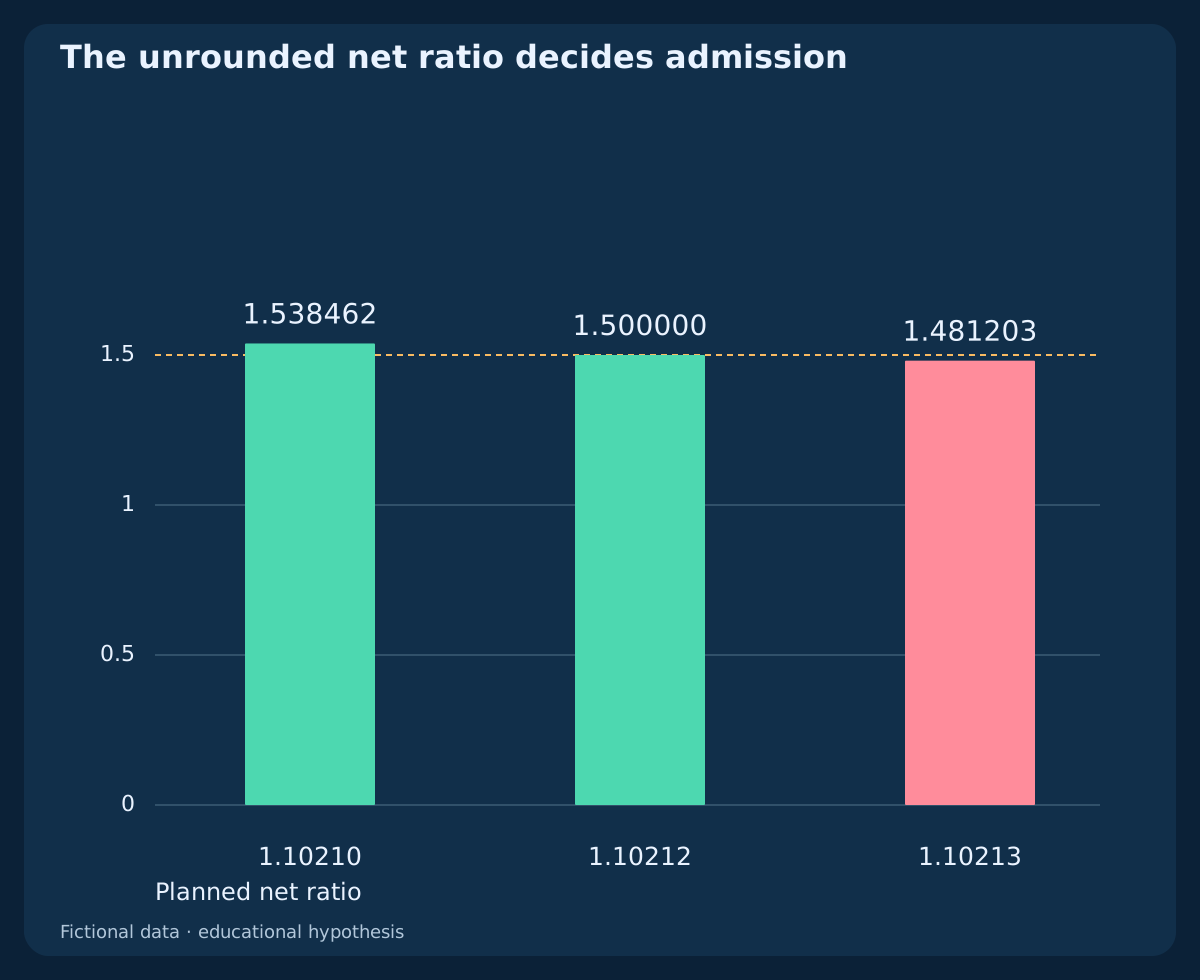
Spread is 0.8 pip and planned entry E* = 1.10210, one pip beyond the signal close. Gross stop and target distances are 12 / 21 pips. After the declared one pip of commission and exit reserve, L_net = 13.0 pips; G_net = 20.0 pips. The unrounded ratio 20 / 13 ≈ 1.538462 passes. Spread and entry reserve are already in E*; do not charge them a second time.
9. Reject the first poor quote and preserve the boundary rule
For the same signal and frozen exits, an independent quote Bid 1.10203 / Ask 1.10211 gives E* = 1.10213. Spread and directional distance pass, but L_net = 13.3; G_net = 19.7; G_net/L_net ≈ 1.481203 fails. Reject this C, even if the next quote would be cheaper.
The separate equality case has E* = 1.10212 and 19.8 / 13.2 = 1.5, which passes. Another first quote with a 1.3-pip spread fails despite passing the ratio. These are independent alternatives, not a sequence for shopping for an entry. A request at the exclusive deadline also fails. Any rejection consumes C; only a new eligible closed cross can create a candidate.
10. Mirror SELL prices and keep Ask exits explicit
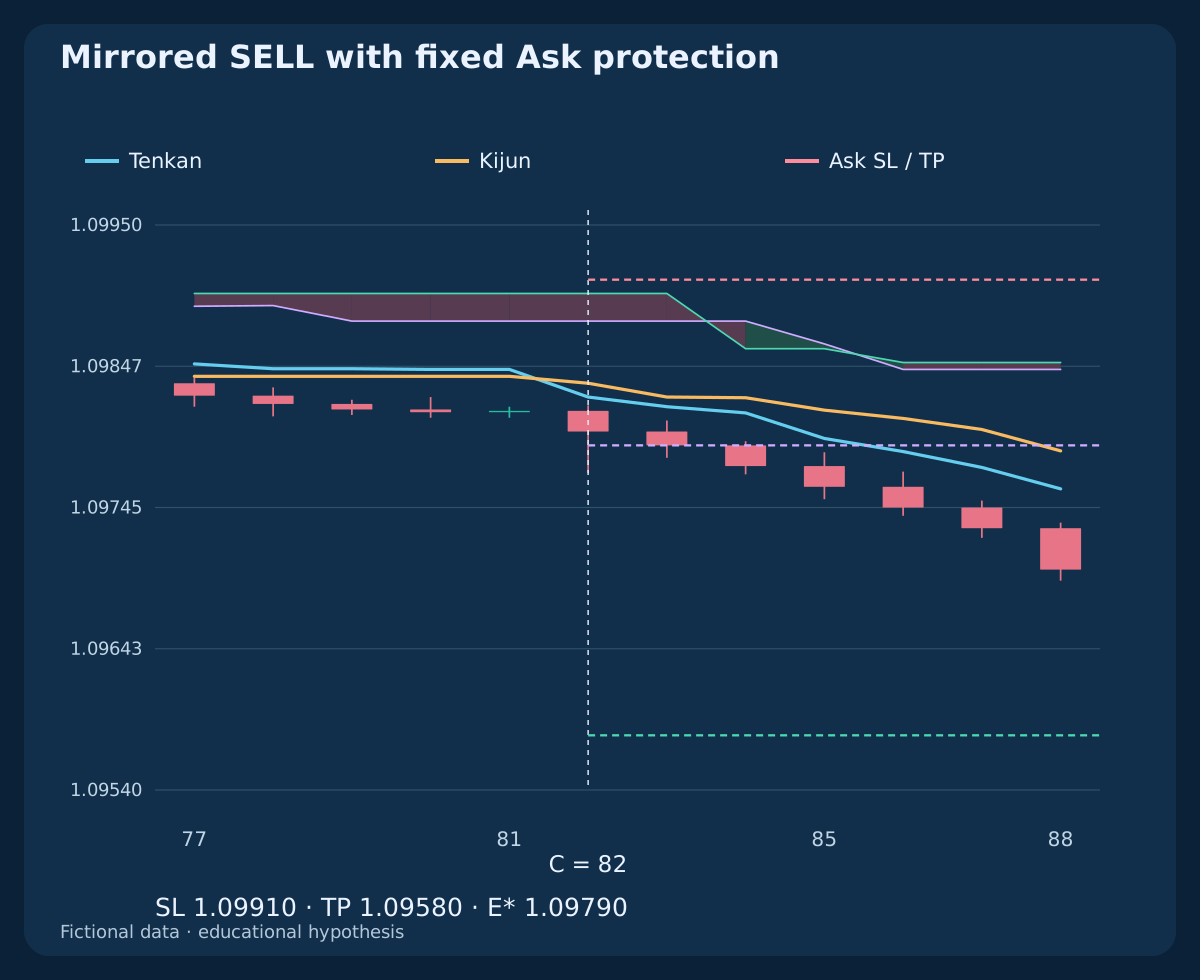
The SELL OHLC is reflected around 1.10000 using price_sell = 2.20000 − price_buy, exchanging reflected highs and lows. At C, Close = 1.09800; T = 1.09825; K = 1.09835; the cloud spans 1.09880 … 1.09900. Prior price and line-pair comparisons are strictly below their corresponding clouds.
The fixed exits are Ask SL = 1.09910; Ask TP = 1.09580. A first quote Bid 1.09792 / Ask 1.09800 gives E* = 1.09790, L_net = 13.0; G_net = 20.0 and the same ratio 20 / 13. This symmetry comes from the chosen independent quotes, not from ignoring spread. A Bid low reaching the target does not prove that Ask reached it.
| Side | Planned E* | Fixed SL | Fixed TP | Net loss, pips | Net gain, pips | Net ratio |
|---|---|---|---|---|---|---|
| BUY | 1.10210 | 1.10090 | 1.10420 | 13.0 | 20.0 | 1.538462 |
| BUY EQ | 1.10212 | 1.10090 | 1.10420 | 13.2 | 19.8 | 1.500000 |
| SELL | 1.09790 | 1.09910 | 1.09580 | 13.0 | 20.0 | 1.538462 |
11. Distinguish a request, confirmed fill and execution exception
Verify tick size, volume rules, free margin, current stop restrictions and an account workflow that supports the declared protection. Send at most one entry market request using the current permitted quote side. E* is used for admission and sizing, not substituted as an invented executable quote. The official order reference explains Bid/Ask and price restrictions.
Confirm the actual ticket, fill, volume and protection before treating a position as established. A timeout or unknown response requires reconciliation, not another request. If a fill violates the admitted plan or protection fails, follow the predefined exception rule: stop new entries, reconcile the position and seek an executable close without widening the original stop. Count every resulting cost; losses can exceed reserves.
12. Size from the complete planned loss and round down
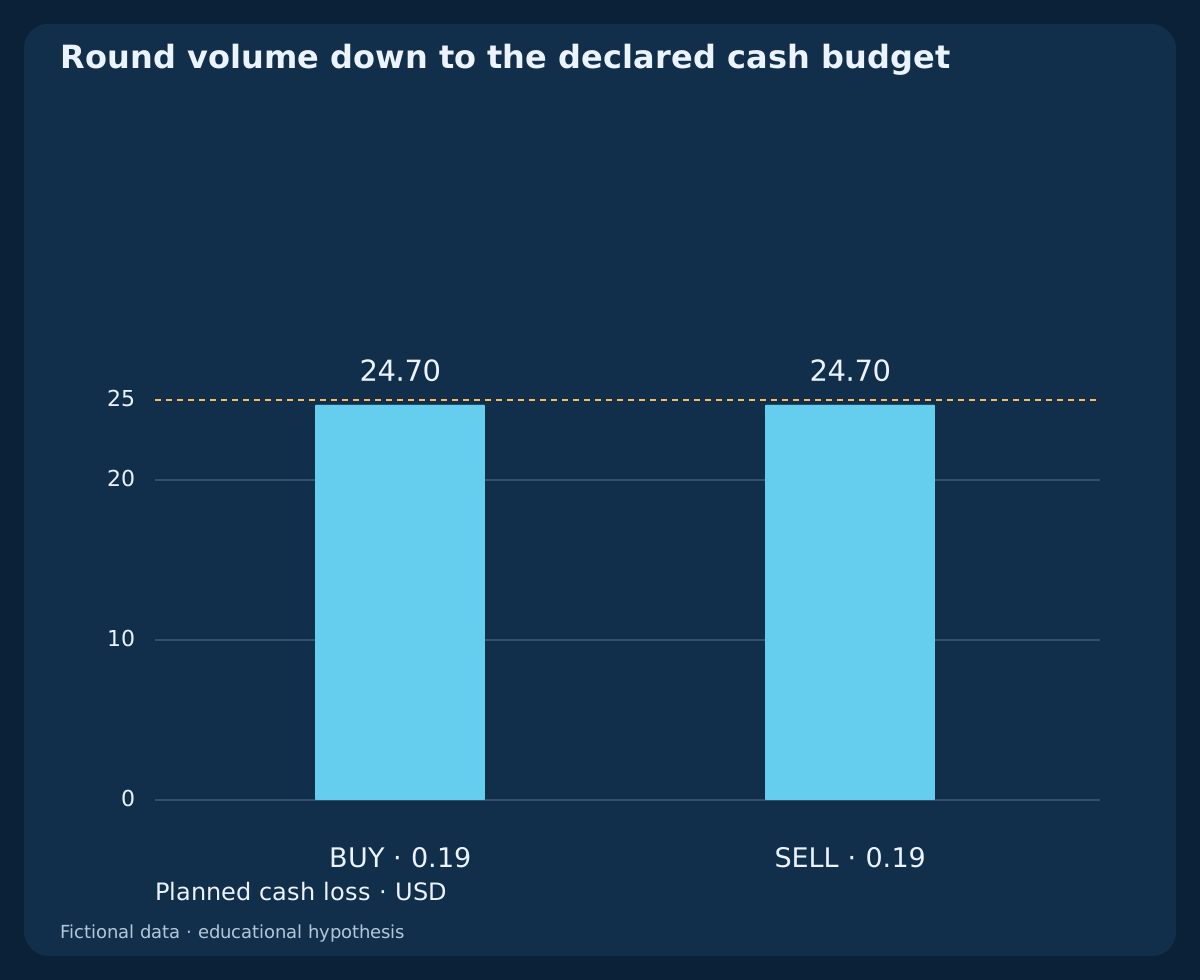
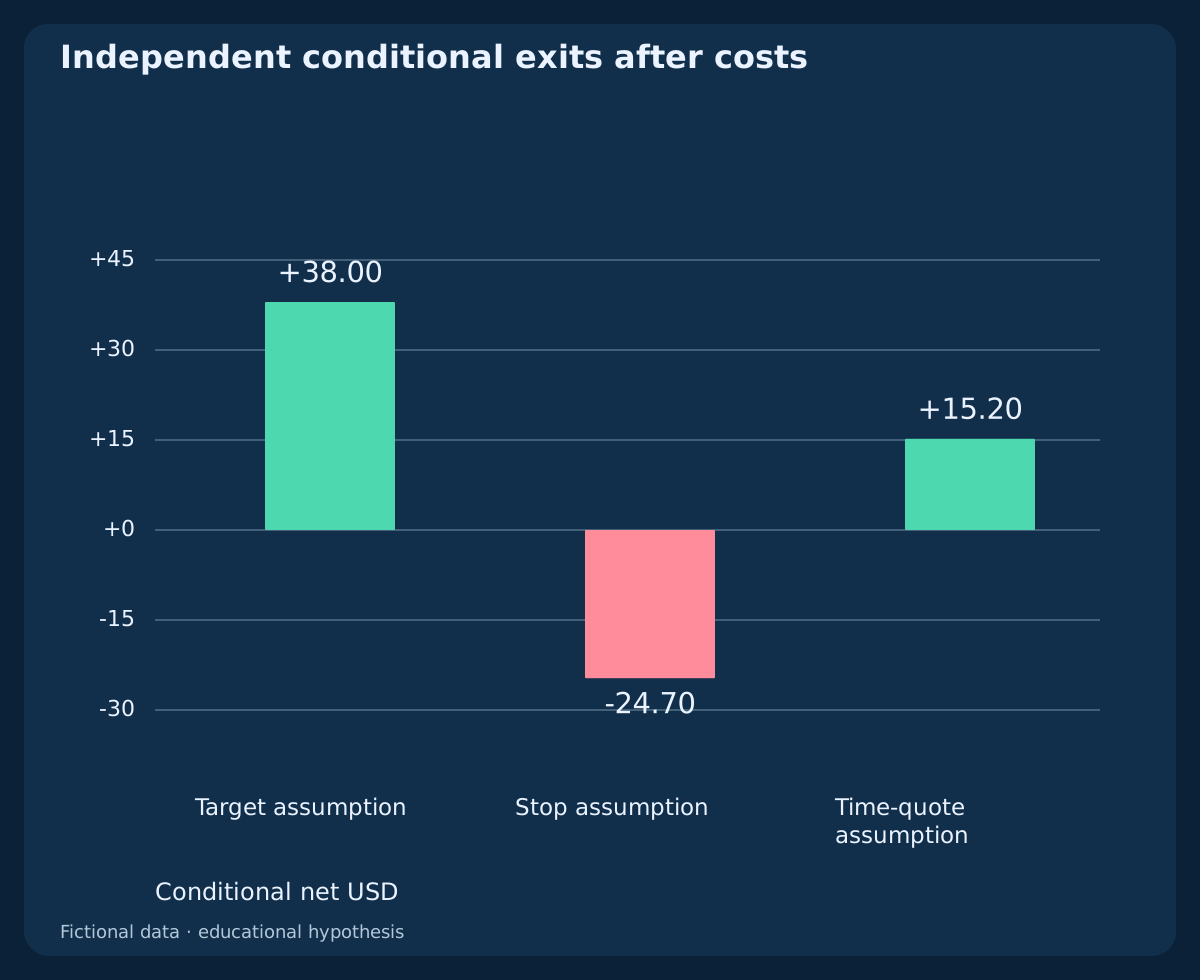
For the illustration, assume a USD account, a standard EUR/USD lot of EUR 100000, USD 10 per pip per lot, a USD 25 cash budget and 0.01 lot step. BUY loss of 13.0 pips is USD 130 per lot. floor((25 / 130) / 0.01) × 0.01 = 0.19 lot. Planned loss is USD 24.70; the conditional target amount is USD 38.00.
For SELL, loss of 13.0 pips gives 0.19 lot, planned loss USD 24.70 and conditional target amount USD 38.00. Verify actual contract and account-currency values separately. If the minimum lot exceeds the budget, skip; margin is another check. This budget is an example, not a recommended risk amount or a guaranteed maximum loss.
13. Keep protection fixed and separate the exit clock
SL and TP remain fixed. The first opposite fresh completed Tenkan/Kijun cross requests an exit at the first executable quote, without an entry context or session requirement. Unavailable required exit inputs also request an exit. A separate time exit occurs at C.close_UTC + 6 h; here that is 17:00 UTC. Anchor the clock to C, not the later fill.
Use broker-confirmed chronology for protection fills and the earliest observable exit decision. If both boundaries occur inside one OHLC candle without quote order, classify the outcome as unresolved rather than assuming a favorable sequence. Keep protection active while an exit is pending. Do not reverse on the same signal that was recognized while a position or unresolved request existed.
14. Read the conditional cash outcomes honestly
Assume the admitted BUY actually filled at 1.10210 with 0.19 lot. A target-side exit with the declared 0.4-pip adverse reserve gives +20.0 net pips, or USD 38.00; a stop-side exit with that reserve gives −13.0 pips, or −USD 24.70. These are independent assumptions, not two observed results or an execution guarantee.
In the separate time-exit example, the first executable Bid at the 17:00 deadline is 1.10300 and the assumed exit fill is 1.10296. After 0.6-pip commission, net is 8.0 pips = USD 15.20. Gaps, financing, rejected closes and larger slippage can change every result. Never turn these constructed cases into a win rate.
15. Reproduce the shifted data without looking ahead
The three files contain 360 fictional H1 OHLC rows; 7 independent quote plans; 5 conditional exits. Recompute each midpoint from the complete declared window and each displayed span from its source 26 bars earlier. Exact rational comparisons drive the reference; CSV display values use 12 decimal places. Indicator midpoints may fall between tradable ticks; order prices still require broker-valid increments.
The projection chart stops price and Tenkan/Kijun at C while showing only cloud values whose source index is no later than C. The separate continuation candles illustrate conditional exit paths; they are not future information available to entry. Keep candidate eligibility, flat-account assumptions, first quotes, requests and confirmed fills separate. These examples are not a continuous portfolio backtest.
Download three fictional H1 histories with calculated 9/26/52 lines and aligned clouds (CSV)
Download seven independent first-quote plans and admission gates (CSV)
16. Test the whole decision, including displacement errors
Predeclare parameters, gaps, costs, protection, first-observation policy and exception handling. Test unseen trending and ranging periods, flat Kijun lines, cloud-edge equality, rapid recrosses, unavailable inputs and wider spreads. Count every eligible cross and every rejected first quote. Compare settings without presenting the retrospectively best variant as proof.
A projected bullish cloud is not a forecast or an extra required filter here. Chikou is also excluded: adding a historical plotted Chikou comparison silently changes the information set. This version tests a fresh outside-cloud line crossing with established price context. The files establish reproducible logic and arithmetic only; no observed returns, live orders or measured advantage are claimed.
Frequently asked questions
Does a price close above Kumo prove a strong Tenkan/Kijun cross?
No. Both lines must be outside the correctly aligned cloud at C−1 and C, with the specified prior price context and a fresh completed cross. Price alone can pass while the line pair fails.
Which cloud belongs to the signal candle?
At C use source spans computed 26 bars earlier. Spans newly computed at C are drawn 26 bars ahead and cannot replace the cloud at C. Displacement counts bars, not invented elapsed-hour candles.
Is the target always two times the actual net risk?
No. It is frozen at twice the signal-close-to-stop distance. Ask/Bid entry, slippage, commission and exit reserves change the actual net ratio.
Can a rejected cross be repaired by a later pullback?
No. This version evaluates C and its first observed quote. Wait for a new eligible closed Tenkan/Kijun cross; a later retest belongs to a different entry rule.
Can an unknown order response be retried?
Reconcile the original request first. An unknown response may conceal a fill; a duplicate request could create excess exposure.
Are the example profits a backtest or a risk guarantee?
No. They are conditional arithmetic on fictional data and supplied execution assumptions. Real losses may exceed the planned reserve.
Sources and research notes
MetaQuotes documents Ichimoku line definitions and displacement, and market-order quote sides and restrictions. The prior-close context, two-endpoint outside-cloud test, fixed exits, first-quote policy and all numerical thresholds are this article’s research specification. These sources do not establish performance.
- MetaTrader 5: Ichimoku lines and cloud displacement
- MQL4: OrderSend, quote sides and request restrictions
Educational strategy hypothesis. Fictional OHLC and independent assumed quotes and exits; no observed orders, continuous backtest, measured advantage or guaranteed outcome.