

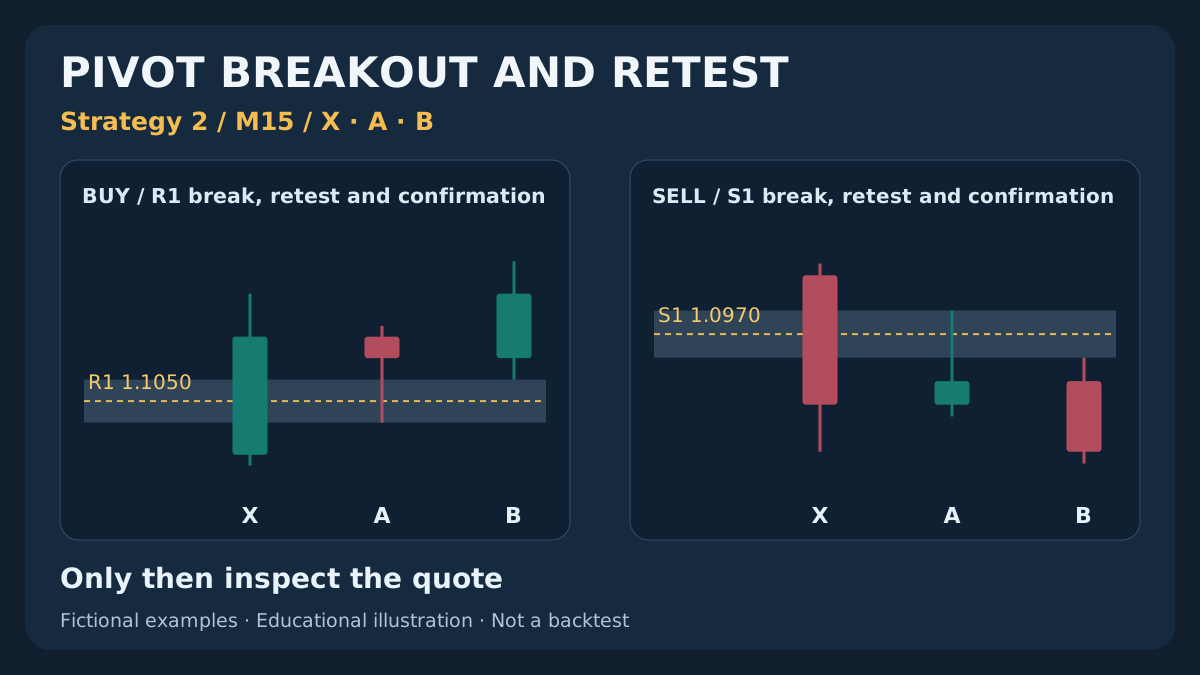
A candle closing beyond a daily pivot is not proof that the level will hold on a return. This strategy separates three observable events: a completed breakout X, the first later retest A, and the immediately following confirmation B. Only then is the first new Bid/Ask quote assessed for an entry toward the next pivot. The specification fixes expiry, invalidation, executable exits and a cost-aware risk budget. Every price path, trade and ledger below is fictional teaching material, not a demonstrated profitable system.
1. What changes when a pivot breaks rather than rejects price
A bounce asks whether price can turn back toward P from S1 or R1. This hypothesis instead asks whether a completed break beyond R1 or S1 can survive its first later return, then continue toward R2 or S2. A former resistance is only a candidate support after a break, not a proven new floor. The observed sequence does not reveal hidden orders or guarantee continuation.
Use EUR/USD and completed M15 Bid candles for the baseline. Pivots come from the same broker’s completed D1 Bid data. Other pairs, H1 signals, different pivot families or two-bar retests create separate specifications. The explicit parameters below are research choices, not optimized settings. Adding confirmation can reduce entries without creating a positive net expectancy.
The daily pivot-bounce strategy remains a different experiment. Do not turn its stopped BUY into this breakout SELL unless the independent sequence and account limits actually permit it. This is the second strategy in the pivot cluster; no live recommendation or verified performance is implied by its presence in a catalog.
2. Calculate the frozen daily map from completed inputs
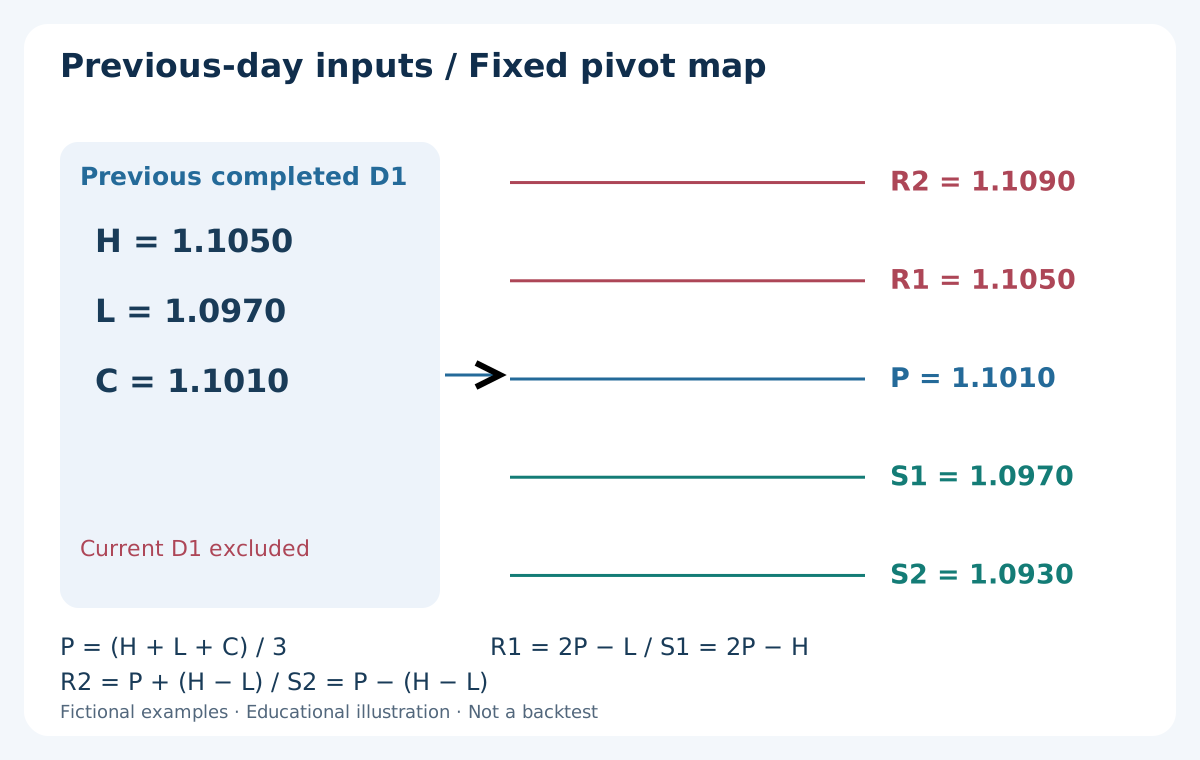
Save the latest completed broker D1 high H, low L, close C, its time boundaries and data source. Traditional formulas are P = (H + L + C) / 3, R1 = 2P − L, S1 = 2P − H, R2 = P + (H − L), S2 = P − (H − L). Do not substitute the current unfinished D1. Keep calculation precision for comparisons; round actual order prices separately to a permitted tick.
The fictional previous day has H = 1.1050, L = 1.0970 and C = 1.1010. This gives P = 1.1010, R1 = 1.1050, S1 = 1.0970, R2 = 1.1090 and S2 = 1.0930. The convenient coincidence of R1/S1 with the prior extremes comes from these chosen inputs, not a general property. Require L ≤ C ≤ H and H > L; reject missing, zero or inconsistent data.
Keep a saved broker calendar and the date-specific UTC offset. If the latest completed D1 is an abbreviated Sunday/holiday session or lacks expected bars under that calendar, skip the current day rather than quietly selecting an older D1. Do not merge Sunday data after seeing an outcome. The pivot formulas and time-zone guide explains why broker-midnight and New York-close maps can differ.
3. Fix the observation band, clocks and expiry before a signal
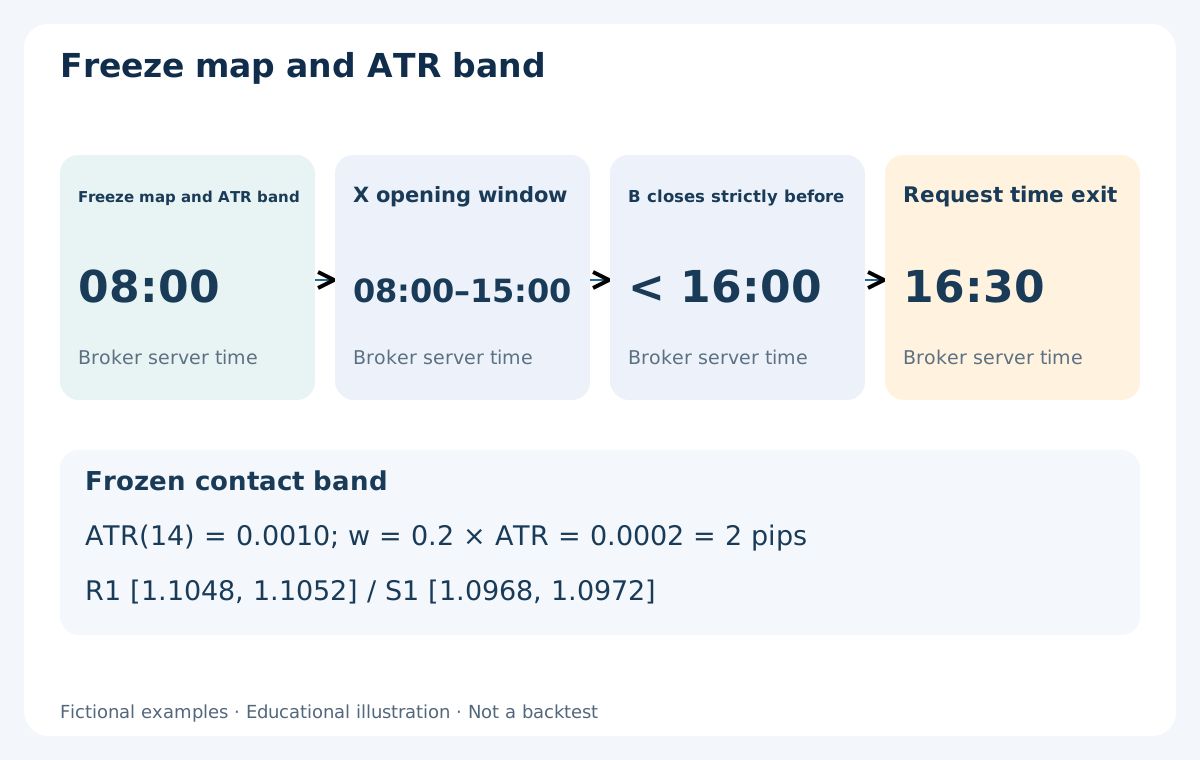
At 08:00 broker server time, save the map and ATR(14) from completed M15 candles, including the one opened at 07:45. Freeze the band half-width w = 0.2 × ATR for the day. Here ATR = 0.0010, so w = 0.0002 or 2 pips. R1 is surrounded by [1.1048, 1.1052] and S1 by [1.0968, 1.0972]. The band is an observation tolerance, not a stop distance. Require an initialized positive ATR and complete expected history; never replace a failed read with zero.
Watch breakout candles X opening from 08:00 through 15:00 inclusive. The first retest must occur among the next 3 completed M15 candles after X; B is immediately after that retest and must close strictly before 16:00. Request a time exit for any remaining position at 16:30. All are arbitrary server-clock research hours, not universal London times. A nominal close is usable only when subsequent data make the completed candle available.
Fix buffer b = 1 pip, maximum entry spread s = 2 pips, adverse-execution allowance a = 1 pip, quote age at most 2 seconds and entry deadline 5 seconds after B’s scheduled close. Require conservative net reward-to-risk ≥ 1.5. Here one pip is 0.0001; a five-decimal point is 0.00001. Check the real minimum tick increment rather than treating pip, point and tick as interchangeable. Reject crossed or invalid quotes; require 0 ≤ Ask − Bid ≤ s.
| Parameter | Baseline value | What is fixed |
|---|---|---|
| Market / level source | EUR/USD · M15 Bid | Previous completed broker D1 |
| Band half-width | w = 0.2 × ATR(14) | 08:00 snapshot; example 2 pips |
| Breakout / session | X opens 08:00–15:00 | B closes before 16:00; exit request 16:30 |
| First retest / confirmation | A within 3 bars after X | B immediately follows A |
| Buffer / spread / allowance | b = 1 · s = 2 · a = 1 pip | Conservative net ratio ≥ 1.5 |
| Quote age / entry deadline | 2 seconds / 5 seconds | First subsequent quote only |
| Daily limit / risk budget | 1 filled entry · 0.5% | Round volume down; no loss guarantee |
4. Define the first breakout attempt and its state transitions
Use the last completed 07:45 candle as the 08:00 seed. If its close is already above R1 + w, disable the BUY direction that day; if already below S1 − w, disable SELL. For each enabled direction, consume the first M15 close strictly beyond its outer edge inside the X window. The attempt is spent even if that candidate subsequently fails eligibility. Repeated closes outside do not create repeated attempts.
A BUY X needs the preceding close strictly between P and R1 − w, then X.close > R1 + w. SELL mirrors this: S1 + w < preceding close < P, then X.close < S1 − w. A prior close inside the band or equal to a required boundary fails. Reject an opening gap with BUY X.open > R1 + w or SELL X.open < S1 − w. Also cancel BUY if X.low ≤ S1 − w, or SELL if X.high ≥ R1 + w, and reject a missing predecessor; do not infer a useful intrabar order from OHLC.
Also require X’s extension beyond the outer edge to be no more than the frozen ATR: X.close − (R1 + w) ≤ ATR for BUY, or (S1 − w) − X.close ≤ ATR for SELL. X must not already touch the reference-side target: X.high < R2 − b or X.low > S2 + b. State progresses from watch to breakout, first return, confirmation and quote, or to cancellation. Only one filled entry per broker day and one open strategy position are allowed.
5. BUY: a later R1 retest A and a separate confirmation B
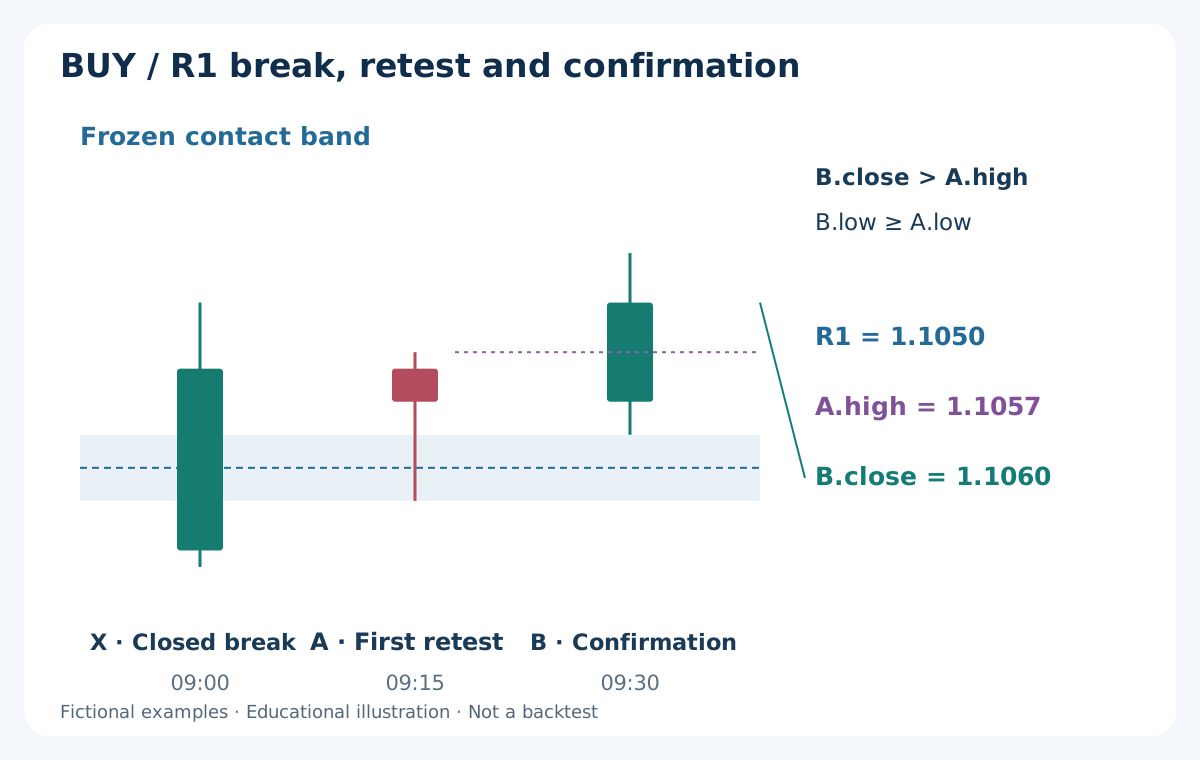
After a valid X, examine only the next 3 completed M15 candles. The first whose [low, high] overlaps the R1 band becomes A. It must approach from a preceding close above R1 + w, keep A.low ≥ R1 − w and close strictly above R1 + w. A low exactly on the far edge is allowed; a close exactly on the upper edge is not. X’s earlier low cannot be relabelled A.
From the candle after X onward, any completed low below R1 − w cancels, even if that candle closes back above. A bar that gaps entirely below the band also cancels rather than proving a retest. Before entry, any high reaching R2 − b cancels because the specified target has already been visited. If the first contact is invalid, do not select a later prettier A or restart the 3-bar clock.
B must be the candle immediately after A, with B.close > A.high, B.low ≥ A.low and B.high < R2 − b. In this notation high, low and close mean the candle’s high, low and closing price. The equal low is permitted, but equal close at A.high fails. A new low cancels; it does not move the eventual stop. After B, require the first quote to retain Bid > A.high and Ask ≤ B.close + s before the common checks.
6. SELL: retest S1 from below and protect the Ask side
After a valid downward X, A is the first band-overlap candle among the next 3 completed M15 bars. Its preceding close must be below S1 − w. Require A.high ≤ S1 + w and A.close < S1 − w. The far-edge high may equal the boundary; the close cannot equal the lower edge. From X’s next candle onward, any high above S1 + w cancels, including a gap back across the band.
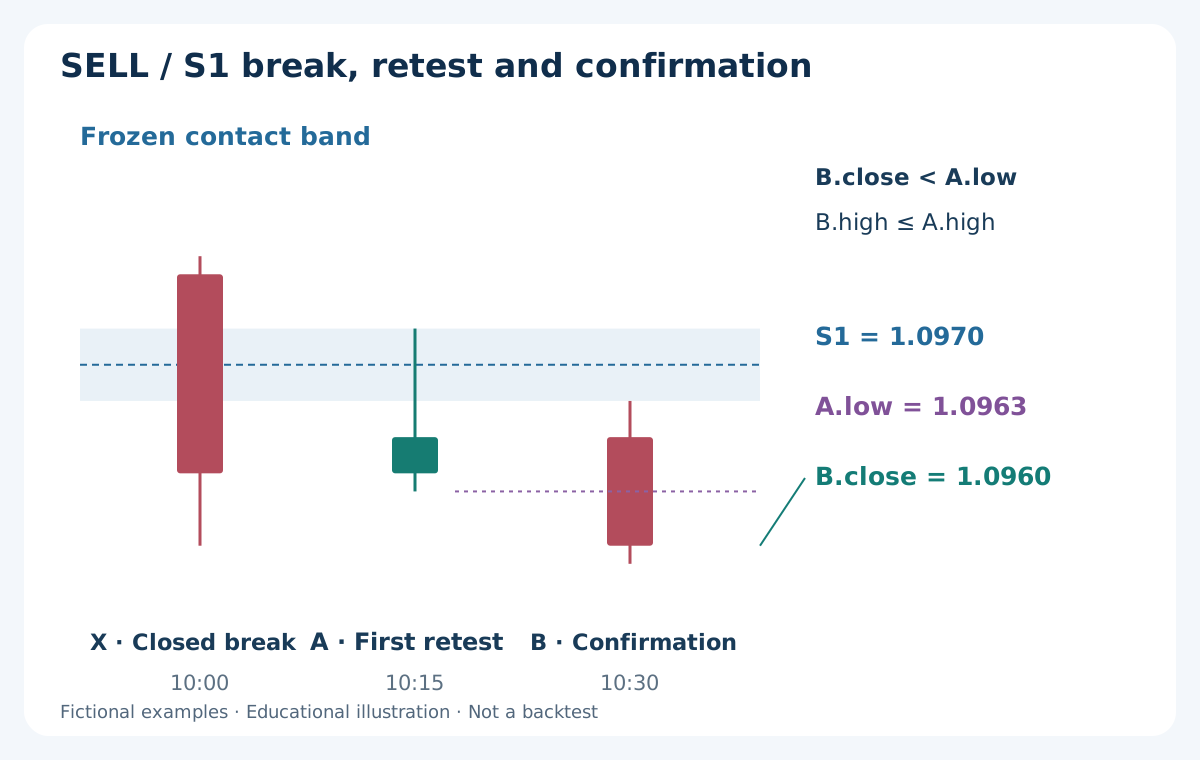
Before entry, any low at or below S2 + b cancels. The immediately following B needs B.close < A.low, B.high ≤ A.high and B.low > S2 + b. Do not replace A with a later contact or move its extreme after B. At the first new quote, require Bid < A.low and Bid ≥ B.close − s, in addition to deadline, age, spread, costs and volume checks.
A market SELL enters at Bid. Fix the protective Ask stop at A.high + b + s and the Ask target at S2 + b + s. The fixed 2-pip allowance s is not an observed historical Ask high. At a constant 2-pip spread the target corresponds to Bid S2 + b, before S2. Later spread widening can change that mapping or trigger a short stop while the displayed Bid remains below its Ask level; keep actual quote-side evidence.
7. Distinguish the retest deadline from the confirmation deadline
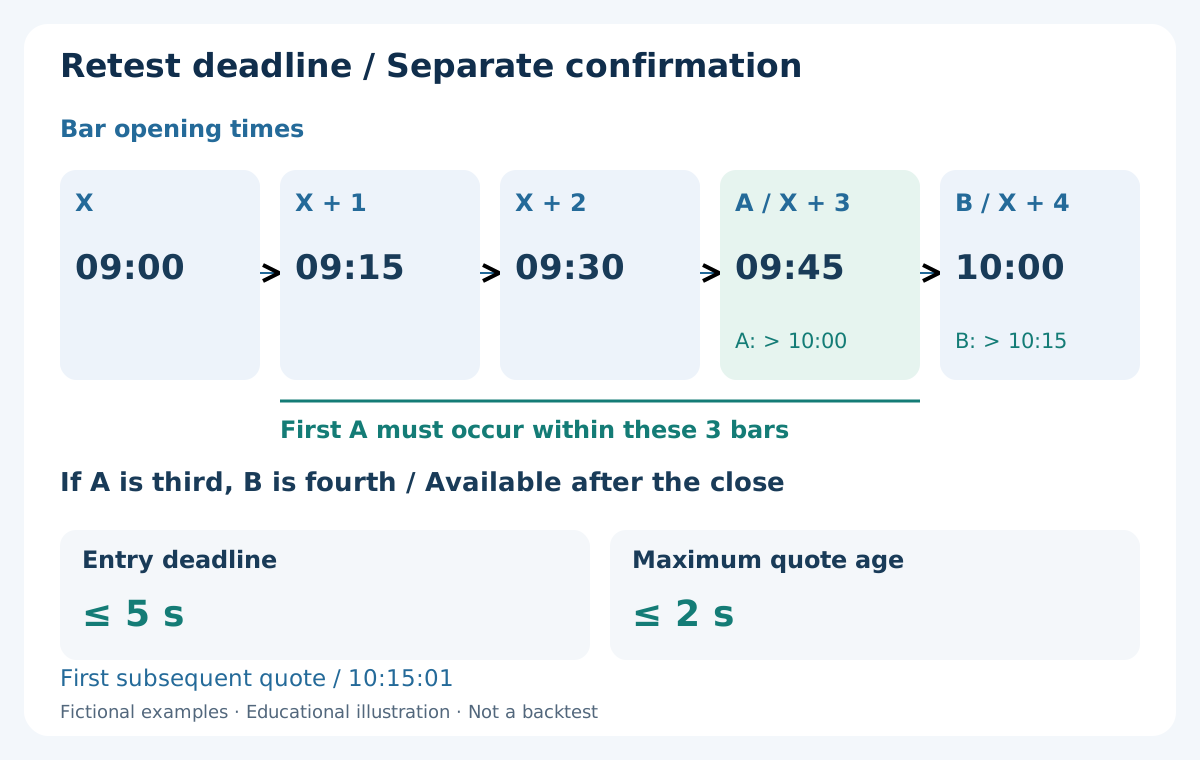
Suppose X opens at 09:00 and becomes available after 09:15. The next three retest candidates open at 09:15, 09:30 and 09:45, becoming available after 09:30, 09:45 and 10:00. If A is the third candidate, B opens at 10:00 and is known after 10:15. B may therefore be the fourth bar after X; the 3-bar limit applies to the first return A, not to the entire sequence.
If no contact occurs by the third candidate’s close, cancel rather than chase a later return. If the session cut-off or missing data prevents full observation, record session-expired or incomplete, not a fully observed no-retest case. Every B still must close before 16:00: exactly 16:00 fails. The earliest possible B after an X opened at 15:15 would close at 16:00, which is why the X opening window ends at 15:00.
Once B is available, inspect only the first received Bid/Ask snapshot. It must arrive within 5 seconds of B’s scheduled close and be at most 2 seconds old. Use this symbol’s timestamp and a synchronized receipt clock, rejecting future-dated or untimed quotes; another symbol’s clock update does not prove freshness. If spread, price confirmation, target room or risk fails, skip without waiting for a better second quote. Cancel in this order: data/session, far-edge or prior-target failure, invalid/expired A, invalid B, used daily state, then quote/cost/volume. A missing B, rejected order or unknown acknowledgement cannot be repaired with a historical fill at X’s break price; reconcile broker tickets before another request.
8. Worked BUY: X, A and B before the next Ask
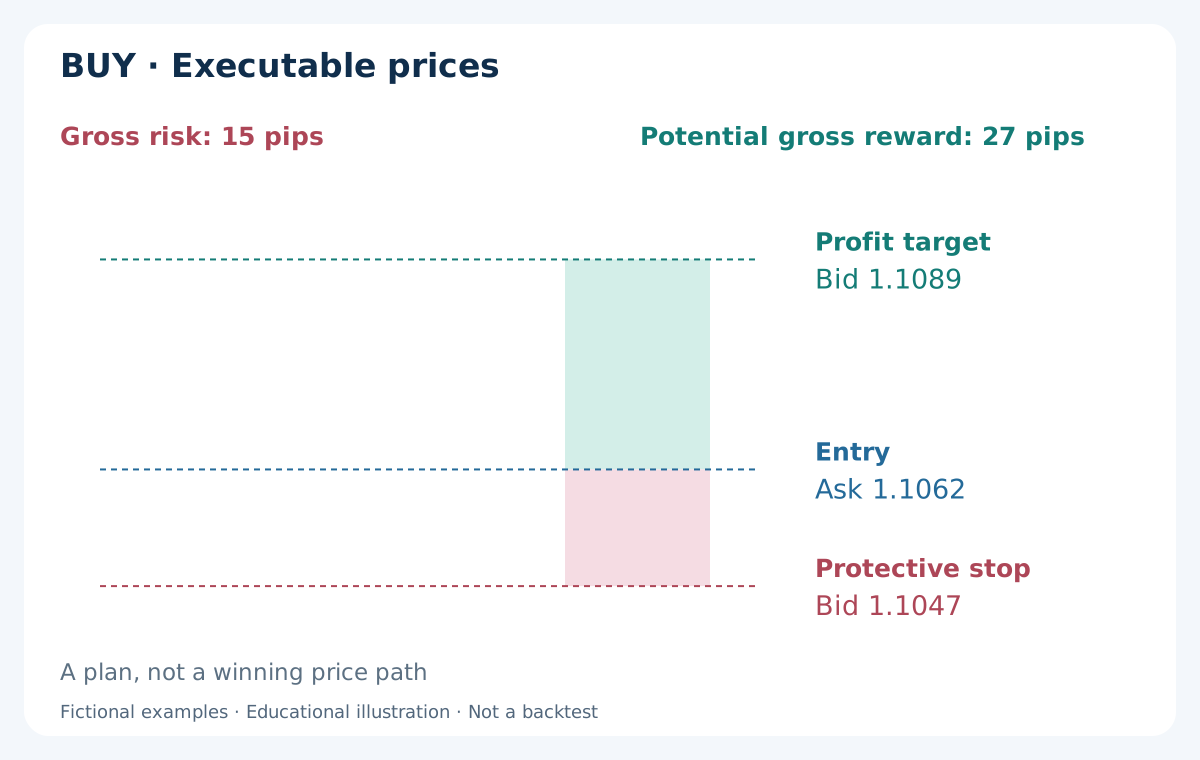
Use R1 = 1.1050, R2 = 1.1090, P = 1.1010 and w = 0.0002. The preceding close is 1.1045. X at 09:00 has open 1.1045, high 1.1060, low 1.1044, close 1.1056; its break is known after 09:15. A at 09:15 has open 1.1056, high 1.1057, low 1.1048, close 1.1054. It is the first later return, with its low exactly on the permitted far edge.
B at 09:30 has open 1.1054, high 1.1063, low 1.1052 and close 1.1060. Confirmation is available after 09:45. Assume the first fresh quote at 09:45:01 is Bid 1.1060 / Ask 1.1062 and the BUY fills at Ask 1.1062 with protection accepted. Bid exceeds A.high and Ask = B.close + s, an allowed equality. No entry at X’s earlier close or A’s earlier low is assumed.
The fixed Bid stop is A.low − b = 1.1047 and the Bid target R2 − b = 1.1089. Gross risk is 15 pips and potential gross reward 27 pips, a gross ratio of 1.8. The chart is an exit plan, not a winning trajectory. In a separate losing continuation, Bid can reach 1.1046 and the stop fill there instead of 1.1047, causing a 16-pip price loss. A protective order does not guarantee its requested price.
9. Worked SELL: the independent mirrored sequence
Use a separate scenario, not a second filled entry on the BUY example’s day. S1 = 1.0970, S2 = 1.0930, P = 1.1010, w = 0.0002 and the preceding close 1.0975. X at 10:00 has open 1.0975, high 1.0976, low 1.0960, close 1.0964. A at 10:15 has open 1.0964, high 1.0972, low 1.0963, close 1.0966. Its far-edge high is equal to the permitted boundary.
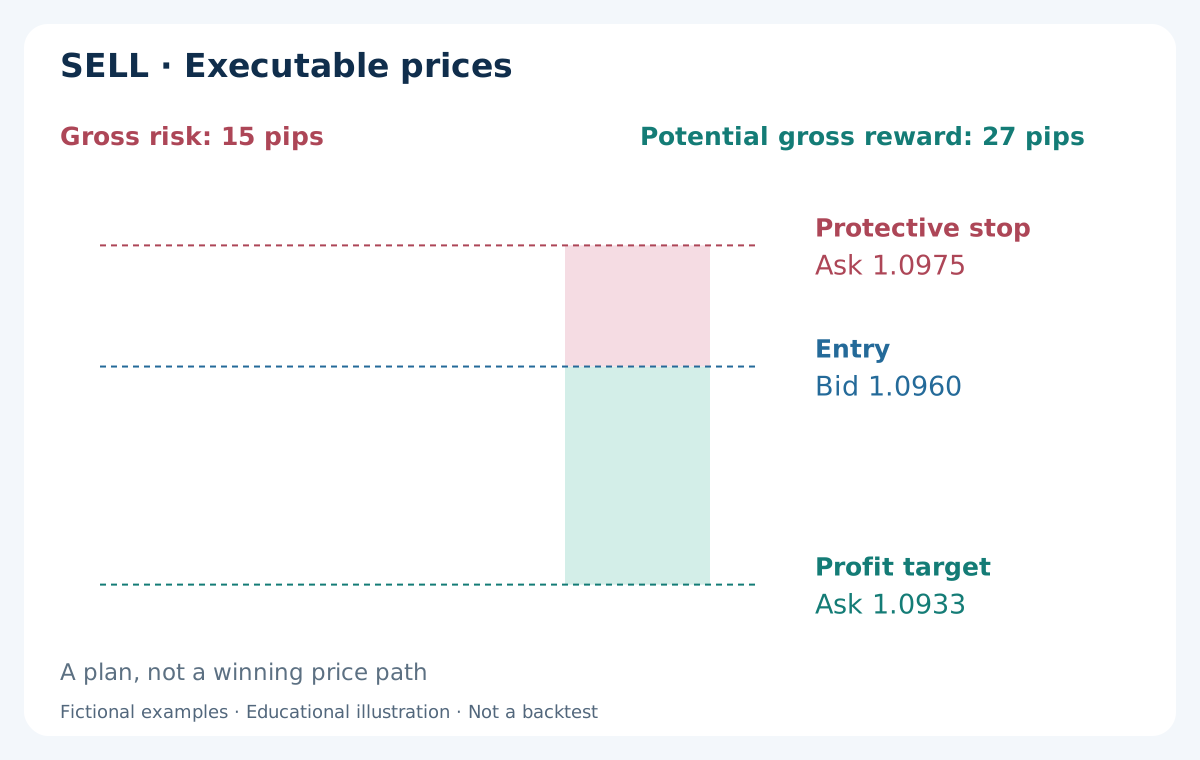
B at 10:30 has open 1.0966, high 1.0968, low 1.0959 and close 1.0960. Assume the first fresh quote at 10:45:01 is Bid 1.0960 / Ask 1.0962 and the SELL fills at Bid 1.0960 after confirmation. A is known after 10:30 and B after 10:45. The earlier high of A is not a post-entry stop event.
The fixed Ask stop is 1.0972 + 0.0001 + 0.0002 = 1.0975. The Ask target is 1.0930 + 0.0001 + 0.0002 = 1.0933. Gross risk is 15 pips and potential gross reward 27, again 1.8. With constant 2-pip spread the corresponding Bid stop and target are 1.0973 and 1.0931. A Bid touch alone does not prove either Ask exit executed; the order-types guide explains the distinction.
10. Use the next pivot as a fixed target and check obstacles
BUY uses Bid target R2 − b; SELL uses Ask target S2 + b + s. These are the next fixed Traditional references, not a target recalculated from the developing day. The BUY stop is Bid A.low − b; SELL protection remains Ask A.high + b + s. Round a stop away from entry and a target toward entry on the actual permitted tick grid, then recalculate risk and room.
The baseline obstacle map contains prior D1 H/L and a zero-anchored grid of 100-pip round numbers, with halves and quarters disabled. Skip if a reference lies strictly between current Bid and the reference-side target R2 − b for BUY or S2 + b for SELL. None does in the two worked plans. Save this list before 08:00. Extra swing zones or half-level filters are new specifications, not discretionary additions after a loss.
The support/resistance guide and round-number guide explain different references. Overlapping lines do not supply independent probability votes. An earlier target touch, excessive X extension or an invalid first retest remains a cancellation even if price later continues beautifully; do not use the later path to choose the earlier rule.
11. Apply costs and the adverse-execution allowance before sending
Let r be executable stop distance and g executable target distance in pips. Convert round-trip commission into c pips using the actual pip value in account currency. Require (g − a − c) / (r + a + c) ≥ 1.5 with positive numerator and denominator. The a = 1 pip allowance covers one assumed adverse entry-or-exit difference; spread is already present in executable prices and is not subtracted again.
For r = 15 and g = 27, USD 7 commission per standard lot and USD 10 per pip give c = 0.7. Gross ratio 1.8 becomes 26.3/15.7 ≈ 1.68 after commission at the unchanged fills. The conservative planning ratio is (27 − 1 − 0.7) / (15 + 1 + 0.7) = 25.3/16.7 ≈ 1.51. Its margin above 1.5 is small; this is a sensitivity example, not proof of a robust advantage.
In a separate BUY variant B.close = 1.1061 and the first quote is Bid 1.1061 / Ask 1.1063. Spread and overshoot remain within 2 pips, but the unchanged stop/target give r = 16 and g = 26. The planning ratio is 24.3/17.7 ≈ 1.37, so skip. A later cheaper quote does not revive it. An entry spread of 3 pips would fail the spread check first; record one primary reason rather than double-counting the same skip.
12. Size in the deposit currency and keep the lot-step budget
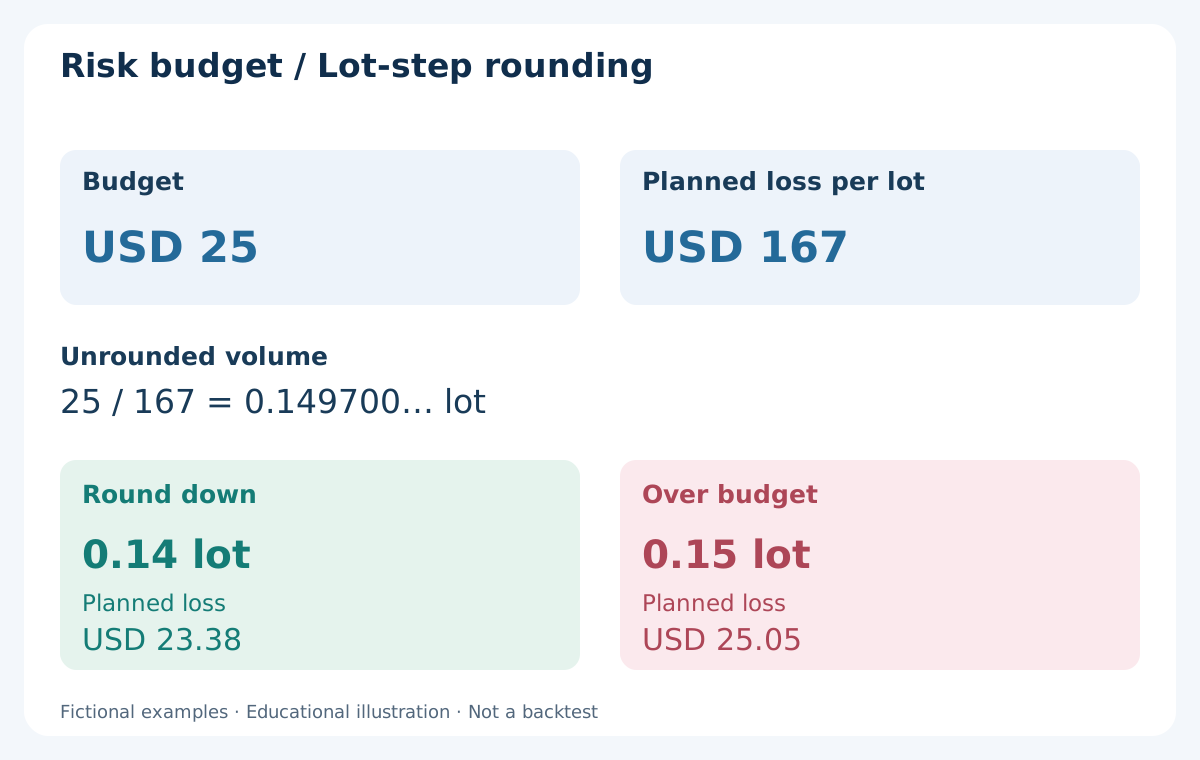
For USD 5000 equity and a 0.5% planning budget, risk budget is USD 25. Assume EUR/USD, a 100000 EUR standard lot, USD 10 per pip per lot and USD 7 round-trip commission per lot. With the 15-pip stop plus 1-pip allowance, planned loss per lot is (15 + 1) × 10 + 7 = USD 167. Raw volume is 25/167 = 0.149700… lot.
A 0.01 volume step requires rounding down to 0.14 lot, with USD 23.38 planned loss. Rounding up to 0.15 gives USD 25.05 and breaches budget. With the unchanged illustrative fills, gross stop loss is USD 21 plus USD 0.98 commission, or USD 21.98. Potential gross target gain is USD 37.80 less USD 0.98, or USD 36.82. These are conditional amounts, not observed returns.
Verify actual contract size, tick value in deposit currency, conversion, lot limits and margin. Quote currency USD does not imply a USD account. If minimum volume exceeds budget, skip. Slippage, gaps and conversion can exceed the allowance. The position-sizing guide and trading-cost guide provide the broader checks. A budget is a planning constraint, not a maximum-loss guarantee.
13. Reconcile execution, fixed exits and the daily lock
Check trading permission, tick grid, stop distance, volume and margin before submission. MQL4 MODE_TICKSIZE is in points, so multiply by Point for a price distance; MODE_STOPLEVEL = 0 may still involve dynamic restrictions. The baseline requires acceptance of stop and target with the opening request. If protection cannot be accepted, skip rather than intentionally open unprotected or widen the stop to avoid rejection.
After a fill, reconcile real entry, protection and actual distances. Reduce remaining a by the realized adverse entry difference, floored at zero, instead of adding the full allowance twice. If protection is absent, the 1.5 cost gate fails or planned loss exceeds budget, request an immediate close under the exception rule and retain its real outcome. Uncertain responses must be matched to broker tickets before any resubmission; a timeout may already have filled.
Keep stop and target fixed: no averaging down, partial exit, trailing, automatic break-even or reverse entry belongs to this version. Request a market close at 16:30 if still open and record the actual fill or failed close. One filled entry uses the day’s allowance, preserved across restarts. Reset only on a confirmed new broker day with no old or unresolved position. Other EAs and pivot strategies need a separately declared account-wide exposure limit, not an assumption that their risks are independent.
14. Test availability and execution rather than a finished pattern
Rebuild D1, the 08:00 ATR snapshot, seed state, first X and first A with information available then. An indicator that uses the day’s final high/low or redraws past bands can make a completed pattern appear earlier than it existed. Separate X, A and B by their actual completed bars. The breakout candle’s own wick is not a later retest, and a third-bar A cannot justify an entry before the fourth-bar B closes.
M15 OHLC can classify many signal conditions, but not the first quote’s age, the 5-second entry window, actual Ask exits or order of two exit touches in one candle. Use ordered Bid/Ask ticks and broker records. Mark missing histories and ambiguous exits explicitly instead of assuming a target came first. Include spread changes, commission, rejected requests, adverse fills and the time exit.
Separate development, chronological out-of-sample testing and forward observation. Retain every tested pivot feed, ATR factor, retest horizon, hour window and threshold rather than publishing only the best combination. Report net expectancy, drawdown, counts and cost sensitivity. The MT4 backtesting guide explains platform limitations. A high reaction rate or a minimum sample count cannot establish future profitability.
15. Keep cancellations and missing coverage out of invented win rates
Log broker day/UTC offset, D1 H/L/C and times, P/R1/S1/R2/S2, 08:00 ATR and bands, seed and preceding closes, first X, each retest candidate, A/B OHLC and availability. Add cancellation reason, first quote timestamp/age/spread, rounded exits, r/g/c/a, cost ratio, budget, volume, request response and real fills. A screenshot supplies context rather than replacing the sequence record.
An invented ledger across several broker days has 12 fully observed first-break attempts: 2 invalid X, 2 with no retest in the full window, 2 invalid A, 2 invalid or expired B, 1 quote/cost skip and 3 fills. Of the 3 fills, 1 reaches target, 1 reaches stop and 1 exits by time. Three fills out of 12 is 25% execution frequency, not a win rate; 1/3 target exits is not a validated win rate either. A timed exit may be positive or negative after costs.
Another 2 histories lack required tick coverage and are reported separately, not counted as no-retest or resolved performance. Report this missingness and sensitivity, rather than silently dropping inconvenient data. Store the first cancellation reason plus optional extra flags; do not count one attempt twice. Rule-changing editorial or code corrections require a new version and rerunning the affected sample.
16. A practical review before enabling the experiment
Before 08:00 check the broker calendar, completed D1 and contract. At 08:00 freeze levels, ATR, bands, obstacles, parameters, seed state and budget. In the window, consume the first breakout attempt, allow only the first return within 3 bars, then require immediate B before the session deadline. Before sending, check the first quote, age, 5-second deadline, tick rounding, costs, protection, size, margin and unused daily allowance.
After entry, reconcile the fill and protection, use the exception rule if necessary, then retain fixed exits and the 16:30 close request. Afterwards include cancellations, skips, rejects, losses, time exits and incomplete cases in the journal. The aim is a reproducible decision record that can reject an unprofitable hypothesis, not a chart narrative that always finds a successful retest.
The three price-level guides explain how references are produced; the S1/R1 bounce strategy applies a different directional idea. Keep experiment identifiers and risk records separate. A later Camarilla strategy will need its own levels and invalidation; it should not be blended into this Traditional breakout rule after seeing results.
Frequently asked questions
What is a pivot breakout-and-retest strategy?
It tests continuation after a completed R1 or S1 break, a separate first later return and an immediately following confirmation bar. This version uses Traditional daily levels, M15 Bid signals, fixed expiry, next-pivot targets and cost-aware execution. It is a research specification, not a demonstrated profitable system.
Can the breakout candle count as its own retest?
No. X must close first. A is the first band-overlap candle among the next 3 completed M15 bars. A wick inside X occurred before its breakout was known and cannot stand in for a later return. B must then be the candle immediately after A.
Does confirmation also have to finish within three bars?
The 3-bar deadline applies to A. If A is the third bar after X, B can be the fourth, provided it closes before 16:00 server time. A missing or invalid first A is not replaced with another contact, and B closing exactly at 16:00 fails.
Where are the stop and target placed?
BUY uses Ask entry, Bid stop A.low − b and Bid target R2 − b. SELL uses Bid entry, Ask stop A.high + b + s and Ask target S2 + b + s. Here b = 1 pip and s = 2 pips. The spread allowance does not reconstruct historical Ask or guarantee a stop price.
Why skip a confirmed pattern with a gross ratio above 1.5?
The gate uses costs and the adverse allowance: (g − a − c) / (r + a + c) ≥ 1.5. In the higher-price BUY variant, 16-pip risk and 26-pip potential reward become a planning ratio about 1.37. A gross chart ratio alone does not establish sufficient executable room.
Is a retest safer or more profitable than entering the break?
This article does not establish that. Waiting can miss continuations, create later fills or still precede losses. All examples and the 12-attempt ledger are invented; another 2 incomplete histories are tracked separately. Compare fixed alternatives with realistic quotes, costs, chronological out-of-sample and forward data. A 0.5% planning budget does not guarantee a maximum loss.
Sources and execution notes
Platform documentation is used to check Traditional pivot formulas, data conventions and Bid/Ask execution. The X/A/B rules, expiry, parameters, price paths and ledger are original fictional teaching exercises; the cited sources do not validate their profitability.
Educational content. All diagram prices, trade examples and ledger counts are fictional. Forex trading involves risk; protective stops and planning budgets do not guarantee a maximum loss.