

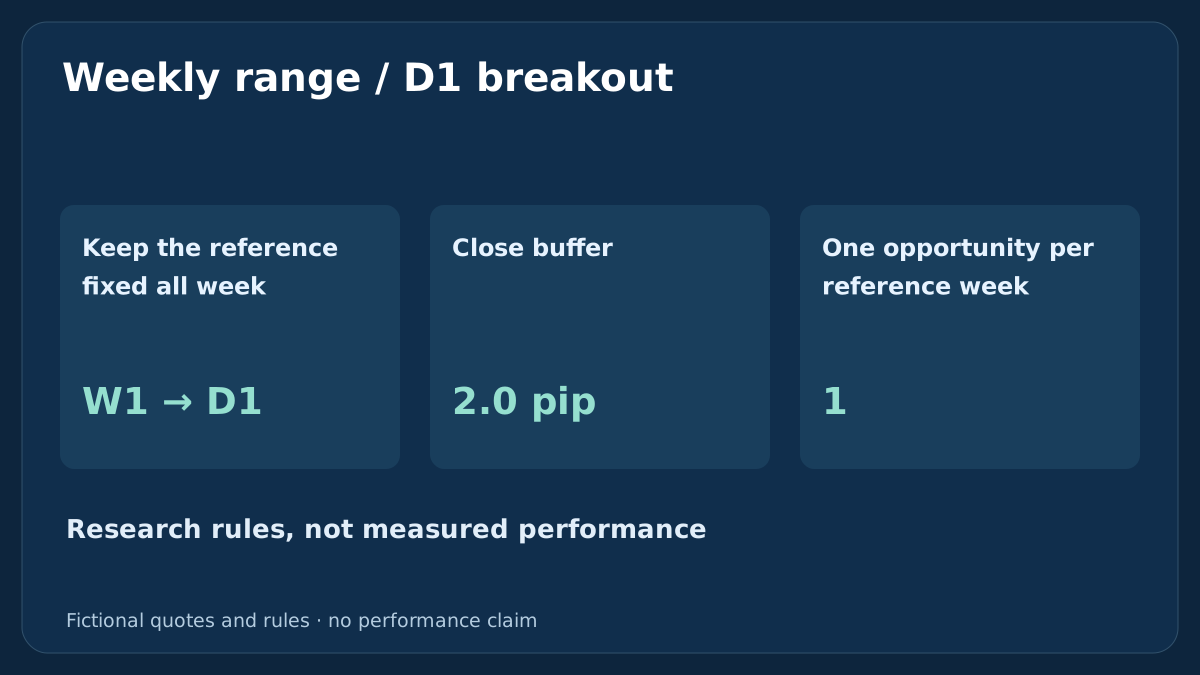
A weekly breakout needs more than a price crossing last week’s high. This research model freezes one completed weekly range, waits for a later daily close and evaluates one subsequent quote. The worked rules connect the signal to executable price sides, position size, financing and an explicit end to the holding period.
1. Define a weekly model before calling it a breakout
This model uses one configured EUR/USD symbol and one completed calendar trading week as a fixed reference. It is not a rolling channel updated after every new bar. The existing Donchian-channel strategy has a different reference and decision process. Here a daily close creates an opportunity; an intraday touch alone does not create an order.
Treat every numerical setting below as a frozen teaching assumption, not an optimised or recommended live parameter. No historical profitability has been established. The H4/D1 swing-trading guide provides the holding-risk context. This article specifies a candidate that can be rejected after realistic testing.
2. Freeze the instrument, calendar and limits
Assume an EUR 100000 standard contract, USD account, point and tick size 0.00001, and 1 pip = 0.0001, giving USD 10 per pip per lot. The example calendar has daily boundaries at 21:00 UTC throughout the illustrated summer weeks. That is an explicit dataset convention, not a universal MT4 setting. Map actual historical server offsets before using another date or feed.
The table fixes the remaining parameters. A normal reference week needs five regular daily sessions, including the calendar’s ordinary breaks, with verified data; a holiday-shortened or unverified reference is rejected. Eligible signal closes are Monday through Thursday, before the Friday cutoff. Use the daily-candle protocol to define those sessions, not a convenient set of five rows.
| Parameter group | Frozen assumption | Interpretation |
|---|---|---|
| Instrument and prices | EUR/USD · Bid · USD | Use the exact symbol and declared price side |
| Reference week | 5 D1 · 40–250 pip | Regular verified sessions; width bounds included |
| Close quality | 2.0 pip · 20.0 pip | Strict buffer break; maximum extension |
| Entry timing | 60 s · 2 s | Boundary-based expiry; maximum quote age |
| Quote and reward gates | 1.5 pip · 3.0 pip · 1.4 | Maximum spread, maximum drift, minimum planned net ratio |
| Protection | 10 pip · 2.0R | Stop inside broken edge; target from first entry quote |
| Budget and volume step | 0.5% · 0.01 lot | Equity budget; round volume down |
| Planning costs | 0.6 + 1.0 + 2.0 pip | Commission, combined adverse fills, holding allowance |
| Holding limits | 3 D1 · 20:45 UTC | Subsequent boundaries or Friday cutoff, whichever comes first |
3. Complete the weekly reference and leave it unchanged
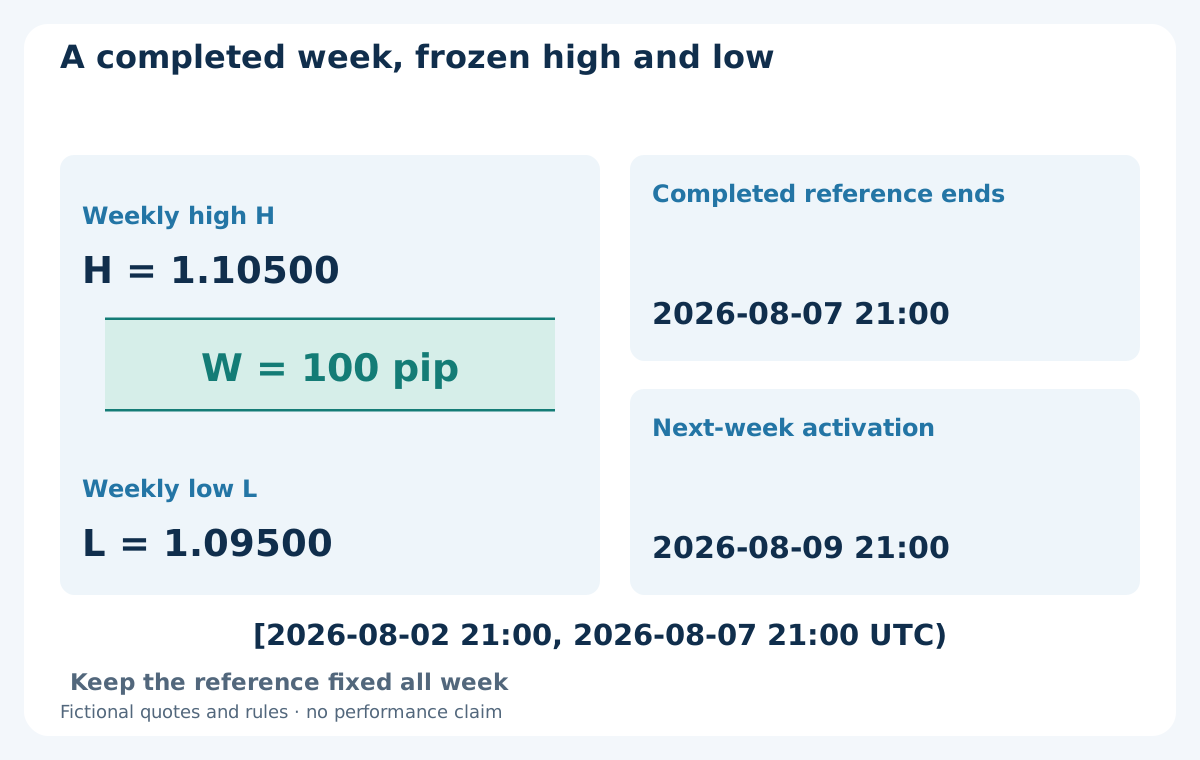
For this fictional dataset the reference is [2026-08-02 21:00, 2026-08-07 21:00 UTC), covering five daily sessions. Its verified summary has high H = 1.10500 and low L = 1.09500, so width W = 100 pips, within the inclusive 40–250-pip gate. These are invented summary inputs, not a supplied historical quote archive. Include the start and exclude the end.
Activate that reference only after the next week opens at 2026-08-09 21:00 UTC and the previous data are verified. Freeze H and L throughout the new trading week; new highs do not move them. W1 here denotes this defined completed-week reference. Use a native W1 candle only if its boundaries and constituent data match; otherwise aggregate the specified sessions. Unknown data disable the week rather than borrowing later bars.
4. Require the first eligible daily close beyond the buffer
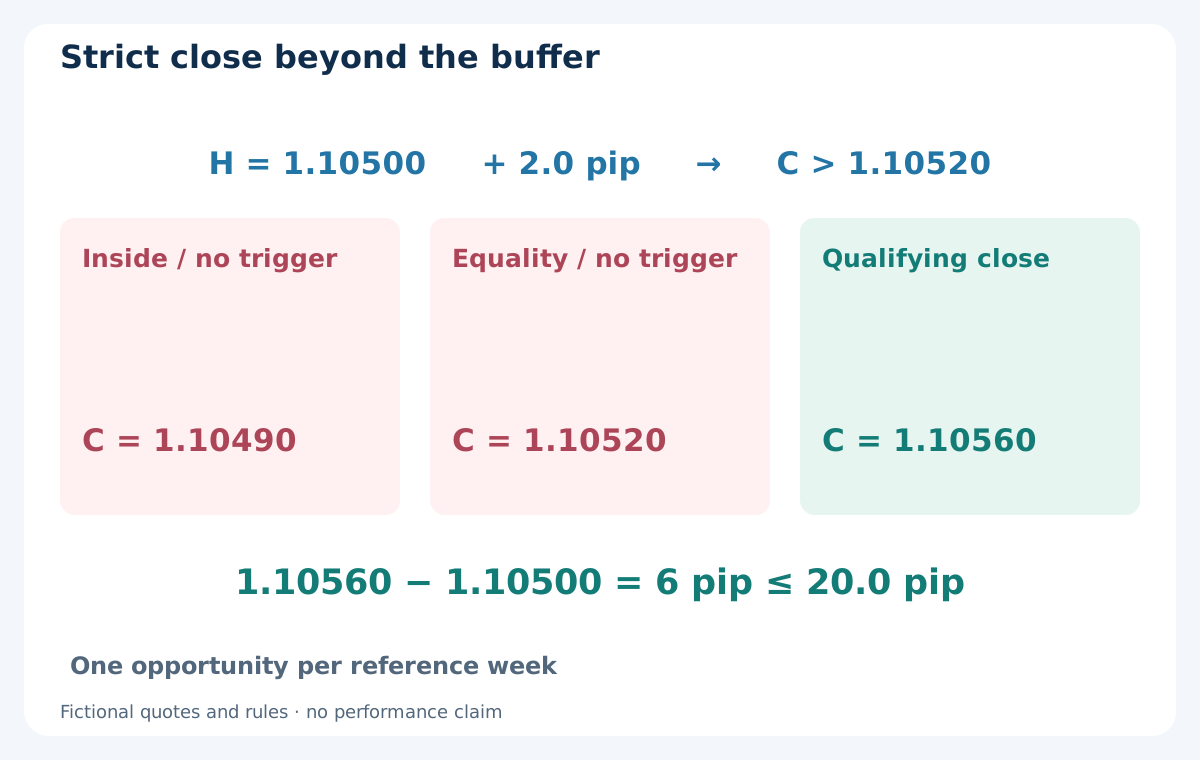
Let C be a completed Bid D1 close. The first eligible close with C > H + 2.0 pips creates a BUY opportunity; C < L − 2.0 pips creates a SELL opportunity. The thresholds are 1.10520 and 1.09480. Equality does not qualify. A candle with an intraday high outside the range but a close of 1.10490 does not trigger this model, regardless of its wick or colour.
For the BUY example, Monday 2026-08-10 closes at 1.10560: its 6-pip extension beyond H exceeds the buffer and is within the 20.0-pip extension cap. A first breakout close more than 20.0 pips beyond the relevant edge consumes the week’s opportunity and is skipped; do not wait for a prettier close later. Both the trigger and the quality rejection are recorded before a quote is selected.
5. Wait until the completed signal is actually observable
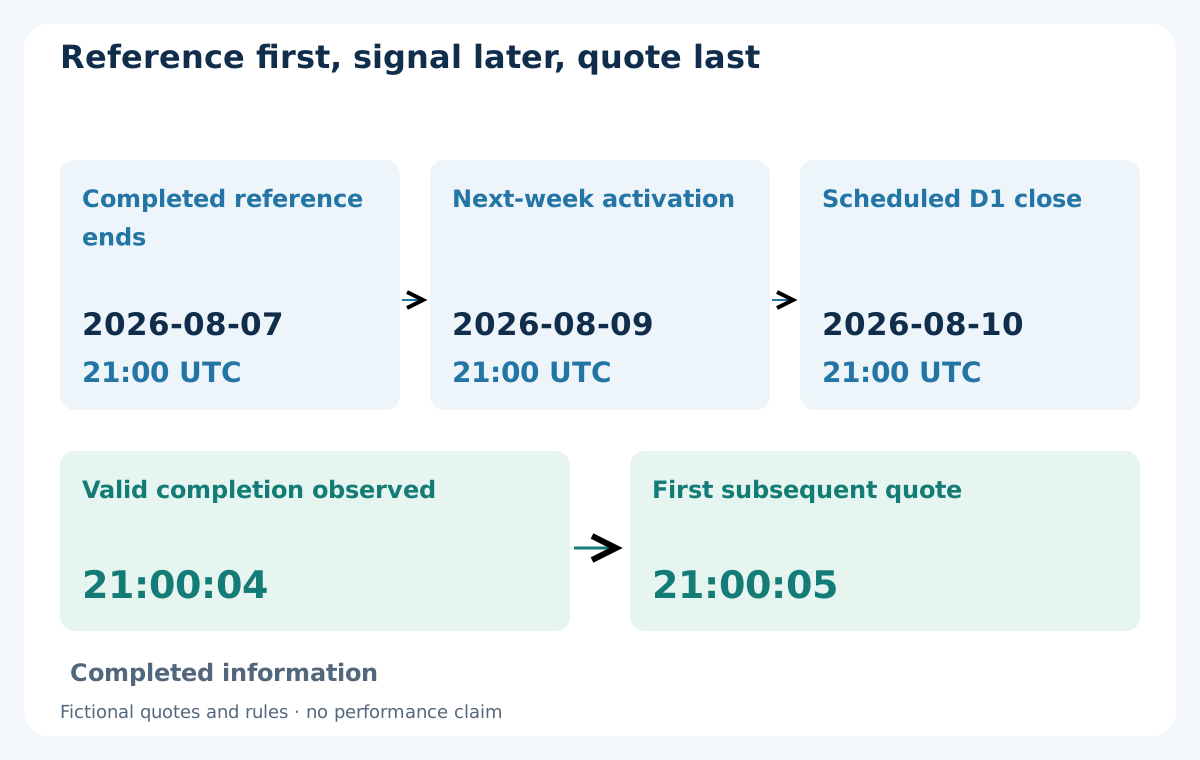
The example D1 boundary is 2026-08-10 21:00 UTC. Suppose valid completed history first becomes observable at 21:00:04. The model then considers the first subsequent symbol quote, at 21:00:05. The daily close is historical information, not a fill available after its analysis. MT4 index 0 is forming; verify the preceding bar’s actual interval and loaded history.
Expiry stays fixed at 21:01:00, sixty seconds after the scheduled boundary, not after observation or restart. Required history must become valid before that expiry. If any intervening eligible D1 could not be evaluated in time, disable that week: a later download must not silently replace an unknown first event. Store reference-week identity, signal interval and observation time separately.
6. Evaluate one subsequent quote and apply every cost gate
For the first quote at 21:00:05, assume Bid 1.10570 and Ask 1.10580. A BUY uses Ask, so spread is 1.0 pip and executable-price drift from C is 2.0 pips. Require spread ≤ 1.5 pips, absolute drift ≤ 3.0 pips, quote age between 0 and 2 seconds against a verified clock, and quote time strictly before 21:01:00. These checks apply together.
A quote at 21:01:00 or 21:01:01 is late. Separate alternatives with a 1.6-pip spread or 3.1-pip drift also fail. The first subsequent quote consumes the opportunity even if a gate fails; do not shop through later quotes. The strategy’s decision expiry is a local rule, not the pending-order expiration argument of OrderSend. Record both quoted prices and the reason for rejection.
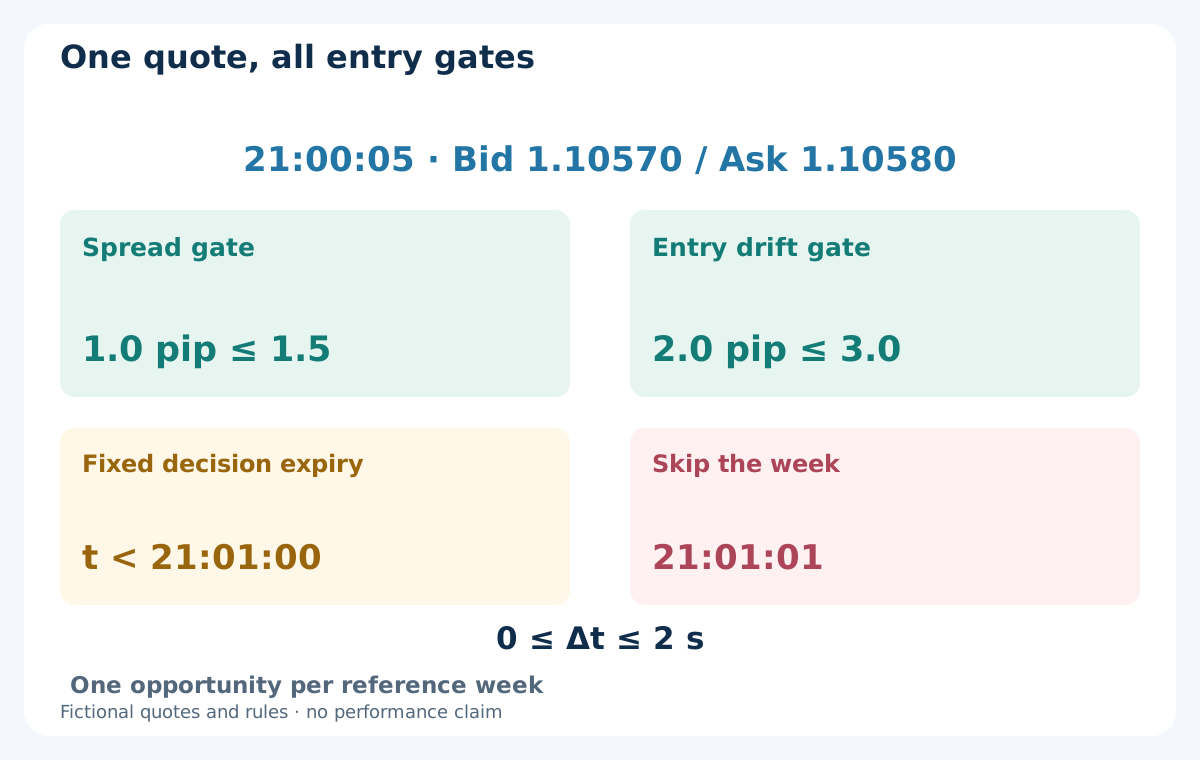
| Observation or alternative | Value | Gate / treatment |
|---|---|---|
| Signal close | C = 1.10560 | Above 1.10520; extension 6 pips within 20.0 |
| Completion observed | 21:00:04 | Required completed history verified |
| First subsequent quote | 21:00:05 | Before 21:01:00; age no more than 2 seconds |
| Bid / Ask | 1.10570 / 1.10580 | BUY uses Ask |
| Spread | 1.0 pip | At most 1.5 pips |
| Absolute entry drift | 2.0 pip | At most 3.0 pips |
| Separate late alternative | 21:01:01 | Skip the week; no next-quote replacement |
| Separate wide-spread alternative | 1.6 pip | Fails spread gate |
| Separate excess-drift alternative | 3.1 pip | Fails drift gate |
7. Consume the opportunity once and verify order eligibility
Allow one entry opportunity per reference week and at most one model position on the configured symbol. Mark the first breakout event as consumed before any request, whether it passes, is rejected or finds an occupied account state. Require valid minimum size, lot step, tick rounding, margin, trading permissions and server stop distances. If other positions make the account risk budget unavailable or uncertain, skip.
Persist the event identity and order state across restarts. Send at most one market-entry request; a rejection does not earn another try that week. An uncertain response requires account reconciliation before any further action, never a blind resend. A zero MODE_STOPLEVEL does not prove every stop distance is acceptable. No averaging, opposite hedge, second entry or volume increase is added after failure.
8. Size the position using the full planned loss
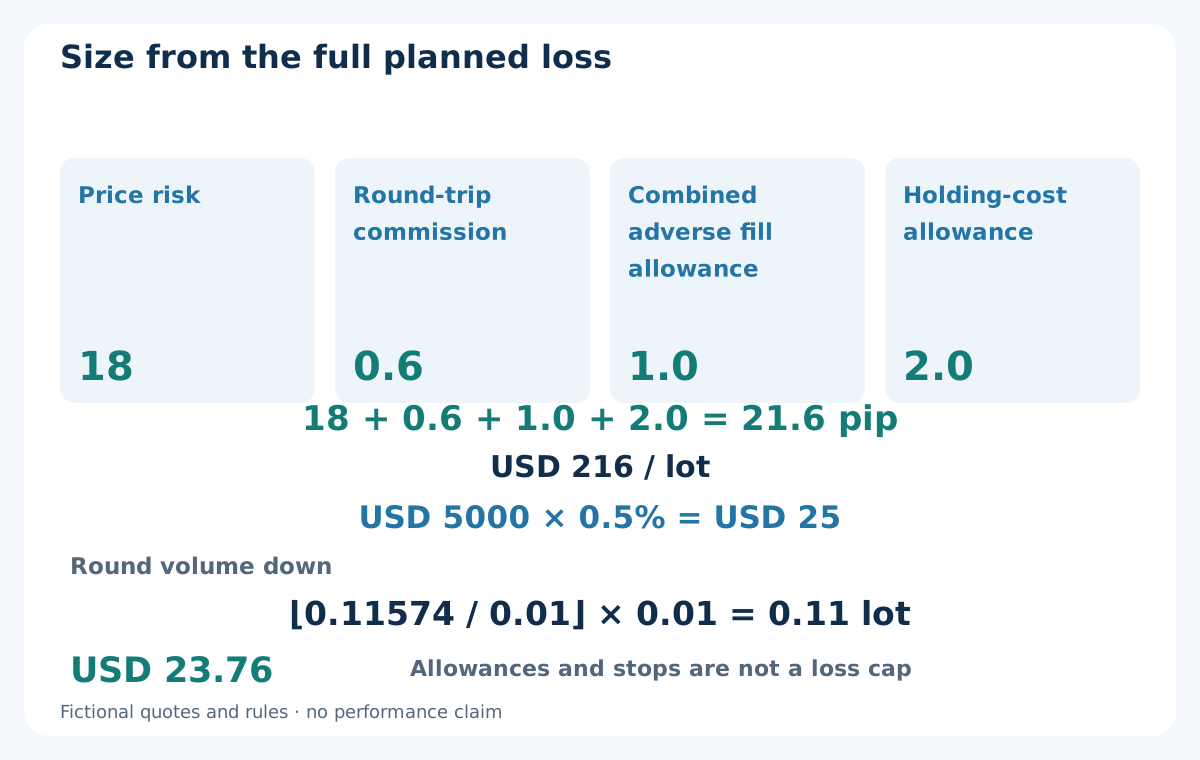
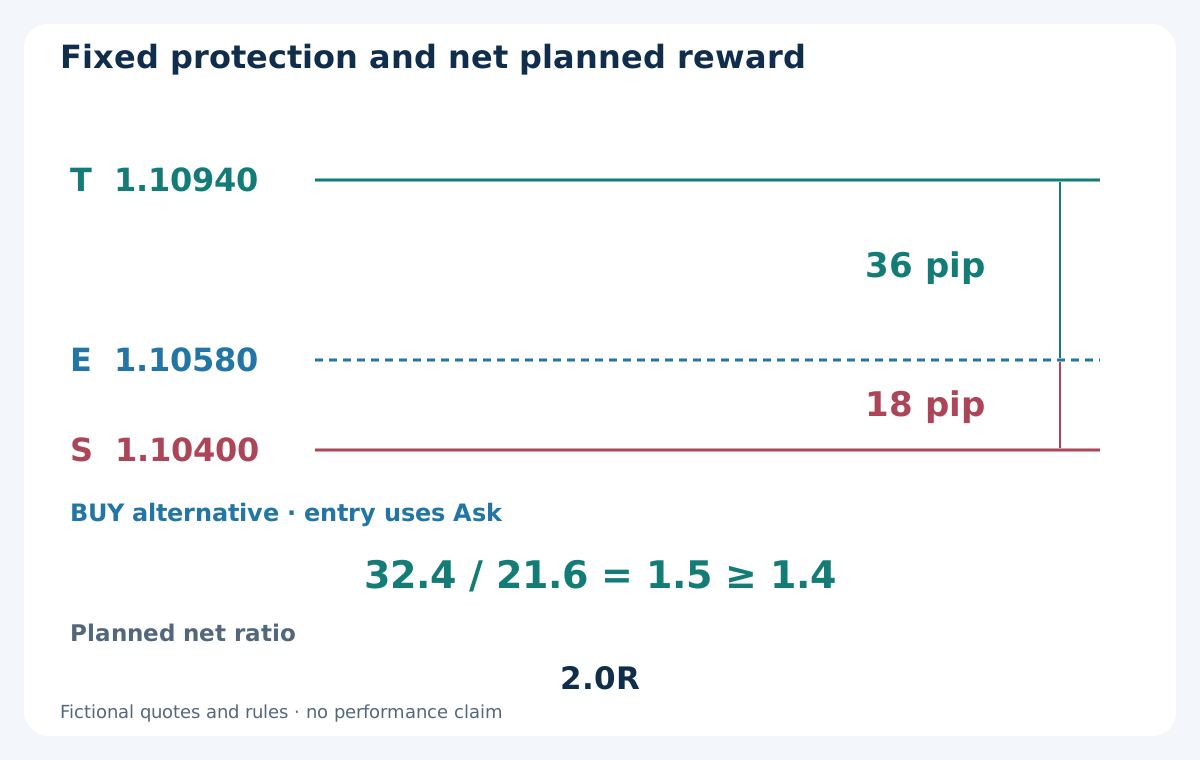
For the first BUY quote, freeze entry reference E = 1.10580 and stop S = H − 10 pips = 1.10400, inside the broken boundary rather than at the opposite weekly edge. Price risk is 18 pips. Add 0.6 pip round-trip commission, a combined 1.0-pip adverse entry/exit allowance and 2.0 pips of holding-cost allowance: 18 + 0.6 + 1.0 + 2.0 = 21.6 pips, or USD 216 per lot.
At USD 5000 equity and a 0.5% budget, available planned risk is USD 25. Raw volume is 25 / 216 ≈ 0.11574 lot. With minimum and step both 0.01 lot, round down to 0.11 lot, giving USD 23.76 planned loss. Skip if minimum size or margin prevents the plan. The position-sizing guide explains the units. Gaps, financing changes and failed exits can exceed the allowance; it is not a loss cap.
9. Freeze the target and distinguish price R from net reward
Using the quote-based 18-pip distance, set T = E + 2 × 18 pips = 1.10940 before the request. Keep S and T fixed; there is no trailing, break-even move, partial close or later re-anchoring to a different weekly range. The gross target distance is 36 pips. After the same 0.6 + 1.0 + 2.0-pip planning deductions, planned reward is 32.4 pips and the ratio is 32.4 / 21.6 = 1.5, above the frozen minimum 1.4.
This is a price-based 2.0R target, not a promise of a 2.0R net outcome. Actual entry may differ from E; verify the fill, protection and updated cost/risk gates. A fill that breaks those gates or lacks verified protection enters the emergency-close state; do not erase the fill or redraw S/T to make it pass. The stop-distance and risk guide provides a separate volatility-based alternative, not a hidden ATR rule in this model.
10. Reconcile a fictional completed BUY without double-counting
Assume the order actually fills at Ask 1.10580 for 0.11 lot and exits at Bid 1.10940 on 2026-08-12 at 10:00 UTC, before the time limit. The 36-pip price gain is USD 39.60. With actual round-trip commission −USD 0.66 and total booked swap −USD 0.44, the result is 39.60 − 0.66 − 0.44 = USD 38.50. These are fictional fills and booked costs, not measured performance.
The spread is already reflected in the Ask-to-Bid prices. An unused slippage allowance and the unused part of the funding reserve are not extra charges. In MT4, OrderProfit excludes swap and commission; reconcile signed components once with the account record. The swap and rollover guide explains why the actual financing calendar, not simply the D1 count, determines charges.
| Booked item | USD | Treatment |
|---|---|---|
| Actual fill-to-fill price gain | +39.60 | 36 pips at 0.11 lot |
| Round-trip commission | −0.66 | Actual signed cost |
| Booked swap | −0.44 | Actual cumulative financing, counted once |
| Realised net result | +38.50 | 39.60 − 0.66 − 0.44 |
| Unused planning reserves | 0.00 | No additional booked charge |
11. Exit on the first applicable price or time event
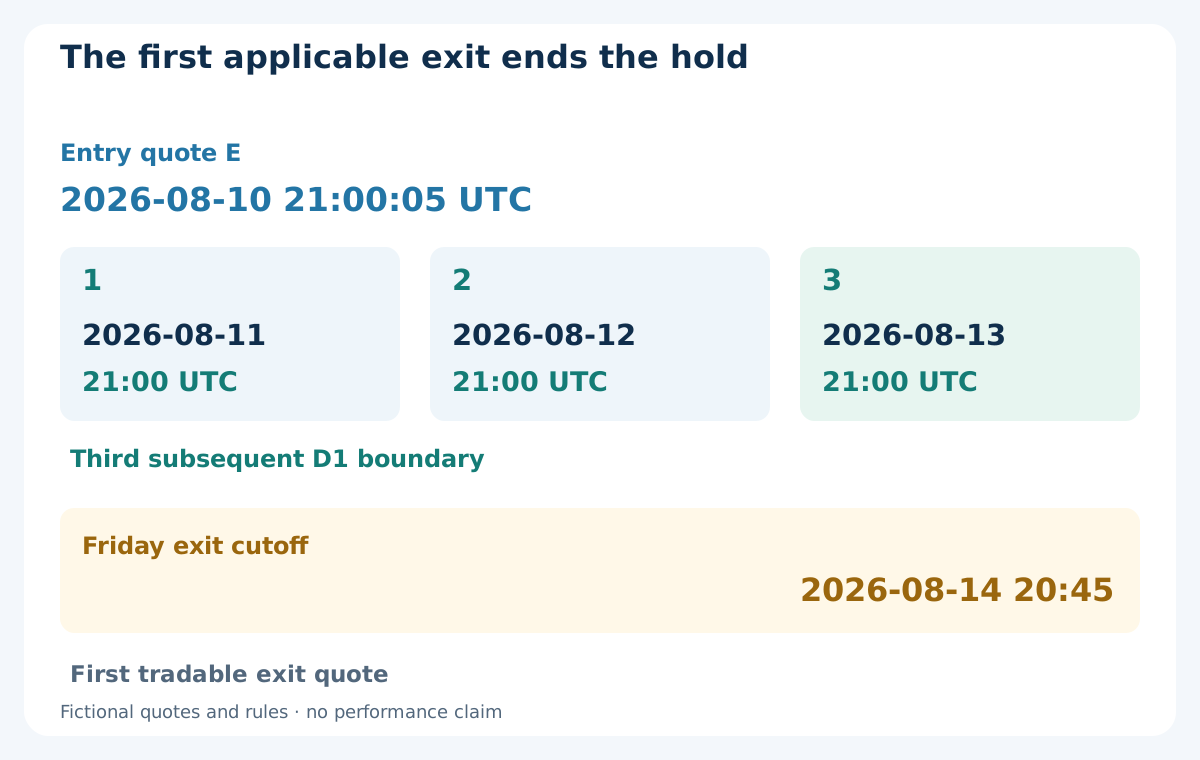
If still open, exit on the first event among stop, target, the third subsequent D1 boundary after the actual entry, and the Friday cutoff. For the Monday 21:00:05 entry, the subsequent boundaries are Tuesday 2026-08-11 21:00, Wednesday 2026-08-12 21:00 and Thursday 2026-08-13 21:00 UTC. The third boundary triggers a close request at the first tradable quote at or after it; it is not a guaranteed fill at 21:00.
The example Friday cutoff is 2026-08-14 20:45 UTC, fifteen minutes before the assumed weekly close. Use an earlier announced session close minus 15 minutes when applicable; if the necessary calendar is unknown, do not enable entries. No new entry is allowed at or after the cutoff. The first applicable exit closes the full position; later scheduled exits do not create another trade.
12. Treat failed protection and exits as real exposure
A stop can fill beyond its level through a gap. A timed or Friday close requires a functioning process, a tradable quote and a confirmed account event. If no quote arrives at the deadline, retain the close-due state and act at the first available opportunity; do not invent a historical exit. Failure to flatten before the weekend leaves actual weekend risk in the record.
The one-request entry rule does not mean abandoning an open position after one failed close. Reconcile uncertain outcomes and continue controlled exit handling until flat status is verified. Block new entries while exposure or account state is unresolved. A new week or terminal restart does not erase the old position, reset its holding age or regenerate the consumed opportunity.
13. Mirror SELL with the executable price sides
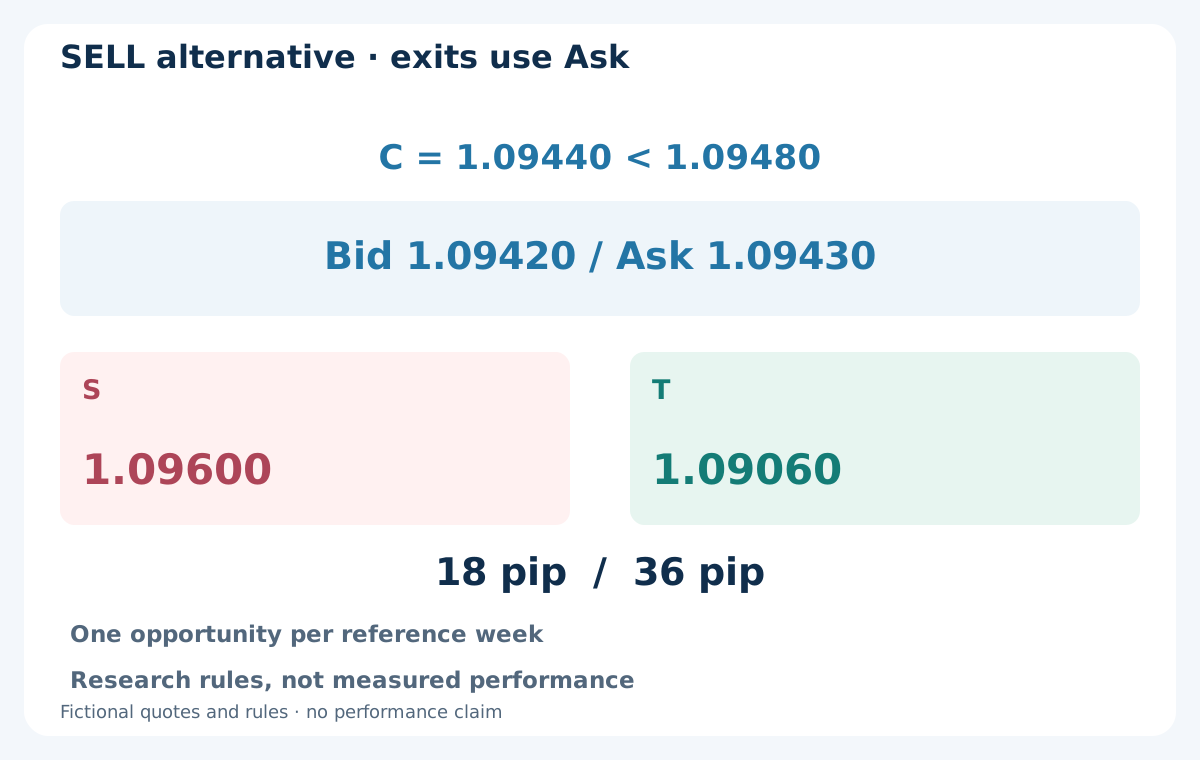
In a separate alternative week scenario, let the first qualifying Bid D1 close be C = 1.09440, below 1.09480. A first later quote of Bid 1.09420 and Ask 1.09430 has a 1.0-pip spread and 2.0-pip absolute entry drift. SELL uses Bid 1.09420. Freeze S = L + 10 pips = 1.09600 and T = 1.09420 − 2 × 18 pips = 1.09060.
The same cost, size, one-opportunity and time rules apply. SELL exits use Ask: the stop/target comparison must not silently switch to Bid candles. The 18-pip price risk and 36-pip target distance mirror BUY, but execution, financing and net results require their own account record. This is an alternative direction, not permission to hold both trades or to hedge a failed BUY.
14. Backtest the sequence, including rejected weeks
Rebuild reference weeks from the frozen calendar and preserve historical offsets, gaps, holiday exclusions and original Bid/Ask evidence. Reproduce the first observable D1 event and the single later quote, including expired and failed gates. A completed-candle simulator must not fill at C merely because C triggered the decision. Include actual or explicitly assumed financing and commissions over the full holding path.
If a bar touches both stop and target, OHLC alone cannot reveal the sequence. Use sufficient quote data or label a conservative unresolved-path rule; never choose the profitable ordering silently. Preserve failed requests and close-due states. Compare with the existing breakout guide and strategy for broader mechanics without changing this model’s fixed weekly reference.
15. Validate a frozen candidate in chronological order
Keep development data, untouched later testing and forward observation separate in time. Record every parameter set tried, not just the surviving winner. Review trade count, rejected weeks, equity drawdown, adverse movement, exposure duration, financing sensitivity and failed exits. A small sample or a positive gross result cannot establish that costs and operational risk are covered.
Stress higher spreads, late quotes, changed funding, time-zone transitions and restarts without rewriting past signals. Demo can test process behaviour but cannot establish identical live execution. The forward-validation protocol supplies the wider evidence framework. No return, win-rate or drawdown statistic is invented for this research model.
16. Use a reproducible weekly-breakout checklist
Before an opportunity, verify the completed reference and its 40–250-pip width, fixed H/L, eligible D1 interval, strict buffer break, extension limit, first later quote, expiry and all cost/account gates. Freeze volume, S and T; retain the week/event identifier and confirm any actual fill. During the hold, track booked financing and the earliest applicable exit independently of the signal chart.
Afterward reconcile the actual result and every rejected or failed event. Changing a clock, threshold or holding rule creates a new version requiring new validation. The objective is a testable lifecycle, not an assertion that slower breakouts are safe or profitable. These fictional examples do not show that any commercial EA on this site implements the model or would obtain its illustrated result.
Frequently asked questions
What is the weekly reference in this strategy?
It is one verified completed calendar trading week whose high and low stay fixed during the next trading week. Native W1 data are used only when their boundaries match the declared calendar. The reference is not a continuously rolling channel.
Does an intraday break of last week’s high trigger a BUY?
No. This specification requires the first eligible completed Bid D1 close strictly above H + 2.0 pips, then one later quote and all quality gates. A wick outside with a close of 1.10490 does not qualify in the example.
Does a close exactly at the buffered boundary count?
No. Equality at 1.10520 for BUY or 1.09480 for SELL does not pass the strict test. A first genuine breakout that fails the 20.0-pip extension cap consumes the opportunity rather than allowing a later replacement.
Can the model wait for a better quote after rejection?
No. It evaluates one subsequent quote before the fixed expiry. A late quote, excessive spread or drift consumes that week’s opportunity. A restart or failed entry request does not create another chance.
Why is the example volume 0.11 lot?
The USD 25 budget divided by USD 216 planned loss per lot gives about 0.11574 lot. Rounding down to the 0.01 step gives 0.11 lot and USD 23.76 planned loss. This allowance does not cap losses through gaps or failed exits.
Does the Friday exit eliminate weekend exposure?
It defines an attempted early exit, not guaranteed closure. If quotes or execution are unavailable, preserve the real position and close-due state, reconcile account status and block new entries until resolved. Do not record a fictitious Friday fill.
Sources and educational notes
MetaQuotes documents current-bar indexing, asynchronous historical data and market-order price/stop requirements. OrderProfit and OrderClose were also checked for accounting and exit semantics. The weekly calendar, thresholds, cost gates and lifecycle below are an original educational research specification, not a documented broker product or a profitability finding. All dates, quotes, rates and results in the examples are fictional. No backtest or commercial-EA implementation is claimed.
Educational research model. Prices, calendars, settings and results are fictional. Forex trading involves risk. No backtest, guaranteed execution, maximum loss or future performance is established.