

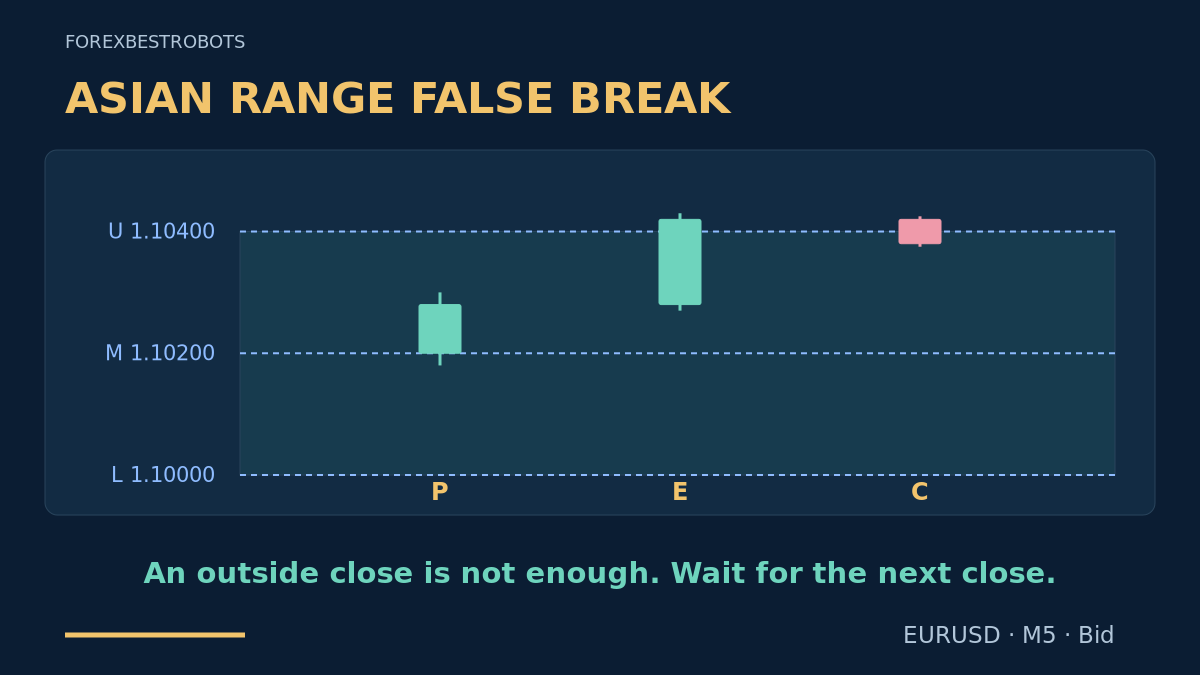
A price can close outside a range and then return inside on the next candle. This model studies that failed expansion during a defined London window, using an earlier Asian reference range. The simple idea is to wait for the return before considering a trade toward the old midpoint. A spike alone is not enough, and a late return does not qualify.
1. Give this model a separate job
The opening-range breakout strategy follows a completed break of a range formed after London starts. This model instead opposes a failed break of an earlier fixed range. Unlike the broader Asian-session framework, it requires an outside close followed by an immediate inside close. Unlike the D1 false-breakout model, its reference is a fixed UTC window, not yesterday's broker day. Test these systems separately; do not turn a losing breakout into this reversal after the fact.
2. Separate the reference clock from the entry clock
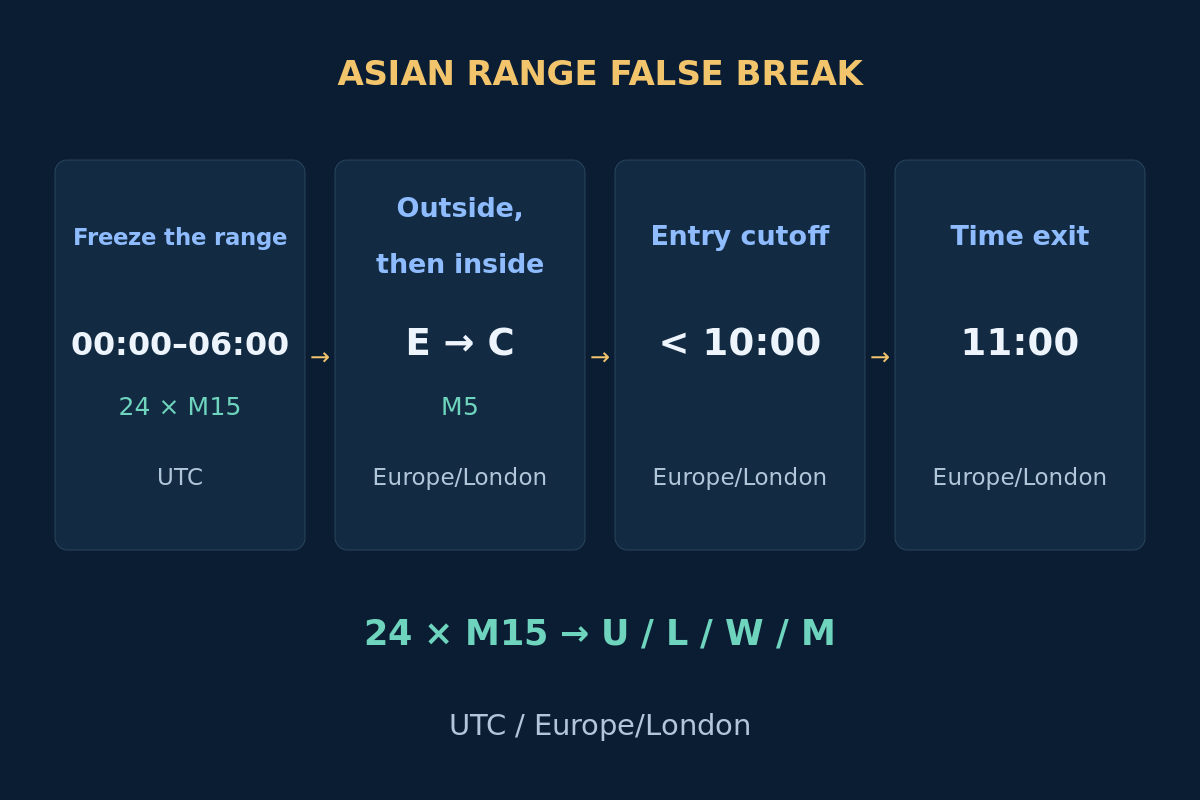
Build the reference during [00:00, 06:00) UTC on the trading date. This chosen window is an Asian reference, not a universal definition of the whole Asian session. Use Europe/London for later decisions: E may close from 08:05 through 09:50 inclusive; C must close immediately afterward, from 08:10 through 09:55. Submit before 10:00 and request closure of a remaining position at 11:00 London.
London 08:00 is UTC 08:00 in winter and UTC 07:00 during British Summer Time. Therefore the gap between the fixed reference and entry window changes seasonally. Convert both clocks to broker time for each historical date; do not apply today's offset to the past. MT4 candle timestamps are opening times; the example labels closing times. See the sessions and time-zone guide.
3. Fix the range and decide whether to arm the day
Use valid, consecutive EURUSD M15 Bid candles opening from 00:00 through 05:45 UTC: 24 candles. At 06:00 save U = max(High), L = min(Low), W = U − L and M = (U + L) / 2. Keep them fixed. Accept W from 20 to 60 pips inclusive; one pip is 0.00010 and the illustrative tick is 0.00001. Skip missing history, an invalid width or a closed market.
At 08:00 London require the just-completed M5 Bid close P in the central half: L + 0.25 × W ≤ P_close ≤ U − 0.25 × W. Otherwise do not arm that day. The rule checks the starting location; it does not claim that the market is balanced. An earlier excursion before this London window is not itself a candidate under these rules.
Before arming and again before entry, verify a current calendar with complete relevant EUR/USD event coverage. Skip the day if a selected high-impact event's exclusion [event − 15 minutes, event + 15 minutes) intersects [08:00, 11:00) London. Fix provider, event families and impact definitions before testing. Missing or unverified coverage blocks entry. The news-risk guide explains interval overlaps and unscheduled surprises.
4. Use the first completed excursion E once
Find the first M5 close strictly outside the range in E's permitted window. It consumes the day's single candidate across both directions, even if later rejected. For a possible SELL require 0 < E_close − U ≤ 0.25 × W and E_high ≤ U + 0.50 × W. For a possible BUY require 0 < L − E_close ≤ 0.25 × W and E_low ≥ L − 0.50 × W. In either case require 0 < E_high − E_low ≤ W.
E's body may have either direction; the required fact is its outside close. A wick outside with an inside close, or a close exactly on a boundary, is not E. A first outside close that exceeds a limit ends the day. Save E's high and low. Do not replace E with a later candle, switch sides or redraw the reference after seeing the outcome.
5. Give only the immediately following candle C a chance
SELL needs a bearish C with U − 0.25 × W < C_close < U, C_high < E_high and C_low > M. BUY needs a bullish C with L < C_close < L + 0.25 × W, C_low > E_low and C_high < M. These strict conditions keep the return near the breached edge, reject a renewed excursion and reject a candidate that already visited the midpoint.
The next candle must return at once. Equality, a flat candle, a missing M5 interval, a later return or C closing after 09:55 ends the candidate and the day. These pre-entry vetoes are Bid-candle conditions, not simulated stop or target fills. The midpoint is an arithmetic target, not a price magnet, and an inside close can still be followed by a renewed breakout.
6. Check one quote and establish fixed protection
Inspect the first own-symbol quote received after C closes, within 15 seconds, with receipt age at most 2 seconds on verified clocks. Require tradable Bid < Ask, spread no greater than both 2 pips and 0.05 × W, and abs(Bid − C_close) ≤ 0.10 × W. Bid must remain in C's specified return zone. Any observed Bid touch of E's outer extreme or M after C and before submission cancels. Reject unavailable or inconsistent data; do not wait for a better quote. Submit strictly before 10:00 London.
BUY enters at Ask, with fixed Bid stop S = E_low − 0.00010 and target T = M, both rounded down to valid ticks. SELL enters at Bid, with fixed Ask stop S = E_high + 0.00010 + 0.00020 and target T = M + 0.00020, both rounded up. The short-side 2-pip conversion is a declared allowance, not historical Ask data or a spread forecast. Check the final price ordering and broker distances.
Require no EURUSD position or pending EURUSD order in the account. Check aggregate exposure, permission, margin, volume and the cost gate below. Establish valid stop and target protection with the initial order or do not open. After a confirmed fill, recheck the fixed levels, cost ratio and loss budget using the actual entry. A failed constraint or missing protection requests closure and records the costs. A failed or uncertain response consumes the day; reconcile broker state before another action.
7. Read the invented SELL sequence
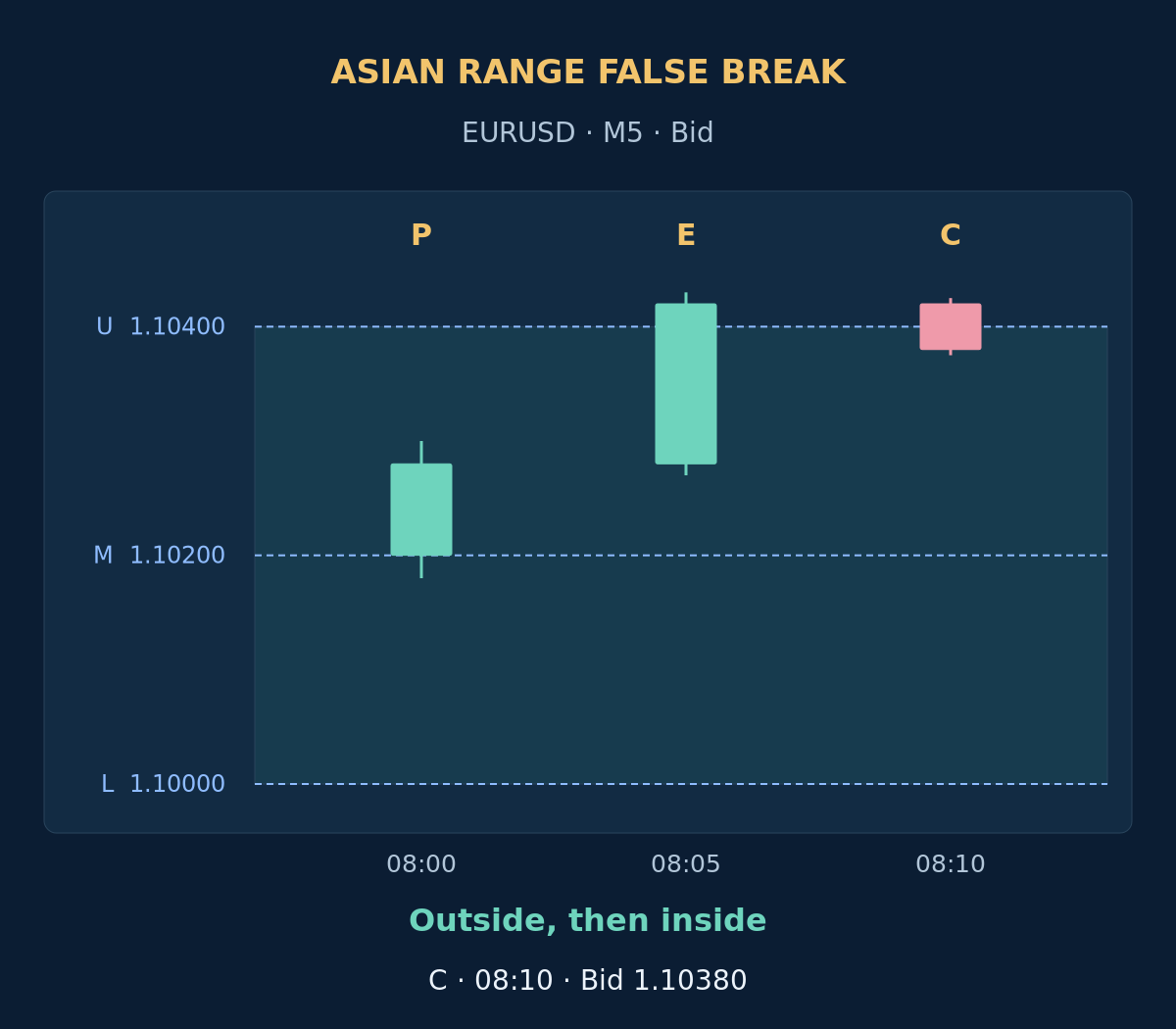
Assume a valid reference U = 1.10400, L = 1.10000, W = 40 pips and M = 1.10200. The table shows invented M5 Bid candles in London closing time on 2026-03-16, when London uses UTC. P closes in the central half. E closes 2 pips above U; its high is 3 pips above U, within the 10-pip close and 20-pip extreme limits. Its 16-pip range is below W.
| London close | Bid open | Bid high | Bid low | Bid close |
|---|---|---|---|---|
| 08:00 P | 1.10200 | 1.10300 | 1.10180 | 1.10280 |
| 08:05 E | 1.10280 | 1.10430 | 1.10270 | 1.10420 |
| 08:10 C | 1.10420 | 1.10425 | 1.10375 | 1.10380 |
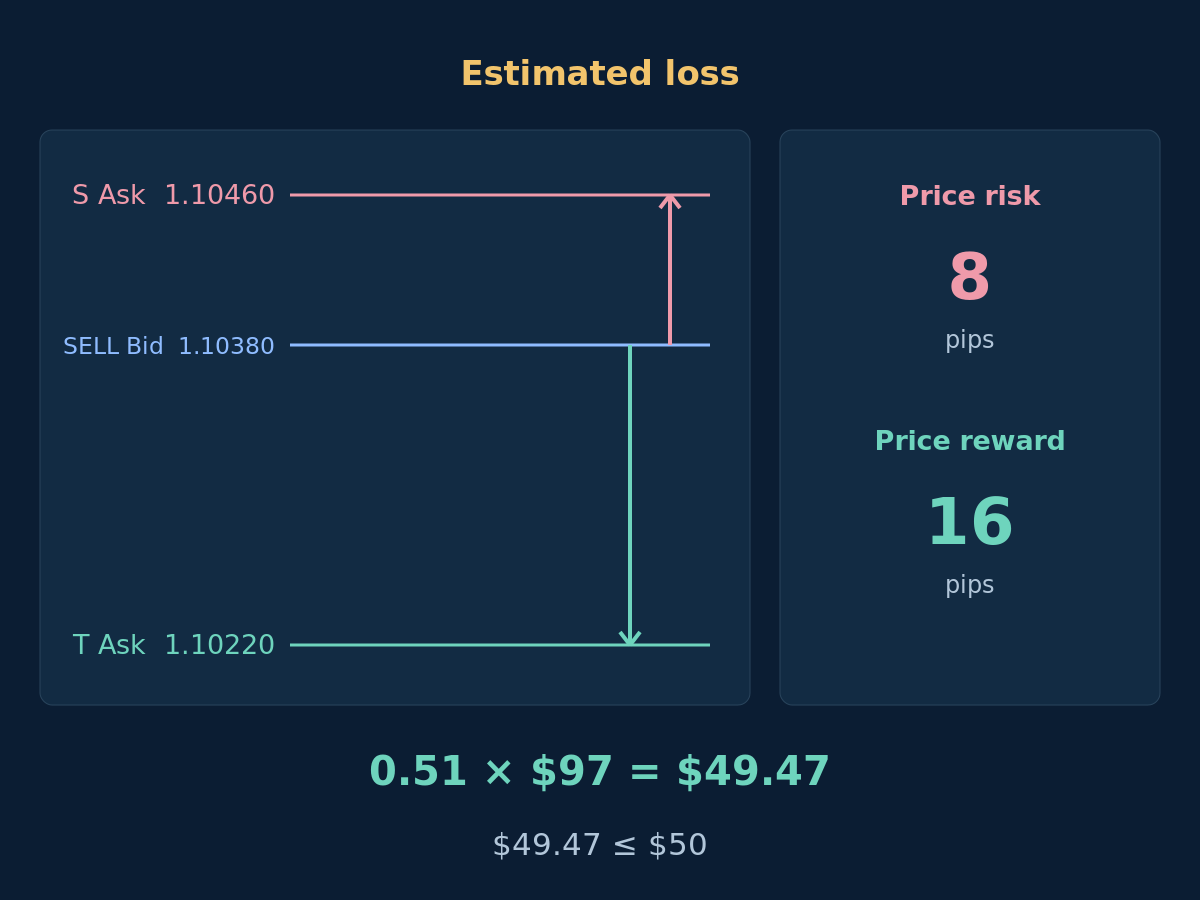
C is bearish, closes in the upper return zone above 1.10300, stays below E's high and above M. Assume all news, data and order checks pass. The first quote at 08:10:01 is Bid 1.10380 / Ask 1.10390, with no intervening cancellation. A SELL fill at that Bid gives S = 1.10460 and T = 1.10220: 8 pips of risk and 16 pips of reward. A later exit is not supplied.
If that first Bid were instead 1.10340 with the same 1-pip spread, the permitted 4-pip displacement would still pass. But risk and reward would both be 12 pips. With the costs below, Reward1 / Loss1 = $103 / $137 ≈ 0.75, below 1.25. Reject the late entry. Do not move the target to the opposite edge or shrink the stop to manufacture room.
8. Use a cost-adjusted entry test and round volume down
The example uses illustrative equity $10,000 and a $50 loss budget, or 0.5%. The accepted quote estimates $97 loss per lot. Volume 0.51 lots therefore estimates $49.47 loss; the next step, 0.52 lots, would estimate $50.44 and exceed budget. These are planning assumptions, not a risk recommendation or guaranteed cap.
Show the exact costs, lot calculation and reference candles
Let dSL and dTP be positive executable entry-to-stop and entry-to-target distances in pips. Assume a USD account, 100,000 EUR per lot, pip value V = $10 per lot, total additional adverse execution s = 1 pip per outcome, round-turn commission c = $7 per lot and financing reserve f = $0. Fees scale linearly without a minimum. Use Loss1 = (dSL + s) × V + c + f and Reward1 = (dTP − s) × V − c − f. Spread inside the distances is counted once. Require both estimates positive and Reward1 / Loss1 ≥ 1.25 using unrounded estimates.
Here Loss1 = (8 + 1) × $10 + $7 = $97 and Reward1 = (16 − 1) × $10 − $7 = $143, so $143 / $97 ≈ 1.47. With minimum and step 0.01 lot, floor(($50 / $97) / 0.01) × 0.01 = 0.51 lots. Then 0.51 × $97 = $49.47 and 0.51 × $143 = $72.93. These are alternative estimated outcomes, not two charges or realized results. Verify actual contract values, conversion, charges and margin; skip if the minimum lot is too large. See trading costs and account risk.
To reproduce the reference, repeat R1–R6 below four times in order, giving 24 consecutive M15 candles from 00:00 to 06:00 UTC. Each last close joins the next open. On this invented winter date, the intervening M5 candles from 06:00 through 07:50 open and close at 1.10200, high 1.10220 and low 1.10180; P then opens at 07:55. This supplies a reproducible price example, not historical tick fills. No return, win rate or expectancy is established by the cost ratio.
| Reference row | Bid open | Bid high | Bid low | Bid close |
|---|---|---|---|---|
| R1 | 1.10200 | 1.10300 | 1.10100 | 1.10240 |
| R2 | 1.10240 | 1.10400 | 1.10160 | 1.10320 |
| R3 | 1.10320 | 1.10360 | 1.10060 | 1.10120 |
| R4 | 1.10120 | 1.10220 | 1.10000 | 1.10080 |
| R5 | 1.10080 | 1.10240 | 1.10040 | 1.10160 |
| R6 | 1.10160 | 1.10300 | 1.10100 | 1.10200 |
9. Keep exits fixed and respect the time limit
Keep accepted S and T unchanged: no trailing, break-even move, partial exit, averaging or automatic reversal. Stop/target fills that actually occurred take priority. If still open at 11:00 London, request closure at the first tradable quote, using Bid to close BUY or Ask to close SELL. A connection outage does not extend the deadline, but actual execution may be delayed. The same day has no second candidate, including after a loss or uncertain order response.
If required prices, clock mapping or calendar coverage becomes invalid while open, or a newly selected news exclusion intersects the remaining planned holding period, keep accepted protection and request closure when execution is available. Block new entries and reconcile orders after restarts. A drawn level or a sent close request is not an executed exit. The EA filter guide separates these mechanisms. Gaps, worse execution and changing charges can exceed the loss estimate.
10. Test rejection as its own system
Replay the frozen M15 reference, P, the first E, the next C, incoming quotes, order responses and exits in timestamp order. Use real historical Bid/Ask ticks for side-specific triggers; the short conversion is not Ask history. If OHLC cannot resolve an intrabar stop/target sequence, use finer data or mark the case unresolved under a declared conservative convention. MT4 modeled ticks are not automatically original records. See responsible EA backtesting.
Preserve rejected candidates and days without trades, including initial-location failures, failed returns, news blocks, stale quotes, rejected orders and post-fill aborts. Reserve a later chronological evaluation period and forward demo checks. Stress costs, range width, return depth and seasonal clock changes without reporting only the winning variant. Compare continuation and rejection separately; assess net results, drawdown, losing sequences and shared currency exposure. The closed return and the midpoint target do not themselves establish an edge.
- The date's UTC, London and server mappings are verified.
- All 24 M15 reference candles and P are valid; fixed width and starting-location checks pass.
- The current calendar covers the complete required news policy.
- The first E satisfies the outside-close and excursion limits.
- The immediately following C returns in the correct zone without a veto.
- The first quote, fixed exits and unrounded cost ratio pass.
- Volume, margin and combined exposure fit the budget; no EURUSD order or position blocks entry.
- The daily attempt, actual broker state and 11:00 exit will be tracked and reconciled.
11. Asian-range false-breakout questions
Is a wick beyond the Asian high enough to sell?
No. This baseline first requires an outside close E, then the next candle C must close back in the specified inside zone. A wick-only rejection is another model. Neither pattern proves that price will reach the midpoint.
Can I wait several candles for the return?
Not in this version. Only the immediately following M5 candle may confirm. A later return ends with no trade; giving it a longer life requires a separate specification and test.
Why does the reference use UTC while entry uses London time?
The model deliberately keeps the reference at fixed UTC hours and the decision window aligned with London local time. Their seasonal relationship changes. A year-round fixed UTC entry window would be a different system.
Does a cost-adjusted ratio above 1.25 prove positive expectancy?
No. It only compares two planned outcome estimates for one candidate. It does not measure the chance of either outcome, the frequency of time exits, or the complete result distribution. Actual costs and fills may differ.
12. References and scope
GOV.UK verifies the UK clock convention; MetaQuotes OrderSend documents entry quotes and order constraints. Neither source endorses these false-breakout rules or their profitability. The range, timing, immediate-return rule and cost threshold are authored research choices.
Forex and leveraged trading involve substantial risk. This material is educational, not investment advice. Past or simulated results do not guarantee future performance.