

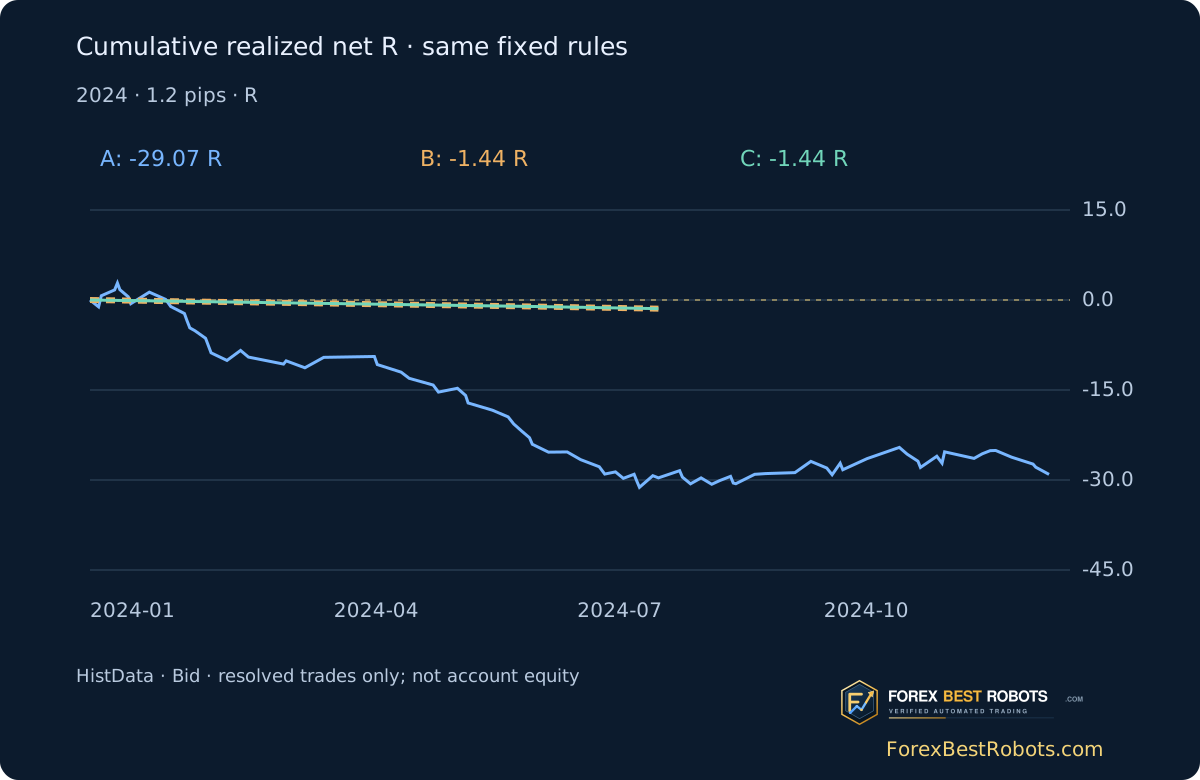
A return inside the Asian range is not automatically a usable reversal. In this fixed 2024 USD/JPY test, RSI at the first reentry leaves only two trades, both shorts and both losing. They total −36.10 pips, or −1.44 additive R, after a hypothetical 1.2-pip round trip. The sample cannot establish an edge; its rarity is the main finding.
1. Define a failed breakout before entering against it
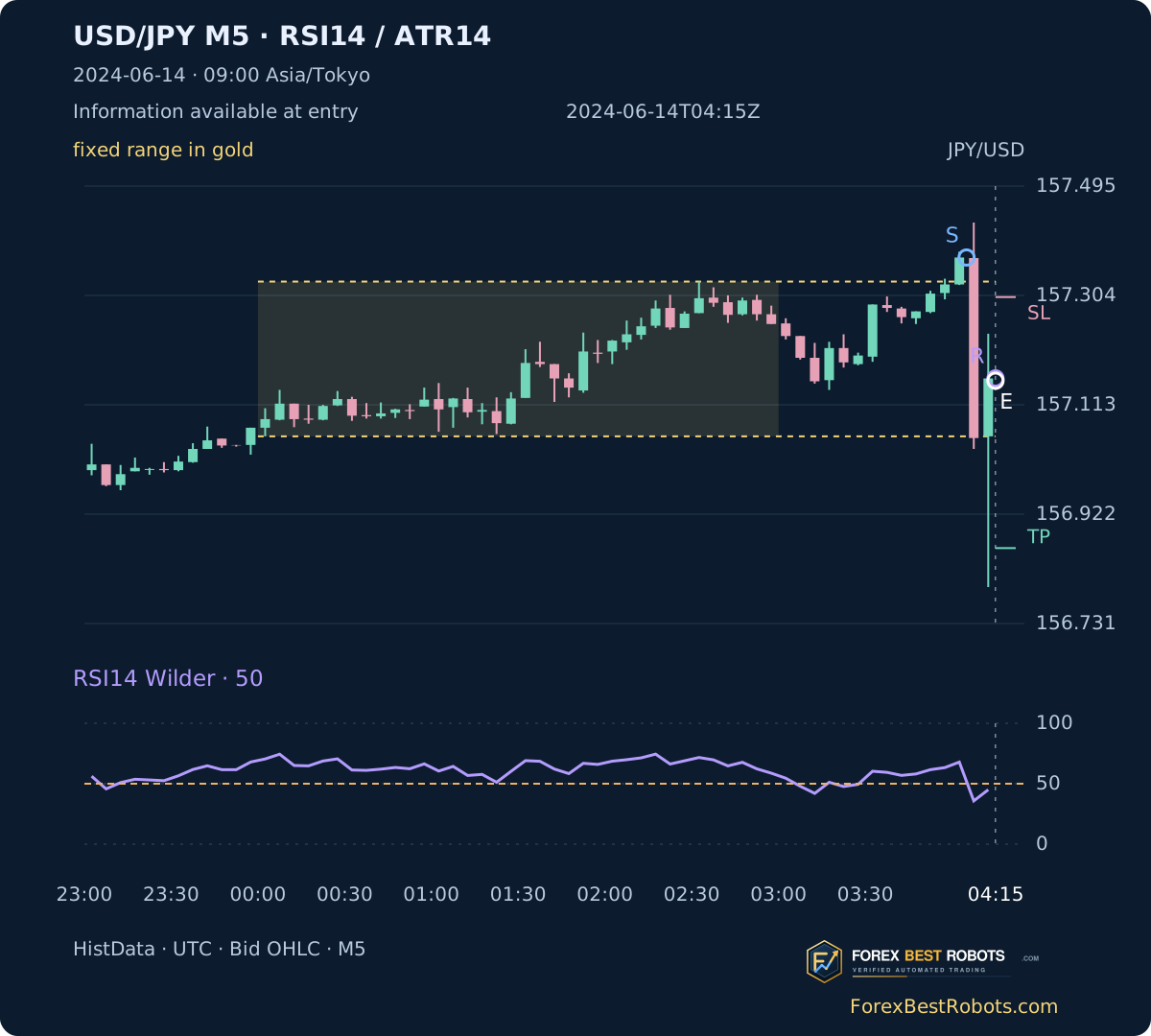
Use USD/JPY M5. Freeze the High and Low of 09:00–12:00 Asia/Tokyo. S is the first completed close strictly outside the box after it is frozen, known by 15:00 Tokyo. R is the first later completed close strictly back inside, known no later than S plus 30 minutes. A wick alone is not S; touching a boundary is not R.
A enters against S at R: sell after an upward break, buy after a downward break. B accepts that same R only with the directional RSI condition. C also checks the original S reading. Keep one first sequence per date; a rejection cannot be replaced by a later attractive return. The first figure ends at the known entry boundary, not at a future outcome.
2. Separate the Asian reference clock from the expiry clock
The range is 00:00–03:00 UTC all year, corresponding to 09:00–12:00 Tokyo. It needs 36 consecutive complete M5 candles, each containing five recorded M1 minutes. 09:00 is a declared Forex session reference, not an exchange auction. HistData uses fixed EST without daylight saving: add five hours for UTC; Tokyo is UTC+9.
Search the first outside close through 06:00 UTC inclusive. The 30-minute return deadline runs from S, so a qualifying R can finish after 06:00, up to 06:30. Equality with High/Low fails both strict outside/inside tests. Missing search history makes the sequence unknown; only a complete search without R is expired. Never restart the clock at a later break.
3. Apply RSI at the first return, not at a later convenient candle
RSI14 uses completed observed M5 closes and Wilder smoothing. After an upward S, B needs RSI at R below 50 for a short; after a downward S, above 50 for a long. Exactly 50 fails. R is retained even when RSI fails; do not wait for a later crossing. This differs from simply selling an overbought reading or buying an oversold one.
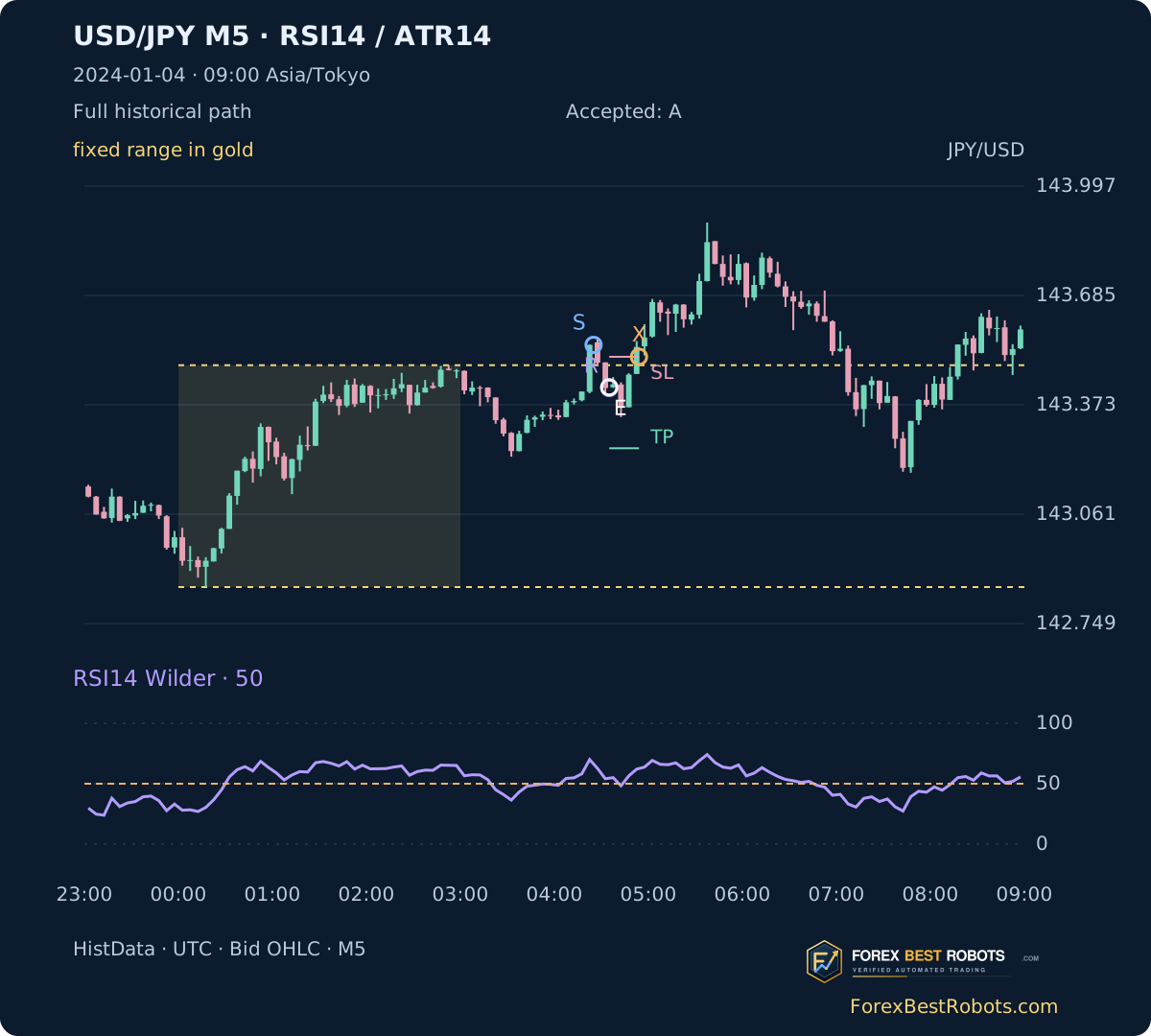
C additionally requires RSI at S ≥ 50 after an upward break, or ≤ 50 after a downward break. Its endpoints change sides of 50; this does not assert a single crossing or that the first crossing occurs at R. Here B/C have identical two-trade ledgers. On 4 January RSI at R is 54.12 after an upward S: B/C reject; the displayed later loss belongs to A.
RSI14 = 100 - 100/(1 + averageGain/averageLoss)
Wilder[t] = (13*Wilder[t-1] + change[t])/14
S↑ → R: RSI_R < 50 → Short
S↓ → R: RSI_R > 50 → Long
C: S↑ → RSI_S ≥ 50; S↓ → RSI_S ≤ 50
Initial risk · pips = ceil(1.5*ATR14[R] / 0.1pip) * 0.1pip
USD/JPY: 1pip = 0.01; 0.1pip = 0.001
4. Enter at R with a clearly defined yen-pair pip
Use the exact M1 Open at the minute R becomes complete; if absent, entry is unavailable. The direction opposes S. Initial risk is 1.5 × ATR14 at R rounded upward to 0.1 pip. For USD/JPY, one pip is 0.01 JPY per USD and 0.1 pip is 0.001. Stop 1R and target 2R stay fixed; the target is not forced to the box midpoint or opposite edge.
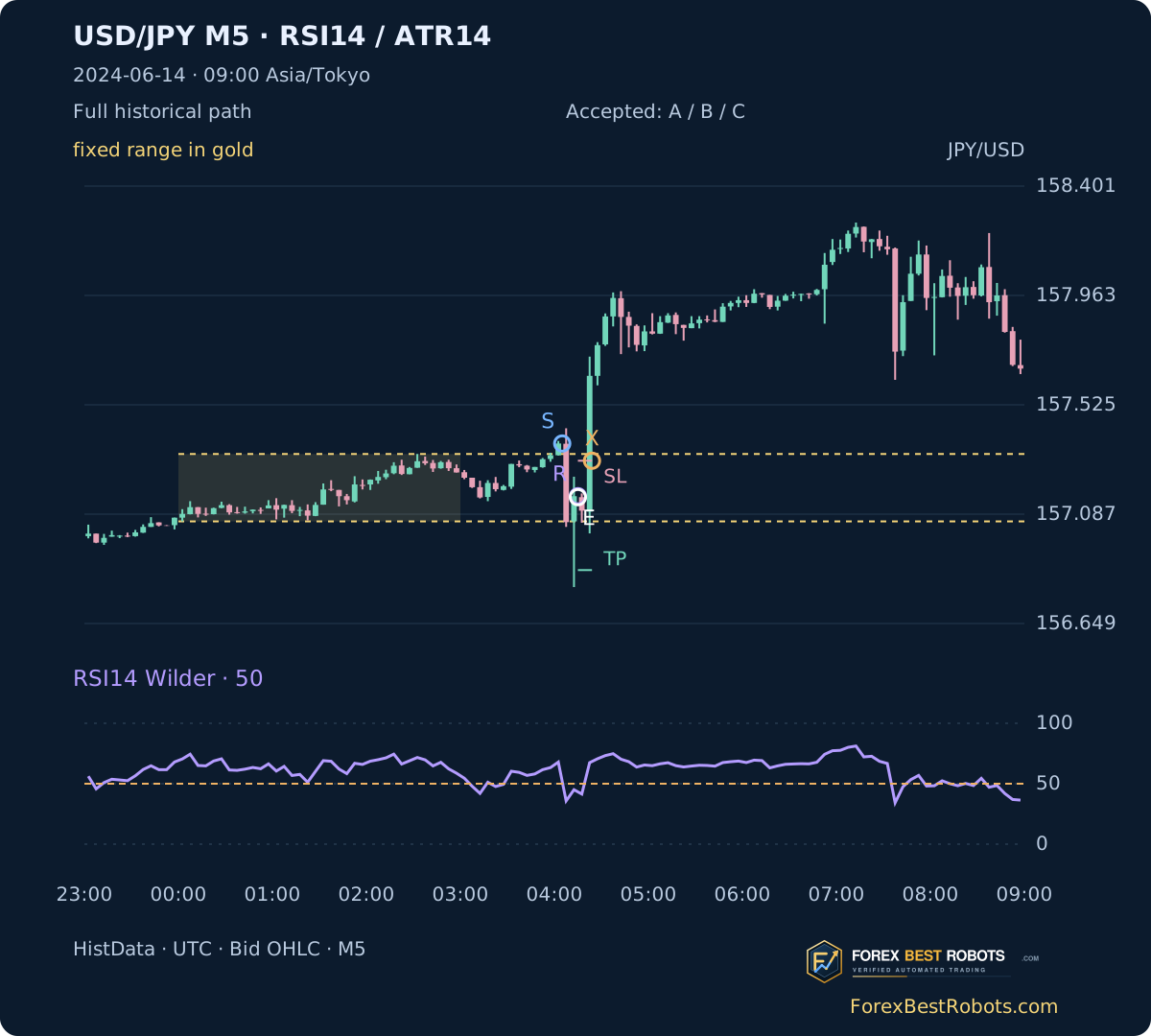
The first C trade is 14 June. S is known at 04:05 UTC, RSI 67.89; R at 04:15, RSI 45.04. The short reference is 157.155, risk 14.6 pips, stop 157.301 and target 156.863. Stop is observed in [04:23,04:24): −14.60 gross pips, −15.80 after 1.2. An entry-time snapshot hides later candles and X; the full figure shows the retrospective path.
5. Keep stop, deadline and missing records in the same exit order
Process consecutive M1 records. An adverse Open beyond stop exits at Open; a favourable Open beyond target exits at the target. Next apply the 90-minute limit at Open; otherwise test High/Low, assuming stop first if both barriers are touched in one minute. No trailing stop or break-even move. An intraminute exit is an observation interval, not an exact fill second.
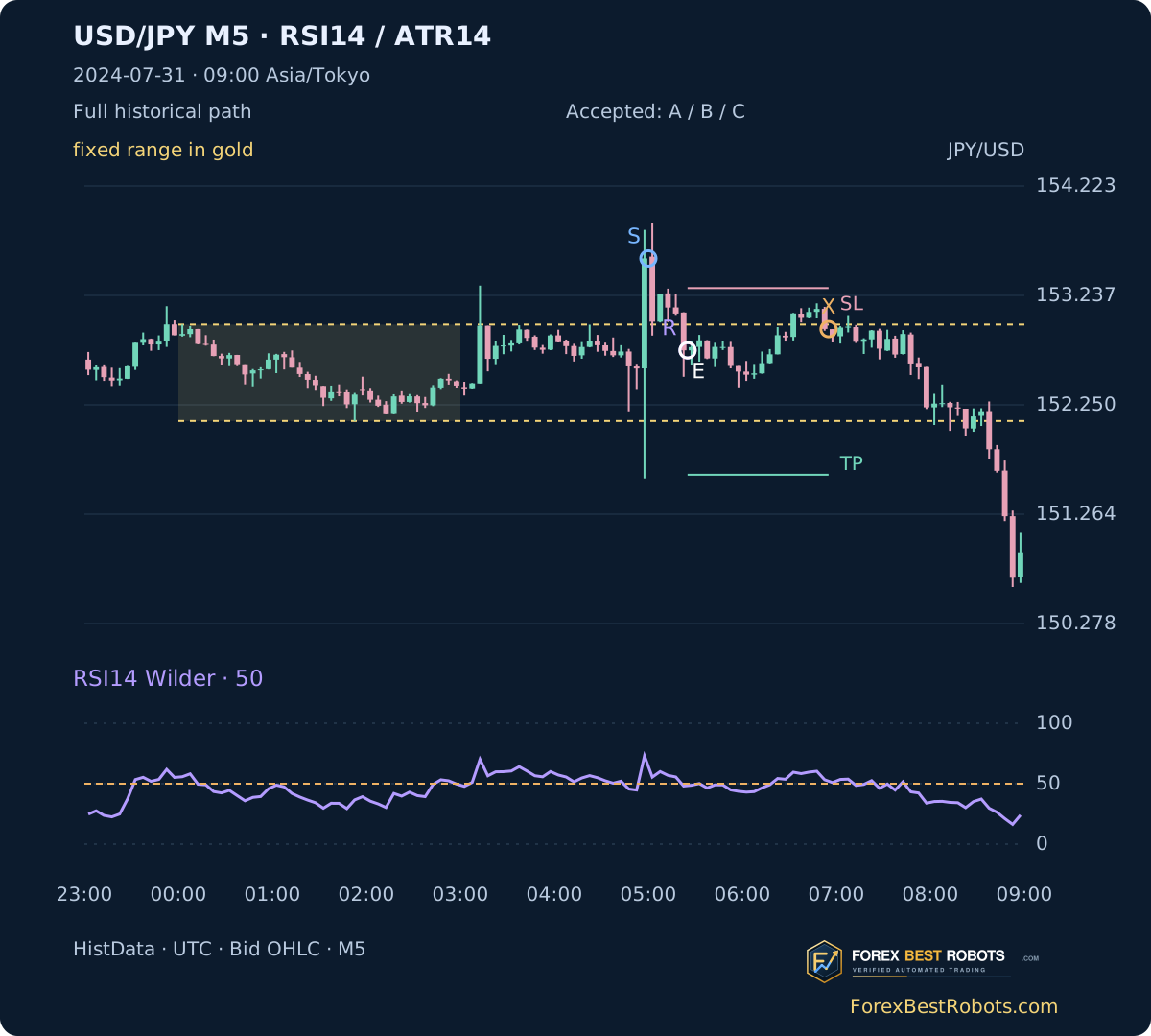
The second C trade, 31 July, shorts 152.742 at 05:25 UTC. Risk is 56.1 pips, stop 153.303, target 151.620. The 06:55 time limit exits at Open 152.933: −19.10 gross, −20.30 net. A’s 14 May path loses its next record at 03:47; its outcome remains unknown despite later available prices, and contributes no profit or loss to totals.
6. Read two filtered trades as a sample limit
At a hypothetical 1.2-pip round trip, A has 84 resolved trades and one unresolved entry: −217.10 pips and −29.07R. B/C each have two resolved trades, no unresolved paths, −36.10 pips and −1.44R. Their net-R profit factor is 0 and realized drawdown 1.44R, but two losses cannot estimate a stable win rate or validate the filter.
C totals −1.34R with zero allowance and −1.55R with 2.4 pips. The single allowance includes spread, commission and slippage, deducted once per resolved trade. It never changes entries or barriers. Pips assume equal position units; additive R divides each result by its own initial risk. Neither is a compounded account return. B/C retain only 2 of A’s 85 entered paths.
| Model | Resolved trades | Net total · pips | Net total · additive R | Profit factor · net R | Maximum realized drawdown · R |
|---|---|---|---|---|---|
| A | 84 | -217.10 | -29.07 | 0.5207 | 34.05 |
| B | 2 | -36.10 | -1.44 | 0.0000 | 1.44 |
| C | 2 | -36.10 | -1.44 | 0.0000 | 1.44 |
| Combined round-trip cost · pips | Resolved trades | Net total · pips | Net total · additive R |
|---|---|---|---|
| 0.0 | 2 | -33.70 | -1.34 |
| 1.2 | 2 | -36.10 | -1.44 |
| 2.4 | 2 | -38.50 | -1.55 |
7. Inspect a first return and change only its cost
Choose model, period and recorded trade. Enter 0–5 pips in steps of 0.1 or use a preset. Only net accounting changes. Example buttons restore the full year and 1.2 pips. B/C have only two trades, both losses.
Loading the historical examples…
This single allowance includes spread, commission and slippage; no other fee is added. A cost change leaves all entries, stops and exits unchanged.
Selected model and period
- Resolved trades
- —
- Entered but unresolved
- —
- Entry unavailable
- —
- Net total · pips
- —
- Net total · additive R
- —
- Profit factor · net R
- —
- Maximum realized drawdown · R
- —
- Net winning trades · %
- —
Selected historical trade
Gross − combined cost = net; net / initial risk = R
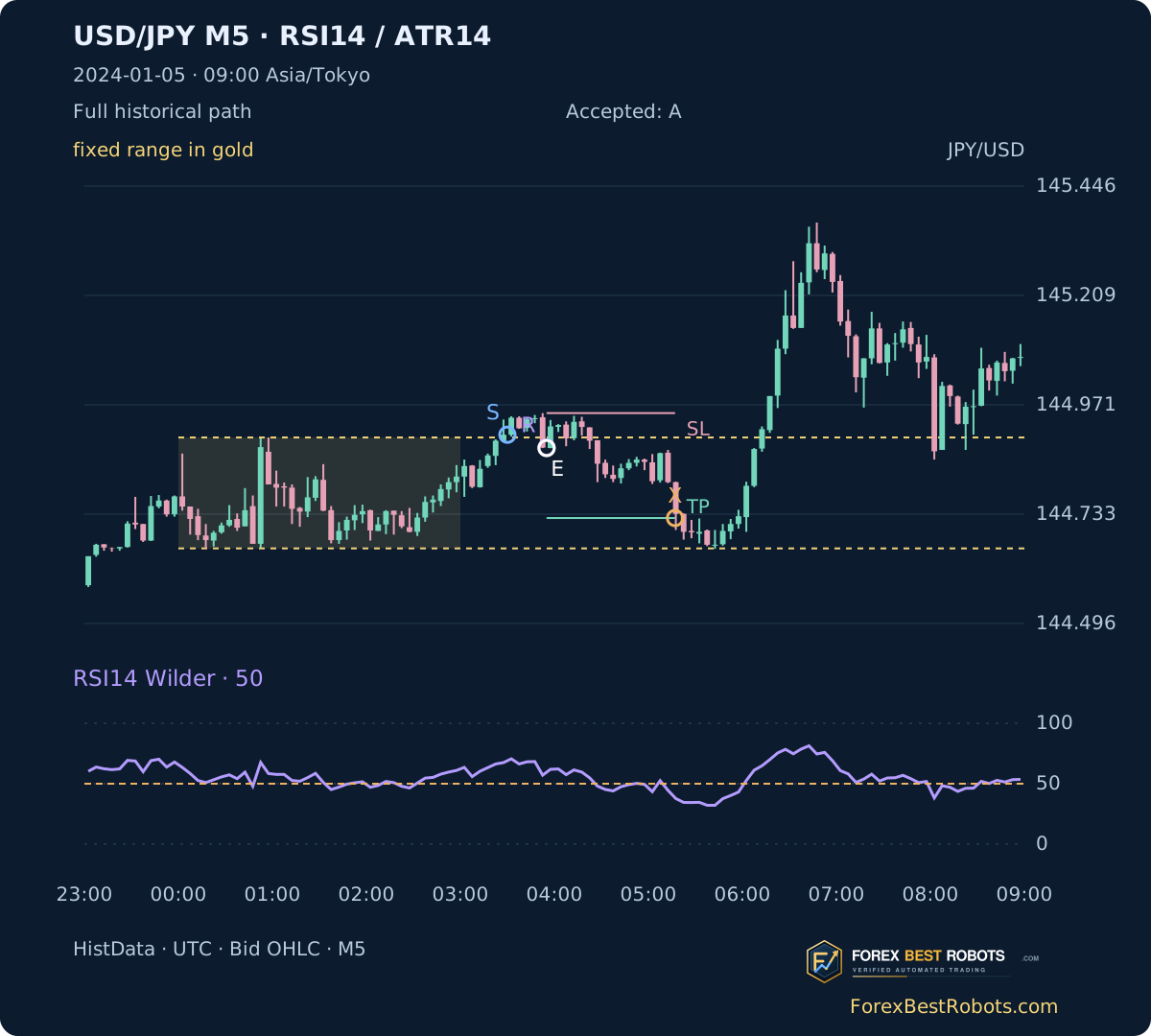
S: first closing break. R: first strict return inside. E: Bid entry reference in the opposite direction. X: exit known time; intraminute exits are minute intervals. SL/TP: fixed levels. Purple: RSI14; dashed orange: 50. The interactive chart is retrospective and includes candles after entry. Faded candles contain fewer than five recorded M1 minutes.
Static figures fit the article width and open at full size. Wide interactive charts and tables scroll horizontally on small screens.
- Direction
- —
- Entry reference · UTC
- —
- Exit observation · UTC
- —
- Entry Bid reference
- —
- Exit Bid reference
- —
- Initial risk · pips
- —
- Fixed stop
- —
- Fixed target
- —
- Exit / unresolved reason
- —
- Gross result · pips
- —
- Net result · pips
- —
- Net result · R
- —
- First break S known · UTC
- —
- First return R known · UTC
- —
- RSI14 at first break S
- —
- RSI14 at first return R
- —
Open the complete selected trade table
| Date | Direction | Entry reference · UTC | Exit observation · UTC | Exit / unresolved reason | Net result · pips | Net result · R |
|---|
8. Check what the filter rejects as well as what it keeps
On 5 January, A’s first winning trade shorts 144.877 at 03:55 UTC, risk 7.6 pips. Target 144.725 is observed in [05:16,05:17): +15.20 gross, +14.00 net at 1.2. RSI at the first R is 57.07, so B/C reject this winner too. Its later result was not known to the filter. No C winner or extra C-only rejection exists in this study.
At 1.2 pips, C has one trade and −1.08R in January–June, then one and −0.36R in July–December. These are two historical observations, not a stability test or untouched validation sample. The fixed RSI 50 rule is very restrictive at a first return near the broken edge. Changing the threshold or waiting longer would define a different strategy and needs a separate locked test.
| Period | Resolved trades | Net total · pips | Net total · additive R |
|---|---|---|---|
| January–June | 1 | -15.80 | -1.08 |
| July–December | 1 | -20.30 | -0.36 |
9. Show the coverage losses and execution limits
The real HistData input contains 401,025 unique M1 records and 80,533 observed M5 candles including December warmup. Of 262 source-covered weekdays, 20 ranges are incomplete. Among 242 complete ranges, 82 complete searches have no break, 15 lose first-break coverage, 60 first breaks expire without R, and 85 produce entered A paths. Of those, 84 resolve and one remains unknown.
No missing prices are interpolated. Observed partial candles contribute to the disclosed indicator reconstruction; range, S and R need complete candles. Charts are branded ForexBestRobots reconstructions of actual Bid OHLC, not terminal screenshots. Cost deduction cannot reproduce historical Ask, variable spread, short Ask-triggered stops, tick order or broker fills. No news or holiday filter was applied; one pair and one year provide limited evidence.
Frequently asked questions
Does a wick outside the range trigger the strategy?
No. S requires a completed close strictly outside. R is a later close strictly inside within 30 minutes. A wick-only excursion is not the required sequence.
Can RSI qualify on a later return?
Not under this protocol. Only the first R counts. If RSI fails there, that model skips the date even if RSI later crosses 50.
Is the entry in the breakout direction?
It is opposite S: short after an upward break returns inside, long after a downward break returns inside. RSI is checked in that reversal direction.
Why are B and C identical, with no winning C chart?
Both B trades already satisfy C’s extra S condition. Both lose after the base cost. The article reports these absences instead of adding a selected or simulated winner.
What does one pip mean on USD/JPY?
0.01 JPY per USD; 0.1 pip is 0.001. The adjustable cost is one hypothetical combined round-trip allowance, charged once per resolved trade. It is not measured historical spread.
Can this small test establish a profitable strategy?
No. There are only two RSI-confirmed trades and both lose. Downloads include all dates, missing cases, M1/M5 inputs, trades, fixed rules and standalone recalculation so the restrictive assumptions can be inspected.
Data, timing and reproducibility
Retained input: 2023-12-01 00:00 UTC through 2024-12-31 21:58 UTC. Each original annual archive contains 60 identical timestamp duplicates, removed only after equality checks. Original SHA-256 hashes are included. Prices retain the source’s 0.001 precision in integer 0.000001 quote units.
RSI starts at index 14 with arithmetic means of positive/negative changes 1–14, then (13 × previous average + new change)/14. Positive gain with zero loss gives 100; zero gain with positive loss gives 0; both zero gives 50. ATR starts at index 13 with mean of 14 True Ranges; first TR is High−Low, later TR is max(High−Low, |High−previous Close|, |Low−previous Close|). It uses the same Wilder recurrence.
Primary examples were selected chronologically across all 2024. The first C is also the first C loss; no C winner and no B-accepted/C-rejected case exists. Additional illustrations explicitly show the second C, first A winner and first unknown A. These presentation choices change no strategy parameter. In downloads key B stores chart event S, distinct from model B; key R is the first return.
- Reconstructed M5 inputs (ZIP)
- All model trades (CSV)
- M1 data, fixed method and standalone replay (ZIP)