

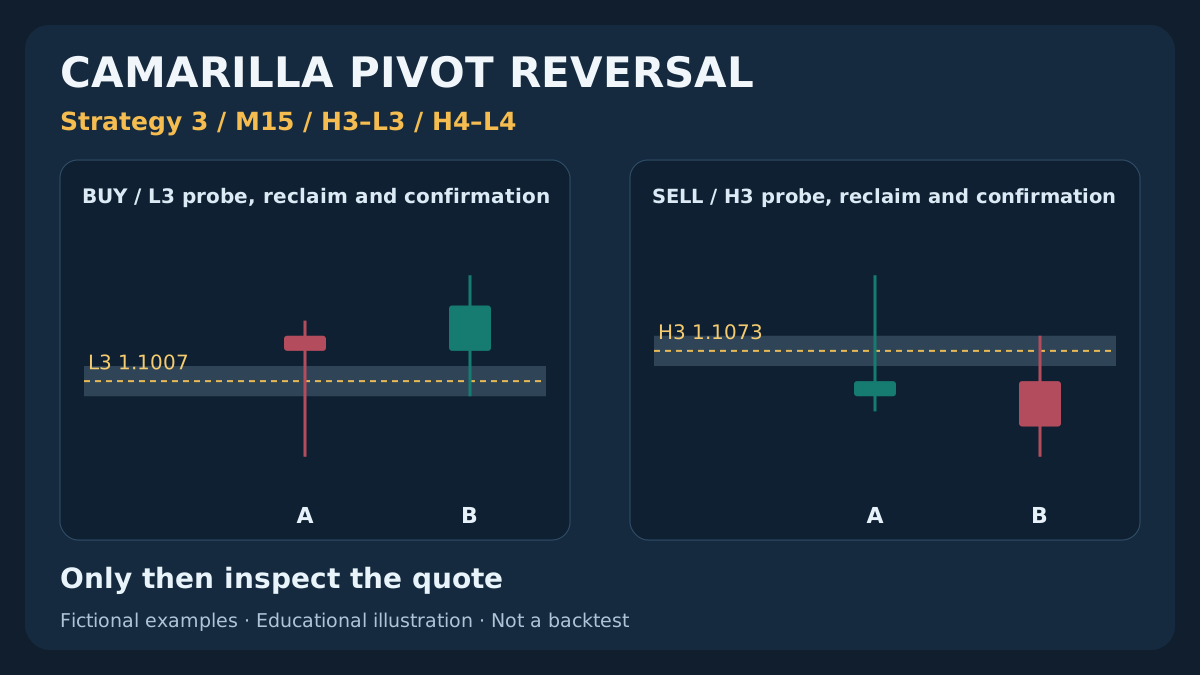
Camarilla levels are arithmetic references, not instructions to fade every touch. This strategy tests a specific reversal: the first L3 or H3 contact must probe beyond the level, close back inside and receive a separate confirmation before the first new quote is assessed. H4 and L4 cancel new entries for the day; they are not automatically the trade’s stop or an instruction to reverse. The specification fixes opening eligibility, quote timing, executable exits and a cost-aware budget. All prices, trades and counts are fictional teaching examples, not evidence of a profitable system.
1. What the Camarilla reversal hypothesis actually tests
The hypothesis is that a first excursion outside L3 or H3 can fail and return toward the previous daily close C. It is not the claim that a formula identifies hidden liquidity or a statistically reliable turning point. A visible rejection can precede another loss. The opening filter and outer-boundary rule below deliberately narrow the experiment rather than prove that the market is ranging.
Use EUR/USD, completed M15 Bid candles and the same broker’s completed D1 Bid data. H3/L3 are this article’s upper/lower Camarilla labels; some platforms call them R3/S3, and H4/L4 become R4/S4. H here denotes the upper family, not the previous daily high. Save the mapping rather than assuming that every indicator uses identical names, periods or feeds.
This is the third strategy in the pivot cluster. The Traditional S1/R1 bounce and R1/S1 breakout and retest have different maps and hypotheses. Do not combine their entries, copy their stops or switch to a breakout after a failed Camarilla reversal without defining and testing a separate version.
2. Calculate H3/L3 and H4/L4 from a completed daily range
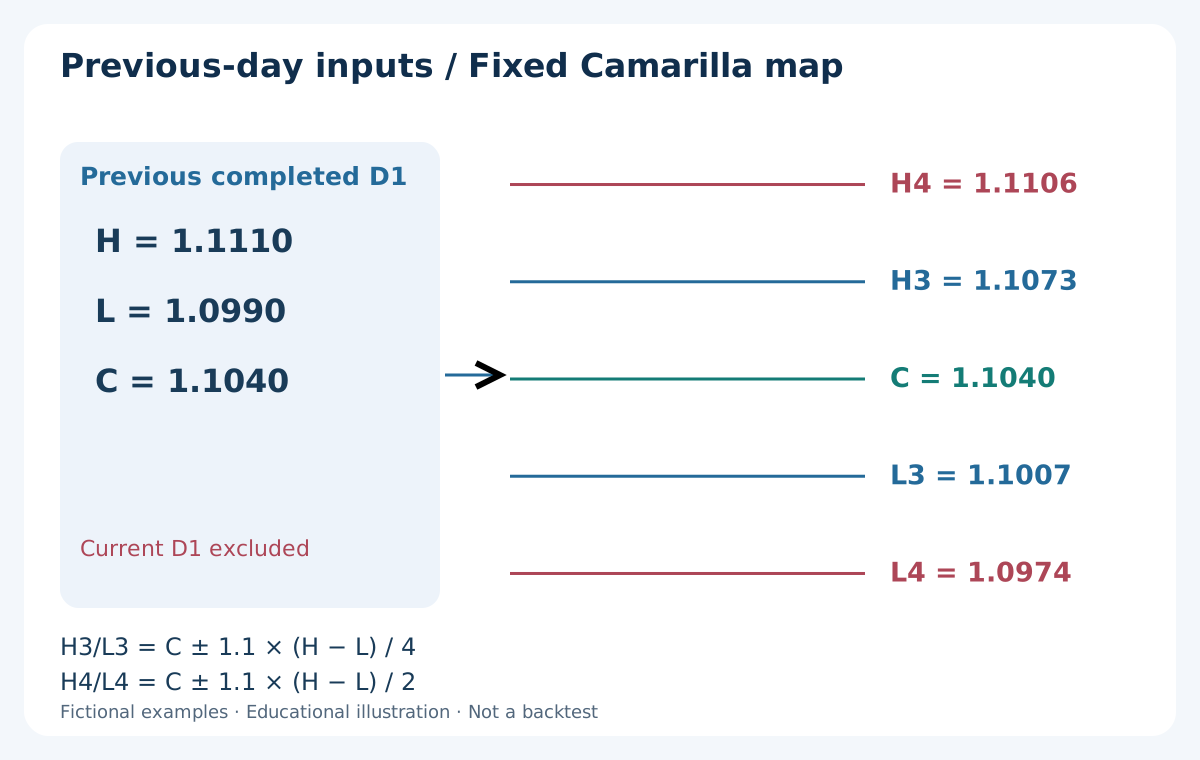
Save the latest completed broker D1 high H, low L, close C, time boundaries and source. Let R = H − L. Use H3 = C + 1.1 × R / 4, L3 = C − 1.1 × R / 4, H4 = C + 1.1 × R / 2 and L4 = C − 1.1 × R / 2. Require H > L, L ≤ C ≤ H and valid positive prices. The current unfinished D1 contributes no input; retain calculation precision and round actual order prices separately.
The fictional previous day has H = 1.1110, L = 1.0990 and C = 1.1040. Thus R = 0.0120, or 120 pips; 1.1 × R = 0.0132. H3 = 1.1073, L3 = 1.1007, H4 = 1.1106 and L4 = 1.0974. Each inner level is 33 pips from C and each outer level 66 pips. C is the target reference, not Traditional P: the latter would be about 1.1046667 for these inputs.
Keep the broker calendar and date-specific UTC offset. If the latest D1 is an abbreviated Sunday/holiday session or misses expected bars, skip the current day rather than quietly substituting an older day or merging data after the outcome. Freeze the resulting map at 08:00 server time. The pivot formulas and time-zone guide explains why changing the daily cut-off changes every level.
3. Fix the opening gate, observation hours and units
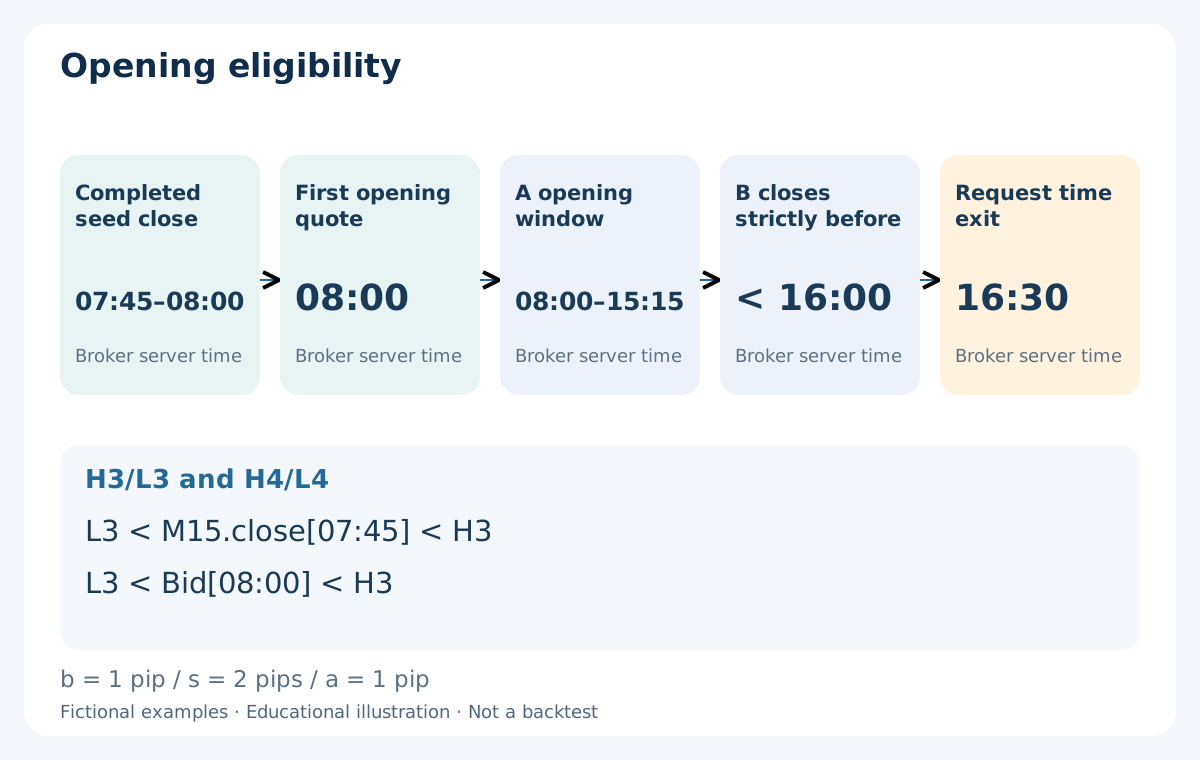
At 08:00 save the close of the completed M15 candle opened at 07:45 and inspect the first received quote for this symbol. Both that close and the new Bid must lie strictly between L3 and H3; equality fails. The quote must arrive within 5 seconds of 08:00, be at most 2 seconds old and satisfy the spread checks below. If this opening gate fails or the required snapshot is missing, disable all entries for that broker day. Do not activate later after price returns inside.
Observe contact candles A opening from 08:00 through 15:15 inclusive. B is immediately after A and must close strictly before 16:00; exactly 16:00 fails. Ask to close any remaining position at 16:30. These arbitrary research hours use broker server time, not universal London time. A scheduled close is usable only when subsequent data make its completed candle available. M15 time labels denote candle opening times. No current ATR or evolving daily range is used to move the levels.
Fix buffer b = 1 pip, maximum entry spread s = 2 pips, adverse-execution allowance a = 1 pip, quote-age cap 2 seconds and entry deadline 5 seconds after B’s scheduled close. Require conservative net reward-to-risk ≥ 1.5. For this EUR/USD example, 1 pip = 0.0001 and a five-decimal point = 0.00001; a tick is the actual permitted increment, checked separately. Reject crossed or invalid quotes and require 0 ≤ Ask − Bid ≤ s.
| Parameter | Baseline value | What is fixed |
|---|---|---|
| Market / level source | EUR/USD · M15 Bid | Previous completed broker D1 |
| Opening gate | 07:45 close + first 08:00 Bid | Both strictly inside L3/H3 |
| Contact / session | A opens 08:00–15:15 | B closes before 16:00; exit request 16:30 |
| Outer boundary | Any L4/H4 Bid touch | Disable new entries for the day |
| Buffer / spread / allowance | b = 1 · s = 2 · a = 1 pip | Conservative net ratio ≥ 1.5 |
| Quote age / entry deadline | 2 seconds / 5 seconds | First subsequent quote only |
| Daily limit / risk budget | 1 filled entry · 0.5% | Round volume down; no loss guarantee |
4. Consume the first inner-level contact and retain state
After an eligible opening, the first completed M15 candle in the A window with low ≤ L3 consumes the BUY attempt; the first with high ≥ H3 consumes SELL. A mere touch that lacks the required probe still consumes the attempt. No later prettier rejection replaces it. Each direction has one attempt, but the entire strategy may have only one open position and one filled entry per broker day.
BUY requires the preceding close and A.open strictly between L3 and C − b. SELL requires both strictly between C + b and H3. A missing predecessor, equality or opening gap outside the required interval fails. This prevents treating a gap directly beyond the inner level as an observed rejection from inside. A candle touching both inner levels fails both candidate directions; do not infer which contact came first from OHLC.
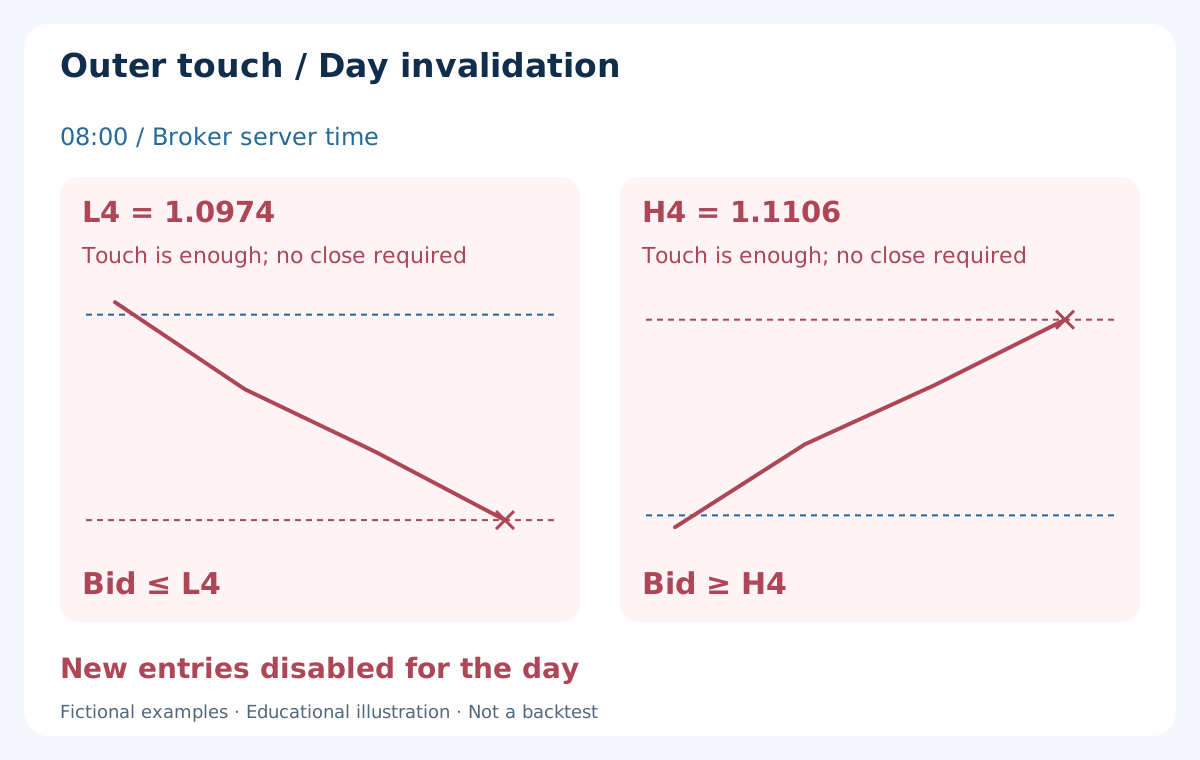
Monitor Bid from 08:00 onward. Any Bid ≤ L4 or ≥ H4 disables all new entries for the rest of the day, even if price immediately returns inside. Completed candle lows/highs can establish such a past breach; live monitoring also reacts to the first observed tick without waiting for a close. Keep this disabled state across restarts. It has priority over selecting A, B or a later quote; missing tick coverage cannot prove that no outer touch occurred.
5. BUY: probe L3, reclaim it in A, then confirm with B
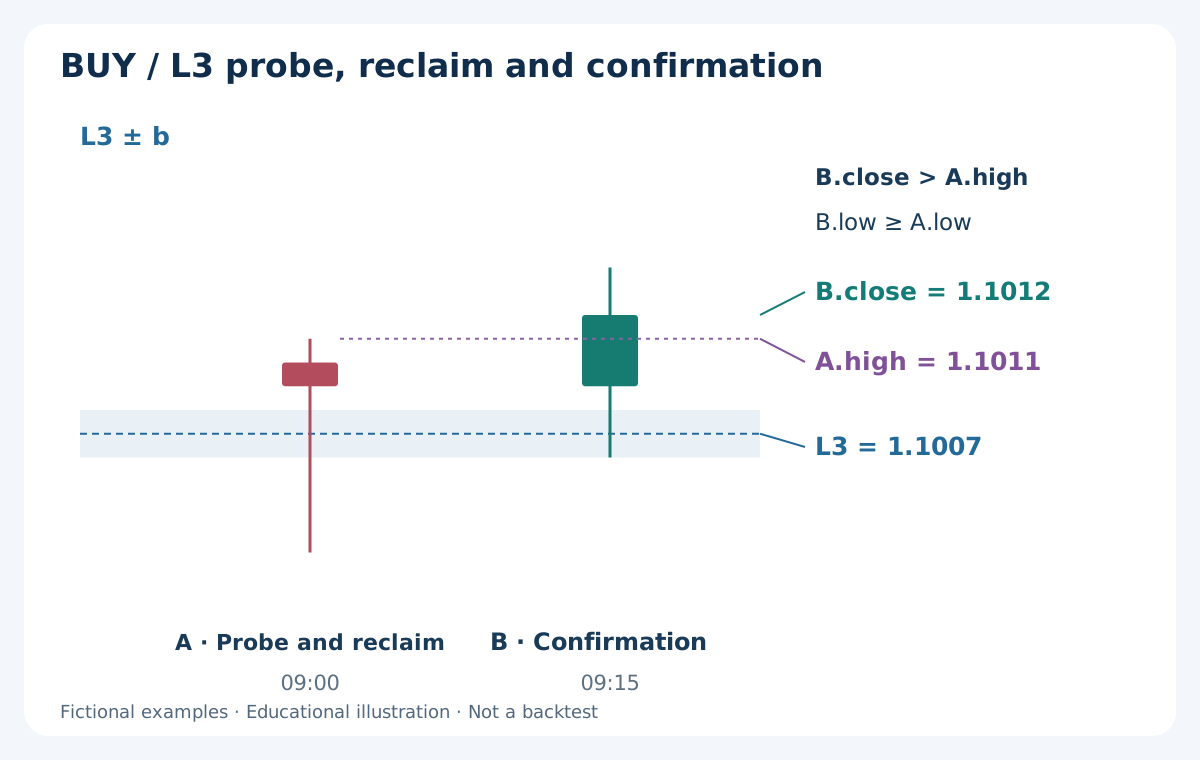
For the first BUY contact, require A.low ≤ L3 − b, A.close > L3 + b, A.high < C − b and A.low − b > L4. A probe exactly at L3 − b is allowed; a close exactly at L3 + b is not. high, low and close mean the candle’s high, low and closing price. The deeper wick does not justify a fill at its low, because the reclaim is known only after A closes.
B must be the immediately following completed M15 candle, with B.close > A.high, B.low ≥ A.low and B.high < C − b. An equal low is allowed; equal close at A.high fails. A new low cancels rather than moving the intended stop. From A’s opening until entry, a Bid high reaching C − b cancels because this attempt’s reference target has already been visited. A visit before A is not part of this target-visit test.
After B is available, inspect only the first new Bid/Ask snapshot. Require Bid > A.high and Ask ≤ B.close + s, plus age, deadline, spread, costs and size checks. A market BUY enters at Ask. Its fixed protective Bid stop is A.low − b and its fixed Bid target C − b. The stop is deliberately nearer than L4; the outer day boundary and the executable protective order serve different purposes.
6. SELL: probe H3 and keep the protective prices on Ask
For the first SELL contact, require A.high ≥ H3 + b, A.close < H3 − b, A.low > C + b and A.high + b < H4. An equal probe at H3 + b is allowed; equal reclaim close at H3 − b fails. B immediately follows A, with B.close < A.low, B.high ≤ A.high and B.low > C + b. Do not replace A, delay B or redraw an extreme after seeing the result.
From A’s opening until entry, any Bid low ≤ C + b cancels for a previously visited reference target. At the first new quote after B, require Bid < A.low and Bid ≥ B.close − s, plus all common checks. A market SELL enters at Bid. Use fixed protective Ask stop A.high + b + s and fixed Ask target C + b + s; no entry at the earlier H3 touch is assumed.
The fixed s = 2 pips is a spread allowance, not an observed historical Ask high. With a constant 2-pip spread, the target corresponds to Bid C + b, before C, and the stop to Bid A.high + b. Later spread widening changes that mapping and may trigger a short stop while the displayed Bid has not touched the drawn Ask line. Retain actual Bid/Ask evidence; the order-types guide explains the distinction.
7. Distinguish outer invalidation from a protective stop
H4/L4 cancel new entries on a touch, not only on a close beyond them. If a gap first appears at Bid 1.0974 or below, the day is disabled even without a recorded tick exactly on L4. A high reaching H4 1.1106 has the same effect. Returning inside later does not restore permission. This rule is a testable filter, not proof that a trend has started or an automatic breakout trade.
The BUY example’s stop will be Bid 1.1001, above L4 1.0974. Replacing it with L4 − b = 1.0973 would increase price risk from 13 to 41 pips while leaving the 25-pip potential reward unchanged. That is another risk specification and fails this example’s cost gate. Conversely, do not tighten a wide wick’s stop merely to manufacture an acceptable ratio. An invalid candidate is skipped, not repaired.
Apply cancellation priority: invalid data/opening/session, outer-boundary touch, both-inner-level or invalid A, invalid/expired B, used daily state, then first-quote/price/cost/volume and broker acceptance. Only the first quote after B is assessed, within 5 seconds and with age at most 2 seconds. Use this symbol’s timestamp and a synchronized receipt clock; reject future-dated or untimed data. Another Market Watch symbol’s clock update does not establish freshness. An unknown broker response requires ticket reconciliation before another request.
8. Worked BUY: the completed sequence before Ask entry
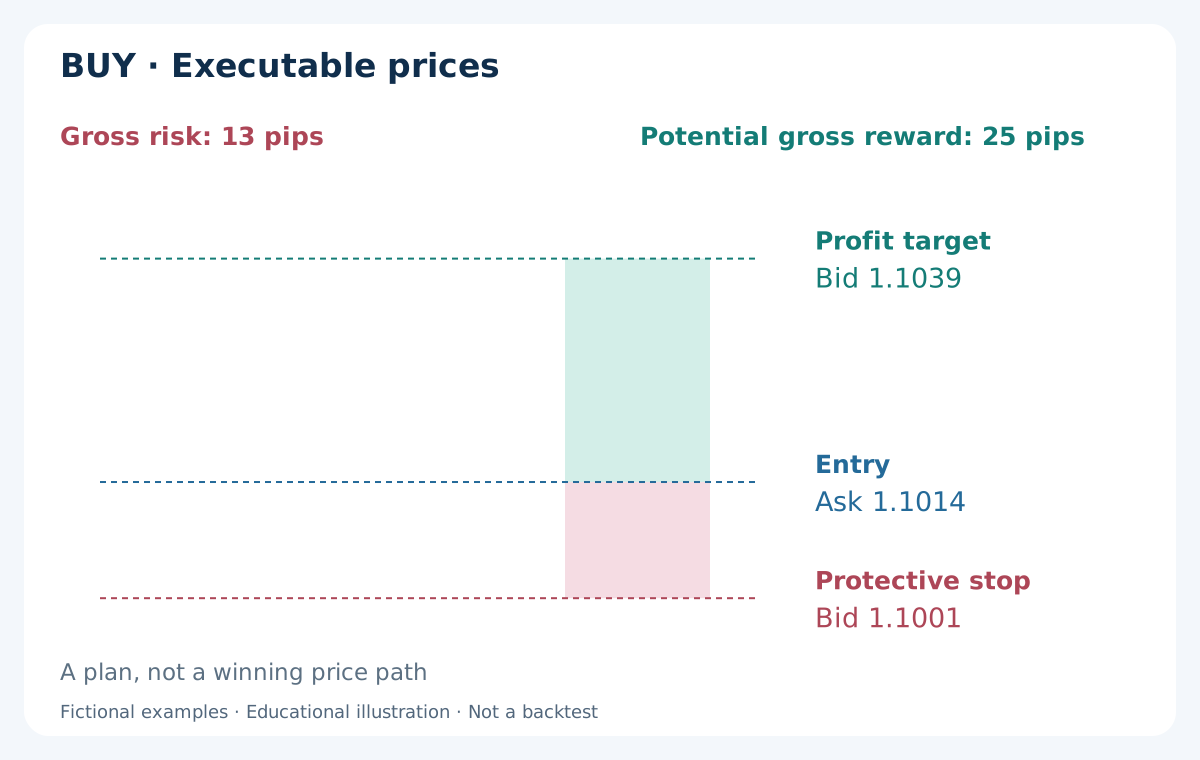
Use C = 1.1040, L3 = 1.1007 and L4 = 1.0974. Suppose the 07:45 close and first 08:00 Bid both equal 1.1040, inside the inner corridor, and no earlier candidate or outer touch occurred. The preceding close before A is 1.1012. A at 09:00 has open 1.1010, high 1.1011, low 1.1002 and close 1.1009. Its probe and reclaim are known after 09:15, not at the low.
B at 09:15 has open 1.1009, high 1.1014, low 1.1006 and close 1.1012. Confirmation is known after 09:30. Assume the first fresh quote at 09:30:01 is Bid 1.1012 / Ask 1.1014 and a BUY fills at Ask 1.1014 with protection accepted. Bid > A.high and Ask = B.close + s, an allowed equality. Entry occurs after both closes, not at L3 or B’s earlier crossing.
The fixed Bid stop is 1.1002 − 0.0001 = 1.1001; the Bid target is 1.1040 − 0.0001 = 1.1039. Gross risk is 13 pips and potential gross reward 25, a gross ratio about 1.92. The diagram is an exit plan with no future winning path. In a separate losing continuation, Bid can gap to 1.0999 and the stop fill there instead of 1.1001, producing a 15-pip price loss. A protective order does not guarantee its requested fill or maximum loss.
9. Worked SELL: an independent scenario with Ask exits
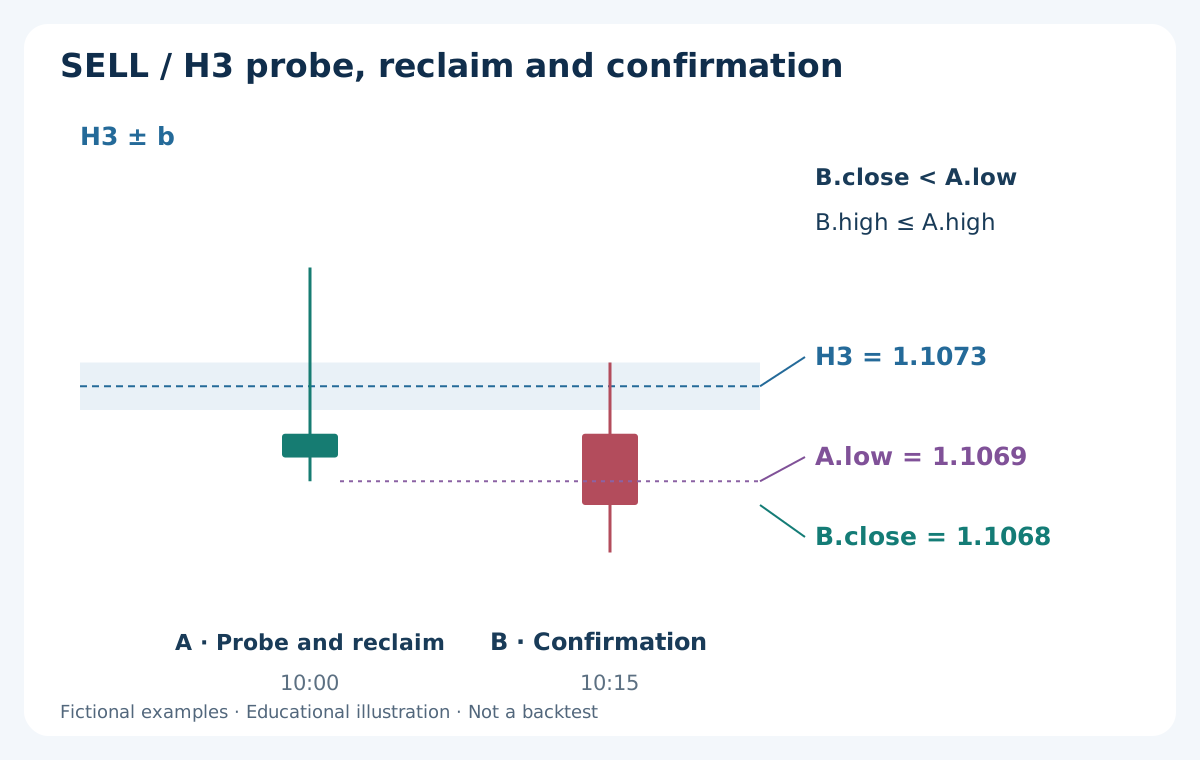
This is a separate scenario, not a second filled entry on the BUY example’s day. Use C = 1.1040, H3 = 1.1073 and H4 = 1.1106, with the opening gate passed and no prior SELL contact or outer touch. The preceding close is 1.1068. A at 10:00 has open 1.1070, high 1.1078, low 1.1069 and close 1.1071. The probe is beyond H3 + b; the close reclaims below H3 − b.
B at 10:15 has open 1.1071, high 1.1074, low 1.1066 and close 1.1068. A is known after 10:15 and B after 10:30. Assume the first fresh quote at 10:30:01 is Bid 1.1068 / Ask 1.1070 and the SELL fills at Bid 1.1068. The earlier A.high is not a post-entry stop event, and the short is not assumed to have entered at the earlier H3 touch.
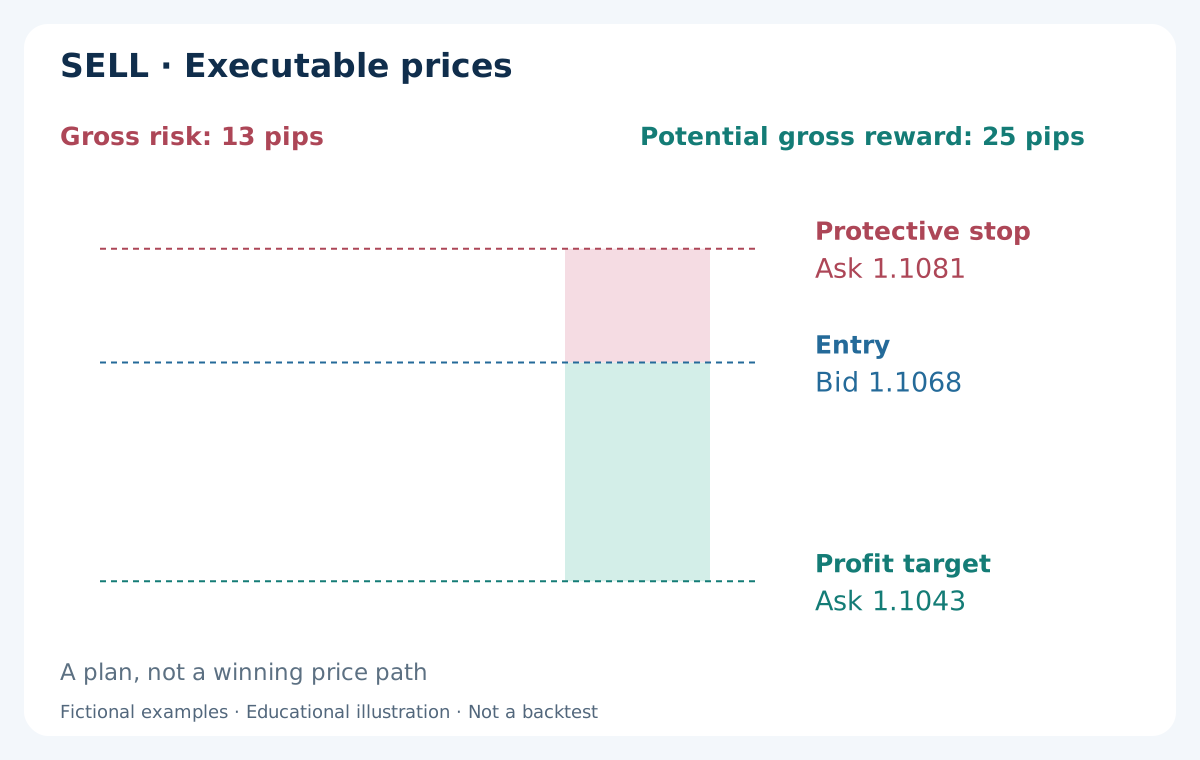
The fixed Ask stop is 1.1078 + 0.0001 + 0.0002 = 1.1081. The fixed Ask target is 1.1040 + 0.0001 + 0.0002 = 1.1043. Gross risk is 13 pips and potential gross reward 25. With constant 2-pip spread, the corresponding Bid levels are 1.1079 and 1.1041. The Ask target is reached before the reference Bid reaches C; an isolated Bid touch does not establish an actual Ask fill.
10. Keep C fixed and disclose the obstacle map
BUY targets Bid C − b; SELL targets Ask C + b + s. C is the previous completed daily close, not today’s evolving midpoint, Traditional P or an adaptive moving average. Stops stay at the accepted A-based prices. Round stops away from entry and targets toward entry on the real tick grid, then recompute distances, cost ratio and volume. Skip if the rounded BUY stop is not above L4, or the fixed-spread Bid equivalent of the rounded SELL stop is not below H4.
The baseline obstacle list contains prior D1 H/L and a zero-anchored 100-pip round-number grid, with halves and quarters disabled. Skip if a reference lies strictly between current Bid and BUY C − b or SELL C + b; endpoints are excluded. None intervenes in the two worked plans. Save the list before 08:00. Additional swing zones, news exclusions or partial exits are new specifications, not discretionary repairs after a loss.
The support/resistance guide and round-number guide explain reference construction. A Camarilla line near another level is not an independent probability vote. A prior target visit is checked only from A onward, while the outer-day invalidation runs from 08:00. Conflating those two lookback windows would incorrectly cancel an opening near C before any reversal attempt existed.
11. Check the net cost ratio before sending the first request
Let r be executable stop distance and g executable target distance, in pips. Convert round-trip commission into c pips using actual pip value in account currency. Require (g − a − c) / (r + a + c) ≥ 1.5, with positive numerator and denominator. The allowance a = 1 pip represents one adverse entry-or-exit difference, not an extra loss at both ends. Spread is already in executable quote-side prices and is not subtracted again.
For r = 13 and g = 25, assume USD 7 round-trip commission per standard lot and USD 10 per pip, so c = 0.7. Gross ratio 25/13 ≈ 1.92 becomes 24.3/13.7 ≈ 1.77 after commission at unchanged fills. The conservative planning ratio is (25 − 1 − 0.7) / (13 + 1 + 0.7) = 23.3/14.7 ≈ 1.59. This is a sensitivity calculation, not evidence of an exploitable advantage.
In a separate BUY variant, B.close = 1.1013 and the first quote is Bid 1.1013 / Ask 1.1015. Spread and overshoot still satisfy 2 pips, but the original exits give r = 14 and g = 24. The planning ratio is 22.3/15.7 ≈ 1.42, so skip. Do not wait for a cheaper second quote or move C. A 3-pip initial spread would fail the spread check first; retain one primary reason, with optional secondary flags, rather than counting two skipped trades.
12. Size in account currency and round the lot volume down
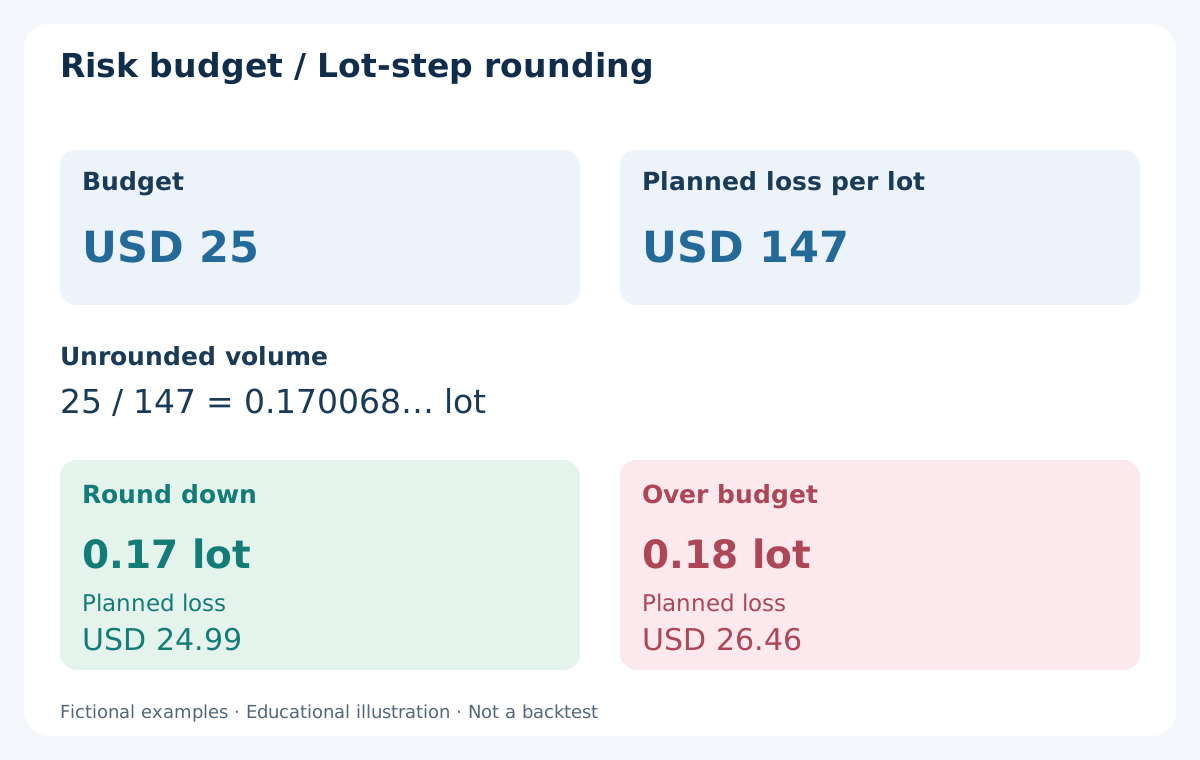
For USD 5000 equity and a 0.5% planning budget, risk budget is USD 25. Assume EUR/USD, a standard lot of 100000 EUR, USD 10 per pip per lot and USD 7 round-trip commission per lot. With a 13-pip stop plus 1-pip adverse allowance, planned loss per lot is (13 + 1) × 10 + 7 = USD 147. Raw volume is 25/147 = 0.170068… lot.
With volume step 0.01, round down to 0.17 lot, giving USD 24.99 planned loss. Rounding to 0.18 gives USD 26.46 and exceeds budget. At the unchanged illustrative fills, gross stop loss is USD 22.10 plus USD 1.19 commission, or USD 23.29. Potential gross target gain is USD 42.50 less USD 1.19, or USD 41.31. The separate 15-pip losing fill would cost USD 26.69 after commission, exceeding the planning budget.
These are conditional examples, not observed returns. Verify real contract size, account-currency tick value, currency conversion, lot limits and margin. USD as the quote currency does not imply a USD deposit account. If minimum volume exceeds budget, skip. The position-sizing guide and trading-cost guide explain broader checks. Gaps, slippage and conversion can exceed any allowance; a budget is not a maximum-loss guarantee.
13. Reconcile protection, fixed exits and the daily lock
Before submission check trading permission, tick grid, minimum stop distance, volume and margin. MQL4 MODE_TICKSIZE is in points: multiply by Point to obtain a price increment. MODE_STOPLEVEL = 0 may still involve dynamic restrictions. The baseline requires stop and target accepted with the opening request. If protection is not accepted, skip rather than intentionally open unprotected or widen the stop to avoid a rejection.
After a fill reconcile real entry, protection and distances. Reduce remaining a by the adverse entry difference already realized, floored at zero, rather than charging the full allowance twice. If protection is absent, the 1.5 cost gate fails or planned loss exceeds budget, request an immediate close under the exception rule and keep its actual outcome. A timeout may already have filled; match uncertain acknowledgements to broker tickets before resubmission.
Keep stop and target fixed: no averaging down, partial exit, trailing, automatic break-even or opposite breakout order. Ask to close at 16:30 if still open and record the real fill or failed close. One filled entry consumes the daily allowance even after a loss, preserved across restarts. Reset only on a confirmed new broker day with no old or unresolved position. A later outer touch cannot be used to erase an earlier filled loss; other EAs require a separately declared account-wide exposure limit.
14. Test what was knowable at each decision time
Rebuild the broker D1, 08:00 map, 07:45 seed close, first opening quote, outer-touch state, first contact and A/B with information available then. Using today’s final high/low or a redrawn historical indicator introduces future data. A and B are different completed candles; the low of A cannot justify a fill before its reclaim is known, and a delayed B cannot replace an invalid immediate one.
M15 OHLC can classify many signal conditions, but not the first quote’s age, the 5-second deadline, actual Ask exits or exit order when both levels appear touched in one candle. Use ordered Bid/Ask ticks and broker records. Missing ticks also prevent proving that no outer boundary was touched before entry. Mark incomplete histories and ambiguous exits instead of assuming a favorable path. Include spread changes, commission, rejections, adverse fills and time exits.
Separate development, chronological out-of-sample testing and forward observation. Preserve every tested daily feed, opening filter, buffer, hour window, target and cost threshold rather than publishing only the best combination. Report net expectancy, drawdown, fills, cancellations and cost sensitivity. The MT4 backtesting guide explains platform limitations. No reaction rate, neat pattern or minimum sample count establishes future profitability.
15. Keep attempt, day and outcome denominators separate
Log broker day/UTC offset, D1 H/L/C and boundaries, all four Camarilla levels, C, opening close/quote and gate result. Save the first inner contact per direction, outer ticks, A/B OHLC and availability, cancellation reason, first post-B quote/age/spread, rounded exits, r/g/c/a, ratio, budget, volume, request response and fills. The image supplies context; it does not replace this sequence record.
An invented ledger over several days has 14 fully observed first-contact attempts after a passed opening gate: 3 invalid A, 2 invalid or expired B, 2 outer-boundary cancellations before entry, 2 quote/cost skips, 1 known broker rejection with no fill, and 4 fills. Of the 4 fills, 2 reach target, 1 reaches stop and 1 exits by time. Thus 4/14 ≈ 28.57% is execution frequency, not win rate. Two target exits out of 4, or 50%, is not a validated win rate either; net time-exit returns are still needed.
Separately record 3 days whose opening gate fails and another 2 incomplete candidate histories. Days and attempts are different units; do not add them to invent an attempt denominator or treat missing coverage as no contact. Retain the first cancellation reason plus extra flags, without double-counting an attempt. Publish missingness and sensitivity. Editorial or code corrections that change a rule need a new version and rerunning the affected sample, not a rewritten profitable history.
16. A practical review before enabling the experiment
Before 08:00 verify calendar, completed D1, contract and budget. At 08:00 freeze the map and obstacle list, then check the completed 07:45 close and first timely opening quote. If eligible, monitor outer boundaries and consume the first inner contact per direction during the A window. Require a valid reclaim A and immediate B closing before 16:00. Before submission check the first quote, 2-second age, 5-second deadline, rounded protection, target room, costs, volume, margin and unused daily allowance.
After entry reconcile fill and protection, apply the exception rule if needed and keep fixed exits plus the 16:30 close request. Afterwards include cancellations, skips, rejections, losses, time exits, disabled days and incomplete cases in the journal. The purpose is a reproducible decision record capable of rejecting an unprofitable hypothesis, not a narrative in which every failed reversal becomes a successful breakout.
The cluster now contains three distinct specifications: Traditional pivot bounce, Traditional breakout and retest, and this Camarilla reversal. The three price-level guides explain their references. Compare fixed versions and account-wide exposure; do not choose the winning explanation after the same price path has already unfolded.
Frequently asked questions
What is the Camarilla H3/L3 reversal strategy?
It tests a first inner-level probe, a completed reclaim A and an immediately following confirmation B toward the previous daily close C. This version fixes an opening gate, H4/L4 day invalidation, quote timing, costs and risk. The examples do not demonstrate profitability.
How are H3/L3 and H4/L4 calculated?
With R = H − L from the previous completed D1, H3/L3 = C ± 1.1 × R / 4 and H4/L4 = C ± 1.1 × R / 2. Some platforms label them R3/S3 and R4/S4. Keep the feed and day boundary fixed; exclude the current unfinished D1.
Does H4/L4 invalidation mean putting the stop there?
No. Any outer Bid touch from 08:00 disables new entries for the day. The BUY protective stop is A.low − b, and the SELL Ask stop is A.high + b + s. In the BUY example, replacing the 13-pip stop with L4 − b would create 41-pip risk for the same 25-pip potential reward. That is a different specification.
Can I enter at L3/H3 or wait for a better second quote?
Not in this version. A must reclaim and the immediate B must close with confirmation before 16:00. Only the first new quote is assessed within 5 seconds, with age at most 2 seconds. A failed opening gate or first contact is not repaired with a later attractive return.
Why can a confirmed reversal fail the cost check?
The gate is (g − a − c) / (r + a + c) ≥ 1.5. The higher-price BUY variant has 14-pip risk and 24-pip potential reward but a planning ratio about 1.42 after commission and allowance. A gross chart ratio is insufficient; do not move C or widen the stop to pass.
Is a Camarilla reversal safer than a pivot breakout?
This article does not establish that. All examples, the 14-attempt ledger, 3 opening-gate-failed days and 2 incomplete histories are invented. Test fixed alternatives with realistic Bid/Ask, costs, chronological out-of-sample and forward data. A 0.5% budget and a protective stop do not guarantee a maximum loss.
Sources and execution notes
Platform documentation checks Camarilla formulas, completed-period data conventions and Bid/Ask execution. The opening gate, A/B conditions, H4/L4 cancellation rule, parameters, prices and ledger are original fictional teaching exercises; the sources do not validate profitability.
Educational content. All diagram prices, trade examples and ledger counts are fictional. Forex trading involves risk; protective stops and planning budgets do not guarantee a maximum loss.